PUBLISHER: Mordor Intelligence | PRODUCT CODE: 2122393

PUBLISHER: Mordor Intelligence | PRODUCT CODE: 2122393
Oil And Gas Pipeline - Market Share Analysis, Industry Trends & Statistics, Growth Forecasts (2026 - 2031)
According to Mordor Intelligence, oil and gas pipeline market size in 2026 is estimated at USD 108.73 billion, growing from 2025 value of USD 103.63 billion with 2031 projections showing USD 138.17 billion, growing at 4.92% CAGR over 2026-2031.
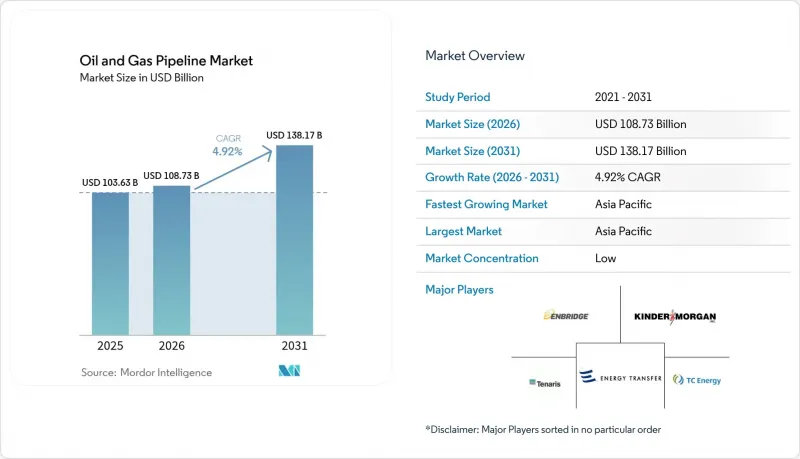
This report is Segmented by Activity (CAPEX and OPEX), Function (Gathering Lines, Transmission Lines, and Distribution Lines), Location of Deployment (Onshore and Offshore), and Geography (North America, Europe, Asia-Pacific, South America, and Middle East, and Africa). The Market Sizes and Forecasts are Provided in Terms of Value (USD).
Global Oil And Gas Pipeline Market Trends and Insights
Permian Associated-Gas Takeaway Expansions Stabilize Waha Hub Pricing
Kinder Morgan's Permian Highway and Energy Transfer's Warrior systems have added 4.1 Bcf/d of takeaway since early 2024, narrowing Waha basis differentials from -USD 2.50/MMBtu to -USD 0.75/MMBtu and cutting regional flaring by 35%. Improved netbacks reinforce drilling economics, prompting producers to execute 15- to 20-year acreage dedications that underpin additional gathering and compression investments. Texas regulators are supporting the buildout by green-lighting USD 3.2 billion in new intrastate pipeline projects, shrinking environmental review cycles, and lowering financing risk.
Deepwater FPSO Tie-Back Pipelines Accelerate Subsea Order Books
ExxonMobil's Stabroek Block in Guyana requires eight FPSOs connected by 450 km of flowlines by 2030, while Petrobras has awarded USD 2.8 billion for flexible subsea pipes in Brazil's Mero and Buzios fields. Flexible thermoplastic composite pipe pioneered by TechnipFMC withstands 15,000 psi yet slices installation cost by 25%. Concentrated demand is driving fabrication yards in Brazil and Trinidad to achieve 15% cost efficiencies through bulk procurement and local content mandates.
Growing ESG-Led Capital Flight from Oil Infrastructure
Global asset managers controlling USD 130 trillion have adopted exclusion criteria that have curtailed pipeline financing, driving borrowing costs up by 200-300 bp for projects lacking transition alignment. European banks now demand credible net-zero pathways by 2050, effectively sidelining greenfield crude lines with 40-year design lives. Operators are pivoting; TC Energy channels 30% of its USD 7 billion program into hydrogen-ready and carbon-capture assets, while private capital targets higher-return modernization plays.
Other drivers and restraints analyzed in the detailed report include:
- US-Canada Crude Export Corridors Monetize Price Differentials
- Hydrogen-Ready Pipeline Retrofits Unlock Subsidy Pools
- Heightened Cybersecurity Threats Drive Insurance Costs
For complete list of drivers and restraints, kindly check the Table Of Contents.
Segment Analysis
Capital expenditure captured 73.65% of the oil and gas pipeline market share in 2025, supported by multi-billion-dollar projects such as Energy Transfer's USD 6 billion Warrior system and TC Energy's USD 4.5 billion Southeast Gateway line. Roughly 60% of CAPEX outlays are allocated to pipe materials and compression equipment, a share inflated by hydrogen-compatible X70 and X80 grades that command 25% price premiums over legacy alloys. Construction services account for the remaining 40%, yet chronic shortages of certified welders have stretched average build schedules by four months, thereby elevating contingency costs for developers. Engineering contractors mitigate these delays through modular spool fabrication and automated welding rigs, techniques that can lift weekly lay rates by 12% on linear spreads. Sub-segment prioritization increasingly favors lines with dual-service potential, such as natural gas today and hydrogen tomorrow, helping owners future-proof their assets against stranded-capital risk.
OPEX accounts for 26.35% of 2025 revenue but is evolving rapidly; AI-enabled inspections reduce survey frequency from triennial to quinquennial cycles, resulting in a 30% cost reduction. Inline inspection tools with ultrasonic crack detection identify micro-fissures that are invisible to older magnetic methods, thereby raising asset reliability. Decommissioning remains a niche market today but is expected to accelerate after 2028 as North American legacy assets approach the end of their life, unlocking specialized remediation opportunities.
Distribution networks contributed 58.25% revenue in 2025, underpinned by dense residential and commercial demand in OECD nations. Smart meters and automated pressure controls are lowering leak incidents and enhancing regulatory compliance. The oil and gas pipeline market size for distribution lines is projected to rise steadily as urban centers electrify their heating systems with gas-fired backup and adopt hydrogen readiness.
Transmission systems, although smaller, are growing at a faster rate, with a 6.38% CAGR projected to 2031. Interstate lines, such as Mountain Valley and Coastal GasLink, cost roughly USD 8 million per mile due to high-spec compressors and thicker walls. Regulatory priority for energy-security projects reduces approval friction, and updated FERC policies reward ventures that cut regional price volatility. Gathering networks, closely tied to unconventional drilling, add 2.5 miles of pipe per horizontal well, anchoring midstream CAPEX in shale basins.
Complete Report Scope:
- By Activity
- CAPEX
- Pipeline Materials & Equipment
- Pipeline Fabrication & Construction
- OPEX
- Inspection
- MRO
- Decommissioning
- CAPEX
- By Function
- Gathering Lines
- Transmission Lines
- Distribution Lines
- By Location of Deployment
- Onshore
- Offshore
- By End-user Sector
- Upstream (E&P)
- Midstream Operators
- Downstream & Petrochemicals
- By Geography
- North America
- United States
- Canada
- Mexico
- Europe
- Germany
- France
- United Kingdom
- Spain
- NORDIC Countries
- Turkey
- Russia
- Rest of Europe
- Asia-Pacific
- India
- China
- South Korea
- Japan
- Malaysia
- Thailand
- Indonesia
- Vietnam
- Rest of Asia-Pacific
- South America
- Brazil
- Argentina
- Colombia
- Rest of South America
- Middle East and Africa
- Saudi Arabia
- United Arab Emirates
- South Africa
- Egypt
- Rest of Middle East and Africa
- North America
Geography Analysis
Asia-Pacific dominated 2025 revenue at 34.35% and posts the fastest 6.46% CAGR through 2031. India's trunkline blitz will connect remote gasfields to urban hubs, fostering industrial gas use and displacing coal in power generation. China's Power of Siberia and Central Asia integrations deepen supply diversity and reduce LNG dependence, while emerging Southeast Asian economies court public-private partnerships to fund cross-border pipes.
North America remains pivotal as shale output pushes incremental takeaway builds and AI-enabled upgrades improve network uptime. The oil and gas pipeline market size for North America is projected to keep expanding as Gulf Coast export hubs secure additional feedgas pipes for LNG terminals. Europe's focus is on retrofitting gas grids for hydrogen, channeling REPowerEU grants to accelerate conversions and lower Russian supply risk. The Middle East and Africa offer greenfield prospects linking gas-rich basins to coastal demand centers, but geopolitical risk and financing gaps restrain near-term momentum. South America's opportunities center around Brazil's presalt and Argentina's Vaca Muerta gas evacuation, where regional cooperation frameworks aim to standardize regulatory and tariff regimes.
- Tenaris S.A.
- Nippon Steel Corporation
- TMK Group
- United States Steel Corporation
- ChelPipe Group
- OMK Steel Ltd
- Shengli Oil & Gas Pipe Holdings Ltd
- Jindal SAW Ltd
- EVRAZ North America
- Vallourec S.A.
- Welspun Corp
- ArcelorMittal S.A.
- TechnipFMC plc
- Saipem S.p.A.
- Subsea 7 S.A.
- Enbridge Inc.
- Kinder Morgan Inc.
- Energy Transfer LP
- Pembina Pipeline Corp.
- TC Energy Corp.
- Gazprom PJSC
Additional Benefits:
- The market estimate (ME) sheet in Excel format
- 3 months of analyst support
TABLE OF CONTENTS
1 Introduction
- 1.1 Study Assumptions & Market Definition
- 1.2 Scope of the Study
2 Research Methodology
3 Executive Summary
4 Market Landscape
- 4.1 Market Overview
- 4.2 Market Drivers
- 4.2.1 Permian associated-gas takeaway expansions stabilise Waha basis
- 4.2.2 Deep-water FPSO tie-back pipelines in Guyana & Brazil accelerate subsea order books
- 4.2.3 US-Canada crude export corridors monetise price-differentials post-TMX
- 4.2.4 Hydrogen-ready pipeline retrofits unlock IRA & REPowerEU subsidy pools
- 4.2.5 AI-enabled integrity analytics slash OPEX and shrink unplanned downtime
- 4.2.6 FERC fast-track for small-diameter gas laterals de-risks gathering build-outs
- 4.3 Market Restraints
- 4.3.1 Growing ESG-led capital flight from long-lived oil trunklines
- 4.3.2 Heightened ransomware & OT-cyber threats drive insurance costs
- 4.3.3 Rising large-diameter steel prices widen project IRR hurdle rates
- 4.3.4 Accelerating renewables-to-grid penetration cannibalises refined-product demand
- 4.4 Supply-Chain Analysis
- 4.5 Regulatory Landscape
- 4.6 Technological Outlook
- 4.7 Installed Pipeline Capacity Analysis
- 4.8 Key Upcoming Projects
- 4.9 Porter's Five Forces
- 4.9.1 Bargaining Power of Suppliers
- 4.9.2 Bargaining Power of Consumers
- 4.9.3 Threat of New Entrants
- 4.9.4 Threat of Substitutes
- 4.9.5 Intensity of Competitive Rivalry
5 Market Size & Growth Forecasts
- 5.1 By Activity
- 5.1.1 CAPEX
- 5.1.1.1 Pipeline Materials & Equipment
- 5.1.1.2 Pipeline Fabrication & Construction
- 5.1.2 OPEX
- 5.1.2.1 Inspection
- 5.1.2.2 MRO
- 5.1.2.3 Decommissioning
- 5.1.1 CAPEX
- 5.2 By Function
- 5.2.1 Gathering Lines
- 5.2.2 Transmission Lines
- 5.2.3 Distribution Lines
- 5.3 By Location of Deployment
- 5.3.1 Onshore
- 5.3.2 Offshore
- 5.4 By End-user Sector
- 5.4.1 Upstream (E&P)
- 5.4.2 Midstream Operators
- 5.4.3 Downstream & Petrochemicals
- 5.5 By Geography
- 5.5.1 North America
- 5.5.1.1 United States
- 5.5.1.2 Canada
- 5.5.1.3 Mexico
- 5.5.2 Europe
- 5.5.2.1 Germany
- 5.5.2.2 France
- 5.5.2.3 United Kingdom
- 5.5.2.4 Spain
- 5.5.2.5 NORDIC Countries
- 5.5.2.6 Turkey
- 5.5.2.7 Russia
- 5.5.2.8 Rest of Europe
- 5.5.3 Asia-Pacific
- 5.5.3.1 India
- 5.5.3.2 China
- 5.5.3.3 South Korea
- 5.5.3.4 Japan
- 5.5.3.5 Malaysia
- 5.5.3.6 Thailand
- 5.5.3.7 Indonesia
- 5.5.3.8 Vietnam
- 5.5.3.9 Rest of Asia-Pacific
- 5.5.4 South America
- 5.5.4.1 Brazil
- 5.5.4.2 Argentina
- 5.5.4.3 Colombia
- 5.5.4.4 Rest of South America
- 5.5.5 Middle East and Africa
- 5.5.5.1 Saudi Arabia
- 5.5.5.2 United Arab Emirates
- 5.5.5.3 South Africa
- 5.5.5.4 Egypt
- 5.5.5.5 Rest of Middle East and Africa
- 5.5.1 North America
6 Competitive Landscape
- 6.1 Market Concentration
- 6.2 Strategic Moves (M&A, Partnerships, PPAs)
- 6.3 Market Share Analysis (Market Rank/Share for key companies)
- 6.4 Company Profiles (includes Global level Overview, Market level overview, Core Segments, Financials as available, Strategic Information, Products & Services, and Recent Developments)
- 6.4.1 Tenaris S.A.
- 6.4.2 Nippon Steel Corporation
- 6.4.3 TMK Group
- 6.4.4 United States Steel Corporation
- 6.4.5 ChelPipe Group
- 6.4.6 OMK Steel Ltd
- 6.4.7 Shengli Oil & Gas Pipe Holdings Ltd
- 6.4.8 Jindal SAW Ltd
- 6.4.9 EVRAZ North America
- 6.4.10 Vallourec S.A.
- 6.4.11 Welspun Corp
- 6.4.12 ArcelorMittal S.A.
- 6.4.13 TechnipFMC plc
- 6.4.14 Saipem S.p.A.
- 6.4.15 Subsea 7 S.A.
- 6.4.16 Enbridge Inc.
- 6.4.17 Kinder Morgan Inc.
- 6.4.18 Energy Transfer LP
- 6.4.19 Pembina Pipeline Corp.
- 6.4.20 TC Energy Corp.
- 6.4.21 Gazprom PJSC
7 Market Opportunities & Future Outlook
- 7.1 White-space & Unmet-Need Assessment

