PUBLISHER: Mordor Intelligence | PRODUCT CODE: 2122621

PUBLISHER: Mordor Intelligence | PRODUCT CODE: 2122621
Rail Freight Transport - Market Share Analysis, Industry Trends & Statistics, Growth Forecasts (2026 - 2031)
According to Mordor Intelligence, the rail freight transport market size is estimated at USD 340.5 billion in 2026, and is expected to reach USD 423.87 billion by 2031, at a CAGR of 4.48% during the forecast period (2026-2031).
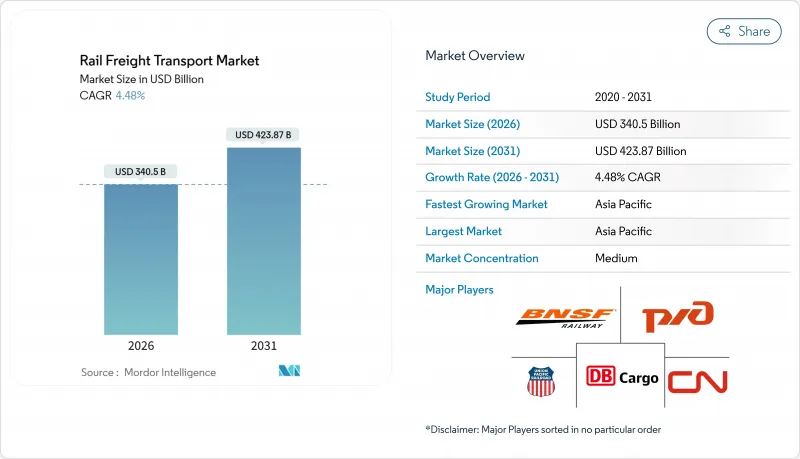
This report is Segmented by Cargo Type (Containerised, Dry Bulk, and More), by Service Type (Transportation, Allied Services), by End-User Industry (Mining & Minerals, Oil/Gas/Chemicals, and More), by Traction Type (Diesel, Electric, Hybrid/Hydrogen/LNG), by Destination (Domestic, International), by Geography (North America, Europe, and More). Market Forecasts are Provided in Terms of Value (USD).
Global Rail Freight Transport Market Trends and Insights
Decarbonization Mandates Accelerate Long-haul Modal Substitution
Emission standards are reshaping freight mode choices on routes longer than 800 km. The EU "Fit for 55" package requires a 43% reduction in heavy-duty vehicle CO2 emissions by 2030 and a 90% drop by 2040, prompting shippers to favor rail to meet Scope 3 targets. California's Advanced Clean Fleets rule obliges large fleets to procure zero-emission trucks from 2024, further tilting demand toward the rail freight transport market. Operators are reacting by ordering hydrogen and battery locomotives; Deutsche Bahn alone intends to replace 1,300 diesel units by 2030 with federal backing of EUR 13.7 million (USD 16 million). As carbon pricing widens, the rail freight transport market gains structural cost advantages over road, supporting steady volume gains through 2031.
Nearshoring Reconfigures North American and European Rail Corridors
Manufacturers relocating closer to end markets are boosting south-north and east-west rail flows. Mexico exported more than USD 550 billion of goods to the United States in 2025, surpassing China, with automotive and electronics firms leading the shift. In Central and Eastern Europe, suppliers have clustered within 500 km of German plants, lifting cross-border rail tonnage through Poland and Czechia by 12% year over year. These shifts expand the addressable rail freight transport market while rewarding incumbents that already handle customs and interchange complexity.
Class-I Network Congestion Constrains Agricultural Export Competitiveness
US grain rail carloads rose to approximately 1.11 million in 2025, up about 3.7% from 1.07 million in 2024, supported by strong export demand and above-average weekly volumes. Proposed reciprocal-switching rules aim to improve service but may disrupt network planning. A USD 50 million siding extension in Chicago boosted CN's velocity by 30%, illustrating that targeted capital can ease chokepoints. Operators that fail to expand capacity risk losing share of the rail freight transport market to barge and truck rivals.
Other drivers and restraints analyzed in the detailed report include:
- Energy Transition Minerals Demand Specialized Bulk Rail Capacity
- China-EU Land-Bridge Optimization Enhances Eurasian Connectivity
- Divergent Coupling Standards Fragment Eurasian Rail Integration
For complete list of drivers and restraints, kindly check the Table Of Contents.
Segment Analysis
The rail freight transport market size for bulk commodities accounted for 41.75% of the 2025 value, underscoring rail's cost edge for coal, ore, and grain. Rio Tinto's 1,700 km AutoHaul network runs at 99.7% reliability, proving autonomous bulk operations at scale. Containerized and intermodal flows are advancing at a 6.23% CAGR, fueled by e-commerce and nearshoring that prioritize flexible logistics. BNSF's USD 3.8 billion 2025 capex includes a Phoenix intermodal hub targeting 15% domestic-container growth.
Liquid bulk, chiefly oil and chemicals, retains stable demand because rail offers safer handling of hazardous cargo over pipelines for specific routes. Break-bulk and project cargo remain niche, serving turbines and oversize machinery. The Federal Railroad Administration's 2025 Freight Car Safety Standards ban components from countries of concern, raising procurement costs yet strengthening long-term resilience. Operators that balance mass-bulk roots with container diversification will weather commodity cycles better than pure-play specialists.
Transportation services generated 83.14% of 2025 revenue, reflecting the historic core of the rail freight transport market. Precision-scheduled railroading, asset turns, and line-haul velocity remain central performance metrics. Allied services maintenance, switching, and storage are growing at a 7.49% CAGR, signaling a pivot to higher-margin business lines. SNCF's split into Hexafret (operations) and Technis (maintenance) targets EUR 200 million (USD 233.6 million) third-party maintenance revenue by 2027.
Regulatory rules demanding more frequent inspections of tank cars and hazardous-materials wagons raise compliance hurdles for new entrants, protecting incumbent profits. Wabtec booked over USD 1 billion in fourth-quarter 2024 orders for locomotive upgrades and digital diagnostics, underscoring aftermarket scale. Operators that internalize maintenance talent can capture lifecycle value and strengthen negotiating power with rolling-stock suppliers.
Complete Report Scope:
- By Cargo Type
- Containerised / Intermodal
- Dry Bulk (Coal, Ores, Grains)
- Liquid Bulk (Crude, Chemicals)
- Break-bulk and Project Cargo
- By Service Type
- Transportation
- Services Allied to Transportation (Maintenance of Railcars and Rail Tracks, Switching of Cargo, and Storage)
- By End-user Industry
- Mining and Minerals
- Oil, Gas and Chemicals
- Agriculture and Food
- Manufacturing and Automotive
- Retail and FMCG
- Construction Materials and Forestry
- By Traction Type
- Diesel
- Electric
- Hybrid / Hydrogen and LNG
- By Destination
- Domestic
- International / Cross-border
- By Geography
- North America
- United States
- Canada
- Mexico
- South America
- Brazil
- Peru
- Chile
- Argentina
- Rest of South America
- Asia-Pacific
- India
- China
- Japan
- Australia
- South Korea
- South East Asia (Singapore, Malaysia, Thailand, Indonesia, Vietnam, and Philippines)
- Rest of Asia-Pacific
- Europe
- United Kingdom
- Germany
- France
- Spain
- Italy
- BENELUX (Belgium, Netherlands, and Luxembourg)
- NORDICS (Denmark, Finland, Iceland, Norway, and Sweden)
- Rest of Europe
- Middle East And Africa
- United Arab of Emirates
- Saudi Arabia
- South Africa
- Nigeria
- Rest of Middle East And Africa
- North America
Geography Analysis
Asia-Pacific contributes the fastest regional expansion at 6.21% CAGR through 2031, underpinned by China's Belt and Road projects and India's 3,360 km of dedicated freight corridors. India's corridors support 25-ton axle loads and 1,500 m trains, slicing per-ton costs up to 40%. Japan is piloting hydrogen locomotives, Australia's mining lines run autonomous consists, and Southeast Asia is modernizing track and terminals, such as Vietnam SuperPort.
North America records stable mid-single-digit growth as nearshoring boosts south-north volumes. Union Pacific posted USD 1.8 billion in Q3 2025, including merger costs. CPKC, now the continent's only single-line Canada-U.S.-Mexico operator, is capturing automotive and consumer goods traffic on the newly branded Southeast Mexico Express.
Europe's liberalization increases rivalry; SNCF's Hexafret spin-off pursues profitability via specialization, and Germany subsidizes hydrogen locomotives. South America remains commodity-focused, with FCAB's hydrogen locomotive proving green traction at high altitude. The Middle East and Africa present greenfield prospects such as the USD 3 billion UAE-Oman line and a USD 1 billion AfDB loan to rehabilitate South Africa's Transnet Freight Rail. Narrow gauges and axle-load limits temper near-term capacity but provide long-run upside once upgrades finish.
- Union Pacific Railroad Company
- BNSF Railway Company
- Canadian National Railway Company
- Canadian Pacific Kansas City Limited (CPKC)
- CSX Transportation, Inc.
- Norfolk Southern Railway Company
- DB Cargo AG
- Fret SNCF (Hexafret)
- SBB Cargo AG
- Russian Railways (RZD)
- PKP Cargo S.A.
- Genesee & Wyoming Inc.
- Pacific National Pty Ltd
- Qube Holdings Limited
- Japan Freight Railway Company
- Indian Railways
- Qatar Railways Company (Qatar Rail)
- Etihad Rail PJSC
- Transnet Freight Rail
- Aurizon LTD*
Additional Benefits:
- The market estimate (ME) sheet in Excel format
- 3 months of analyst support
TABLE OF CONTENTS
1 Introduction
- 1.1 Study Assumptions and Market Definition
- 1.2 Scope of the Study
2 Research Methodology
3 Executive Summary
4 Market Landscape
- 4.1 Market Overview
- 4.2 Market Drivers
- 4.2.1 Decarbonization Mandates Driving Modal Shift on Long-haul (more than 800 km) North-South Corridors (EU & NA)
- 4.2.2 Near-shoring of Heavy Manufacturing to Mexico and CEE Boosting Cross-border Rail Volumes
- 4.2.3 Energy-transition Commodities (Lithium, Copper) Requiring Bulk Rail Capacity in Andean & Australian Basins
- 4.2.4 China-EU Land-Bridge Resilience Programs (Post-BRI Optimisation)
- 4.2.5 Tier-1 Port Congestion in Asia Spurs Inland Rail-based Intermodal to Dry-Ports
- 4.2.6 Government Stimulus for Hydrogen-ready Freight Locomotives in Germany & Japan
- 4.3 Market Restraints
- 4.3.1 Class-I Network Congestion on the United States Midwest Grain Routes
- 4.3.2 Draft-imposed Axle-Load Limitations on Sub-Saharan Narrow-Gauge Lines
- 4.3.3 Divergent Wagon-Coupling Standards Hindering China-Central Asia Through-Traffic
- 4.3.4 Long-haul Trucking Cost Deflation (2023-24) Narrowing Rail Price Advantage in NAFTA
- 4.4 Value / Supply-Chain Analysis
- 4.5 Regulatory Outlook
- 4.6 Technological Outlook
- 4.7 Porter's Five Forces
- 4.7.1 Bargaining Power of Suppliers
- 4.7.2 Bargaining Power of Buyers
- 4.7.3 Threat of New Entrants
- 4.7.4 Threat of Substitutes
- 4.7.5 Intensity of Competitive Rivalry
- 4.8 Cost Structure & Pricing Analysis
- 4.9 Transport Corridors Analysis (Silk Road, NAFTA, TEN-T, GCC)
- 4.10 Impact of Belt and Road Initiative (BRI)
- 4.11 Key Trade Agreements Affecting Rail Freight
- 4.12 Impact of Geo-Political Events in the Market
5 Market Size & Growth Forecasts (Value)
- 5.1 By Cargo Type
- 5.1.1 Containerised / Intermodal
- 5.1.2 Dry Bulk (Coal, Ores, Grains)
- 5.1.3 Liquid Bulk (Crude, Chemicals)
- 5.1.4 Break-bulk and Project Cargo
- 5.2 By Service Type
- 5.2.1 Transportation
- 5.2.2 Services Allied to Transportation (Maintenance of Railcars and Rail Tracks, Switching of Cargo, and Storage)
- 5.3 By End-user Industry
- 5.3.1 Mining and Minerals
- 5.3.2 Oil, Gas and Chemicals
- 5.3.3 Agriculture and Food
- 5.3.4 Manufacturing and Automotive
- 5.3.5 Retail and FMCG
- 5.3.6 Construction Materials and Forestry
- 5.4 By Traction Type
- 5.4.1 Diesel
- 5.4.2 Electric
- 5.4.3 Hybrid / Hydrogen and LNG
- 5.5 By Destination
- 5.5.1 Domestic
- 5.5.2 International / Cross-border
- 5.6 By Geography
- 5.6.1 North America
- 5.6.1.1 United States
- 5.6.1.2 Canada
- 5.6.1.3 Mexico
- 5.6.2 South America
- 5.6.2.1 Brazil
- 5.6.2.2 Peru
- 5.6.2.3 Chile
- 5.6.2.4 Argentina
- 5.6.2.5 Rest of South America
- 5.6.3 Asia-Pacific
- 5.6.3.1 India
- 5.6.3.2 China
- 5.6.3.3 Japan
- 5.6.3.4 Australia
- 5.6.3.5 South Korea
- 5.6.3.6 South East Asia (Singapore, Malaysia, Thailand, Indonesia, Vietnam, and Philippines)
- 5.6.3.7 Rest of Asia-Pacific
- 5.6.4 Europe
- 5.6.4.1 United Kingdom
- 5.6.4.2 Germany
- 5.6.4.3 France
- 5.6.4.4 Spain
- 5.6.4.5 Italy
- 5.6.4.6 BENELUX (Belgium, Netherlands, and Luxembourg)
- 5.6.4.7 NORDICS (Denmark, Finland, Iceland, Norway, and Sweden)
- 5.6.4.8 Rest of Europe
- 5.6.5 Middle East And Africa
- 5.6.5.1 United Arab of Emirates
- 5.6.5.2 Saudi Arabia
- 5.6.5.3 South Africa
- 5.6.5.4 Nigeria
- 5.6.5.5 Rest of Middle East And Africa
- 5.6.1 North America
6 Competitive Landscape
- 6.1 Market Concentration
- 6.2 Strategic Moves
- 6.3 Market Share Analysis
- 6.4 Company Profiles (includes Global level Overview, Market level overview, Core Segments, Financials as available, Strategic Information, Market Rank/Share, Products & Services, Recent Developments)
- 6.4.1 Union Pacific Railroad Company
- 6.4.2 BNSF Railway Company
- 6.4.3 Canadian National Railway Company
- 6.4.4 Canadian Pacific Kansas City Limited (CPKC)
- 6.4.5 CSX Transportation, Inc.
- 6.4.6 Norfolk Southern Railway Company
- 6.4.7 DB Cargo AG
- 6.4.8 Fret SNCF (Hexafret)
- 6.4.9 SBB Cargo AG
- 6.4.10 Russian Railways (RZD)
- 6.4.11 PKP Cargo S.A.
- 6.4.12 Genesee & Wyoming Inc.
- 6.4.13 Pacific National Pty Ltd
- 6.4.14 Qube Holdings Limited
- 6.4.15 Japan Freight Railway Company
- 6.4.16 Indian Railways
- 6.4.17 Qatar Railways Company (Qatar Rail)
- 6.4.18 Etihad Rail PJSC
- 6.4.19 Transnet Freight Rail
- 6.4.20 Aurizon LTD*
7 Market Opportunities & Future Outlook

