PUBLISHER: Mordor Intelligence | PRODUCT CODE: 2122945

PUBLISHER: Mordor Intelligence | PRODUCT CODE: 2122945
North America HVAC Equipment - Market Share Analysis, Industry Trends & Statistics, Growth Forecasts (2026 - 2031)
According to Mordor Intelligence, the North America HVAC equipment market size is expected to grow from USD 31.12 billion in 2025 to USD 33.22 billion in 2026 and is forecast to reach USD 48.66 billion by 2031 at 7.93% CAGR over 2026-2031.
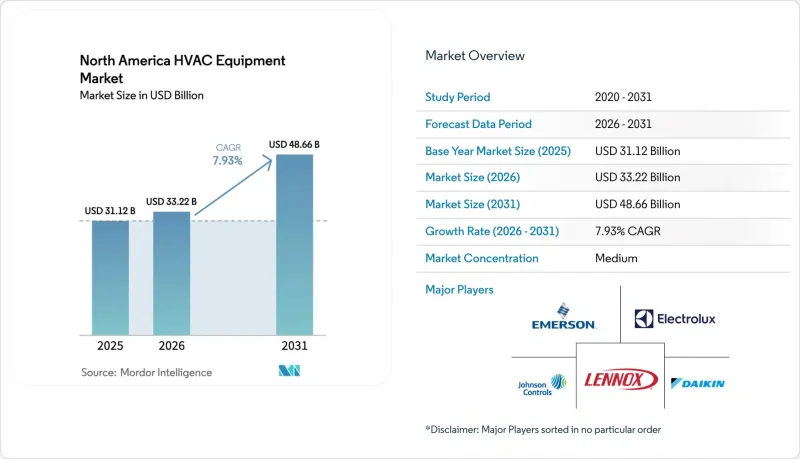
This report is Segmented by Equipment Type (Heating Equipment, Ventilation Equipment, and Air-Conditioning Equipment), Installation Type (New Construction, Retrofit, and Replacement), End User (Residential, Commercial, and Industrial), Building Type for Commercial (Office Buildings, Healthcare Facilities, and More), and Country. The Market Forecasts are Provided in Terms of Value (USD).
North America HVAC Equipment Market Trends and Insights
Rapid Adoption of Heat Pumps and Electrification of Heating
Federal tax credits of up to USD 2,000 per unit, combined with state bans on new natural-gas hookups, have propelled heat-pump shipments beyond gas furnaces for the first time in U.S. history. Cold-climate units capable of delivering full capacity at -15 °F, backed by CAD 5,000 (USD 3,950) in utility rebates, are taking hold in Canada. Variable-speed compressors now routinely achieve seasonal COPs of 3.5, reducing payback periods to fewer than 6 years in many Northeast markets. As regional gas utilities pivot toward electrification incentives, dual-fuel systems pairing heat pumps with backup resistance heaters are gaining traction in retrofit projects. This structural shift is expected to re-weight the North America HVAC equipment market toward electrically driven heating across the forecast horizon.
Accelerating Adoption of Low-GWP A2L Refrigerants Creating Replacement Wave
The American Innovation and Manufacturing Act triggered a 40% cut in hydrofluorocarbon quotas by 2024, lifting R-410A prices 60% and pushing OEMs to R-454B and R-32 formulations. Revised ASHRAE 15 and NFPA 1 codes now require integrated leak detection and enhanced ventilation, encouraging factory-charged equipment that minimizes field refrigerant handling. Building owners are pre-emptively retiring 10- to 12-year-old systems ahead of further quota cuts, accelerating a replacement wave that benefits brands with deep distributor networks. Shorter product life cycles increase aftermarket parts revenue and favor manufacturers able to quickly pivot design platforms.
Transition to A2L Refrigerants Increasing Liability Insurance Costs
Contractor insurance premiums rose 15-25% in 2025 as underwriters priced in leak-related fire risk, with compliance upgrades adding USD 500-1,500 per mechanical room. Smaller installers unable to fund training and detection equipment are exiting, consolidating channels, and raising labor costs. Multifamily property managers face insurer scrutiny, slowing approvals for heat-pump retrofits that would displace legacy furnaces. In the near term, elevated liability costs suppress penetration of A2L systems among price-sensitive residential buyers.
Other drivers and restraints analyzed in the detailed report include:
- Growing Demand for Smart and Connected HVAC Systems
- Stringent Energy-Efficiency Regulations and Incentives
- Supply-Chain Vulnerability Due to Critical Electronics and Sensor Shortages
For complete list of drivers and restraints, kindly check the Table Of Contents.
Segment Analysis
Air-conditioning equipment represented 46.43% of the overall North America HVAC equipment market share in 2025 and is scaling at an 8.64% CAGR, supported by rising cooling-degree days and the retirement of R-410A systems. The subsegment's revenue of the North America HVAC equipment market reflects its entrenched role in both residential and light-commercial buildings. Ductless mini-splits stand out by capturing retrofit demand where duct installation is impractical, while variable refrigerant flow platforms enable simultaneous heating and cooling across large commercial footprints.
Heat pumps, classified within heating equipment, are closing the gap fast. Electrification mandates and rebate stacks narrow the installed-cost delta versus gas furnaces, redirecting share within the North America HVAC equipment market toward electrically driven solutions. Ventilation gear such as energy-recovery ventilators and humidifiers rides the wave of IAQ compliance, while packaged terminal units return to multifamily design specs due to simplified billing and space savings.
Retrofit and replacement installations accounted for 60.84% of the North America HVAC equipment market share in 2025 and continue to drive near-term sales as owners accelerate system retirements ahead of tighter refrigerant caps. Financing promotions and seasonal replacement campaigns encourage homeowners to act before costly midsummer failures. Meanwhile, the North America HVAC equipment market size attached to new construction grows at an 8.29% CAGR, propelled by industrial plants in Mexico and multifamily projects across the U.S. Sunbelt.
Builders increasingly specify pre-packaged mechanical rooms that arrive fully wired and charged, trimming onsite labor by up to 50%. Electrification simplifies floor plans by eliminating gas piping but pushes panel upgrades that add USD 2,000-4,000 per dwelling. The balance between retrofit and new construction will narrow only modestly through 2031, keeping replacement spend a dominant thread in the overall growth story.
Complete Report Scope:
- By Equipment Type
- Heating Equipment
- Boilers and Furnaces
- Heat Pumps
- Unitary Heaters
- Ventilation Equipment
- Air Handling Units (AHUs)
- Air Filters
- Fan Coil Units
- Humidifiers and Dehumidifiers
- Air-Conditioning Equipment
- Unitary Air Conditioners
- Ducted Splits
- Ductless Mini-Splits
- Packaged Rooftops
- Variable Refrigerant Flow (VRF) Systems
- Room Air Conditioners
- Packaged Terminal Air Conditioners
- Chillers
- Unitary Air Conditioners
- Heating Equipment
- By Installation Type
- New Construction
- Retrofit / Replacement
- By End User
- Residential
- Commercial
- Industrial
- By Building Type (Commercial)
- Office Buildings
- Healthcare Facilities
- Hospitality and Leisure
- Retail Stores and Malls
- Educational Institutions
- Data Centers
- By Country
- United States
- Canada
- Mexico
List of Companies Covered in this Report:
- Carrier Global Corporation
- Daikin Industries Ltd.
- Johnson Controls International PLC
- Trane Technologies PLC
- Lennox International Inc.
- Rheem Manufacturing Company, Inc.
- Goodman Manufacturing Company, L.P.
- Nortek Global HVAC LLC
- Emerson Electric Co.
- Honeywell International Inc.
- LG Electronics Inc.
- Mitsubishi Electric Corporation
- Panasonic Corporation
- Bosch Thermotechnology Corp.
- Danfoss A/S
- Electrolux AB
- Uponor Corporation
- Gree Electric Appliances Inc.
- AAON Inc.
- Fujitsu General Ltd.
Additional Benefits:
- The market estimate (ME) sheet in Excel format
- 3 months of analyst support
TABLE OF CONTENTS
1 INTRODUCTION
- 1.1 Study Assumptions and Market Definition
- 1.2 Scope of the Study
2 RESEARCH METHODOLOGY
3 EXECUTIVE SUMMARY
4 MARKET LANDSCAPE
- 4.1 Market Overview
- 4.2 Market Drivers
- 4.2.1 Rising Residential and Non-residential Construction Activity
- 4.2.2 Stringent Energy-Efficiency Regulations and Incentives
- 4.2.3 Rapid Adoption of Heat Pumps and Electrification of Heating
- 4.2.4 Growing Demand for Smart and Connected HVAC Systems
- 4.2.5 Accelerating Adoption of Low-GWP A2L Refrigerants Creating Replacement Wave
- 4.2.6 Emergence of Prefabricated Modular HVAC Units for Quick Retrofits
- 4.3 Market Restraints
- 4.3.1 High Initial Capital Cost of High-Efficiency Systems
- 4.3.2 Skilled Labor Shortage for Installation and Maintenance
- 4.3.3 Supply-Chain Vulnerability Due to Critical Electronics and Sensor Shortages
- 4.3.4 Transition to A2L Refrigerants Increasing Liability Insurance Costs
- 4.4 Industry Value Chain Analysis
- 4.5 Impact of Macroeconomic Factors on the Market
- 4.6 Regulatory Landscape
- 4.7 Technological Outlook
- 4.8 Porter's Five Forces Analysis
- 4.8.1 Bargaining Power of Suppliers
- 4.8.2 Bargaining Power of Buyers
- 4.8.3 Threat of New Entrants
- 4.8.4 Threat of Substitutes
- 4.8.5 Intensity of Competitive Rivalry
- 4.9 Key Performance Indicators
5 MARKET SIZE AND GROWTH FORECASTS (VALUE)
- 5.1 By Equipment Type
- 5.1.1 Heating Equipment
- 5.1.1.1 Boilers and Furnaces
- 5.1.1.2 Heat Pumps
- 5.1.1.3 Unitary Heaters
- 5.1.2 Ventilation Equipment
- 5.1.2.1 Air Handling Units (AHUs)
- 5.1.2.2 Air Filters
- 5.1.2.3 Fan Coil Units
- 5.1.2.4 Humidifiers and Dehumidifiers
- 5.1.3 Air-Conditioning Equipment
- 5.1.3.1 Unitary Air Conditioners
- 5.1.3.1.1 Ducted Splits
- 5.1.3.1.2 Ductless Mini-Splits
- 5.1.3.1.3 Packaged Rooftops
- 5.1.3.1.4 Variable Refrigerant Flow (VRF) Systems
- 5.1.3.2 Room Air Conditioners
- 5.1.3.3 Packaged Terminal Air Conditioners
- 5.1.3.4 Chillers
- 5.1.3.1 Unitary Air Conditioners
- 5.1.1 Heating Equipment
- 5.2 By Installation Type
- 5.2.1 New Construction
- 5.2.2 Retrofit / Replacement
- 5.3 By End User
- 5.3.1 Residential
- 5.3.2 Commercial
- 5.3.3 Industrial
- 5.4 By Building Type (Commercial)
- 5.4.1 Office Buildings
- 5.4.2 Healthcare Facilities
- 5.4.3 Hospitality and Leisure
- 5.4.4 Retail Stores and Malls
- 5.4.5 Educational Institutions
- 5.4.6 Data Centers
- 5.5 By Country
- 5.5.1 United States
- 5.5.2 Canada
- 5.5.3 Mexico
6 COMPETITIVE LANDSCAPE
- 6.1 Market Concentration
- 6.2 Strategic Moves
- 6.3 Market Share Analysis
- 6.4 Company Profiles (Includes Global Level Overview, Market Level Overview, Core Segments, Financials as Available, Strategic Information, Market Rank/Share, Products and Services, and Recent Developments)
- 6.4.1 Carrier Global Corporation
- 6.4.2 Daikin Industries Ltd.
- 6.4.3 Johnson Controls International PLC
- 6.4.4 Trane Technologies PLC
- 6.4.5 Lennox International Inc.
- 6.4.6 Rheem Manufacturing Company, Inc.
- 6.4.7 Goodman Manufacturing Company, L.P.
- 6.4.8 Nortek Global HVAC LLC
- 6.4.9 Emerson Electric Co.
- 6.4.10 Honeywell International Inc.
- 6.4.11 LG Electronics Inc.
- 6.4.12 Mitsubishi Electric Corporation
- 6.4.13 Panasonic Corporation
- 6.4.14 Bosch Thermotechnology Corp.
- 6.4.15 Danfoss A/S
- 6.4.16 Electrolux AB
- 6.4.17 Uponor Corporation
- 6.4.18 Gree Electric Appliances Inc.
- 6.4.19 AAON Inc.
- 6.4.20 Fujitsu General Ltd.
7 MARKET OPPORTUNITIES AND FUTURE OUTLOOK
- 7.1 White-Space and Unmet-Need Assessment

