PUBLISHER: Mordor Intelligence | PRODUCT CODE: 2123506

PUBLISHER: Mordor Intelligence | PRODUCT CODE: 2123506
Medical Suction Devices - Market Share Analysis, Industry Trends & Statistics, Growth Forecasts (2026 - 2031)
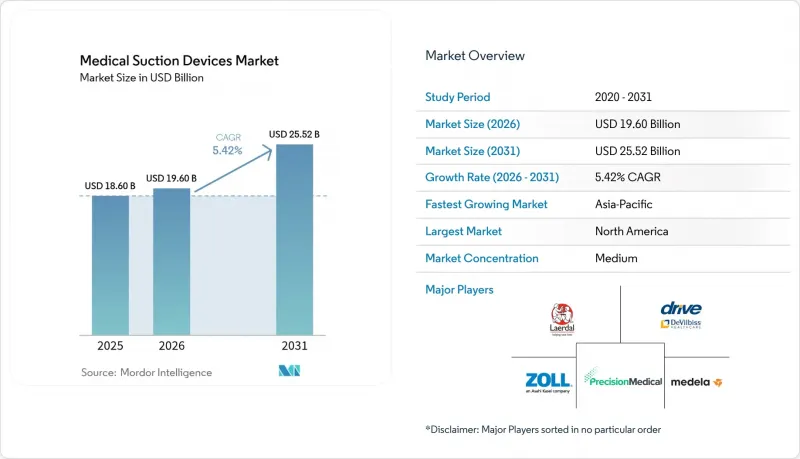
According to Mordor Intelligence, medical suction devices market size in 2026 is estimated at USD 19.60 billion, growing from 2025 value of USD 18.60 billion with projections showing USD 25.52 billion, growing at 5.42% CAGR over 2026-2031.
This report is Segmented by Type (AC-Powered, Battery-Powered, and More), Portability (Hand-Held/Portable, Wall-Mounted, and Trolley/Cart-Mounted), Application (Airway Clearance, Surgical Applications, and More), End User (Hospitals, Home Healthcare Settings, and More), and Geography (North America, Europe, Asia-Pacific, and More). The Market Forecasts are Provided in Terms of Value (USD).
Global Medical Suction Devices Market Trends and Insights
Growth in Surgical Volume Globally
Worldwide surgical procedures reached 310 million in 2025, with minimally invasive techniques responsible for 60% of incremental growth. The higher procedural load drives demand for reliable operating-room suction that maintains clear visualization and prevents thermal injury. Ambulatory surgery centers, which now handle 72% of elective cases in the United States, prefer compact, cart-mounted units that can be moved between suites without requiring facility-wide pipeline upgrades. Emerging economies in Southeast Asia and Latin America are adding theater capacity at double-digit rates, yet inconsistent grid performance spurs procurement of dual-powered configurations capable of seamless AC-to-battery switchover. Standardization initiatives tied to value-based purchasing encourage health systems to negotiate fleet-wide contracts, driving volume discounts and accelerated refresh cycles. Collectively, these forces sustain steady replacement demand and position the medical suction devices market for continued uptake in core surgical environments.
Rising Prevalence of Respiratory Diseases
Chronic respiratory diseases affected 569.2 million people in 2023, causing 4.2 million deaths and ranking as the third-leading global killer. Chronic obstructive pulmonary disease and asthma account for three-quarters of the burden, underscoring the need for airway-clearance suction in critical care and home-monitoring programs. Hospital readmission penalties incentivize care teams to deploy portable units after discharge, cutting 30-day readmissions by 18% in pilot cohorts. Air-quality deterioration across South Asia and sub-Saharan Africa is widening the patient pool among younger demographics, reinforcing long-term volume growth. Closed-suction systems mandated by infection-control guidelines reduce microbial colonization by 40% compared to open techniques. The convergence of epidemiological pressure and protocol evolution sustains long-run demand across both institutional and home-care channels.
High Cost of Advanced Suction Equipment
Premium portable systems incorporating connectivity and extended battery life list at USD 2,500-USD 4,000, straining budgets of rural clinics and low-income households. Hospital capital budgets fell 8% in 2024 as funds shifted to workforce retention, lengthening replacement cycles from five to seven years. Emerging markets face import tariffs up to 25% on medical electronics, inflating landed costs and deterring adoption. Equipment-as-a-service models spread slowly where credit infrastructure is weak, limiting creative financing options. Low-acuity facilities sometimes revert to manual pumps, cannibalizing potential volume for powered devices in the medical suction devices market.
Other drivers and restraints analyzed in the detailed report include:
- Expansion of Home Healthcare Services
- Stringent Infection Control Regulations
- Limited Reimbursement for Capital Equipment
For complete list of drivers and restraints, kindly check the Table Of Contents.
Segment Analysis
AC-powered systems captured 45.32% of the medical suction devices market share in 2025, and the segment is advancing at a 7.54% CAGR through 2031. High vacuum capacity exceeding 600 mmHg and flow rates of 40 L/min satisfy strict operating-room requirements, sustaining entrenched demand among perioperative stakeholders. Performance verification under ISO 10079-1 covers vacuum stability, noise emissions, and electromagnetic compatibility, adding compliance confidence for biomedical teams. Smart sensors now monitor canister fill levels, motor temperature, and vacuum pressure, issuing alerts before clinical disruption. Dual-powered designs, priced 15% higher, win contracts in seismic zones and areas prone to grid failure, reinforcing resilience planning across new hospital projects.
Battery-powered units trail in absolute revenue yet post the fastest growth as lithium-ion platforms narrow runtime gaps and maintenance-free brushless motors enhance reliability. Manual devices persist in austere regions; however, donor programs increasingly prioritize electrified donations equipped with solar charging kits, gradually eroding the manual installed base. As performance parity tightens, the medical suction devices market sees procurement decisions pivot toward interoperability with electronic health records and ease of field servicing.
Wall-mounted networks held 46.54% of the medical suction devices market in 2025, benefitting from centralized vacuum plants that feed multiple patient rooms and procedure suites. Installation cost, however, exceeds USD 500,000 for a 200-bed facility, deterring smaller ambulatory centers. Portable hand-held and cart-mounted units are therefore projected to rise at an 8.21% CAGR to 2031, buoyed by home healthcare migration, emergency preparedness mandates, and telehealth integration. Pandemic drills accelerated adoption of battery-backed units that can be deployed in tented wards and transport vehicles within minutes.
Hand-held devices weighing under 1.5 kilograms lower caregiver fatigue and have reduced Medicare readmissions by 18% in pilot programs. Cart-mounted platforms now integrate oxygen concentrators and patient monitors, turning them into mobile respiratory stations for post-anesthesia care. Harmonized FDA, CE, and PMDA approvals shorten global launch cycles, allowing manufacturers to amortize tooling costs across regions and to scale production faster. Consequently, mobility-first architectures reorient purchasing criteria throughout the medical suction devices market.
Complete Report Scope:
- By Type
- AC-Powered
- Battery-Powered
- Dual (AC & Battery) Powered
- Manually Operated
- By Portability
- Hand-Held / Portable
- Wall-Mounted
- Trolley / Cart-Mounted
- By Application
- Airway Clearance
- Surgical Applications
- Obstetrics & Gynecology
- Research & Diagnostics
- Other Applications
- By End User
- Hospitals
- Home Healthcare Settings
- Dental Clinics
- Other End Users
- Geography
- North America
- United States
- Canada
- Mexico
- Europe
- Germany
- United Kingdom
- France
- Italy
- Spain
- Rest of Europe
- Asia-Pacific
- China
- Japan
- India
- Australia
- South Korea
- Rest of Asia-Pacific
- Middle East & Africa
- GCC
- South Africa
- Rest of Middle East & Africa
- South America
- Brazil
- Argentina
- Rest of South America
- North America
Geography Analysis
North America captured 42.43% of revenue in 2025, supported by USD 4.5 trillion in U.S. healthcare expenditure, rigorous infection-control mandates, and extensive home-care reimbursement. Canada pursues province-wide equipment standardization, while Mexico's private-hospital expansion fuels demand for premium portable systems. FDA 510(k) oversight and Joint Commission accreditation create high compliance thresholds that favor incumbent suppliers, although value-based payment models are unlocking incremental budgets for connected suction fleets. Hospital capital allocations contracted 8% in 2024 but are rebounding as labor stabilization frees funds for deferred equipment projects.
Asia-Pacific is projected to grow at 6.97% through 2031, the fastest regional pace, propelled by China's USD 860 billion healthcare sector, India's rapid hospital construction, and Japan's aging population. China's Healthy China 2030 program funnels investment into county hospitals that prioritize dual-powered suction for emergency readiness. India's Ayushman Bharat insurance scheme stimulates procedural volume, driving uptake of obstetric and surgical systems. Japan encourages home-care transitions, boosting demand for compact caregiver-friendly models. Southeast Asian nations add operating rooms at double-digit rates, yet unreliable electricity enhances the appeal of battery-backed configurations.
Europe contributes significant share through Germany, the United Kingdom, and France, where ISO 10079 compliance is obligatory and MDR-related audits intensify vendor selection rigor. The Gulf Cooperation Council allocates USD 100 billion to healthcare infrastructure from 2024-2030, specifying premium suction in new mega-hospitals. Brazil expands surgical capacity under SUS, although tariff policies and fiscal pressure tilt buyers toward lower-cost models. Argentina's currency instability slows replacement cycles, encouraging refurbished purchases that prolong equipment life yet limit penetration of advanced telemetry-enabled devices in the medical suction devices market.
- Ambu
- Allied Healthcare Products
- Amsino International
- ATMOS MedizinTechnik
- Cardinal Health
- Drive DeVilbiss Healthcare
- Hillrom / Welch Allyn (Baxter)
- Integra Biosciences AG
- Intersurgical Ltd.
- Labconco
- Laerdal Medical AS
- Medela
- MG Electric Ltd.
- Olympus
- Pennine Healthcare
- Precision Medical
- Smiths Group
- Stryker
- Teleflex
- ZOLL Medical Corporation (Asahi Kasei)
Additional Benefits:
- The market estimate (ME) sheet in Excel format
- 3 months of analyst support
TABLE OF CONTENTS
1 Introduction
- 1.1 Study Assumptions & Market Definition
- 1.2 Scope Of The Study
2 Research Methodology
3 Executive Summary
4 Market Landscape
- 4.1 Market Overview
- 4.2 Market Drivers
- 4.2.1 Growth in Surgical Volume Globally
- 4.2.2 Rising Prevalence of Respiratory Diseases
- 4.2.3 Expansion of Home Healthcare Services
- 4.2.4 Stringent Infection Control Regulations
- 4.2.5 Technological Advancements in Portable Suction Devices
- 4.3 Market Restraints
- 4.3.1 High Cost of Advanced Suction Equipment
- 4.3.2 Limited Reimbursement for Capital Equipment
- 4.3.3 Availability of Alternative Airway Clearance Methods
- 4.3.4 Environmental Concerns Related to Disposable Components
- 4.4 Value / Supply-Chain Analysis
- 4.5 Regulatory Outlook
- 4.6 Technological Outlook
- 4.7 Porter's Five Forces Analysis
- 4.7.1 Threat Of New Entrants
- 4.7.2 Bargaining Power Of Buyers
- 4.7.3 Bargaining Power Of Suppliers
- 4.7.4 Threat Of Substitutes
- 4.7.5 Intensity Of Competitive Rivalry
5 Market Size & Growth Forecasts (Value, USD)
- 5.1 By Type
- 5.1.1 AC-Powered
- 5.1.2 Battery-Powered
- 5.1.3 Dual (AC & Battery) Powered
- 5.1.4 Manually Operated
- 5.2 By Portability
- 5.2.1 Hand-Held / Portable
- 5.2.2 Wall-Mounted
- 5.2.3 Trolley / Cart-Mounted
- 5.3 By Application
- 5.3.1 Airway Clearance
- 5.3.2 Surgical Applications
- 5.3.3 Obstetrics & Gynecology
- 5.3.4 Research & Diagnostics
- 5.3.5 Other Applications
- 5.4 By End User
- 5.4.1 Hospitals
- 5.4.2 Home Healthcare Settings
- 5.4.3 Dental Clinics
- 5.4.4 Other End Users
- 5.5 Geography
- 5.5.1 North America
- 5.5.1.1 United States
- 5.5.1.2 Canada
- 5.5.1.3 Mexico
- 5.5.2 Europe
- 5.5.2.1 Germany
- 5.5.2.2 United Kingdom
- 5.5.2.3 France
- 5.5.2.4 Italy
- 5.5.2.5 Spain
- 5.5.2.6 Rest of Europe
- 5.5.3 Asia-Pacific
- 5.5.3.1 China
- 5.5.3.2 Japan
- 5.5.3.3 India
- 5.5.3.4 Australia
- 5.5.3.5 South Korea
- 5.5.3.6 Rest of Asia-Pacific
- 5.5.4 Middle East & Africa
- 5.5.4.1 GCC
- 5.5.4.2 South Africa
- 5.5.4.3 Rest of Middle East & Africa
- 5.5.5 South America
- 5.5.5.1 Brazil
- 5.5.5.2 Argentina
- 5.5.5.3 Rest of South America
- 5.5.1 North America
6 Competitive Landscape
- 6.1 Market Concentration
- 6.2 Market Share Analysis
- 6.3 Company Profiles {(Includes Global Level Overview, Market Level Overview, Core Segments, Financials as Available, Strategic Information, Market Rank/Share for Key Companies, Products & Services, and Recent Developments)}
- 6.3.1 Ambu A/S
- 6.3.2 Allied Healthcare Products Inc.
- 6.3.3 Amsino International Inc.
- 6.3.4 ATMOS MedizinTechnik GmbH & Co. KG
- 6.3.5 Cardinal Health Inc.
- 6.3.6 Drive DeVilbiss Healthcare
- 6.3.7 Hillrom / Welch Allyn (Baxter)
- 6.3.8 Integra Biosciences AG
- 6.3.9 Intersurgical Ltd.
- 6.3.10 Labconco Corporation
- 6.3.11 Laerdal Medical AS
- 6.3.12 Medela AG
- 6.3.13 MG Electric Ltd.
- 6.3.14 Olympus Corporation
- 6.3.15 Pennine Healthcare
- 6.3.16 Precision Medical Inc.
- 6.3.17 Smiths Medical (ICU Medical)
- 6.3.18 Stryker Corporation
- 6.3.19 Teleflex Incorporated
- 6.3.20 ZOLL Medical Corporation (Asahi Kasei)
7 Market Opportunities & Future Outlook
- 7.1 White-Space & Unmet-Need Assessment

