PUBLISHER: Mordor Intelligence | PRODUCT CODE: 2123666

PUBLISHER: Mordor Intelligence | PRODUCT CODE: 2123666
Hyaluronic Acid Based Dermal Fillers - Market Share Analysis, Industry Trends & Statistics, Growth Forecasts (2026 - 2031)
According to Mordor Intelligence, the hyaluronic acid based dermal fillers market size is projected to be USD 5.22 billion in 2025, USD 5.75 billion in 2026, and reach USD 9.33 billion by 2031, growing at a CAGR of 10.16% from 2026 to 2031.
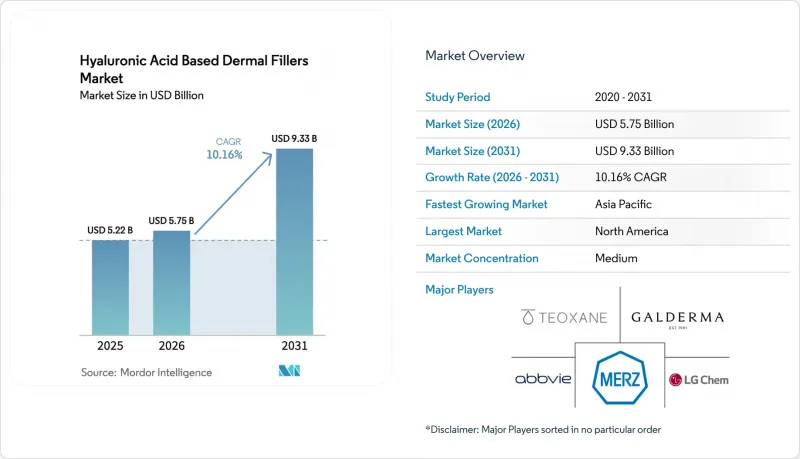
This report is Segmented by Product Phase (Single Phase and Duplex), Application (Wrinkle Correction, Scar Treatment, Volume Restoration, and More), End-User (Hospitals, Specialty Dermatology Clinics, and Medical Spas), Ingredient Source (Animal-Derived, Fully-Synthetic, and More), and Geography (North America, Europe, and More). The Market Forecasts are Provided in Terms of Value (USD).
Global Hyaluronic Acid Based Dermal Fillers Market Trends and Insights
Rising Demand for Minimally-Invasive Aesthetic Procedures Among Aging Populations
Demographic aging is expanding the candidate pool for fillers, and the 40-54 cohort accounted for 50% of U.S. procedures in 2024. Procedure counts climbed to 5.33 million in 2024 even as average fees slid to USD 715, confirming that convenience outweighs cost concerns for many patients. Regulatory allowances for medical-spa injections in North America and Europe are widening access, while maintenance-oriented "tweakments" support quarterly visit schedules and repeat revenue. The result is a steady cadence of injections that benefits both product suppliers and clinics.
Rapid Product Innovation in Cross-Linking Chemistry Extending Filler Longevity
Manufacturers have shifted from BDDE to PEGDE and auto-crosslinked polymer platforms that improve durability and reduce soluble fractions, with reaction thresholds above 130 mg/mL yielding better clinical performance gels. Thermoresponsive hydrogels that pass through 34-gauge needles at forces under 72 N lessen injection pain. Animal-free production strains from Novozymes and engineered Corynebacterium have produced titers of 45 g/L, lowering fermentation cost and encouraging local manufacturing.
High Out-of-Pocket Cost Versus Short Durability
Fillers last 6-18 months, and repeat fees accumulate quickly. Although U.S. prices slipped to USD 715, cost remains a deterrent, especially in regions where insurance coverage is absent. China's aggressive competition has pushed retail prices to as low as CNY 200, hurting margins. Multinationals exit low-margin segments, as evidenced by LG Chem's sale of YVOIRE.
Other drivers and restraints analyzed in the detailed report include:
- Expansion of Male & Millennial "Pre-Juvenation" Consumer Segments
- Emergence of Micro-Droplet Skin-Booster HA Treatments Opening New Maintenance-Therapy Streams
- Heightened Regulatory Scrutiny & Adverse-Event Reporting
For complete list of drivers and restraints, kindly check the Table Of Contents.
Segment Analysis
Duplex gels accounted for 58.56% of 2025 revenue, giving the Hyaluronic Acid Based Dermal Fillers market size its structural backbone in cheek, chin, and jawline jobs. Their biphasic composition confers an elastic modulus above 200 Pa, enabling them to hold shape under compression. Single-phase gels, however, will post the swiftest 11.25% CAGR due to their smoother rheology, which suits superficial corrections and skin boosters.
Thermoresponsive single-phase variants, injectable via ultra-fine needles, further lower pain thresholds and shorten chair time. Regulatory traction is building; Juvederm Voluma XC's 2024 temple label expansion validated duplex safety in vascular-rich zones.
Wrinkle correction still ruled with 35.53% revenue in 2025, but lip augmentation will outstrip it at a 12.85% CAGR as social media aesthetics normalize fuller yet balanced lips. Teoxane RHA 3 gained an expanded FDA indication in 2023, opening regulated pathways for lip-specific lines.
Volume restoration for mid-face and chin, along with scar remediation, is expanding steadily, propelled by broader reconstructive uses. Research underpins subtlety: lip ratios above 30% upper-to-lower height were deemed unaesthetic by 88% of respondents, guiding injector training and shaping consumer expectations inside the Hyaluronic Acid-Based Dermal Fillers market.
Complete Report Scope:
- By Product Phase
- Single-Phase
- Duplex
- By Application
- Wrinkle Correction
- Scar Treatment
- Volume Restoration
- Lip Augmentation
- Others
- By End-User
- Hospitals
- Specialty Dermatology Clinics
- Medical Spas
- By Ingredient Source
- Animal-Derived
- Non-Animal Fermentation
- Fully-Synthetic
- By Geography
- North America
- United States
- Canada
- Mexico
- Europe
- Germany
- United Kingdom
- France
- Italy
- Spain
- Rest of Europe
- Asia-Pacific
- China
- Japan
- India
- South Korea
- Australia
- Rest of Asia-Pacific
- Middle East & Africa
- GCC
- South Africa
- Rest of Middle East & Africa
- South America
- Brazil
- Argentina
- Rest of South America
- North America
Geography Analysis
North America delivered 42.13% of 2025 sales, strengthened by 5.33 million U.S. procedures in 2024 despite fee declines, reflecting volume-driven growth. Medical-spa permissiveness broadens access, while FDA approvals of EVOLYSSE FORM and SMOOTH add competitive depth. Canada's adoption of Restylane SHAYPE for body contouring and Mexico's growing tourism trade signal spillover potential.
Asia-Pacific is set for a 12.21% CAGR to 2031, propelled by China's streamlined NMPA approvals, South Korea's price-competitive clinics, and Japan's aging yet aesthetics-aware demographic. Beijing IMEIK's USD 190 million purchase of RegenBiotech highlights strategic consolidation. Bloomage's export sales exceeding domestic revenue in 2024 prove the region's capacity to serve global demand.
Europe retains a sizeable slice, but MDR-driven evidence demands lengthen launch timelines, advantaging entrenched brands. Galderma's Restylane VOLYME launch across major EU markets in 2024 shows continued appetite for high-performance gels. The Middle East, buoyed by GCC wealth and medical tourism, and Latin America, led by Brazil's aesthetic culture, round out growth nodes, though regulatory heterogeneity complicates rollouts.
- Abbvie
- Anika Therapeutics
- Beijing IMEIK Technology Development
- BioPlus
- Bloomage Biotechnology Corp.
- Croma-Pharma GmbH
- Galderma
- Haohai Biological Technology Co.
- Humedix (Cleviel)
- JW Pharmaceutical (Q.O.Fill)
- LG Chem
- Medytox
- Merz Pharma
- Prollenium Medical Technologies Inc.
- Revance Therapeutics
- SciVision Biotech
- Sinclair Pharma Ltd.
- Teoxane Laboratories
Additional Benefits:
- The market estimate (ME) sheet in Excel format
- 3 months of analyst support
TABLE OF CONTENTS
1 Introduction
- 1.1 Study Assumptions & Market Definition
- 1.2 Scope of the Study
2 Research Methodology
3 Executive Summary
4 Market Landscape
- 4.1 Market Overview
- 4.2 Market Drivers
- 4.2.1 Rising demand for minimally-invasive aesthetic procedures among ageing populations
- 4.2.2 Rapid product innovation in cross-linking chemistry extending filler longevity
- 4.2.3 Expansion of male & millennial pre-juvenation consumer segments
- 4.2.4 Emergence of micro-droplet skin-booster HA treatments opening new maintenance-therapy revenue streams
- 4.2.5 Tariff-driven localisation of bacterial-fermentation HA manufacturing capacity
- 4.3 Market Restraints
- 4.3.1 High out-of-pocket procedure cost versus short durability
- 4.3.2 Heightened regulatory scrutiny & adverse-event reporting (vascular occlusion, DIRs)
- 4.3.3 Supply-chain impurity controls (silicone oil, Al particulates) raising COGS
- 4.4 Regulatory Landscape
- 4.5 Technological Outlook
- 4.6 Porter's Five Forces
- 4.6.1 Threat of New Entrants
- 4.6.2 Bargaining Power of Buyers
- 4.6.3 Bargaining Power of Suppliers
- 4.6.4 Threat of Substitutes
- 4.6.5 Intensity of Competitive Rivalry
5 Market Size & Growth Forecasts (Value, USD)
- 5.1 By Product Phase
- 5.1.1 Single-Phase
- 5.1.2 Duplex
- 5.2 By Application
- 5.2.1 Wrinkle Correction
- 5.2.2 Scar Treatment
- 5.2.3 Volume Restoration
- 5.2.4 Lip Augmentation
- 5.2.5 Others
- 5.3 By End-User
- 5.3.1 Hospitals
- 5.3.2 Specialty Dermatology Clinics
- 5.3.3 Medical Spas
- 5.4 By Ingredient Source
- 5.4.1 Animal-Derived
- 5.4.2 Non-Animal Fermentation
- 5.4.3 Fully-Synthetic
- 5.5 By Geography
- 5.5.1 North America
- 5.5.1.1 United States
- 5.5.1.2 Canada
- 5.5.1.3 Mexico
- 5.5.2 Europe
- 5.5.2.1 Germany
- 5.5.2.2 United Kingdom
- 5.5.2.3 France
- 5.5.2.4 Italy
- 5.5.2.5 Spain
- 5.5.2.6 Rest of Europe
- 5.5.3 Asia-Pacific
- 5.5.3.1 China
- 5.5.3.2 Japan
- 5.5.3.3 India
- 5.5.3.4 South Korea
- 5.5.3.5 Australia
- 5.5.3.6 Rest of Asia-Pacific
- 5.5.4 Middle East & Africa
- 5.5.4.1 GCC
- 5.5.4.2 South Africa
- 5.5.4.3 Rest of Middle East & Africa
- 5.5.5 South America
- 5.5.5.1 Brazil
- 5.5.5.2 Argentina
- 5.5.5.3 Rest of South America
- 5.5.1 North America
6 Competitive Landscape
- 6.1 Market Concentration
- 6.2 Market Share Analysis
- 6.3 Company Profiles (includes Global level Overview, Market level overview, Core Segments, Financials as available, Strategic Information, Market Rank/Share for key companies, Products & Services, and Recent Developments)
- 6.3.1 AbbVie Inc. (Allergan Aesthetics)
- 6.3.2 Anika Therapeutics Inc.
- 6.3.3 Beijing IMEIK Technology Development
- 6.3.4 BioPlus Co. Ltd.
- 6.3.5 Bloomage Biotechnology Corp.
- 6.3.6 Croma-Pharma GmbH
- 6.3.7 Galderma S.A.
- 6.3.8 Haohai Biological Technology Co.
- 6.3.9 Humedix (Cleviel)
- 6.3.10 JW Pharmaceutical (Q.O.Fill)
- 6.3.11 LG Chem Ltd.
- 6.3.12 Medytox Inc.
- 6.3.13 Merz Pharma GmbH & Co. KGaA
- 6.3.14 Prollenium Medical Technologies Inc.
- 6.3.15 Revance Therapeutics Inc.
- 6.3.16 SciVision Biotech Inc.
- 6.3.17 Sinclair Pharma Ltd.
- 6.3.18 Teoxane S.A.
7 Market Opportunities & Future Outlook
- 7.1 White-space & Unmet-Need Assessment

