PUBLISHER: Mordor Intelligence | PRODUCT CODE: 2124150

PUBLISHER: Mordor Intelligence | PRODUCT CODE: 2124150
United States Contract Packaging - Market Share Analysis, Industry Trends & Statistics, Growth Forecasts (2026 - 2031)
According to Mordor Intelligence, the United States contract packaging market size was valued at USD 25.50 billion in 2025 and estimated to grow from USD 27.78 billion in 2026 to reach USD 42.64 billion by 2031, at a CAGR of 8.96% during the forecast period (2026-2031).
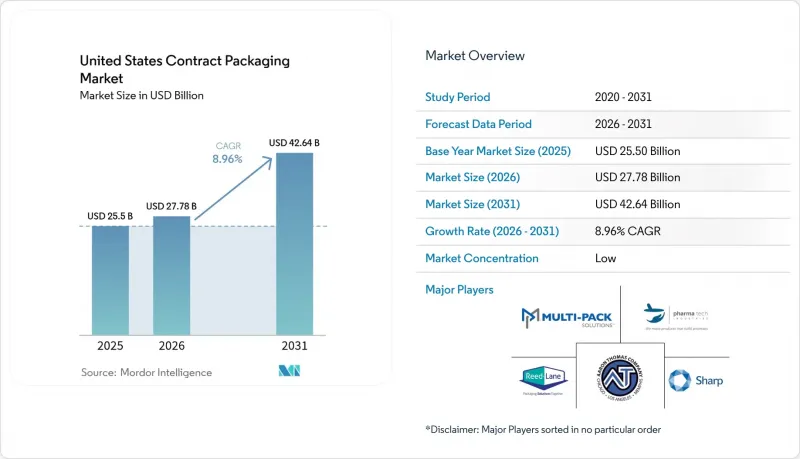
This report is Segmented by Packaging Type (Primary, Secondary, Tertiary), End-User Industry (Food, Beverage, Pharmaceutical, and More), Service Offering (Formulation and Blending, Filling and Assembly, and More), Material Substrate (Paper and Paperboard, Plastics, Metals, and More), Automation Level (Manual, Semi-Automated, and More). The Market Forecasts are Provided in Terms of Value (USD).
United States Contract Packaging Market Trends and Insights
E-commerce Boom Drives Agile Co-packing Demand
The rapid expansion of online retail continues to rewrite packaging economics for brand owners. Dimensional-weight shipping policies reward formats that minimize wasted air, pushing co-packers to redesign primary and secondary packs for lighter, tighter footprints. A surge in ready-to-drink coffee, projected to be worth USD 64.78 billion by 2032, illustrates how category-specific growth fuels line extensions that require flexible filling and labeling capability. Contract packagers able to combine AI-driven demand forecasting with rapid changeovers capture a larger share of e-commerce programs, reinforcing the strategic relevance of the United States contract packaging market for omnichannel brands.
Pharma and Nutraceutical Outsourcing Surge
Heightened regulatory scrutiny and a pipeline of complex biologics are driving drug makers to expand external partnerships. Virtual pharmaceutical firms have cut development costs by up to 50% by leaning on specialized packagers that can manage formulation, sterile fill-finish, and serialization in one workflow The need for precise dosing systems for GLP-1 therapies further raises the bar for contamination control, turning capacity expansions such as Novo Nordisk's USD 4.1 billion North Carolina facility into anchor opportunities for the United States contract packaging market. As a result, co-packers that hold Annex 1 expertise and vaccine-grade cleanroom certifications are transitioning from transactional vendors to strategic supply-chain partners.
Rising Logistics and Cold-Chain Costs
Geopolitical disruptions in the Red Sea and canal corridors have pushed spot freight rates well above long-term averages, adding volatility to domestic inventory planning. Temperature-controlled segments carry even higher risk, as limited reefer container availability inflates landed costs for biologics and premium food products. Brand owners are passing those expenses upstream, pressuring contract packagers to widen working-capital buffers or renegotiate delivery terms. AI-derived demand forecasts, like those deployed by Americold, help mitigate uncertainty but cannot fully erase cost swings, constraining profit margin expansion within the United States contract packaging market.
Other drivers and restraints analyzed in the detailed report include:
- Labor Shortages Accelerate Robotics Adoption
- FDA FOP Labeling Rule Spurs Relabeling Needs
- High Cap-ex for Automation
For complete list of drivers and restraints, kindly check the Table Of Contents.
Segment Analysis
Primary packaging accounts for 55.88% of United States contract packaging market share in 2025, and its 11.25% CAGR signals that the segment will capture most incremental revenue through 2031. Demand concentrates in injectable kits, child-resistant vials, and smart blister packs that monitor adherence. Increased personalization in oncology and diabetes therapies pushes fill volumes lower and SKU counts higher, favoring agile filling lines with quick-change tooling. Secondary packaging continues to service club-store displays and retail multipacks, yet innovation intensity remains lower as brands channel capital toward intelligent primary containers.
The segment is also where smart packaging technologies take root. QR-enabled packs provide provenance data, while NFC tags collect patient feedback for real-world evidence programs. Investments such as Gerresheimer's USD 180 million expansion in Georgia underline the capital requirements for medical-grade plastics and injection-molded inhalers. As a result, the United States contract packaging market sees primary packaging evolve from a passive enclosure to a digitally connected interface.
The food segment remains the largest revenue contributor at 35.06% in 2025, yet pharmaceuticals are advancing at a 13.74% CAGR, twice the overall market rate. This divergence mirrors drug makers' willingness to outsource highly specialized fill-finish and labeling steps that demand Grade C cleanrooms and real-time environmental monitoring. Updated Annex 1 sterilization guidance adds further impetus by ratcheting up contamination control requirements.
Ready-to-eat and functional beverage lines continue to allocate volume to the United States contract packaging market, but growth moderates as brands mature their direct-to-consumer supply chains. In contrast, Eli Lilly's and Novo Nordisk's multi-billion-dollar North Carolina builds are channeling a fresh wave of injectable demand toward regional co-pack partners. Over the forecast horizon, pharmaceutical outsourcing is therefore expected to narrow the historical gap with food in overall contribution to the United States contract packaging market.
Complete Report Scope:
- By Packaging Type
- Primary
- Secondary
- Tertiary
- By End-user Industry
- Food
- Beverage
- Pharmaceutical
- Home and Personal Care
- Automotive
- Electronics and High-tech
- Pet Food
- Other End-user Industry
- By Service Offering
- Formulation and Blending
- Filling and Assembly
- Packaging and Labeling
- Fulfillment and Logistics
- By Material Substrate
- Paper and Paperboard
- Plastics
- Metals
- Glass
- Biodegradable/Bio-based
- By Automation Level
- Manual
- Semi-automated
- Fully Automated
- Robotics-integrated
List of Companies Covered in this Report:
- Aaron Thomas Company
- Sharp Packaging Services
- Multipack Solutions
- Pharma Tech Industries
- Reed-Lane Inc.
- UNICEP Packaging
- Bell-Carter Packaging
- Jones Packaging Inc.
- Stamar Packaging
- FedEx Supply Chain (GENCO)
- GreenSeed Contract Packaging
- Honeyville Inc.
- Ryder Contract Packaging
- Motion Controls Robotics
- Nulogy Corp.
- Custom Pak Illinois
- Buske Logistics
- Very Good Mfg.
- SMT Packaging
- Thermo Fisher CDMO Services
- Catalent Inc.
Additional Benefits:
- The market estimate (ME) sheet in Excel format
- 3 months of analyst support
TABLE OF CONTENTS
1 INTRODUCTION
- 1.1 Study Assumptions and Market Definition
- 1.2 Scope of the Study
2 RESEARCH METHODOLOGY
3 EXECUTIVE SUMMARY
4 MARKET LANDSCAPE
- 4.1 Market Overview
- 4.2 Market Drivers
- 4.2.1 E-commerce boom drives agile co-packing demand
- 4.2.2 Pharma and nutraceutical outsourcing surge
- 4.2.3 Labor shortages accelerate robotics adoption
- 4.2.4 FDA FOP labeling rule spurs relabeling needs
- 4.2.5 Reshoring incentives lift domestic demand
- 4.2.6 Eco-friendly packaging mandates and preferences
- 4.3 Market Restraints
- 4.3.1 Rising logistics and cold-chain costs
- 4.3.2 High cap-ex for automation
- 4.3.3 Fragmented supplement/FOP compliance burden
- 4.3.4 Brand owners insource core SKUs under inflation
- 4.4 Supply-Chain Analysis
- 4.5 Regulatory Landscape
- 4.6 Technological Outlook
- 4.7 Porter's Five Forces Analysis
- 4.7.1 Bargaining Power of Suppliers
- 4.7.2 Bargaining Power of Buyers
- 4.7.3 Threat of New Entrants
- 4.7.4 Threat of Substitutes
- 4.7.5 Intensity of Rivalry
5 MARKET SIZE AND GROWTH FORECASTS (VALUE)
- 5.1 By Packaging Type
- 5.1.1 Primary
- 5.1.2 Secondary
- 5.1.3 Tertiary
- 5.2 By End-user Industry
- 5.2.1 Food
- 5.2.2 Beverage
- 5.2.3 Pharmaceutical
- 5.2.4 Home and Personal Care
- 5.2.5 Automotive
- 5.2.6 Electronics and High-tech
- 5.2.7 Pet Food
- 5.2.8 Other End-user Industry
- 5.3 By Service Offering
- 5.3.1 Formulation and Blending
- 5.3.2 Filling and Assembly
- 5.3.3 Packaging and Labeling
- 5.3.4 Fulfillment and Logistics
- 5.4 By Material Substrate
- 5.4.1 Paper and Paperboard
- 5.4.2 Plastics
- 5.4.3 Metals
- 5.4.4 Glass
- 5.4.5 Biodegradable/Bio-based
- 5.5 By Automation Level
- 5.5.1 Manual
- 5.5.2 Semi-automated
- 5.5.3 Fully Automated
- 5.5.4 Robotics-integrated
6 COMPETITIVE LANDSCAPE
- 6.1 Market Concentration
- 6.2 Strategic Moves
- 6.3 Market Share Analysis
- 6.4 Company Profiles (includes Global level Overview, Market level overview, Core Segments, Financials as available, Strategic Information, Market Rank/Share for key companies, Products and Services, Recent Developments)
- 6.4.1 Aaron Thomas Company
- 6.4.2 Sharp Packaging Services
- 6.4.3 Multipack Solutions
- 6.4.4 Pharma Tech Industries
- 6.4.5 Reed-Lane Inc.
- 6.4.6 UNICEP Packaging
- 6.4.7 Bell-Carter Packaging
- 6.4.8 Jones Packaging Inc.
- 6.4.9 Stamar Packaging
- 6.4.10 FedEx Supply Chain (GENCO)
- 6.4.11 GreenSeed Contract Packaging
- 6.4.12 Honeyville Inc.
- 6.4.13 Ryder Contract Packaging
- 6.4.14 Motion Controls Robotics
- 6.4.15 Nulogy Corp.
- 6.4.16 Custom Pak Illinois
- 6.4.17 Buske Logistics
- 6.4.18 Very Good Mfg.
- 6.4.19 SMT Packaging
- 6.4.20 Thermo Fisher CDMO Services
- 6.4.21 Catalent Inc.
7 MARKET OPPORTUNITIES AND FUTURE OUTLOOK
- 7.1 White-space and Unmet-Need Assessment

