PUBLISHER: Mordor Intelligence | PRODUCT CODE: 2124446

PUBLISHER: Mordor Intelligence | PRODUCT CODE: 2124446
South America Primary Battery - Market Share Analysis, Industry Trends & Statistics, Growth Forecasts (2026 - 2031)
According to Mordor Intelligence, the South America primary battery market size was valued at USD 1.01 billion in 2025 and is estimated to grow from USD 1.06 billion in 2026 to reach USD 1.38 billion by 2031, at a CAGR of 5.41% during the forecast period (2026-2031).
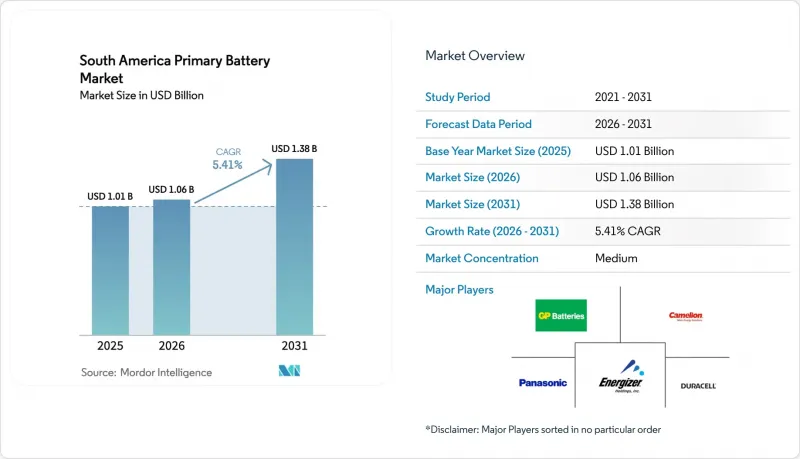
This report is Segmented by Type (Alkaline, Primary Lithium, Zinc-Air, Zinc-Carbon/Chloride, and Silver-Oxide and Others), Form Factor (Cylindrical, Coin and Button Cells, Prismatic/Packaged, and Others), Application (Consumer Electronics, Industrial and OEM, Medical and Healthcare, Defence and Aerospace, and IoT Sensor and Smart-Infrastructure), and Geography (Brazil, Argentina, Chile, and More)
South America Primary Battery Market Trends and Insights
Expanding Consumer-Electronics Penetration
Smartphone adoption passed 70% of adults in 2025, and accessories ranging from wireless gaming controllers to LED flashlights still depend on alkaline AA and AAA cells. Retail partnerships with Lojas Americanas and Carrefour Brasil lifted Energizer's Latin America alkaline shipments by 9% in fiscal 2025. Price-sensitive buyers in Colombia and Peru continue to favor disposable batteries over upfront rechargeable costs. Seasonal toy demand during Christmas and Carnival further sustains replacement cycles. Although USB-rechargeable peripherals are gaining shelf space, entrenched device ecosystems delay rapid substitution.
Government Incentives for Rural Off-Grid Electrification
Brazil allocated BRL 450 million (USD 90 million) in 2024 to distribute solar-battery kits across indigenous territories, pairing photovoltaic modules with primary lithium cells that buffer cloudy intervals. Chile's SEC mandated sub-zero-rated backup cells for off-grid sites in Aysen and Magallanes in 2025, favoring Li-SOCl2 chemistry. Peru supplied 12,000 LED lamps and radio kits to Loreto households the same year, creating a recurring D-cell replacement stream. These initiatives produce lumpy tenders but cement last-mile distribution networks that later benefit retail sales.
Rapid Substitution by Rechargeable Chemistries
USB-rechargeable LED flashlights, gaming controllers, and wireless speakers are replacing disposable-battery models in major Brazilian and Chilean retailers. Energizer's fiscal-2025 Latin America alkaline volume slipped 4%, partly offset by higher prices and lithium-primary growth. Urban households with stable grids can charge overnight, accelerating the shift, while rural areas remain alkaline-centric. Consumer education remains limited, delaying total-cost-of-ownership awareness in lower-income segments.
Other drivers and restraints analyzed in the detailed report include:
- Proliferation of Battery-Powered IoT Sensors in Brazilian Agribusiness
- Growing Demand for Primary Cells in Critical Medical Devices
- Stricter Disposal Rules on Cadmium / Mercury Content
For complete list of drivers and restraints, kindly check the Table Of Contents.
Segment Analysis
Alkaline batteries maintained 50.5% of 2025 revenue thanks to ubiquitous AA and AAA devices in retail channels. In contrast, primary lithium chemistries are projected to grow 8.7% annually through 2031, powering medical implants, industrial IoT nodes, and defense radios that need decade-long service lives. Zinc-air cells dominate the hearing-aid segment as the population aged 65+ expands 3.2% per year. Regulatory pressure on mercury content accelerates the phase-out of zinc-carbon variants.
Silver-oxide cells, priced three to five times higher than alkaline, serve precision watches and gas detectors in Chile's mines. Specialty chemistries like lithium-iron-disulfide target extreme temperatures in Patagonian and Andean defense applications with a commercial launch slated for 2026. As a result, the South America primary battery market size for lithium chemistries is set to widen its footprint, even as alkaline remains the volume leader.
Complete Report Scope:
- By Type
- Alkaline
- Primary Lithium (Li-MnO2, Li-SOCl2, Li-CFx)
- Zinc-Air
- Zinc-Carbon/Chloride
- Silver-Oxide and Others
- By Form Factor
- Cylindrical (AA, AAA, C, D)
- Coin and Button Cells
- Prismatic/Packaged
- Others (Special shapes)
- By Application
- Consumer Electronics
- Industrial and OEM
- Medical and Healthcare
- Defence and Aerospace
- IoT Sensors and Smart-Infrastructure
- By Geography
- Brazil
- Argentina
- Colombia
- Chile
- Peru
- Rest of South America
List of Companies Covered in this Report:
- Duracell Inc.
- Energizer Holdings Inc.
- Panasonic Corp.
- GP Batteries International Ltd.
- Camelion Battery Co. Ltd.
- Saft Groupe SA
- Toshiba Corp.
- VARTA AG
- Maxell Holdings Ltd.
- Sony Corp.
- FDK Corp.
- Ultralife Corp.
- Spectrum Brands Holdings Inc.
- Rayovac Brasil (PRIMO Industria)
- Eveready Industries India Ltd. (SA export)
- Zhejiang Ningbo Hi-Watt Battery
- Wuhan FULI Battery
- Ningbo Sonyun Battery
- Shenzhen MUSTANG Battery
- Zhongyin (BB Battery)
Additional Benefits:
- The market estimate (ME) sheet in Excel format
- 3 months of analyst support
TABLE OF CONTENTS
1 Introduction
- 1.1 Study Assumptions & Market Definition
- 1.2 Scope of the Study
2 Research Methodology
3 Executive Summary
4 Market Landscape
- 4.1 Market Overview
- 4.2 Market Drivers
- 4.2.1 Expanding consumer-electronics penetration
- 4.2.2 Government incentives for rural off-grid electrification
- 4.2.3 Growing demand for primary cells in critical medical devices
- 4.2.4 Disaster-preparedness kits amid rising extreme-weather events
- 4.2.5 Proliferation of battery-powered IoT sensors in Brazilian agribusiness
- 4.2.6 Tactical communications upgrades in Andean defence procurements
- 4.3 Market Restraints
- 4.3.1 Rapid substitution by rechargeable chemistries
- 4.3.2 Stricter disposal rules on cadmium / mercury content
- 4.3.3 Port-logistics & import-tariff volatility in Brazil
- 4.3.4 Pilot "battery-sharing" services dampening single-use sales in Argentina
- 4.4 Supply-Chain Analysis
- 4.5 Regulatory Landscape
- 4.6 Technological Outlook
- 4.7 Porter's Five Forces
- 4.7.1 Bargaining Power of Suppliers
- 4.7.2 Bargaining Power of Consumers
- 4.7.3 Threat of New Entrants
- 4.7.4 Threat of Substitute Products
- 4.7.5 Intensity of Competitive Rivalry
5 Market Size & Growth Forecasts
- 5.1 By Type
- 5.1.1 Alkaline
- 5.1.2 Primary Lithium (Li-MnO2, Li-SOCl2, Li-CFx)
- 5.1.3 Zinc-Air
- 5.1.4 Zinc-Carbon/Chloride
- 5.1.5 Silver-Oxide and Others
- 5.2 By Form Factor
- 5.2.1 Cylindrical (AA, AAA, C, D)
- 5.2.2 Coin and Button Cells
- 5.2.3 Prismatic/Packaged
- 5.2.4 Others (Special shapes)
- 5.3 By Application
- 5.3.1 Consumer Electronics
- 5.3.2 Industrial and OEM
- 5.3.3 Medical and Healthcare
- 5.3.4 Defence and Aerospace
- 5.3.5 IoT Sensors and Smart-Infrastructure
- 5.4 By Geography
- 5.4.1 Brazil
- 5.4.2 Argentina
- 5.4.3 Colombia
- 5.4.4 Chile
- 5.4.5 Peru
- 5.4.6 Rest of South America
6 Competitive Landscape
- 6.1 Market Concentration
- 6.2 Strategic Moves (M&A, Partnerships, PPAs)
- 6.3 Market Share Analysis (Market Rank/Share for key companies)
- 6.4 Company Profiles (includes Global level Overview, Market level overview, Core Segments, Financials as available, Strategic Information, Products & Services, and Recent Developments)
- 6.4.1 Duracell Inc.
- 6.4.2 Energizer Holdings Inc.
- 6.4.3 Panasonic Corp.
- 6.4.4 GP Batteries International Ltd.
- 6.4.5 Camelion Battery Co. Ltd.
- 6.4.6 Saft Groupe SA
- 6.4.7 Toshiba Corp.
- 6.4.8 VARTA AG
- 6.4.9 Maxell Holdings Ltd.
- 6.4.10 Sony Corp.
- 6.4.11 FDK Corp.
- 6.4.12 Ultralife Corp.
- 6.4.13 Spectrum Brands Holdings Inc.
- 6.4.14 Rayovac Brasil (PRIMO Industria)
- 6.4.15 Eveready Industries India Ltd. (SA export)
- 6.4.16 Zhejiang Ningbo Hi-Watt Battery
- 6.4.17 Wuhan FULI Battery
- 6.4.18 Ningbo Sonyun Battery
- 6.4.19 Shenzhen MUSTANG Battery
- 6.4.20 Zhongyin (BB Battery)
7 Market Opportunities & Future Outlook
- 7.1 White-space & Unmet-Need Assessment

