PUBLISHER: Mordor Intelligence | PRODUCT CODE: 2125273

PUBLISHER: Mordor Intelligence | PRODUCT CODE: 2125273
Asia-Pacific Electric Drives - Market Share Analysis, Industry Trends & Statistics, Growth Forecasts (2026 - 2031)
According to Mordor Intelligence, the APAC electric drives market size was valued at USD 25.95 billion in 2025 and estimated to grow from USD 27.19 billion in 2026 to reach USD 34.33 billion by 2031, at a CAGR of 4.78% during the forecast period (2026-2031).
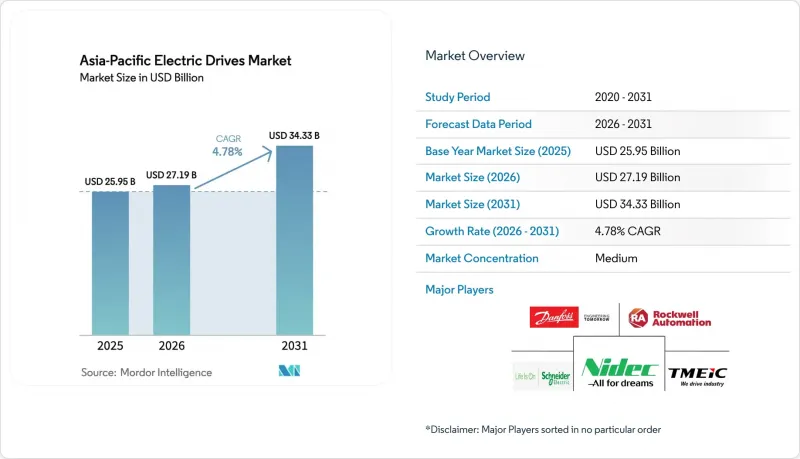
This report is Segmented by Drive Type (AC Drives, DC Drives, Servo Drives, and Permanent-Magnet Drives), Voltage Class (Low Voltage, Medium Voltage, and High Voltage), Power Rating (Micro, Low, Medium, and High), End-User Industry (Oil and Gas, Chemical and Petrochemical, Food and Beverage, Water and Wastewater, and More), and Country. The Market Forecasts are Provided in Terms of Value (USD).
Asia-Pacific Electric Drives Market Trends and Insights
Rapid Automation Across Discrete and Process Industries
Tight labor markets, especially in coastal China, South Korea, and parts of Japan, are accelerating investment in fully automated "lights-out" facilities that rely on high-speed servo systems for pick-and-place, palletizing and quality-inspection tasks. Semiconductor plant expansions in western Japan and advanced packaging lines in Taiwan require nanometer-level positioning accuracy, fueling demand for digitally networked servo drives with gigahertz-class control loops. Process plants in chemicals and petrochemicals are modernizing older induction-motor starters with variable-frequency drives (VFDs) that trim energy use by up to 30%, an imperative as commodity margins stay thin. Variable-speed pump control in India's growing fertilizer industry illustrates how even legacy facilities can capture quick wins on electricity cost without major civil work. Although inventory corrections dampened Japanese vendor shipments in late 2024, purchase orders from ASEAN producers of consumer electronics have since stabilized the book-to-bill ratio at above 1.05, signaling continued capital-equipment momentum.
Regulatory Pressure for IE4+ Motors and Drive Retrofits
Successive rounds of minimum-efficiency legislation tighten the screws on installed motors across the region. Japan's Top Runner Program demands 11.4% efficiency gains in distribution transformers by 2027, pushing facility managers to pair IE4 motors with new drives capable of synchronous-reluctance or permanent-magnet control. Export-oriented manufacturers in Vietnam and Thailand pre-emptively comply with European IE4 mandates on 75-200 kW motors to avoid re-certification costs, making high-efficiency drives a ticket to retain market access. Australia and New Zealand's MEPS program, refreshed in 2025, tips purchasing models toward silicon-carbide-based drives that breach the 98% efficiency threshold.
High Capex and Integration Cost for Medium-Voltage Drives
Total installed cost for a 6.6 kV, 2 MW VFD can exceed equipment price by 50% once switchgear, step-down transformers and harmonic filters are added. Small and mid-size Asian manufacturers, often operating on thin margins, defer such upgrades until asset lifetimes stretch beyond twenty years. Exchange-rate volatility in Indonesia and Malaysia balloons financing costs for imported medium-voltage hardware, forcing buyers to negotiate long-tenor supplier credit lines. Rockwell Automation's sync-transfer technology partially offsets sticker shock by letting one drive control multiple motors, slashing capex by roughly 50%. Still, scarcity of certified engineers makes many operators hesitant to embark on complex retrofits, restraining volume growth in this slice of the APAC electric drives market.
Other drivers and restraints analyzed in the detailed report include:
- Surging HVAC Adoption in Commercial Real-Estate
- Green-Hydrogen Electrolyzer Build-Out Needs Precision Drives
- Skilled-Labour Shortages for Commissioning and Maintenance
For complete list of drivers and restraints, kindly check the Table Of Contents.
Segment Analysis
AC drives generated 72.70% of 2025 revenue and remain the workhorse across pumps, fans and conveyors where cost and reliability trump pinpoint accuracy. Price erosion over the past five years keeps average selling prices nearly 18% below 2019 levels, helping the APAC electric drives market penetrate SME users. Servo drives, although smaller in absolute dollars, will clock a 7.80% CAGR through 2031 on the back of pick-and-place robotics, electronic assembly and 3-D printing lines that demand sub-millisecond speed response. This micro-segment benefits from integration with EtherCAT and Time-Sensitive Networking, features not generally required by bulk-handling applications.
Servo uptake also reflects growing on-machine intelligence: feedback-rich encoders feed real-time position data to digital twins, slashing commissioning time by 30% in new robotic cells. Meanwhile, permanent-magnet drives exploit high torque density to gain share in elevator hoists and commercial HVAC, although supply-chain vulnerability constrains faster substitution. Collectively, precision motion segments keep the APAC electric drives market on a technology-innovation footing despite price pressures in commodity vector control.
Low-voltage drives below 1 kV captured 65.40% revenue in 2025, reflecting the ubiquity of 380-415 V utility feeds across Asian factories. Commodity HVAC and water-treatment installations account for most volume, aided by standardized IP55 enclosures and plug-and-play fieldbus adapters that trim installation cost. The APAC electric drives market size for medium-voltage (1-36 kV) equipment is forecast to expand at 6.68% CAGR as miners, refiners and LNG liquefaction plants seek megawatt-class energy savings.
Manufacturers are narrowing the feature gap: integrated cell-stack architectures reduce harmonic distortion to below 2.3% THDi without external filters, making MV drives attractive even for brownfield retrofits. At the opposite end, micro-drives under 2 kW adopt single-chip inverter ICs, shaving PCB count by 40% and enabling fan-less cooling for food-processing lines with sanitary washdown requirements. As semiconductor fabs upgrade from 415 V to 690 V power distribution to cut copper losses, low-voltage platforms inch upward in rating, muddying traditional voltage-class boundaries while enlarging the addressable APAC electric drives market.
Complete Report Scope:
- By Drive Type
- AC Drives
- DC Drives
- Servo Drives
- Permanent-Magnet Drives
- By Voltage Class
- Low Voltage (<1 kV)
- Medium Voltage (1-36 kV)
- High Voltage (>36 kV)
- By Power Rating
- Micro (<5 kW)
- Low (5-200 kW)
- Medium (200 kW-1 MW)
- High (>1 MW)
- By End-user Industry
- Oil and Gas
- Chemical and Petrochemical
- Food and Beverage
- Water and Wastewater
- Power Generation
- Metals and Mining
- Pulp and Paper
- HVAC and Building Services
- Discrete Manufacturing
- Other Industries
- By Country
- China
- India
- Japan
- South Korea
- Australia and New Zealand
- Rest of Asia-Pacific
List of Companies Covered in this Report:
- ABB Ltd.
- Siemens AG
- Schneider Electric SE
- Danfoss A/S
- Rockwell Automation Inc.
- Mitsubishi Electric Corporation
- Yaskawa Electric Corporation
- Hitachi Industrial Equipment Systems Co. Ltd.
- TMEIC Corporation
- Toshiba International Corporation
- Fuji Electric Co. Ltd.
- Nidec Corporation
- Delta Electronics Inc.
- Inovance Technology
- Wolong Electric Group Co. Ltd.
- WEG S.A.
- CG Power and Industrial Solutions Ltd.
- LS Electric Co. Ltd.
- Bonfiglioli Riduttori S.p.A.
- Emerson Electric Co.
Additional Benefits:
- The market estimate (ME) sheet in Excel format
- 3 months of analyst support
TABLE OF CONTENTS
1 INTRODUCTION
- 1.1 Study Assumptions and Market Definition
- 1.2 Scope of the Study
2 RESEARCH METHODOLOGY
3 EXECUTIVE SUMMARY
4 MARKET LANDSCAPE
- 4.1 Market Overview
- 4.2 Market Drivers
- 4.2.1 Rapid automation across discrete and process industries
- 4.2.2 Regulatory pressure for IE4 + motors and drive retrofits
- 4.2.3 Surging HVAC adoption in commercial real-estate
- 4.2.4 Green hydrogen electrolyzer build-out needs precision drives
- 4.2.5 ASEAN state subsidies for servo-driven packaging lines
- 4.2.6 Grid-interactive buildings deploying VFD-based demand response
- 4.3 Market Restraints
- 4.3.1 High capex and integration cost for medium-voltage drives
- 4.3.2 Skilled-labour shortages for commissioning and maintenance
- 4.3.3 Persistent voltage-quality issues in CLMV* grids
- 4.3.4 Trade-policy risk on rare-earth magnets for PM drives
- 4.4 Value Chain Analysis
- 4.5 Regulatory Landscape
- 4.6 Technological Outlook
- 4.7 Porter's Five Forces Analysis
- 4.7.1 Bargaining Power of Suppliers
- 4.7.2 Bargaining Power of Buyers
- 4.7.3 Threat of New Entrants
- 4.7.4 Threat of Substitutes
- 4.7.5 Intensity of Competitive Rivalry
- 4.8 Assessment of Macro Economic Trends on the Market
5 MARKET SIZE AND GROWTH FORECASTS (VALUES)
- 5.1 By Drive Type
- 5.1.1 AC Drives
- 5.1.2 DC Drives
- 5.1.3 Servo Drives
- 5.1.4 Permanent-Magnet Drives
- 5.2 By Voltage Class
- 5.2.1 Low Voltage (<1 kV)
- 5.2.2 Medium Voltage (1-36 kV)
- 5.2.3 High Voltage (>36 kV)
- 5.3 By Power Rating
- 5.3.1 Micro (<5 kW)
- 5.3.2 Low (5-200 kW)
- 5.3.3 Medium (200 kW-1 MW)
- 5.3.4 High (>1 MW)
- 5.4 By End-user Industry
- 5.4.1 Oil and Gas
- 5.4.2 Chemical and Petrochemical
- 5.4.3 Food and Beverage
- 5.4.4 Water and Wastewater
- 5.4.5 Power Generation
- 5.4.6 Metals and Mining
- 5.4.7 Pulp and Paper
- 5.4.8 HVAC and Building Services
- 5.4.9 Discrete Manufacturing
- 5.4.10 Other Industries
- 5.5 By Country
- 5.5.1 China
- 5.5.2 India
- 5.5.3 Japan
- 5.5.4 South Korea
- 5.5.5 Australia and New Zealand
- 5.5.6 Rest of Asia-Pacific
6 COMPETITIVE LANDSCAPE
- 6.1 Market Concentration
- 6.2 Strategic Moves
- 6.3 Market Share Analysis
- 6.4 Company Profiles (includes Global level Overview, Market level overview, Core Segments, Financials as available, Strategic Information, Market Rank/Share for key companies, Products and Services, and Recent Developments)
- 6.4.1 ABB Ltd.
- 6.4.2 Siemens AG
- 6.4.3 Schneider Electric SE
- 6.4.4 Danfoss A/S
- 6.4.5 Rockwell Automation Inc.
- 6.4.6 Mitsubishi Electric Corporation
- 6.4.7 Yaskawa Electric Corporation
- 6.4.8 Hitachi Industrial Equipment Systems Co. Ltd.
- 6.4.9 TMEIC Corporation
- 6.4.10 Toshiba International Corporation
- 6.4.11 Fuji Electric Co. Ltd.
- 6.4.12 Nidec Corporation
- 6.4.13 Delta Electronics Inc.
- 6.4.14 Inovance Technology
- 6.4.15 Wolong Electric Group Co. Ltd.
- 6.4.16 WEG S.A.
- 6.4.17 CG Power and Industrial Solutions Ltd.
- 6.4.18 LS Electric Co. Ltd.
- 6.4.19 Bonfiglioli Riduttori S.p.A.
- 6.4.20 Emerson Electric Co.
7 MARKET OPPORTUNITIES AND FUTURE OUTLOOK
- 7.1 White-space and Unmet-need Assessment

