PUBLISHER: Mordor Intelligence | PRODUCT CODE: 2125650

PUBLISHER: Mordor Intelligence | PRODUCT CODE: 2125650
China Sensors - Market Share Analysis, Industry Trends & Statistics, Growth Forecasts (2026 - 2031)
According to Mordor Intelligence, China sensors market size in 2026 is estimated at USD 7.45 billion, growing from 2025 value of USD 7.01 billion with 2031 projections showing USD 10.08 billion, growing at 6.25% CAGR over 2026-2031.
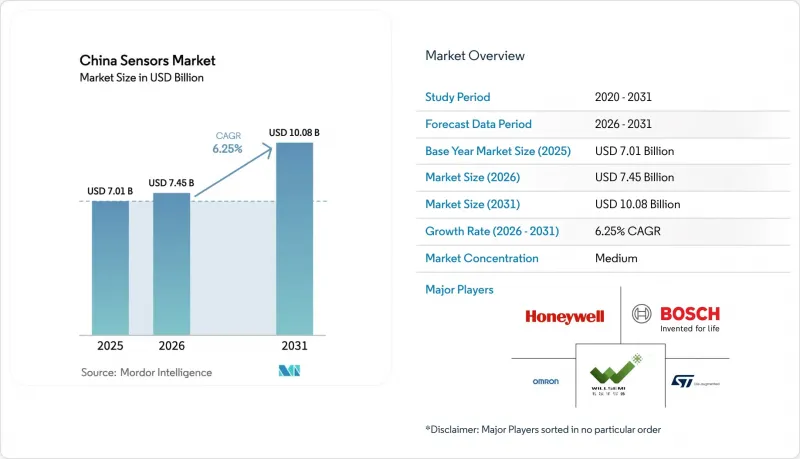
This report is Segmented by Parameter Measured (Temperature, Pressure, Level, Flow, Proximity, and More), Mode of Operation (Optical, Electrical Resistance, Biosensors, Piezoresistive, Image, Lidar, and More), Technology (MEMS, CMOS / IC Sensors, Fiber-Optic, Quantum and NV-Centre, and Others), and by End-User Industry (Automotive, Consumer Electronics, Energy, Industrial and Manufacturing, Medical and Wellness, and More).
China Sensors Market Trends and Insights
Government-led "Made in China 2025" localization push
Large-scale fiscal incentives and mandated procurement preferences lifted domestic content in core sensor components toward 70% by 2025, compared with about 40% in 2020. More than 33 Manufacturing Innovation Centres had been launched by early 2025, anchoring joint R&D between universities and enterprises. Preferential financing, expedited certification, and IP support further reduced entry barriers for local firms, fostering a vertically integrated value chain that now rivals overseas suppliers in pressure, environmental, and inertial categories.
EV production surge boosting demand for high-temperature, pressure, and current sensors
EV sales exceeded 3.5 million units in 2024, sustaining a triple-digit expansion from pre-2023 levels and lifting per-vehicle sensor content at an 8-10% annual pace. BYD bundled its 'God's Eye' smart-driving platform across the full model line without extra cost, normalizing advanced thermal-management, battery-pressure, and current-measurement arrays even in mass-market cars. The trend strengthened order books for domestic MEMS and shunt-based current-sensor makers positioned closest to major assembly hubs.
Dependence on imported specialty wafers creates supply-chain risk
Despite domestic fabs adding mature-node capacity, China still relied on overseas suppliers for SOI, SiC, and GaN wafers used in high-temperature and photonic sensors. Renewed export-control measures on advanced substrates in 2024 heightened procurement uncertainty and forced buffer-stock policies, increasing working-capital needs. Resulting lead-time volatility constrained the production of cutting-edge automotive and medical devices.
Other drivers and restraints analyzed in the detailed report include:
- Mass manufacturing of smartphones and IoT wearables clustering in Guangdong
- Smart-factory retrofits across the Yangtze River Delta are accelerating industrial sensor uptake
- Fragmented IP landscape triggering cross-licensing disputes
For complete list of drivers and restraints, kindly check the Table Of Contents.
Segment Analysis
Pressure sensors accounted for 18.45% of China's sensor market share in 2025, reflecting established automotive, industrial, and handset integration footprints. Environmental sensors represented a smaller base yet posted the fastest 16.59% CAGR forecast, propelled by stricter National Ambient Air Quality Standards and municipal PM2.5 monitoring mandates.
Rapid air-quality site build-outs in Tier-1 cities stimulated demand for micro-precision gas and particulate sensors, pushing the China sensors market size for environmental categories at a significant rate during the forecast period. Consumer IoT air-purifiers and smart-home devices further broadened volume. Meanwhile, flow and level sensors advanced steadily in chemical processing and water-utilities projects, while vibration and magnetic devices gained traction in structural health and autonomous navigation use cases.
Piezoresistive components retained a 31.75% revenue share in 2025, anchored by mature packaging lines and well-established design IP. LiDAR units, however, are projected for a 21.53% CAGR through 2031 as ADAS penetration in mid-range EVs climbs. Hesai and RoboSense jointly shipped more than 520,000 automotive LiDARs in 2024, equal to one-third of global deliveries.
The China sensors market size for LiDAR is expected to approach USD 1.42 billion by 2031 on the strength of national standards such as GB/T 45500-2025 that codify performance metrics. Complementary radar, capacitive-touch, and optical imagers sustained double-digit growth, serving consumer devices and industrial robots that require multi-modal perception arrays.
Complete Report Scope:
- By Parameter Measured
- Temperature
- Pressure
- Level
- Flow
- Proximity
- Environmental (Air-quality, Gas)
- Chemical
- Inertial (Accel/Gyro)
- Magnetic
- Vibration
- Other Parameters
- By Mode of Operation
- Optical
- Electrical Resistance
- Biosensors
- Piezoresistive
- Image
- Capacitive
- Piezoelectric
- LiDAR
- Radar
- Other Modes
- By Technology
- MEMS
- CMOS / IC Sensors
- Fiber-Optic
- Quantum and NV-Centre
- Others (O-NEMS, Thin-Film)
- By End-user Industry
- Automotive
- Consumer Electronics
- Smartphones
- Tablets, Laptops and PCs
- Wearables
- Smart Home Devices
- Other Consumer Electronics
- Energy (Generation and Storage)
- Industrial and Manufacturing
- Medical and Wellness
- Construction, Agriculture and Mining
- Aerospace and Defense
List of Companies Covered in this Report:
- Bosch Sensortec GmbH
- STMicroelectronics NV
- Honeywell International Inc.
- Omron Corporation
- Infineon Technologies AG
- Texas Instruments Inc.
- Panasonic Corporation
- Sensirion AG
- Hesai Technology Co. Ltd.
- NXP Semiconductors NV
- TDK Corporation (InvenSense)
- Analog Devices Inc.
- Melexis NV
- AAC Technologies Holdings Inc.
- Will Semiconductor Co. Ltd.
- Goertek Inc.
- MEMSensing Microsystems Co. Ltd.
- Novosense Microelectronics
- Hanwei Electronics Group Corp.
- OmniVision Technologies Inc.
- Amphenol Advanced Sensors
- Shanghai Zhaohui Pressure Apparatus Co. Ltd.
- Sinochip Electronics Co. Ltd.
- Hefei 3-Nod Sensor Co. Ltd.
- Silan Microelectronics Co. Ltd.
Additional Benefits:
- The market estimate (ME) sheet in Excel format
- 3 months of analyst support
TABLE OF CONTENTS
1 INTRODUCTION
- 1.1 Study Assumptions and Market Definition
- 1.2 Scope of the Study
2 RESEARCH METHODOLOGY
3 EXECUTIVE SUMMARY
4 MARKET LANDSCAPE
- 4.1 Market Overview
- 4.2 Market Drivers
- 4.2.1 Government-led "Made in China 2025" localisation push for sensor supply-chains
- 4.2.2 EV production surge boosting demand for high-temperature, pressure and current sensors
- 4.2.3 Mass-manufacturing of smartphones and IoT wearables clustering in Guangdong raises MEMS volumes
- 4.2.4 Smart-factory retrofits across Yangtze River Delta accelerating industrial sensor uptake
- 4.2.5 Rising adoption of remote patient-monitoring and digital health platforms driving medical sensors
- 4.2.6 Falling 8-inch MEMS wafer costs from domestic foundries widening sensor addressable markets
- 4.3 Market Restraints
- 4.3.1 Dependence on imported specialty wafers creating supply-chain risk
- 4.3.2 Fragmented IP landscape triggering cross-licensing disputes with incumbents
- 4.3.3 Price wars among local vendors eroding RandD budgets
- 4.3.4 China Cyber-security Law complicating deployment of cloud-connected industrial sensors
- 4.4 Value Chain Analysis
- 4.5 Regulatory Outlook
- 4.6 Technological Outlook
- 4.7 Porter's Five Forces
- 4.7.1 Bargaining Power of Suppliers
- 4.7.2 Bargaining Power of Buyers
- 4.7.3 Threat of New Entrants
- 4.7.4 Threat of Substitutes
- 4.7.5 Degree of Competition
- 4.8 Investment Analysis
- 4.9 Imapct of Macroeconomic Factors on the market
5 MARKET SIZE AND GROWTH FORECASTS (VALUE)
- 5.1 By Parameter Measured
- 5.1.1 Temperature
- 5.1.2 Pressure
- 5.1.3 Level
- 5.1.4 Flow
- 5.1.5 Proximity
- 5.1.6 Environmental (Air-quality, Gas)
- 5.1.7 Chemical
- 5.1.8 Inertial (Accel/Gyro)
- 5.1.9 Magnetic
- 5.1.10 Vibration
- 5.1.11 Other Parameters
- 5.2 By Mode of Operation
- 5.2.1 Optical
- 5.2.2 Electrical Resistance
- 5.2.3 Biosensors
- 5.2.4 Piezoresistive
- 5.2.5 Image
- 5.2.6 Capacitive
- 5.2.7 Piezoelectric
- 5.2.8 LiDAR
- 5.2.9 Radar
- 5.2.10 Other Modes
- 5.3 By Technology
- 5.3.1 MEMS
- 5.3.2 CMOS / IC Sensors
- 5.3.3 Fiber-Optic
- 5.3.4 Quantum and NV-Centre
- 5.3.5 Others (O-NEMS, Thin-Film)
- 5.4 By End-user Industry
- 5.4.1 Automotive
- 5.4.2 Consumer Electronics
- 5.4.2.1 Smartphones
- 5.4.2.2 Tablets, Laptops and PCs
- 5.4.2.3 Wearables
- 5.4.2.4 Smart Home Devices
- 5.4.2.5 Other Consumer Electronics
- 5.4.3 Energy (Generation and Storage)
- 5.4.4 Industrial and Manufacturing
- 5.4.5 Medical and Wellness
- 5.4.6 Construction, Agriculture and Mining
- 5.4.7 Aerospace and Defense
6 COMPETITIVE LANDSCAPE
- 6.1 Market Concentration
- 6.2 Strategic Moves
- 6.3 Market Share Analysis
- 6.4 Company Profiles {(includes Global level Overview, Market level overview, Core Segments, Financials as available, Strategic Information, Market Rank/Share for key companies, Products and Services, and Recent Developments)}
- 6.4.1 Bosch Sensortec GmbH
- 6.4.2 STMicroelectronics NV
- 6.4.3 Honeywell International Inc.
- 6.4.4 Omron Corporation
- 6.4.5 Infineon Technologies AG
- 6.4.6 Texas Instruments Inc.
- 6.4.7 Panasonic Corporation
- 6.4.8 Sensirion AG
- 6.4.9 Hesai Technology Co. Ltd.
- 6.4.10 NXP Semiconductors NV
- 6.4.11 TDK Corporation (InvenSense)
- 6.4.12 Analog Devices Inc.
- 6.4.13 Melexis NV
- 6.4.14 AAC Technologies Holdings Inc.
- 6.4.15 Will Semiconductor Co. Ltd.
- 6.4.16 Goertek Inc.
- 6.4.17 MEMSensing Microsystems Co. Ltd.
- 6.4.18 Novosense Microelectronics
- 6.4.19 Hanwei Electronics Group Corp.
- 6.4.20 OmniVision Technologies Inc.
- 6.4.21 Amphenol Advanced Sensors
- 6.4.22 Shanghai Zhaohui Pressure Apparatus Co. Ltd.
- 6.4.23 Sinochip Electronics Co. Ltd.
- 6.4.24 Hefei 3-Nod Sensor Co. Ltd.
- 6.4.25 Silan Microelectronics Co. Ltd.
7 MARKET OPPORTUNITIES AND FUTURE OUTLOOK
- 7.1 White-space and Unmet-Need Assessment

