
PUBLISHER: Aviation & Defense Market Reports (A&D) | PRODUCT CODE: 1930534

PUBLISHER: Aviation & Defense Market Reports (A&D) | PRODUCT CODE: 1930534
Global Armored Personnel Carrier Market 2026-2036
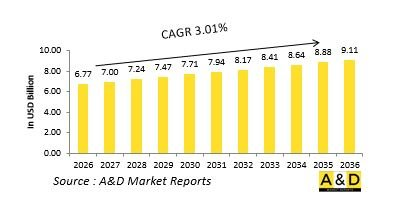
The Global APC market is estimated at USD 6.77 billion in 2026, projected to grow to USD 9.11 billion by 2036 at a Compound Annual Growth Rate (CAGR) of 3.01% over the forecast period 2026-2036.
Introduction
Armored personnel carriers are essential assets for modern land forces, providing protected mobility for troops across contested and high-risk operational environments. These platforms are designed to transport infantry safely while maintaining the ability to operate alongside armored and mechanized units. As battlefield conditions evolve toward complex and hybrid conflict scenarios, the role of armored personnel carriers has expanded beyond simple troop transport. They now support command functions, medical evacuation, logistics, and internal security operations. The emphasis on soldier survivability and operational flexibility has elevated these platforms as critical enablers of maneuver warfare. Armed forces worldwide are modernizing existing fleets and adopting new designs to meet emerging threats and mission profiles. The integration of armored personnel carriers into combined arms operations underscores their importance in maintaining tempo and cohesion during ground engagements. Their continued relevance reflects the need for protected mobility in environments characterized by indirect fire, ambush threats, and asymmetric tactics.
Technology Impact in Armored Personnel Carriers
Technological advancements are transforming armored personnel carriers into more versatile and survivable platforms. Improved armor materials and structural designs enhance protection against a range of threats while minimizing weight penalties. Powertrain innovations improve mobility and fuel efficiency across varied terrains. Advanced suspension systems support smoother movement and greater stability during operations. Integration of situational awareness systems, including sensors and cameras, enhances crew visibility and threat detection. Remote weapon stations and defensive aids increase self-protection without exposing personnel. Digital communication and command interfaces enable armored personnel carriers to function as nodes within networked combat formations. Modular design approaches allow rapid adaptation for different mission roles. These technological developments enhance operational effectiveness while extending platform service life.
Key Drivers in Armored Personnel Carriers
The demand for armored personnel carriers is driven by evolving land warfare requirements and force protection priorities. Military modernization programs emphasize protected mobility as a cornerstone of operational readiness. Urban combat and peacekeeping missions require platforms capable of navigating confined spaces while safeguarding occupants. Increased focus on joint operations and rapid deployment underscores the need for reliable and adaptable transport solutions. National defense policies promoting indigenous production further influence procurement and upgrade decisions. The need to replace aging fleets also sustains demand for modernized platforms. Training and logistics considerations favor platforms that offer ease of maintenance and operational reliability. Together, these drivers reinforce the strategic importance of armored personnel carriers in contemporary land forces.
Regional Trends in Armored Personnel Carriers
Regional defense strategies shape the adoption and development of armored personnel carriers. North American forces emphasize integration with networked command systems and enhanced survivability features. European militaries prioritize interoperability and modular designs suitable for multinational operations. Asia-Pacific countries focus on mobility and adaptability to diverse terrain conditions. Middle Eastern forces emphasize robust protection and reliability in harsh environments. African defense organizations increasingly adopt cost-effective and durable platforms to support peacekeeping and internal security missions. Across regions, there is a growing emphasis on local production and technology partnerships. These trends highlight the enduring role of armored personnel carriers in global defense planning.
Key APC Market Program:
Textron Systems secured a $163.4 million U.S. Army contract in January 2026 to deliver 65 COMMANDO Select armored vehicles to Ukraine under Foreign Military Sales authorities. Based on the M1117 Guardian platform, these wheeled armored personnel carriers feature enhanced ballistic protection, mobility, and firepower to transport infantry squads in contested environments. Deliveries scheduled through 2027 will bolster Ukrainian mechanized infantry capabilities against peer adversaries.
Table of Contents
Armored Personnel Carrier Market - Table of Contents
Armored Personnel Carrier Market Report Definition
Armored Personnel Carrier Market Segmentation
By Range
By Region
By End User
Armored Personnel Carrier Market Analysis for next 10 Years
The 10-year APC Armored Personnel Carrier Market analysis would give a detailed overview of APC Armored Personnel Carrier Market growth, changing dynamics, technology adoption overviews and the overall market attractiveness is covered in this chapter.
Market Technologies of Armored Personnel Carrier Market
This segment covers the top 10 technologies that is expected to impact this market and the possible implications these technologies would have on the overall market.
Global Armored Personnel Carrier Market Forecast
The 10-year Armored Personnel Carrier Market forecast of this market is covered in detailed across the segments which are mentioned above.
Regional Armored Personnel Carrier Market Trends & Forecast
The regional Armored Personnel Carrier Market trends, drivers, restraints and Challenges of this market, the Political, Economic, Social and Technology aspects are covered in this segment. The market forecast and scenario analysis across regions are also covered in detailed in this segment. The last part of the regional analysis includes profiling of the key companies, supplier landscape and company benchmarking. The current market size is estimated based on the normal scenario.
North America
Drivers, Restraints and Challenges
PEST
Market Forecast & Scenario Analysis
Key Companies
Supplier Tier Landscape
Company Benchmarking
Europe
Middle East
APAC
South America
Country Analysis of Armored Personnel Carrier Market
This chapter deals with the key defense programs in this market, it also covers the latest news and patents which have been filed in this market. Country level 10 year market forecast and scenario analysis are also covered in this chapter.
US
Defense Programs
Latest News
Patents
Current levels of technology maturation in this market
Market Forecast & Scenario Analysis
Canada
Italy
France
Germany
Netherlands
Belgium
Spain
Sweden
Greece
Australia
South Africa
India
China
Russia
South Korea
Japan
Malaysia
Singapore
Brazil
Opportunity Matrix for Armored Personnel Carrier Market
The opportunity matrix helps the readers understand the high opportunity segments in this market.
Expert Opinions on APC Armored Personnel Carrier Market Report
Hear from our experts their opinion of the possible analysis for this market.
Conclusions
About Aviation and Defense Market Reports
List of Tables
- Table 1: 10 Year Market Outlook, 2026-2036
- Table 2: Drivers, Impact Analysis, North America
- Table 3: Restraints, Impact Analysis, North America
- Table 4: Challenges, Impact Analysis, North America
- Table 5: Drivers, Impact Analysis, Europe
- Table 6: Restraints, Impact Analysis, Europe
- Table 7: Challenges, Impact Analysis, Europe
- Table 8: Drivers, Impact Analysis, Middle East
- Table 9: Restraints, Impact Analysis, Middle East
- Table 10: Challenges, Impact Analysis, Middle East
- Table 11: Drivers, Impact Analysis, APAC
- Table 12: Restraints, Impact Analysis, APAC
- Table 13: Challenges, Impact Analysis, APAC
- Table 14: Drivers, Impact Analysis, South America
- Table 15: Restraints, Impact Analysis, South America
- Table 16: Challenges, Impact Analysis, South America
- Table 17: Scenario Analysis, Scenario 1, By Region, 2026-2036
- Table 18: Scenario Analysis, Scenario 1, By Range, 2026-2036
- Table 19: Scenario Analysis, Scenario 1, By End User, 2026-2036
- Table 20: Scenario Analysis, Scenario 2, By Region, 2026-2036
- Table 21: Scenario Analysis, Scenario 2, By Range, 2026-2036
- Table 22: Scenario Analysis, Scenario 2, By End User, 2026-2036
List of Figures
- Figure 1: Global Armored Personnel Carrier Market Forecast, 2026-2036
- Figure 2: Global Armored Personnel Carrier Market Forecast, By Range, 2026-2036
- Figure 3: Global Armored Personnel Carrier Market Forecast, By Region, 2026-2036
- Figure 4: Global Armored Personnel Carrier Market Forecast, By End User, 2026-2036
- Figure 5: North America, Armored Personnel Carrier Market, Market Forecast, 2026-2036
- Figure 6: Europe, Armored Personnel Carrier Market, Market Forecast, 2026-2036
- Figure 7: Middle East, Armored Personnel Carrier Market, Market Forecast, 2026-2036
- Figure 8: APAC, Armored Personnel Carrier Market, Market Forecast, 2026-2036
- Figure 9: South America, Armored Personnel Carrier Market, Market Forecast, 2026-2036
- Figure 10: United States, Armored Personnel Carrier Market, Technology Maturation, 2026-2036
- Figure 11: United States, Armored Personnel Carrier Market, Market Forecast, 2026-2036
- Figure 12: Canada, Armored Personnel Carrier Market, Technology Maturation, 2026-2036
- Figure 13: Canada, Armored Personnel Carrier Market, Market Forecast, 2026-2036
- Figure 14: Italy, Armored Personnel Carrier Market, Technology Maturation, 2026-2036
- Figure 15: Italy, Armored Personnel Carrier Market, Market Forecast, 2026-2036
- Figure 16: France, Armored Personnel Carrier Market, Technology Maturation, 2026-2036
- Figure 17: France, Armored Personnel Carrier Market, Market Forecast, 2026-2036
- Figure 18: Germany, Armored Personnel Carrier Market, Technology Maturation, 2026-2036
- Figure 19: Germany, Armored Personnel Carrier Market, Market Forecast, 2026-2036
- Figure 20: Netherlands, Armored Personnel Carrier Market, Technology Maturation, 2026-2036
- Figure 21: Netherlands, Armored Personnel Carrier Market, Market Forecast, 2026-2036
- Figure 22: Belgium, Armored Personnel Carrier Market, Technology Maturation, 2026-2036
- Figure 23: Belgium, Armored Personnel Carrier Market, Market Forecast, 2026-2036
- Figure 24: Spain, Armored Personnel Carrier Market, Technology Maturation, 2026-2036
- Figure 25: Spain, Armored Personnel Carrier Market, Market Forecast, 2026-2036
- Figure 26: Sweden, Armored Personnel Carrier Market, Technology Maturation, 2026-2036
- Figure 27: Sweden, Armored Personnel Carrier Market, Market Forecast, 2026-2036
- Figure 28: Brazil, Armored Personnel Carrier Market, Technology Maturation, 2026-2036
- Figure 29: Brazil, Armored Personnel Carrier Market, Market Forecast, 2026-2036
- Figure 30: Australia, Armored Personnel Carrier Market, Technology Maturation, 2026-2036
- Figure 31: Australia, Armored Personnel Carrier Market, Market Forecast, 2026-2036
- Figure 32: India, Armored Personnel Carrier Market, Technology Maturation, 2026-2036
- Figure 33: India, Armored Personnel Carrier Market, Market Forecast, 2026-2036
- Figure 34: China, Armored Personnel Carrier Market, Technology Maturation, 2026-2036
- Figure 35: China, Armored Personnel Carrier Market, Market Forecast, 2026-2036
- Figure 36: Saudi Arabia, Armored Personnel Carrier Market, Technology Maturation, 2026-2036
- Figure 37: Saudi Arabia, Armored Personnel Carrier Market, Market Forecast, 2026-2036
- Figure 38: South Korea, Armored Personnel Carrier Market, Technology Maturation, 2026-2036
- Figure 39: South Korea, Armored Personnel Carrier Market, Market Forecast, 2026-2036
- Figure 40: Japan, Armored Personnel Carrier Market, Technology Maturation, 2026-2036
- Figure 41: Japan, Armored Personnel Carrier Market, Market Forecast, 2026-2036
- Figure 42: Malaysia, Armored Personnel Carrier Market, Technology Maturation, 2026-2036
- Figure 43: Malaysia, Armored Personnel Carrier Market, Market Forecast, 2026-2036
- Figure 44: Singapore, Armored Personnel Carrier Market, Technology Maturation, 2026-2036
- Figure 45: Singapore, Armored Personnel Carrier Market, Market Forecast, 2026-2036
- Figure 46: United Kingdom, Armored Personnel Carrier Market, Technology Maturation, 2026-2036
- Figure 47: United Kingdom, Armored Personnel Carrier Market, Market Forecast, 2026-2036
- Figure 48: Opportunity Analysis, Armored Personnel Carrier Market, By Region (Cumulative Market), 2026-2036
- Figure 49: Opportunity Analysis, Armored Personnel Carrier Market, By Region (CAGR), 2026-2036
- Figure 50: Opportunity Analysis, Armored Personnel Carrier Market, By Range (Cumulative Market), 2026-2036
- Figure 51: Opportunity Analysis, Armored Personnel Carrier Market, By Range (CAGR), 2026-2036
- Figure 52: Opportunity Analysis, Armored Personnel Carrier Market, By End User (Cumulative Market), 2026-2036
- Figure 53: Opportunity Analysis, Armored Personnel Carrier Market, By End User (CAGR), 2026-2036
- Figure 54: Scenario Analysis, Armored Personnel Carrier Market, Cumulative Market, 2026-2036
- Figure 55: Scenario Analysis, Armored Personnel Carrier Market, Global Market, 2026-2036
- Figure 56: Scenario 1, Armored Personnel Carrier Market, Total Market, 2026-2036
- Figure 57: Scenario 1, Armored Personnel Carrier Market, By Region, 2026-2036
- Figure 58: Scenario 1, Armored Personnel Carrier Market, By Range, 2026-2036
- Figure 59: Scenario 1, Armored Personnel Carrier Market, By End User, 2026-2036
- Figure 60: Scenario 2, Armored Personnel Carrier Market, Total Market, 2026-2036
- Figure 61: Scenario 2, Armored Personnel Carrier Market, By Region, 2026-2036
- Figure 62: Scenario 2, Armored Personnel Carrier Market, By Range, 2026-2036
- Figure 63: Scenario 2, Armored Personnel Carrier Market, By End User, 2026-2036
- Figure 64: Company Benchmark, Armored Personnel Carrier Market, 2026-2036

