
PUBLISHER: Aviation & Defense Market Reports (A&D) | PRODUCT CODE: 1930539

PUBLISHER: Aviation & Defense Market Reports (A&D) | PRODUCT CODE: 1930539
Global Antenna, Transducer and Radome Market 2026-2036
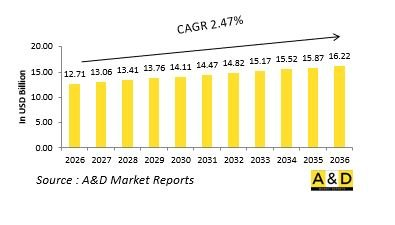
The Global Antenna, Transducer and Radome market is estimated at USD 12.71 billion in 2026, projected to grow to USD 16.22 billion by 2036 at a Compound Annual Growth Rate (CAGR) of 2.47% over the forecast period 2026-2036.
Introduction
Antennas, transducers, and radomes form the invisible infrastructure that enables sensing, communication, navigation, and targeting across modern defense and aerospace platforms. These components do not deliver force directly, yet they are essential for translating physical signals into actionable information and ensuring uninterrupted data exchange in contested environments. Antennas support communication, radar, electronic warfare, and satellite connectivity. Transducers convert mechanical, acoustic, or electromagnetic energy into usable signals for sensing and control applications. Radomes protect sensitive antenna systems while preserving signal transparency under extreme environmental and operational stress. Together, these technologies enable situational awareness, command coordination, and precision engagement across air, land, sea, space, and subsurface domains. As military operations increasingly depend on information dominance rather than sheer firepower, the strategic value of these components continues to rise. Their integration into platforms ranging from fighter aircraft and naval vessels to missiles, unmanned systems, and ground vehicles highlights their cross-domain importance. The growing density of sensors and communication nodes on defense platforms further reinforces their role as foundational enablers of modern warfare capability.
Technology Impact in Antenna, Transducer and Radome Systems
Technological advancement is driving rapid evolution in antenna, transducer, and radome design to meet the demands of complex electromagnetic environments. Adaptive antenna architectures enable dynamic beam steering, frequency agility, and improved resistance to interference. Miniaturization techniques allow high-performance antennas and transducers to be embedded within compact platforms without compromising signal integrity. Advanced materials enhance radome transparency while maintaining structural strength under thermal, aerodynamic, and mechanical stress. Multi-function sensor integration allows single transducer units to support multiple operational roles, reducing platform complexity. Computational modeling improves electromagnetic performance prediction and material optimization. Additive and precision manufacturing enable complex geometries that improve signal efficiency and reduce weight. Enhanced environmental resilience ensures reliable performance in extreme weather, high-speed flight, and maritime exposure. These technological shifts transform antennas, transducers, and radomes from passive components into active contributors to mission success.
Key Drivers in Antenna, Transducer and Radome Systems
The primary drivers for these systems stem from the increasing reliance on networked operations and sensor-driven decision-making. Modern defense platforms require uninterrupted communication and sensing capability across multiple domains. The expansion of electronic warfare and spectrum-contested environments drives demand for resilient and adaptive signal systems. Platform stealth and survivability requirements influence radome design to minimize detection while protecting sensitive equipment. Growth in unmanned and autonomous systems increases demand for compact, reliable signal components. Defense modernization programs emphasize sensor fusion and real-time data sharing, placing greater performance expectations on antennas and transducers. Lifecycle efficiency and reduced maintenance requirements further influence procurement decisions. Additionally, the need for interoperability across allied forces drives standardization and compatibility considerations. These drivers collectively ensure sustained focus on signal-enabling technologies across defense ecosystems.
Regional Trends in Antenna, Transducer and Radome Systems
Regional approaches to antenna, transducer, and radome development reflect differing operational priorities and industrial strengths. North America emphasizes advanced signal processing, multi-domain integration, and high-performance aerospace applications. European efforts focus on electromagnetic resilience, platform interoperability, and materials innovation for long-term durability. Asia-Pacific regions prioritize scalable manufacturing and integration across expanding air and naval fleets. Middle Eastern requirements emphasize environmental robustness and secure communication in high-interference conditions. African adoption focuses on essential communication and sensing capability optimized for reliability and sustainment. Across regions, governments increasingly support domestic research and localized production to protect sensitive technologies. These trends demonstrate how signal-enabling systems are shaped by regional defense doctrines and industrial strategies.
Key Defense Antenna, Transducer and Radome Program:
Northrop Grumman secured a $54.7 million U.S. Air Force Research Laboratory contract in September 2024 to develop advanced satellite communications antennas for military aircraft. Raytheon received a $51.7 million three-year Defense Experimentation contract in August 2024 for military SATCOM antenna systems. These awards support next-generation connectivity requirements for airborne platforms operating in contested electromagnetic environments while maintaining secure, jam-resistant communications links with command centers and other assets.
Table of Contents
Antenna, Transducer and Radome Market - Table of Contents
Antenna, Transducer and Radome Market Report Definition
Antenna, Transducer and Radome Market Segmentation
By Product
By Region
By End-User
Antenna, Transducer and Radome Market Analysis for next 10 Years
The 10-year Antenna, Transducer and Radome Market analysis would give a detailed overview of Antenna, Transducer and Radome Market growth, changing dynamics, technology adoption overviews and the overall market attractiveness is covered in this chapter.
Market Technologies of Antenna, Transducer and Radome Market
This segment covers the top 10 technologies that is expected to impact this market and the possible implications these technologies would have on the overall market.
Global Antenna, Transducer and Radome Market Forecast
The 10-year Antenna, Transducer and Radome Market forecast of this market is covered in detailed across the segments which are mentioned above.
Regional Antenna, Transducer and Radome Market Trends & Forecast
The regional Antenna, Transducer and Radome Market trends, drivers, restraints and Challenges of this market, the Political, Economic, Social and Technology aspects are covered in this segment. The market forecast and scenario analysis across regions are also covered in detailed in this segment. The last part of the regional analysis includes profiling of the key companies, supplier landscape and company benchmarking. The current market size is estimated based on the normal scenario.
North America
Drivers, Restraints and Challenges
PEST
Market Forecast & Scenario Analysis
Key Companies
Supplier Tier Landscape
Company Benchmarking
Europe
Middle East
APAC
South America
Country Analysis of Antenna, Transducer and Radome Market
This chapter deals with the key defense programs in this market, it also covers the latest news and patents which have been filed in this market. Country level 10 year market forecast and scenario analysis are also covered in this chapter.
US
Defense Programs
Latest News
Patents
Current levels of technology maturation in this market
Market Forecast & Scenario Analysis
Canada
Italy
France
Germany
Netherlands
Belgium
Spain
Sweden
Greece
Australia
South Africa
India
China
Russia
South Korea
Japan
Malaysia
Singapore
Brazil
Opportunity Matrix for Antenna, Transducer and Radome Market
The opportunity matrix helps the readers understand the high opportunity segments in this market.
Expert Opinions on Antenna, Transducer and Radome Market Report
Hear from our experts their opinion of the possible analysis for this market.
Conclusions
About Aviation and Defense Market Reports
List of Tables
- Table 1: 10 Year Market Outlook, 2026-2036
- Table 2: Drivers, Impact Analysis, North America
- Table 3: Restraints, Impact Analysis, North America
- Table 4: Challenges, Impact Analysis, North America
- Table 5: Drivers, Impact Analysis, Europe
- Table 6: Restraints, Impact Analysis, Europe
- Table 7: Challenges, Impact Analysis, Europe
- Table 8: Drivers, Impact Analysis, Middle East
- Table 9: Restraints, Impact Analysis, Middle East
- Table 10: Challenges, Impact Analysis, Middle East
- Table 11: Drivers, Impact Analysis, APAC
- Table 12: Restraints, Impact Analysis, APAC
- Table 13: Challenges, Impact Analysis, APAC
- Table 14: Drivers, Impact Analysis, South America
- Table 15: Restraints, Impact Analysis, South America
- Table 16: Challenges, Impact Analysis, South America
- Table 17: Scenario Analysis, Scenario 1, By Region, 2026-2036
- Table 18: Scenario Analysis, Scenario 1, By Product, 2026-2036
- Table 19: Scenario Analysis, Scenario 1, By End-User, 2026-2036
- Table 20: Scenario Analysis, Scenario 2, By Region, 2026-2036
- Table 21: Scenario Analysis, Scenario 2, By Product, 2026-2036
- Table 22: Scenario Analysis, Scenario 2, By End-User, 2026-2036
List of Figures
- Figure 1: Global Antenna, Transducer and Radome Market Forecast, 2026-2036
- Figure 2: Global Antenna, Transducer and Radome Market Forecast, By Product, 2026-2036
- Figure 3: Global Antenna, Transducer and Radome Market Forecast, By Region, 2026-2036
- Figure 4: Global Antenna, Transducer and Radome Market Forecast, By End-User, 2026-2036
- Figure 5: North America, Antenna, Transducer and Radome Market, Market Forecast, 2026-2036
- Figure 6: Europe, Antenna, Transducer and Radome Market, Market Forecast, 2026-2036
- Figure 7: Middle East, Antenna, Transducer and Radome Market, Market Forecast, 2026-2036
- Figure 8: APAC, Antenna, Transducer and Radome Market, Market Forecast, 2026-2036
- Figure 9: South America, Antenna, Transducer and Radome Market, Market Forecast, 2026-2036
- Figure 10: United States, Antenna, Transducer and Radome Market, Technology Maturation, 2026-2036
- Figure 11: United States, Antenna, Transducer and Radome Market, Market Forecast, 2026-2036
- Figure 12: Canada, Antenna, Transducer and Radome Market, Technology Maturation, 2026-2036
- Figure 13: Canada, Antenna, Transducer and Radome Market, Market Forecast, 2026-2036
- Figure 14: Italy, Antenna, Transducer and Radome Market, Technology Maturation, 2026-2036
- Figure 15: Italy, Antenna, Transducer and Radome Market, Market Forecast, 2026-2036
- Figure 16: France, Antenna, Transducer and Radome Market, Technology Maturation, 2026-2036
- Figure 17: France, Antenna, Transducer and Radome Market, Market Forecast, 2026-2036
- Figure 18: Germany, Antenna, Transducer and Radome Market, Technology Maturation, 2026-2036
- Figure 19: Germany, Antenna, Transducer and Radome Market, Market Forecast, 2026-2036
- Figure 20: Netherlands, Antenna, Transducer and Radome Market, Technology Maturation, 2026-2036
- Figure 21: Netherlands, Antenna, Transducer and Radome Market, Market Forecast, 2026-2036
- Figure 22: Belgium, Antenna, Transducer and Radome Market, Technology Maturation, 2026-2036
- Figure 23: Belgium, Antenna, Transducer and Radome Market, Market Forecast, 2026-2036
- Figure 24: Spain, Antenna, Transducer and Radome Market, Technology Maturation, 2026-2036
- Figure 25: Spain, Antenna, Transducer and Radome Market, Market Forecast, 2026-2036
- Figure 26: Sweden, Antenna, Transducer and Radome Market, Technology Maturation, 2026-2036
- Figure 27: Sweden, Antenna, Transducer and Radome Market, Market Forecast, 2026-2036
- Figure 28: Brazil, Antenna, Transducer and Radome Market, Technology Maturation, 2026-2036
- Figure 29: Brazil, Antenna, Transducer and Radome Market, Market Forecast, 2026-2036
- Figure 30: Australia, Antenna, Transducer and Radome Market, Technology Maturation, 2026-2036
- Figure 31: Australia, Antenna, Transducer and Radome Market, Market Forecast, 2026-2036
- Figure 32: India, Antenna, Transducer and Radome Market, Technology Maturation, 2026-2036
- Figure 33: India, Antenna, Transducer and Radome Market, Market Forecast, 2026-2036
- Figure 34: China, Antenna, Transducer and Radome Market, Technology Maturation, 2026-2036
- Figure 35: China, Antenna, Transducer and Radome Market, Market Forecast, 2026-2036
- Figure 36: Saudi Arabia, Antenna, Transducer and Radome Market, Technology Maturation, 2026-2036
- Figure 37: Saudi Arabia, Antenna, Transducer and Radome Market, Market Forecast, 2026-2036
- Figure 38: South Korea, Antenna, Transducer and Radome Market, Technology Maturation, 2026-2036
- Figure 39: South Korea, Antenna, Transducer and Radome Market, Market Forecast, 2026-2036
- Figure 40: Japan, Antenna, Transducer and Radome Market, Technology Maturation, 2026-2036
- Figure 41: Japan, Antenna, Transducer and Radome Market, Market Forecast, 2026-2036
- Figure 42: Malaysia, Antenna, Transducer and Radome Market, Technology Maturation, 2026-2036
- Figure 43: Malaysia, Antenna, Transducer and Radome Market, Market Forecast, 2026-2036
- Figure 44: Singapore, Antenna, Transducer and Radome Market, Technology Maturation, 2026-2036
- Figure 45: Singapore, Antenna, Transducer and Radome Market, Market Forecast, 2026-2036
- Figure 46: United Kingdom, Antenna, Transducer and Radome Market, Technology Maturation, 2026-2036
- Figure 47: United Kingdom, Antenna, Transducer and Radome Market, Market Forecast, 2026-2036
- Figure 48: Opportunity Analysis, Antenna, Transducer and Radome Market, By Region (Cumulative Market), 2026-2036
- Figure 49: Opportunity Analysis, Antenna, Transducer and Radome Market, By Region (CAGR), 2026-2036
- Figure 50: Opportunity Analysis, Antenna, Transducer and Radome Market, By Product (Cumulative Market), 2026-2036
- Figure 51: Opportunity Analysis, Antenna, Transducer and Radome Market, By Product (CAGR), 2026-2036
- Figure 52: Opportunity Analysis, Antenna, Transducer and Radome Market, By End-User (Cumulative Market), 2026-2036
- Figure 53: Opportunity Analysis, Antenna, Transducer and Radome Market, By End-User (CAGR), 2026-2036
- Figure 54: Scenario Analysis, Antenna, Transducer and Radome Market, Cumulative Market, 2026-2036
- Figure 55: Scenario Analysis, Antenna, Transducer and Radome Market, Global Market, 2026-2036
- Figure 56: Scenario 1, Antenna, Transducer and Radome Market, Total Market, 2026-2036
- Figure 57: Scenario 1, Antenna, Transducer and Radome Market, By Region, 2026-2036
- Figure 58: Scenario 1, Antenna, Transducer and Radome Market, By Product, 2026-2036
- Figure 59: Scenario 1, Antenna, Transducer and Radome Market, By End-User, 2026-2036
- Figure 60: Scenario 2, Antenna, Transducer and Radome Market, Total Market, 2026-2036
- Figure 61: Scenario 2, Antenna, Transducer and Radome Market, By Region, 2026-2036
- Figure 62: Scenario 2, Antenna, Transducer and Radome Market, By Product, 2026-2036
- Figure 63: Scenario 2, Antenna, Transducer and Radome Market, By End-User, 2026-2036
- Figure 64: Company Benchmark, Antenna, Transducer and Radome Market, 2026-2036

