
PUBLISHER: Aviation & Defense Market Reports (A&D) | PRODUCT CODE: 2030206

PUBLISHER: Aviation & Defense Market Reports (A&D) | PRODUCT CODE: 2030206
Global Embedded Systems Market 2026-2036
Global Embedded Systems Market
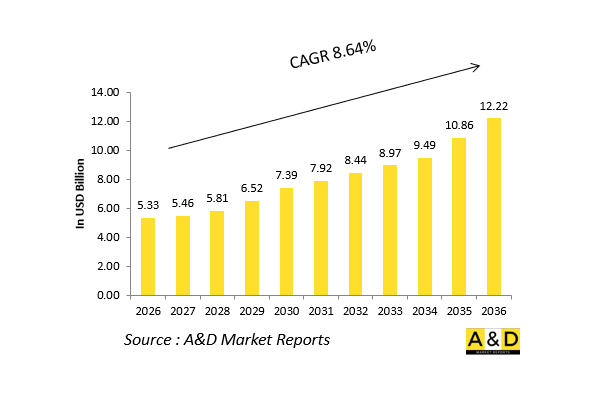
The Global Embedded Systems Market is estimated at USD 5.33 billion in 2026, projected to grow to USD 12.22 billion by 2036 at a Compound Annual Growth Rate (CAGR) of 8.64% over the forecast period 2026-2036.
1. Introduction
The Global Embedded Systems Market represents a foundational segment of the modern electronics and digital ecosystem, encompassing specialized computing systems designed to perform dedicated functions within larger mechanical or electrical systems. These systems are widely deployed across industries such as automotive, healthcare, telecommunications, industrial automation, and aerospace. Embedded systems are characterized by real-time processing capabilities, compact design, and high reliability, making them essential for mission-critical and performance-driven applications.
With the rapid evolution of connected devices and intelligent technologies, embedded systems have become integral to enabling smart operations, automation, and data-driven decision-making. Their role has expanded significantly with the proliferation of the Internet of Things, artificial intelligence, and edge computing. As industries continue to adopt digital transformation strategies, the demand for efficient, secure, and scalable embedded solutions is growing steadily, positioning this market as a key enabler of next-generation technological innovation.
2. Technology Impact in Embedded Systems Market
Technological advancements are profoundly reshaping the embedded systems market by enhancing performance, efficiency, and functionality. Innovations in semiconductor design, microprocessors, and system-on-chip architectures have enabled the development of smaller, faster, and more energy-efficient embedded devices. The integration of artificial intelligence and machine learning has allowed embedded systems to perform complex analytics, predictive maintenance, and autonomous decision-making in real time.
The adoption of edge computing has further transformed the landscape by enabling data processing closer to the source, reducing latency and improving system responsiveness. Additionally, advancements in connectivity technologies such as wireless communication protocols and next-generation networks have facilitated seamless integration across devices and platforms.
Cybersecurity has also become a critical technological focus, with embedded systems increasingly incorporating encryption and threat detection capabilities to safeguard sensitive data. These technological innovations collectively drive the evolution of embedded systems toward smarter, more adaptive, and highly interconnected solutions.
3. Key Drivers in Embedded Systems Market
The growth of the embedded systems market is driven by multiple interrelated factors across industries. One of the primary drivers is the rapid expansion of connected devices and smart technologies, which rely heavily on embedded systems for real-time processing and control. The increasing adoption of automation in manufacturing and industrial processes is also fueling demand for embedded solutions that enhance operational efficiency and precision.
Another significant driver is the rising demand in the automotive sector, particularly with the development of electric vehicles, advanced driver assistance systems, and autonomous driving technologies. Embedded systems play a critical role in enabling vehicle safety, navigation, and communication features. Similarly, the healthcare industry is witnessing increased use of embedded systems in medical devices, diagnostic equipment, and remote monitoring solutions.
The growing importance of energy efficiency and sustainability is also contributing to market expansion, as embedded systems help optimize power consumption in various applications. Additionally, advancements in consumer electronics, including smartphones, wearable devices, and smart home systems, continue to generate strong demand.
The increasing complexity of modern applications and the need for reliable, real-time performance further reinforce the importance of embedded systems across sectors.
4. Regional Trends in Embedded Systems Market
Regional trends in the embedded systems market reflect varying levels of technological maturity, industrial development, and investment in innovation. North America remains a prominent region due to its strong presence of technology companies, advanced research infrastructure, and early adoption of emerging technologies. The region continues to lead in the development of high-performance embedded solutions, particularly in sectors such as aerospace, defense, and telecommunications.
Europe also plays a significant role, driven by its focus on industrial automation, automotive innovation, and stringent regulatory standards. The region is known for its advancements in smart manufacturing and energy-efficient technologies, which heavily rely on embedded systems.
The Asia-Pacific region is emerging as a major growth hub, supported by rapid industrialization, expanding consumer electronics markets, and increasing investments in digital infrastructure. Countries such as China, Japan, South Korea, and India are witnessing strong demand for embedded systems across automotive, electronics, and telecommunications sectors.
Meanwhile, regions such as Latin America and the Middle East are gradually adopting embedded technologies, driven by infrastructure development and increasing digital transformation initiatives, contributing to the overall global market expansion.
5. Key Embedded Systems Market Program
Key programs within the embedded systems market focus on advancing technological capabilities, improving interoperability, and supporting large-scale digital transformation initiatives. Governments and industry stakeholders are increasingly investing in programs that promote innovation in semiconductor manufacturing, embedded software development, and system integration.
One of the major areas of focus is the development of open architecture frameworks that enable flexibility and scalability across applications. These programs encourage the adoption of standardized platforms, allowing organizations to integrate new technologies more efficiently.
In addition, initiatives supporting the growth of the Internet of Things ecosystem are driving the deployment of embedded systems in smart cities, industrial automation, and connected infrastructure. Programs aimed at enhancing cybersecurity are also gaining prominence, ensuring that embedded systems are resilient against evolving threats.
Research and development programs in artificial intelligence and edge computing are further strengthening the capabilities of embedded systems, enabling advanced analytics and autonomous operations. Collaborative efforts between governments, academic institutions, and private companies are accelerating innovation and fostering the development of next-generation embedded technologies, ensuring long-term growth and competitiveness in the market.
Table of Contents
Embedded Systems Market - Table of Contents
Embedded Systems Market Report Definition
Embedded Systems Market Segmentation
By Region
By Platform
By Application
Embedded Systems Market Analysis for next 10 Years
The 10-year Embedded Systems Market analysis would give a detailed overview of Embedded Systems Market growth, changing dynamics, technology adoption overviews and the overall market attractiveness is covered in this chapter.
Market Technologies of Embedded Systems Market
This segment covers the top 10 technologies that is expected to impact this market and the possible implications these technologies would have on the overall market.
Global Embedded Systems Market Forecast
The 10-year Embedded Systems Market forecast of this market is covered in detailed across the segments which are mentioned above.
Regional Embedded Systems Market Trends & Forecast
The regional Embedded Systems Market trends, drivers, restraints and Challenges of this market, the Political, Economic, Social and Technology aspects are covered in this segment. The market forecast and scenario analysis across regions are also covered in detailed in this segment. The last part of the regional analysis includes profiling of the key companies, supplier landscape and company benchmarking. The current market size is estimated based on the normal scenario.
North America
Drivers, Restraints and Challenges
PEST
Market Forecast & Scenario Analysis
Key Companies
Supplier Tier Landscape
Company Benchmarking
Europe
Middle East
APAC
South America
Country Analysis of Embedded Systems Market
This chapter deals with the key defense programs in this market, it also covers the latest news and patents which have been filed in this market. Country level 10 year market forecast and scenario analysis are also covered in this chapter.
US
Defense Programs
Latest News
Patents
Current levels of technology maturation in this market
Market Forecast & Scenario Analysis
Canada
Italy
France
Germany
Netherlands
Belgium
Spain
Sweden
Greece
Australia
South Africa
India
China
Russia
South Korea
Japan
Malaysia
Singapore
Brazil
Opportunity Matrix for Embedded Systems Market
The opportunity matrix helps the readers understand the high opportunity segments in this market.
Expert Opinions on Embedded Systems Market Report
Hear from our experts their opinion of the possible analysis for this market.
Conclusions
About Aviation and Defense Market Reports
List of Tables
- Table 1: 10 Year Market Outlook, 2026-2036
- Table 2: Drivers, Impact Analysis, North America
- Table 3: Restraints, Impact Analysis, North America
- Table 4: Challenges, Impact Analysis, North America
- Table 5: Drivers, Impact Analysis, Europe
- Table 6: Restraints, Impact Analysis, Europe
- Table 7: Challenges, Impact Analysis, Europe
- Table 8: Drivers, Impact Analysis, Middle East
- Table 9: Restraints, Impact Analysis, Middle East
- Table 10: Challenges, Impact Analysis, Middle East
- Table 11: Drivers, Impact Analysis, Apac
- Table 12: Restraints, Impact Analysis, Apac
- Table 13: Challenges, Impact Analysis, Apac
- Table 14: Drivers, Impact Analysis, South America
- Table 15: Restraints, Impact Analysis, South America
- Table 16: Challenges, Impact Analysis, South America
- Table 17: Scenario Analysis, Scenario 1, By Region, 2026-2036
- Table 18: Scenario Analysis, Scenario 1, By Platform 2026-2036
- Table 19: Scenario Analysis, Scenario 1, By Application, 2026-2036
- Table 20: Scenario Analysis, Scenario 2, By Region, 2026-2036
- Table 21: Scenario Analysis, Scenario 2, By Platform 2026-2036
- Table 22: Scenario Analysis, Scenario 2, By Application, 2026-2036
List of Figures
- Figure 1: Global Defense Embedded Systems Market Forecast, 2026-2036
- Figure 2: Global Defense Embedded Systems Market Forecast, By Region, 2026-2036
- Figure 3: Global Defense Embedded Systems Market Forecast, By Platform 2026-2036
- Figure 4: Global Defense Embedded Systems Market Forecast, By Application, 2026-2036
- Figure 5: North America, Defense Embedded Systems Market , Market Forecast, 2026-2036
- Figure 6: Europe, Defense Embedded Systems Market , Market Forecast, 2026-2036
- Figure 7: Middle East, Defense Embedded Systems Market , Market Forecast, 2026-2036
- Figure 8: Apac, Defense Embedded Systems Market , Market Forecast, 2026-2036
- Figure 9: South America, Defense Embedded Systems Market , Market Forecast, 2026-2036
- Figure 10: United States, Defense Embedded Systems Market , Region Maturation, 2026-2036
- Figure 11: United States, Defense Embedded Systems Market , Market Forecast, 2026-2036
- Figure 12: Canada, Defense Embedded Systems Market , Region Maturation, 2026-2036
- Figure 13: Canada, Defense Embedded Systems Market , Market Forecast, 2026-2036
- Figure 14: Italy, Defense Embedded Systems Market , Region Maturation, 2026-2036
- Figure 15: Italy, Defense Embedded Systems Market , Market Forecast, 2026-2036
- Figure 16: France, Defense Embedded Systems Market , Region Maturation, 2026-2036
- Figure 17: France, Defense Embedded Systems Market , Market Forecast, 2026-2036
- Figure 18: Germany, Defense Embedded Systems Market , Region Maturation, 2026-2036
- Figure 19: Germany, Defense Embedded Systems Market , Market Forecast, 2026-2036
- Figure 20: Netherlands, Defense Embedded Systems Market , Region Maturation, 2026-2036
- Figure 21: Netherlands, Defense Embedded Systems Market , Market Forecast, 2026-2036
- Figure 22: Belgium, Defense Embedded Systems Market , Region Maturation, 2026-2036
- Figure 23: Belgium, Defense Embedded Systems Market , Market Forecast, 2026-2036
- Figure 24: Spain, Defense Embedded Systems Market , Region Maturation, 2026-2036
- Figure 25: Spain, Defense Embedded Systems Market , Market Forecast, 2026-2036
- Figure 26: Sweden, Defense Embedded Systems Market , Region Maturation, 2026-2036
- Figure 27: Sweden, Defense Embedded Systems Market , Market Forecast, 2026-2036
- Figure 28: Brazil, Defense Embedded Systems Market , Region Maturation, 2026-2036
- Figure 29: Brazil, Defense Embedded Systems Market , Market Forecast, 2026-2036
- Figure 30: Australia, Defense Embedded Systems Market , Region Maturation, 2026-2036
- Figure 31: Australia, Defense Embedded Systems Market , Market Forecast, 2026-2036
- Figure 32: India, Defense Embedded Systems Market , Region Maturation, 2026-2036
- Figure 33: India, Defense Embedded Systems Market , Market Forecast, 2026-2036
- Figure 34: China, Defense Embedded Systems Market , Region Maturation, 2026-2036
- Figure 35: China, Defense Embedded Systems Market , Market Forecast, 2026-2036
- Figure 36: Saudi Arabia, Defense Embedded Systems Market , Region Maturation, 2026-2036
- Figure 37: Saudi Arabia, Defense Embedded Systems Market , Market Forecast, 2026-2036
- Figure 38: South Korea, Defense Embedded Systems Market , Region Maturation, 2026-2036
- Figure 39: South Korea, Defense Embedded Systems Market , Market Forecast, 2026-2036
- Figure 40: Japan, Defense Embedded Systems Market , Region Maturation, 2026-2036
- Figure 41: Japan, Defense Embedded Systems Market , Market Forecast, 2026-2036
- Figure 42: Malaysia, Defense Embedded Systems Market , Region Maturation, 2026-2036
- Figure 43: Malaysia, Defense Embedded Systems Market , Market Forecast, 2026-2036
- Figure 44: Singapore, Defense Embedded Systems Market , Region Maturation, 2026-2036
- Figure 45: Singapore, Defense Embedded Systems Market , Market Forecast, 2026-2036
- Figure 46: United Kingdom, Defense Embedded Systems Market , Region Maturation, 2026-2036
- Figure 47: United Kingdom, Defense Embedded Systems Market , Market Forecast, 2026-2036
- Figure 48: Opportunity Analysis, Defense Embedded Systems Market , By Region (Cumulative Market), 2026-2036
- Figure 49: Opportunity Analysis, Defense Embedded Systems Market , By Region (Cagr), 2026-2036
- Figure 50: Opportunity Analysis, Defense Embedded Systems Market , By Platform Cumulative Market), 2026-2036
- Figure 51: Opportunity Analysis, Defense Embedded Systems Market , By Platform (Cagr), 2026-2036
- Figure 52: Opportunity Analysis, Defense Embedded Systems Market , By Application(Cumulative Market), 2026-2036
- Figure 53: Opportunity Analysis, Defense Embedded Systems Market , By Application (Cagr), 2026-2036
- Figure 54: Scenario Analysis, Defense Embedded Systems Market , Cumulative Market, 2026-2036
- Figure 55: Scenario Analysis, Defense Embedded Systems Market , Global Market, 2026-2036
- Figure 56: Scenario 1, Defense Embedded Systems Market , Total Market, 2026-2036
- Figure 57: Scenario 1, Defense Embedded Systems Market , By Region, 2026-2036
- Figure 58: Scenario 1, Defense Embedded Systems Market , By Platform 2026-2036
- Figure 59: Scenario 1, Defense Embedded Systems Market , By Application, 2026-2036
- Figure 60: Scenario 2, Defense Embedded Systems Market , Total Market, 2026-2036
- Figure 61: Scenario 2, Defense Embedded Systems Market , By Region, 2026-2036
- Figure 62: Scenario 2, Defense Embedded Systems Market , By Platform 2026-2036
- Figure 63: Scenario 2, Defense Embedded Systems Market , By Application, 2026-2036
- Figure 64: Company Benchmark, Defense Embedded Systems Market , 2026-2036

