PUBLISHER: Aviation & Defense Market Reports (A&D) | PRODUCT CODE: 1936038

PUBLISHER: Aviation & Defense Market Reports (A&D) | PRODUCT CODE: 1936038
Global Air and Missile Defense Market 2026-2036
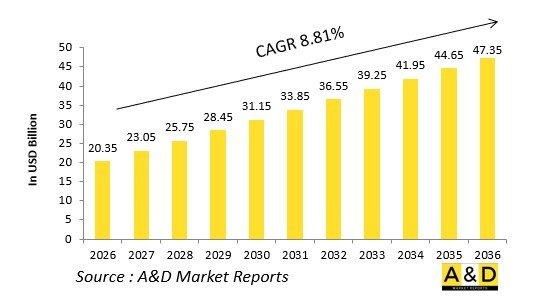
The Global Air and Missile Defense Market is estimated at USD 20.35 billion in 2026, projected to grow to USD 47.35 billion by 2036 at a Compound Annual Growth Rate (CAGR) of 8.81% over the forecast period 2026-2036.
Introduction
The global Air and Missile Defense (AMD) market forms the backbone of strategic deterrence, countering diverse aerial threats from short-range rockets to intercontinental ballistic missiles. Integrated architectures layer sensors, launchers, and battle managers to detect, track, and neutralize incursions, protecting populations, infrastructure, and deployed forces.
Market dynamics reflect escalating missile proliferation and hypersonic innovations, driving demand for scalable, networked defenses. Core elements encompass ground-based interceptors, naval vertical launch systems, airborne early warning, and space-based cueing. Manufacturers innovate with open-system designs for rapid upgrades, ensuring longevity amid technological leaps.
Geopolitical rivalries amplify investments, as nations fortify layered shields against saturation attacks. Interoperability standards enable allied coalitions, while dual-use technologies blur civilian-military lines. Supply chains prioritize resilient semiconductors and propulsion for effectors. Competitive arenas pit incumbents against agile disruptors leveraging AI for threat discrimination.
AMD evolution intertwines with information dominance, fusing kinetic kills with directed energy. This market epitomizes high-stakes engineering, where precision timing averts catastrophe in contested skies.
Technology Impact in Air and Missile Defense
Technological breakthroughs propel Air and Missile Defense (AMD) into a new era of precision and adaptability. Hypersonic glide vehicle interceptors demand solid-state radars with gallium nitride amplifiers, extending detection envelopes against maneuvering targets. AI-driven fusion centers process petabytes from multi-spectral sensors, enabling autonomous salvo management and decoy rejection.
Directed-energy weapons-lasers and microwaves-offer speed-of-light engagements with deep magazines, ideal for drone swarms and cruise missiles. Quantum sensors enhance precision tracking in cluttered environments, while space-based infrared detectors provide persistent global cueing.
Network-centric architectures link terrestrial, naval, airborne, and orbital nodes via secure 5G meshes, creating kill webs that distribute intercepts dynamically. Modular open-system approaches accelerate effector swaps, from hit-to-kill vehicles to net-centric warheads.
Cyber-hardened command systems resist jamming, incorporating blockchain for tamper-proof data sharing. Hypersonic boost-glide countermeasures evolve with scramjet-powered interceptors. Digital engineering twins simulate mega-engagements, slashing development cycles.
These advancements compress decision loops, boost kill probabilities, and expand battlespace awareness, redefining AMD as proactive offense in defensive guise.
Key Drivers in Air and Missile Defense
Proliferating missile threats ignite the Air and Missile Defense (AMD) market. Advanced ballistic and hypersonic arsenals from peer competitors expose gaps in legacy shields, spurring layered architectures for population and asset protection.
Strategic deterrence doctrines mandate robust AMD postures, integrating theater and homeland defense amid alliance commitments. Modernization imperatives retrofit platforms with plug-and-play sensors, countering saturation tactics.
Urbanization heightens collateral stakes, driving low-observable interceptors and precision effectors. Export dynamics flourish as middle powers acquire tiered systems to deter neighbors, bundled with training and sustainment.
Technological convergence-AI, space, cyber-amplifies needs for integrated air pictures, fusing AMD with offensive fires. Budget realignments prioritize high-leverage effectors over massed forces.
Sustainability pushes solid-state power for directed energy, reducing logistics footprints. Regulatory harmonization across coalitions streamlines co-development.
Geopolitical hotspots sustain urgency, from Indo-Pacific tensions to European flanks. Dual-use innovations attract commercial investment, accelerating effectors like railguns.
These drivers cement AMD as cornerstone of credible power projection.
Regional Trends in Air and Missile Defense
Regional imperatives sculpt the Air and Missile Defense (AMD) market. Indo-Pacific tensions propel sea-based AMD, with Aegis-like ships and island-chain radars countering hypersonic salvos.
Europe unifies defenses via NATO frameworks, emphasizing mobile batteries and integrated air defense for high-north flanks.
Middle East deploys dense point defenses against rocket barrages, favoring quick-reaction launchers with local production offsets.
North America pioneers space-layering and directed energy, leveraging vast test ranges for hypersonic validations.
Russia bolsters S-500 equivalents for multi-layered shields against stealth incursions.
South Asia invests in ballistic missile defenses tied to nuclear postures, blending imports with indigenous radars.
Latin America focuses tiered systems for narco-drone threats, prioritizing cost-effective maritime patrols.
Africa adopts man-portable air defense integrated with counter-UAS for peacekeeping.
Global trends favor cloud-based command for coalition ops, with supply chains diversifying to Asia for effectors. Export controls shape tech flows, while alliances drive co-production.
Key Air and Missile Defense Programs
Iconic programs define Air and Missile Defense (AMD) trajectories. Ground-based midcourse systems intercept ICBMs in exo-atmosphere, leveraging boost-phase cueing from satellites.
Naval ballistic missile defense evolves Aegis baselines with hypersonic upgrades, deploying from destroyers in distributed fleets.
Patriot successors introduce modular radars and gallium nitride seekers for cruise missile barrages.
European Sky Shield initiatives harmonize short-range batteries across borders, incorporating drones as forward sensors.
Indo-Pacific allies develop common missile architectures for archipelago defense.
Directed-energy roadmaps mature shipboard lasers for drone interdiction, scaling to boost-phase kills.
Space-based intercept layers prototype hit-to-kill vehicles launched from orbit.
Mobile tactical AMD outfits Stryker brigades with counter-UAS effectors.
Export programs like Iron Dome variants adapt for urban rocket defense, with tech transfers.
Hypersonic defense testbeds validate scramjet interceptors against glide vehicles.
These efforts forge resilient webs, blending kinetic, electronic, and energetic means for all-domain protection.
Table of Contents
Air and Missile Defense Market - Table of Contents Air and Missile Defense Market Report Definition
Air and Missile Defense Market Segmentation
By Region
By Type
By End User
Air and Missile Defense Market Analysis for next 10 Years
The 10-year air and missile defense market analysis would give a detailed overview of air and missile defense market growth, changing dynamics, technology adoption overviews and the overall market attractiveness is covered in this chapter.
Market Technologies of Air and Missile Defense Market
This segment covers the top 10 technologies that is expected to impact this market and the possible implications these technologies would have on the overall market.
Global Air and Missile Defense Market Forecast
The 10-year air and missile defense market forecast of this market is covered in detailed across the segments which are mentioned above.
Regional Air and Missile Defense Market Trends & Forecast
The regional air and missile defense market trends, drivers, restraints and Challenges of this market, the Political, Economic, Social and Technology aspects are covered in this segment. The market forecast and scenario analysis across regions are also covered in detailed in this segment. The last part of the regional analysis includes profiling of the key companies, supplier landscape and company benchmarking. The current market size is estimated based on the normal scenario.
North America
Drivers, Restraints and Challenges
PEST
Market Forecast & Scenario Analysis
Key Companies
Supplier Tier Landscape
Company Benchmarking
Europe
Middle East
APAC
South America
Country Analysis of Air and Missile Defense Market
This chapter deals with the key defense programs in this market, it also covers the latest news and patents which have been filed in this market. Country level 10 year market forecast and scenario analysis are also covered in this chapter.
US
Defense Programs
Latest News
Patents
Current levels of technology maturation in this market
Market Forecast & Scenario Analysis
Canada
Italy
France
Germany
Netherlands
Belgium
Spain
Sweden
Greece
Australia
South Africa
India
China
Russia
South Korea
Japan
Malaysia
Singapore
Brazil
Opportunity Matrix for Air and Missile Defense Market
The opportunity matrix helps the readers understand the high opportunity segments in this market.
Expert Opinions on Air and Missile Defense Market Report
Hear from our experts their opinion of the possible analysis for this market.
Conclusions
About Aviation and Defense Market Reports
List of Tables
- Table 1: 10 Year Market Outlook, 2026-2036
- Table 2: Drivers, Impact Analysis, North America
- Table 3: Restraints, Impact Analysis, North America
- Table 4: Challenges, Impact Analysis, North America
- Table 5: Drivers, Impact Analysis, Europe
- Table 6: Restraints, Impact Analysis, Europe
- Table 7: Challenges, Impact Analysis, Europe
- Table 8: Drivers, Impact Analysis, Middle East
- Table 9: Restraints, Impact Analysis, Middle East
- Table 10: Challenges, Impact Analysis, Middle East
- Table 11: Drivers, Impact Analysis, APAC
- Table 12: Restraints, Impact Analysis, APAC
- Table 13: Challenges, Impact Analysis, APAC
- Table 14: Drivers, Impact Analysis, South America
- Table 15: Restraints, Impact Analysis, South America
- Table 16: Challenges, Impact Analysis, South America
- Table 17: Scenario Analysis, Scenario 1, By Region, 2026-2036
- Table 18: Scenario Analysis, Scenario 1, By Platform, 2026-2036
- Table 19: Scenario Analysis, Scenario 1, By Type, 2026-2036
- Table 20: Scenario Analysis, Scenario 2, By Region, 2026-2036
- Table 21: Scenario Analysis, Scenario 2, By Platform, 2026-2036
- Table 22: Scenario Analysis, Scenario 2, By Type, 2026-2036
List of Figures
- Figure 1: Global Air and Missile Defense Market Forecast, 2026-2036
- Figure 2: Global Air and Missile Defense Market Forecast, By Region, 2026-2036
- Figure 3: Global Air and Missile Defense Market Forecast, By Platform, 2026-2036
- Figure 4: Global Air and Missile Defense Market Forecast, By Type, 2026-2036
- Figure 5: North America, Air and Missile Defense Market, Forecast, 2026-2036
- Figure 6: Europe, Air and Missile Defense Market, Forecast, 2026-2036
- Figure 7: Middle East, Air and Missile Defense Market, Forecast, 2026-2036
- Figure 8: APAC, Air and Missile Defense Market, Forecast, 2026-2036
- Figure 9: South America, Air and Missile Defense Market, Forecast, 2026-2036
- Figure 10: United States, Air and Missile Defense Market, Technology Maturation, 2026-2036
- Figure 11: United States, Air and Missile Defense Market, Forecast, 2026-2036
- Figure 12: Canada, Air and Missile Defense Market, Technology Maturation, 2026-2036
- Figure 13: Canada, Air and Missile Defense Market, Forecast, 2026-2036
- Figure 14: Italy, Air and Missile Defense Market, Technology Maturation, 2026-2036
- Figure 15: Italy, Air and Missile Defense Market, Market Forecast, 2026-2036
- Figure 16: France, Air and Missile Defense Market, Technology Maturation, 2026-2036
- Figure 17: France, Air and Missile Defense Market, Market Forecast, 2026-2036
- Figure 18: Germany, Air and Missile Defense Market, Technology Maturation, 2026-2036
- Figure 19: Germany, Air and Missile Defense Market, Market Forecast, 2026-2036
- Figure 20: Netherlands, Air and Missile Defense Market, Technology Maturation, 2026-2036
- Figure 21: Netherlands, Air and Missile Defense Market, Market Forecast, 2026-2036
- Figure 22: Belgium, Air and Missile Defense Market, Technology Maturation, 2026-2036
- Figure 23: Belgium, Air and Missile Defense Market, Market Forecast, 2026-2036
- Figure 24: Spain, Air and Missile Defense Market, Technology Maturation, 2026-2036
- Figure 25: Spain, Air and Missile Defense Market, Market Forecast, 2026-2036
- Figure 26: Sweden, Air and Missile Defense Market, Technology Maturation, 2026-2036
- Figure 27: Sweden, Air and Missile Defense Market, Market Forecast, 2026-2036
- Figure 28: Brazil, Air and Missile Defense Market, Technology Maturation, 2026-2036
- Figure 29: Brazil, Air and Missile Defense Market, Market Forecast, 2026-2036
- Figure 30: Australia, Air and Missile Defense Market, Technology Maturation, 2026-2036
- Figure 31: Australia, Air and Missile Defense Market, Market Forecast, 2026-2036
- Figure 32: India, Air and Missile Defense Market, Technology Maturation, 2026-2036
- Figure 33: India, Air and Missile Defense Market, Market Forecast, 2026-2036
- Figure 34: China, Air and Missile Defense Market, Technology Maturation, 2026-2036
- Figure 35: China, Air and Missile Defense Market, Market Forecast, 2026-2036
- Figure 36: Saudi Arabia, Air and Missile Defense Market, Technology Maturation, 2026-2036
- Figure 37: Saudi Arabia, Air and Missile Defense Market, Market Forecast, 2026-2036
- Figure 38: South Korea, Air and Missile Defense Market, Technology Maturation, 2026-2036
- Figure 39: South Korea, Air and Missile Defense Market, Market Forecast, 2026-2036
- Figure 40: Japan, Air and Missile Defense Market, Technology Maturation, 2026-2036
- Figure 41: Japan, Air and Missile Defense Market, Market Forecast, 2026-2036
- Figure 42: Malaysia, Air and Missile Defense Market, Technology Maturation, 2026-2036
- Figure 43: Malaysia, Air and Missile Defense Market, Market Forecast, 2026-2036
- Figure 44: Singapore, Air and Missile Defense Market, Technology Maturation, 2026-2036
- Figure 45: Singapore, Air and Missile Defense Market, Market Forecast, 2026-2036
- Figure 46: United Kingdom, Air and Missile Defense Market, Technology Maturation, 2026-2036
- Figure 47: United Kingdom, Air and Missile Defense Market, Market Forecast, 2026-2036
- Figure 48: Opportunity Analysis, Air and Missile Defense Market, By Region (Cumulative Market), 2026-2036
- Figure 49: Opportunity Analysis, Air and Missile Defense Market, By Region (CAGR), 2026-2036
- Figure 50: Opportunity Analysis, Air and Missile Defense Market, By Platform (Cumulative Market), 2026-2036
- Figure 51: Opportunity Analysis, Air and Missile Defense Market, By Platform (CAGR), 2026-2036
- Figure 52: Opportunity Analysis, Air and Missile Defense Market, By Type (Cumulative Market), 2026-2036
- Figure 53: Opportunity Analysis, Air and Missile Defense Market, By Type (CAGR), 2026-2036
- Figure 54: Scenario Analysis, Air and Missile Defense Market, Cumulative Market, 2026-2036
- Figure 55: Scenario Analysis, Air and Missile Defense Market, Global Market, 2026-2036
- Figure 56: Scenario 1, Air and Missile Defense Market, Total Market, 2026-2036
- Figure 57: Scenario 1, Air and Missile Defense Market, By Region, 2026-2036
- Figure 58: Scenario 1, Air and Missile Defense Market, By Platform, 2026-2036
- Figure 59: Scenario 1, Air and Missile Defense Market, By Type, 2026-2036
- Figure 60: Scenario 2, Air and Missile Defense Market, Total Market, 2026-2036
- Figure 61: Scenario 2, Air and Missile Defense Market, By Region, 2026-2036
- Figure 62: Scenario 2, Air and Missile Defense Market, By Platform, 2026-2036
- Figure 63: Scenario 2, Air and Missile Defense Market, By Type, 2026-2036
- Figure 64: Company Benchmark, Air and Missile Defense Market, 2026-2036

