PUBLISHER: Aviation & Defense Market Reports (A&D) | PRODUCT CODE: 1951136

PUBLISHER: Aviation & Defense Market Reports (A&D) | PRODUCT CODE: 1951136
Global Defense Combat Management Systems (CMS) Market 2026-2036
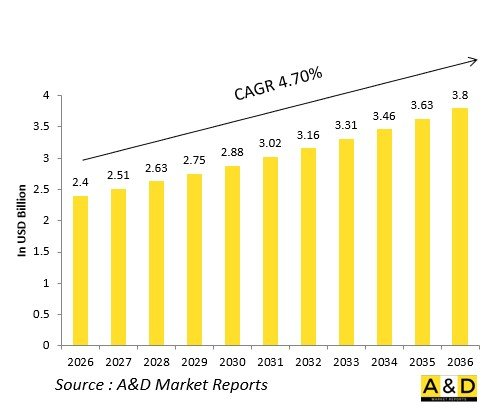
The Global defense combat management systems (CMS) market is estimated at USD 2.4 billion in 2026, projected to grow to USD 3.8 billion by 2036 at a Compound Annual Growth Rate (CAGR) of 4.70% over the forecast period 2026-2036.
Introduction:
The Global defense combat management systems (CMS) market orchestrates sensors, weapons, and decision loops into cohesive battle networks for ships, aircraft, and ground units. These C4ISR cores fuse radar tracks, sonar pings, and missile cues into shared tactical pictures, enabling rapid threat engagement. Naval applications dominate, powering Aegis-like shields on destroyers and carriers, while adaptations serve fighters and armored brigades. Modular architectures allow sensor-agnostic plugs, vital for coalition ops. Demand swells with peer adversaries fielding hypersonics and swarms. Cybersecurity fortifies data buses. The market propels joint all-domain dominance, turning platforms into intelligent nodes amid multi-axis threats.
Technology Impact in Defense Combat Management Systems (CMS)
Technological leaps redefine CMS, amplifying kill-chain speeds. AI track fusion correlates multi-sensor inputs sans human bias. Cloud-edge hybrids process petabyte fires in milliseconds. Digital twins simulate engagements for what-if drills. Quantum encryption secures classified links. Open architectures embrace plug-and-fight effectors. Hypersonic interceptors demand predictive cueing. AR interfaces overlay fires on live feeds. Blockchain logs engagements for attribution. Neural networks automate routine triage. These strides embed autonomy, scale to swarm defenses, and forge resilient C2 fabrics across seas, skies, and soils.
Key Drivers in Defense Combat Management Systems (CMS)
Critical drivers fuel the defense CMS market. Hypersonic threats necessitate compressed OODA loops. Sensor proliferation overwhelms legacy trackers. Joint ops require seamless datalink meshes. Crew limits spur AI decision aids. EW saturation demands cognitive radios. Platform lifecycles trigger spiral upgrades. Interoperability standards unify NATO arsenals. Cyber intrusions target C2 nodes. Unmanned integration feeds organic intel. Budgets chase software-defined flexibility. Collectively, these position CMS as warfighting nervous systems.
Regional Trends in Defense Combat Management Systems (CMS)
Regional strategies tailor CMS evolutions. North America evolves Aegis baselines for Pacific salvos. Europe collaborates on modular cores for frigate nets. Asia-Pacific scales CMS for carrier-killer missiles. Indo-Pacific fuses with JADC2 for archipelago fights. Middle East hardens against drone swarms. Africa adapts for asymmetric patrols. South America links to border radars. Alliances standardize APIs, merging U.S. AI with European modularity. Trends spotlight hypersonic cueing and AI explainability, mirroring saturation attacks and peer rivalries.
Key Defense Combat Management Systems (CMS) Programs
Signature CMS programs showcase integration mastery. Destroyer baselines test swarm-defense algorithms. Carrier CMS ingests UAV feeds for air wing sync. Submarine variants cue tube-launched drones. Allied exercises prove datalink handoffs. Ground CMS tiles brigade battlespaces. Live-fire demos validate kinetic intercepts. Fighter upgrades embed CMS snippets. Developmental quantum CMS pioneer unhackable nets. These initiatives deliver scalable, AI-infused brains, orchestrating victory in chaos.
Table of Contents
Defense Combat Management Systems (CMS) Market - Table of Contents
Defense Combat Management Systems (CMS) Market Report Definition
Defense Combat Management Systems (CMS) Market Segmentation
By Region
By Platform
By Architecture
By Function
Defense Combat Management Systems (CMS) Market Analysis for next 10 Years
The 10-year Defense Combat Management Systems (CMS) Market analysis would give a detailed overview of Defense Combat Management Systems (CMS) Market growth, changing dynamics, technology adoption overviews and the overall market attractiveness is covered in this chapter.
Market Technologies of Defense Combat Management Systems (CMS) Market
This segment covers the top 10 technologies that is expected to impact this market and the possible implications these technologies would have on the overall market.
Global Defense Combat Management Systems (CMS) Market Forecast
The 10-year Defense Combat Management Systems (CMS) Market forecast of this market is covered in detailed across the segments which are mentioned above.
Regional Defense Combat Management Systems (CMS) Market Trends & Forecast
The regional counter drone market trends, drivers, restraints and Challenges of this market, the Political, Economic, Social and Technology aspects are covered in this segment. The market forecast and scenario analysis across regions are also covered in detailed in this segment. The last part of the regional analysis includes profiling of the key companies, supplier landscape and company benchmarking. The current market size is estimated based on the normal scenario.
North America
Drivers, Restraints and Challenges
PEST
Market Forecast & Scenario Analysis
Key Companies
Supplier Tier Landscape
Company Benchmarking
Europe
Middle East
APAC
South America
Country Analysis of Defense Combat Management Systems (CMS) Market
This chapter deals with the key defense programs in this market, it also covers the latest news and patents which have been filed in this market. Country level 10 year market forecast and scenario analysis are also covered in this chapter.
US
Defense Programs
Latest News
Patents
Current levels of technology maturation in this market
Market Forecast & Scenario Analysis
Canada
Italy
France
Germany
Netherlands
Belgium
Spain
Sweden
Greece
Australia
South Africa
India
China
Russia
South Korea
Japan
Malaysia
Singapore
Brazil
Opportunity Matrix for Defense Combat Management Systems (CMS) Market
The opportunity matrix helps the readers understand the high opportunity segments in this market.
Expert Opinions on Defense Combat Management Systems (CMS) Market Report
Hear from our experts their opinion of the possible analysis for this market.
Conclusions
About Aviation and Defense Market Reports
List of Tables
- Table 1: 10 Year Market Outlook, 2026-2036
- Table 2: Drivers, Impact Analysis, North America
- Table 3: Restraints, Impact Analysis, North America
- Table 4: Challenges, Impact Analysis, North America
- Table 5: Drivers, Impact Analysis, Europe
- Table 6: Restraints, Impact Analysis, Europe
- Table 7: Challenges, Impact Analysis, Europe
- Table 8: Drivers, Impact Analysis, Middle East
- Table 9: Restraints, Impact Analysis, Middle East
- Table 10: Challenges, Impact Analysis, Middle East
- Table 11: Drivers, Impact Analysis, APAC
- Table 12: Restraints, Impact Analysis, APAC
- Table 13: Challenges, Impact Analysis, APAC
- Table 14: Drivers, Impact Analysis, South America
- Table 15: Restraints, Impact Analysis, South America
- Table 16: Challenges, Impact Analysis, South America
- Table 17: Scenario Analysis, Scenario 1, By Architecture, 2026-2036
- Table 18: Scenario Analysis, Scenario 1, By Platform, 2026-2036
- Table 19: Scenario Analysis, Scenario 1, By Region, 2026-2036
- Table 20: Scenario Analysis, Scenario 2, By Architecture, 2026-2036
- Table 21: Scenario Analysis, Scenario 2, By Platform, 2026-2036
- Table 22: Scenario Analysis, Scenario 2, By Region, 2026-2036
List of Figures
- Figure 1: Global Defense Combat Management Systems (CMS) Market Forecast, 2026-2036
- Figure 2: Global Defense Combat Management Systems (CMS) Market Forecast, By Architecture, 2026-2036
- Figure 3: Global Defense Combat Management Systems (CMS) Market Forecast, By Platform, 2026-2036
- Figure 4: Global Defense Combat Management Systems (CMS) Market Forecast, By Region, 2026-2036
- Figure 5: North America, Defense Combat Management Systems (CMS) Market, Forecast, 2026-2036
- Figure 6: Europe, Defense Combat Management Systems (CMS) Market, Forecast, 2026-2036
- Figure 7: Middle East, Defense Combat Management Systems (CMS) Market, Forecast, 2026-2036
- Figure 8: APAC, Defense Combat Management Systems (CMS) Market, Forecast, 2026-2036
- Figure 9: South America, Defense Combat Management Systems (CMS) Market, Forecast, 2026-2036
- Figure 10: United States, Defense Combat Management Systems (CMS) Market, Technology Maturation, 2026-2036
- Figure 11: United States, Defense Combat Management Systems (CMS) Market, Forecast, 2026-2036
- Figure 12: Canada, Defense Combat Management Systems (CMS) Market, Technology Maturation, 2026-2036
- Figure 13: Canada, Defense Combat Management Systems (CMS) Market, Forecast, 2026-2036
- Figure 14: Italy, Defense Combat Management Systems (CMS) Market, Technology Maturation, 2026-2036
- Figure 15: Italy, Defense Combat Management Systems (CMS) Market, Market Forecast, 2026-2036
- Figure 16: France, Defense Combat Management Systems (CMS) Market, Technology Maturation, 2026-2036
- Figure 17: France, Defense Combat Management Systems (CMS) Market, Market Forecast, 2026-2036
- Figure 18: Germany, Defense Combat Management Systems (CMS) Market, Technology Maturation, 2026-2036
- Figure 19: Germany, Defense Combat Management Systems (CMS) Market, Market Forecast, 2026-2036
- Figure 20: Netherlands, Defense Combat Management Systems (CMS) Market, Technology Maturation, 2026-2036
- Figure 21: Netherlands, Defense Combat Management Systems (CMS) Market, Market Forecast, 2026-2036
- Figure 22: Belgium, Defense Combat Management Systems (CMS) Market, Technology Maturation, 2026-2036
- Figure 23: Belgium, Defense Combat Management Systems (CMS) Market, Market Forecast, 2026-2036
- Figure 24: Spain, Defense Combat Management Systems (CMS) Market, Technology Maturation, 2026-2036
- Figure 25: Spain, Defense Combat Management Systems (CMS) Market, Market Forecast, 2026-2036
- Figure 26: Sweden, Defense Combat Management Systems (CMS) Market, Technology Maturation, 2026-2036
- Figure 27: Sweden, Defense Combat Management Systems (CMS) Market, Forecast, 2026-2036
- Figure 28: Brazil, Defense Combat Management Systems (CMS) Market, Technology Maturation, 2026-2036
- Figure 29: Brazil, Defense Combat Management Systems (CMS) Market, Market Forecast, 2026-2036
- Figure 30: Australia, Defense Combat Management Systems (CMS) Market, Technology Maturation, 2026-2036
- Figure 31: Australia, Defense Combat Management Systems (CMS) Market, Market Forecast, 2026-2036
- Figure 32: India, Defense Combat Management Systems (CMS) Market, Technology Maturation, 2026-2036
- Figure 33: India, Defense Combat Management Systems (CMS) Market, Market Forecast, 2026-2036
- Figure 34: China, Defense Combat Management Systems (CMS) Market, Technology Maturation, 2026-2036
- Figure 35: China, Defense Combat Management Systems (CMS) Market, Market Forecast, 2026-2036
- Figure 36: Saudi Arabia, Defense Combat Management Systems (CMS) Market, Technology Maturation, 2026-2036
- Figure 37: Saudi Arabia, Defense Combat Management Systems (CMS) Market, Market Forecast, 2026-2036
- Figure 38: South Korea, Defense Combat Management Systems (CMS) Market, Technology Maturation, 2026-2036
- Figure 39: South Korea, Defense Combat Management Systems (CMS) Market, Market Forecast, 2026-2036
- Figure 40: Japan, Defense Combat Management Systems (CMS) Market, Technology Maturation, 2026-2036
- Figure 41: Japan, Defense Combat Management Systems (CMS) Market, Market Forecast, 2026-2036
- Figure 42: Malaysia, Defense Combat Management Systems (CMS) Market, Technology Maturation, 2026-2036
- Figure 43: Malaysia, Defense Combat Management Systems (CMS) Market, Market Forecast, 2026-2036
- Figure 44: Singapore, Defense Combat Management Systems (CMS) Market, Technology Maturation, 2026-2036
- Figure 45: Singapore, Defense Combat Management Systems (CMS) Market, Market Forecast, 2026-2036
- Figure 46: United Kingdom, Defense Combat Management Systems (CMS) Market, Technology Maturation, 2026-2036
- Figure 47: United Kingdom, Defense Combat Management Systems (CMS) Market, Market Forecast, 2026-2036
- Figure 48: Opportunity Analysis, Defense Combat Management Systems (CMS) Market, By Architecture (Cumulative Market), 2026-2036
- Figure 49: Opportunity Analysis, Defense Combat Management Systems (CMS) Market, By Architecture (CAGR), 2026-2036
- Figure 50: Opportunity Analysis, Defense Combat Management Systems (CMS) Market, By (Cumulative Market), 2026-2036
- Figure 51: Opportunity Analysis, Defense Combat Management Systems (CMS) Market, By Platform(CAGR), 2026-2036
- Figure 52: Opportunity Analysis, Defense Combat Management Systems (CMS) Market, By Region (Cumulative Market), 2026-2036
- Figure 53: Opportunity Analysis, Defense Combat Management Systems (CMS) Market, By Region (CAGR), 2026-2036
- Figure 54: Scenario Analysis, Defense Combat Management Systems (CMS) Market, Cumulative Market, 2026-2036
- Figure 55: Scenario Analysis, Defense Combat Management Systems (CMS) Market, Global Market, 2026-2036
- Figure 56: Scenario 1, Defense Combat Management Systems (CMS) Market, Total Market, 2026-2036
- Figure 57: Scenario 1, Defense Combat Management Systems (CMS) Market, By Architecture, 2026-2036
- Figure 58: Scenario 1, Defense Combat Management Systems (CMS) Market, By Platform, 2026-2036
- Figure 59: Scenario 1, Defense Combat Management Systems (CMS) Market, By Region, 2026-2036
- Figure 60: Scenario 2, Defense Combat Management Systems (CMS) Market, Total Market, 2026-2036
- Figure 61: Scenario 2, Defense Combat Management Systems (CMS) Market, By Architecture, 2026-2036
- Figure 62: Scenario 2, Defense Combat Management Systems (CMS) Market, By Platform, 2026-2036
- Figure 63: Scenario 2, Defense Combat Management Systems (CMS) Market, By Region, 2026-2036
- Figure 64: Company Benchmark, Defense Combat Management Systems (CMS) Market, 2026-2036

