PUBLISHER: Aviation & Defense Market Reports (A&D) | PRODUCT CODE: 1996996

PUBLISHER: Aviation & Defense Market Reports (A&D) | PRODUCT CODE: 1996996
Global Defense Data Link Terminals (Link-16) Market 2026-2036
Global Defense Data Link Terminals (Link 16) Market
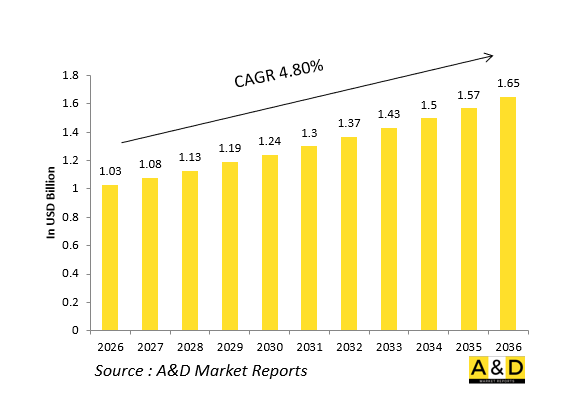
The Global Defense Data Link Terminals (Link 16) Market is estimated at USD 1.03 billion in 2026, projected to grow to USD 1.65 billion by 2036 at a Compound Annual Growth Rate (CAGR) of 4.80% over the forecast period 2026-2036.
1. Introduction:
Defense data link terminals implementing Link 16 are secure, jam resistant, high capacity communication nodes that enable real time exchange of tactical information between aircraft, ships, ground stations, and command centers. These terminals support the TADIL J standard and form the backbone of joint and coalition air battle management, situational awareness, and weapon coordination networks. Over the 2026-2036 horizon, the Link 16 terminal market is being shaped by the continued reliance on this waveform as a common tactical data link standard across allied forces, even as newer waveforms and networks emerge.
Modern Link 16 terminals are increasingly compact, software defined, and multi role, capable of supporting both legacy and advanced mission profiles within a single hardware set. They are embedded in fighters, airborne early warning platforms, naval combatants, ground based command nodes, and some unmanned systems, delivering track data, targeting coordinates, and electronic warfare information across the battlespace. As the digital warfight is becoming more networked and contested, demand is growing for hardened, anti jamming, and cyber secure Link 16 terminals that maintain connectivity and timing in high interference environments. These attributes position Link 16 terminals as enduring, interoperable elements of the multi domain warfare architecture.
2. Technology Impact in Defense Data Link Terminals (Link 16) Market
Technology is transforming Link 16 data link terminals from dedicated, hardware centric radios into flexible, software defined communication processors. Modern terminals leverage advanced digital signal processing, multi channel transceivers, and waveform agility to support robust TADIL J exchanges while mitigating jamming and interference. Integration with onboard mission computers and datalinks allows Link 16 terminals to handle not only basic track data but also complex mission planning messages, electronic warfare cues, and weapon cueing information in near real time.
Enhanced anti jamming and low probability of intercept features such as frequency hopping, spread spectrum signaling, and adaptive power control improve resilience in contested RF environments. Cybersecurity enhancements, including secure key management, cryptographic acceleration, and tamper resistant firmware, protect data in transit and prevent unauthorized access to sensitive tactical information. Miniaturization and reduced power consumption are enabling deployment on compact airborne early warning pods, UAVs, and mobile ground terminals. Open architecture and modular designs support over the air updates and configuration changes, reducing the need for hardware replacements when new platforms or mission profiles are introduced. These innovations collectively raise data link reliability, interoperability, and survivability, making Link 16 terminals central nodes in the digital warfare ecosystem.
3. Key Drivers in Defense Data Link Terminals (Link 16) Market
The defense Link 16 terminal market is driven by the need to maintain secure, interoperable, and real time tactical data link connectivity across a heterogeneous mix of platforms and allied forces. Many air forces, navies, and joint command structures have standardized around TADILE J as the primary tactical data link waveform for air battle management, AWACS supported operations, and coalition exercises, making these terminals essential for interoperability and joint force effectiveness. Fleet modernization and life extension programs are replacing legacy data link hardware with software defined Link 16 terminals that support modern encryption, enhanced anti jamming, and improved interoperability.
Another key driver is the growing demand for networked, multi domain warfare where precise, time synchronized track data and targeting information are critical for coordinated strikes, sensor fusion, and battle space awareness. Security focused requirements are pushing adoption of hardened, encrypted, and anti jamming Link 16 terminals that can operate in high interference and electronic warfare intense environments. Export oriented defense platforms often require Link 16 compatible terminals to participate in coalition operations and exercises, encouraging standardized architectures and waveform compatibility. At the same time, safety and operational effectiveness standards reinforce demand for robust, fault tolerant, and multi role Link 16 terminal designs that can support both legacy and next generation mission profiles.
4. Regional Trends in Defense Data Link Terminals (Link 16) Market
Regionally, North America remains a leading hub for advanced Link 16 terminal development, supported by large scale fighter, multi role, airborne early warning, and naval combat programs that emphasize secure, networked operations. The United States and its partners operate extensive Link 16 centric command and control structures, driving procurement of hardened, multi mode Link 16 terminals compatible with both legacy and digital networked operations.
In Europe, collaborative combat air and joint force initiatives are encouraging adoption of common Link 16 terminal standards and waveforms, supporting interoperability and shared logistics across allied nations. The Asia Pacific region shows growing demand as several air forces and navies modernize their inventories and participate in multinational exercises that require Link 16 compatibility for joint air battle management and maritime patrol operations. Middle Eastern and Gulf states are investing in modernized fleets whose Link 16 terminals must support both encrypted, resilient links and interoperability with a mix of Western and regional forces. Across these regions, there is a growing preference for modular, open architecture Link 16 terminals that can be reused or upgraded across fixed wing, rotary wing, naval, and ground based platforms, alongside designs that minimize electromagnetic interference and spectrum management complexity.
5. Key Defense Data Link Terminals (Link 16) Market Program
Several flagship defense programs are shaping the Link 16 terminal market over the 2026-2036 period. Next generation fighter and multi role combat air initiatives are specifying advanced Link 16 terminals that integrate tightly with digital mission computers and sensor fusion architectures, enabling real time track exchange, weapon cueing, and battle space awareness during complex joint force operations. Airborne early warning and control programs rely on robust Link 16 terminals for coordinating large scale air combat operations, managing track data, and disseminating threat warnings across the force.
Naval aviation and carrier strike programs are equipping ships and carrier air wings with Link 16 terminals that support fleet wide situational awareness and integrated air defense coordination. Ground based air defense and command and control programs are investing in mobile Link 16 terminals that enable seamless integration of air, surface, and land based units into a single tactical data link network. Multinational and coalition level programs standardize Link 16 terminal interfaces and procedures, enabling shared training, exercises, and logistics support across partner nations. Through these programs, Link 16 terminals are evolving from platform specific radios into integrated, interoperable nodes that underpin secure, real time, and globally connected battlefield communications across the full spectrum of air, land, and sea operations.
Table of Contents
Defense Data Link Terminals (Link-16) Market - Table of Contents
Defense Data Link Terminals (Link-16) Market Report Definition
Defense Data Link Terminals (Link-16) Market Segmentation
By Region
By Platform
By Link Type
By Security Level
By Range
Defense Data Link Terminals (Link-16) Market Analysis for next 10 Years
The 10-year Defense Data Link Terminals (Link-16) Market analysis would give a detailed overview of Defense Data Link Terminals (Link-16) Market growth, changing dynamics, technology adoption overviews and the overall market attractiveness is covered in this chapter.
Market Technologies of Defense Data Link Terminals (Link-16) Market
This segment covers the top 10 technologies that is expected to impact this market and the possible implications these technologies would have on the overall market.
Global Defense Data Link Terminals (Link-16) Market Forecast
The 10-year Defense Data Link Terminals (Link-16) Market forecast of this market is covered in detailed across the segments which are mentioned above.
Regional Defense Data Link Terminals (Link-16) Market Trends & Forecast
The regional counter drone market trends, drivers, restraints and Challenges of this market, the Political, Economic, Social and Technology aspects are covered in this segment. The market forecast and scenario analysis across regions are also covered in detailed in this segment. The last part of the regional analysis includes profiling of the key companies, supplier landscape and company benchmarking. The current market size is estimated based on the normal scenario.
North America
Drivers, Restraints and Challenges
PEST
Market Forecast & Scenario Analysis
Key Companies
Supplier Tier Landscape
Company Benchmarking
Europe
Middle East
APAC
South America
Country Analysis of Defense Data Link Terminals (Link-16) Market
This chapter deals with the key defense programs in this market, it also covers the latest news and patents which have been filed in this market. Country level 10 year market forecast and scenario analysis are also covered in this chapter.
US
Defense Programs
Latest News
Patents
Current levels of technology maturation in this market
Market Forecast & Scenario Analysis
Canada
Italy
France
Germany
Netherlands
Belgium
Spain
Sweden
Greece
Australia
South Africa
India
China
Russia
South Korea
Japan
Malaysia
Singapore
Brazil
Opportunity Matrix for Defense Data Link Terminals (Link-16) Market
The opportunity matrix helps the readers understand the high opportunity segments in this market.
Expert Opinions on Defense Data Link Terminals (Link-16) Market Report
Hear from our experts their opinion of the possible analysis for this market.
Conclusions
About Aviation and Defense Market Reports
List of Tables
- Table 1: 10 Year Market Outlook, 2026-2036
- Table 2: Drivers, Impact Analysis, North America
- Table 3: Restraints, Impact Analysis, North America
- Table 4: Challenges, Impact Analysis, North America
- Table 5: Drivers, Impact Analysis, Europe
- Table 6: Restraints, Impact Analysis, Europe
- Table 7: Challenges, Impact Analysis, Europe
- Table 8: Drivers, Impact Analysis, Middle East
- Table 9: Restraints, Impact Analysis, Middle East
- Table 10: Challenges, Impact Analysis, Middle East
- Table 11: Drivers, Impact Analysis, APAC
- Table 12: Restraints, Impact Analysis, APAC
- Table 13: Challenges, Impact Analysis, APAC
- Table 14: Drivers, Impact Analysis, South America
- Table 15: Restraints, Impact Analysis, South America
- Table 16: Challenges, Impact Analysis, South America
- Table 17: Scenario Analysis, Scenario 1, By Region, 2026-2036
- Table 18: Scenario Analysis, Scenario 1, By Link Type, 2026-2036
- Table 19: Scenario Analysis, Scenario 1, By Security Level, 2026-2036
- Table 20: Scenario Analysis, Scenario 2, By Region, 2026-2036
- Table 21: Scenario Analysis, Scenario 2, By Link Type, 2026-2036
- Table 22: Scenario Analysis, Scenario 2, By Security Level, 2026-2036
List of Figures
- Figure 1: Global Defense Data Link Terminals (Link-16) Market Forecast, 2026-2036
- Figure 2: Global Defense Data Link Terminals (Link-16) Market Forecast, By Region, 2026-2036
- Figure 3: Global Defense Data Link Terminals (Link-16) Market Forecast, By Link Type, 2026-2036
- Figure 4: Global Defense Data Link Terminals (Link-16) Market Forecast, By Security Level, 2026-2036
- Figure 5: North America, Defense Data Link Terminals (Link-16) Market, Market Forecast, 2026-2036
- Figure 6: Europe, Defense Data Link Terminals (Link-16) Market, Market Forecast, 2026-2036
- Figure 7: Middle East, Defense Data Link Terminals (Link-16) Market, Market Forecast, 2026-2036
- Figure 8: APAC, Defense Data Link Terminals (Link-16) Market, Market Forecast, 2026-2036
- Figure 9: South America, Defense Data Link Terminals (Link-16) Market, Market Forecast, 2026-2036
- Figure 10: United States, Defense Data Link Terminals (Link-16) Market, Region Maturation, 2026-2036
- Figure 11: United States, Defense Data Link Terminals (Link-16) Market, Market Forecast, 2026-2036
- Figure 12: Canada, Defense Data Link Terminals (Link-16) Market, Region Maturation, 2026-2036
- Figure 13: Canada, Defense Data Link Terminals (Link-16) Market, Market Forecast, 2026-2036
- Figure 14: Italy, Defense Data Link Terminals (Link-16) Market, Region Maturation, 2026-2036
- Figure 15: Italy, Defense Data Link Terminals (Link-16) Market, Market Forecast, 2026-2036
- Figure 16: France, Defense Data Link Terminals (Link-16) Market, Region Maturation, 2026-2036
- Figure 17: France, Defense Data Link Terminals (Link-16) Market, Market Forecast, 2026-2036
- Figure 18: Germany, Defense Data Link Terminals (Link-16) Market, Region Maturation, 2026-2036
- Figure 19: Germany, Defense Data Link Terminals (Link-16) Market, Market Forecast, 2026-2036
- Figure 20: Netherlands, Defense Data Link Terminals (Link-16) Market, Region Maturation, 2026-2036
- Figure 21: Netherlands, Defense Data Link Terminals (Link-16) Market, Market Forecast, 2026-2036
- Figure 22: Belgium, Defense Data Link Terminals (Link-16) Market, Region Maturation, 2026-2036
- Figure 23: Belgium, Defense Data Link Terminals (Link-16) Market, Market Forecast, 2026-2036
- Figure 24: Spain, Defense Data Link Terminals (Link-16) Market, Region Maturation, 2026-2036
- Figure 25: Spain, Defense Data Link Terminals (Link-16) Market, Market Forecast, 2026-2036
- Figure 26: Sweden, Defense Data Link Terminals (Link-16) Market, Region Maturation, 2026-2036
- Figure 27: Sweden, Defense Data Link Terminals (Link-16) Market, Market Forecast, 2026-2036
- Figure 28: Brazil, Defense Data Link Terminals (Link-16) Market, Region Maturation, 2026-2036
- Figure 29: Brazil, Defense Data Link Terminals (Link-16) Market, Market Forecast, 2026-2036
- Figure 30: Australia, Defense Data Link Terminals (Link-16) Market, Region Maturation, 2026-2036
- Figure 31: Australia, Defense Data Link Terminals (Link-16) Market, Market Forecast, 2026-2036
- Figure 32: India, Defense Data Link Terminals (Link-16) Market, Region Maturation, 2026-2036
- Figure 33: India, Defense Data Link Terminals (Link-16) Market, Market Forecast, 2026-2036
- Figure 34: China, Defense Data Link Terminals (Link-16) Market, Region Maturation, 2026-2036
- Figure 35: China, Defense Data Link Terminals (Link-16) Market, Market Forecast, 2026-2036
- Figure 36: Saudi Arabia, Defense Data Link Terminals (Link-16) Market, Region Maturation, 2026-2036
- Figure 37: Saudi Arabia, Defense Data Link Terminals (Link-16) Market, Market Forecast, 2026-2036
- Figure 38: South Korea, Defense Data Link Terminals (Link-16) Market, Region Maturation, 2026-2036
- Figure 39: South Korea, Defense Data Link Terminals (Link-16) Market, Market Forecast, 2026-2036
- Figure 40: Japan, Defense Data Link Terminals (Link-16) Market, Region Maturation, 2026-2036
- Figure 41: Japan, Defense Data Link Terminals (Link-16) Market, Market Forecast, 2026-2036
- Figure 42: Malaysia, Defense Data Link Terminals (Link-16) Market, Region Maturation, 2026-2036
- Figure 43: Malaysia, Defense Data Link Terminals (Link-16) Market, Market Forecast, 2026-2036
- Figure 44: Singapore, Defense Data Link Terminals (Link-16) Market, Region Maturation, 2026-2036
- Figure 45: Singapore, Defense Data Link Terminals (Link-16) Market, Market Forecast, 2026-2036
- Figure 46: United Kingdom, Defense Data Link Terminals (Link-16) Market, Region Maturation, 2026-2036
- Figure 47: United Kingdom, Defense Data Link Terminals (Link-16) Market, Market Forecast, 2026-2036
- Figure 48: Opportunity Analysis, Defense Data Link Terminals (Link-16) Market, By Region (Cumulative Market), 2026-2036
- Figure 49: Opportunity Analysis, Defense Data Link Terminals (Link-16) Market, By Region (CAGR), 2026-2036
- Figure 50: Opportunity Analysis, Defense Data Link Terminals (Link-16) Market, By Link Type (Cumulative Market), 2026-2036
- Figure 51: Opportunity Analysis, Defense Data Link Terminals (Link-16) Market, By Link Type (CAGR), 2026-2036
- Figure 52: Opportunity Analysis, Defense Data Link Terminals (Link-16) Market, By Security Level(Cumulative Market), 2026-2036
- Figure 53: Opportunity Analysis, Defense Data Link Terminals (Link-16) Market, By Security Level(CAGR), 2026-2036
- Figure 54: Scenario Analysis, Defense Data Link Terminals (Link-16) Market, Cumulative Market, 2026-2036
- Figure 55: Scenario Analysis, Defense Data Link Terminals (Link-16) Market, Global Market, 2026-2036
- Figure 56: Scenario 1, Defense Data Link Terminals (Link-16) Market, Total Market, 2026-2036
- Figure 57: Scenario 1, Defense Data Link Terminals (Link-16) Market, By Region, 2026-2036
- Figure 58: Scenario 1, Defense Data Link Terminals (Link-16) Market, By Link Type, 2026-2036
- Figure 59: Scenario 1, Defense Data Link Terminals (Link-16) Market, By Security Level, 2026-2036
- Figure 60: Scenario 2, Defense Data Link Terminals (Link-16) Market, Total Market, 2026-2036
- Figure 61: Scenario 2, Defense Data Link Terminals (Link-16) Market, By Region, 2026-2036
- Figure 62: Scenario 2, Defense Data Link Terminals (Link-16) Market, By Link Type, 2026-2036
- Figure 63: Scenario 2, Defense Data Link Terminals (Link-16) Market, By Security Level, 2026-2036
- Figure 64: Company Benchmark, Defense Data Link Terminals (Link-16) Market, 2026-2036

