PUBLISHER: Aviation & Defense Market Reports (A&D) | PRODUCT CODE: 2009457

PUBLISHER: Aviation & Defense Market Reports (A&D) | PRODUCT CODE: 2009457
Global Defense Aircraft Windshield Market 2026-2036
Global Defense Aircraft Windshield Market
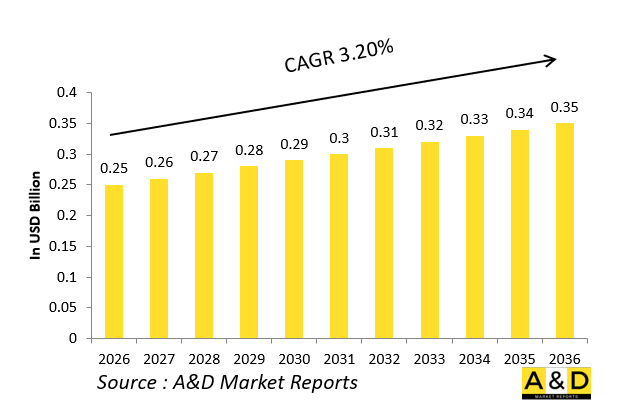
The Global Defense Aircraft Windshield Market is estimated at USD 0.25 billion in 2026, projected to grow to USD 0.35 billion by 2036 at a Compound Annual Growth Rate (CAGR) of 3.20% over the forecast period 2026-2036.
Introduction:
The global defense aircraft windshield market supplies transparent forward-facing panels vital for pilot visibility and navigation in military operations. Constructed from layered polycarbonate, chemically strengthened glass, and acrylic composites, these windshields withstand bird strikes, debris impacts, and pressure differentials at altitude. Features include anti-reflective coatings, heater elements for de-icing, and integration with heads-up displays. Manufacturers cater to fighters, bombers, transports, helicopters, and UAVs, emphasizing optical purity alongside ballistic protection. Market growth links to airframe modernizations, expanded training fleets, and survivability enhancements. Windshields serve as the pilot's primary interface, blending clarity with armor-like resilience. This specialized segment supports mission-critical tasks from low-level ingress to high-altitude intercepts, ensuring operational edge in diverse theaters.
Technology Impact in Defense Aircraft Windshield Market
Technologies elevate the defense aircraft windshield market, fusing optics with smart functionality. Gradient-index optics minimize distortion for helmet-mounted sights, enhancing targeting accuracy. Conductive interlayers enable rapid de-icing and defogging without mechanical wipers. Self-polishing nanocoatings repel sand, rain, and oils, preserving clarity in abrasive environments. Embedded photovoltaic layers power onboard sensors discreetly. Ballistic laminates with spall liners contain fragments from small-arms fire. Acoustic interlayers dampen engine noise and sonic booms for pilot comfort. 3D-printed frames allow seamless curvature matching airframes. Multispectral treatments support night-vision and IR imaging compatibility. Predictive analytics via strain gauges forecast stress failures. These strides transform windshields into active components, integrating augmented overlays and health monitoring to boost situational awareness and aircraft uptime.
Key Drivers in Defense Aircraft Windshield Market
Essential drivers fuel the defense aircraft windshield market. Intensified flight training hours accelerate wear, demanding frequent replacements with superior durability. Next-gen cockpit designs integrate windshields as extended displays for sensor fusion. Regulatory pushes for bird-strike resistance heighten material standards across fleets. Harsh operational theaters-like dusty Middle East bases-necessitate abrasion-resistant surfaces. Supply chain resilience prompts diversified sourcing of rare-earth dopants for strengthening. Stealth retrofits require low-emissivity coatings to evade IR detection. Pilot feedback drives ergonomic shapes reducing neck strain during high-G turns. Sustainment efficiencies favor modular designs for quick swaps. Export growth adapts windshields to customer-specific HUDs and climates. These elements underscore a market oriented toward reliability, adaptability, and lifecycle cost savings in high-tempo air campaigns.
Regional Trends in Defense Aircraft Windshield Market
Regional trends in the defense aircraft windshield market reflect operational demands and industrial strengths. North America pioneers integrated display windshields for advanced fighters and trainers. Europe focuses on de-icing innovations for northern patrol aircraft via multinational consortia. Asia-Pacific scales production of cost-optimized laminates for regional air forces and exports. Middle East emphasizes sand-eroding coatings for desert fighters. Australia and Southeast Asia prioritize corrosion resistance for maritime operations. Eastern Europe supplies rugged replacements for legacy Soviet-era jets. Localization efforts establish coating facilities to bypass sanctions. Collaborative testing harmonizes standards for allied interoperability. Adaptations for extreme weather-like monsoon hydrophobicity-gain prominence. This distribution promotes tailored solutions, blending global R&D with regional resilience to sustain air readiness.
Key Defense Aircraft Windshield Market Program
Flagship programs illuminate the defense aircraft windshield market's innovations. Advanced trainer overhauls deploy wide-view windshields with HUD projection for immersive simulation. Multirole fighter upgrades integrate ballistic, NVG-compatible panels with defog grids. Heavy transport modernizations feature heated, bird-safe windshields for global logistics. Attack helicopter programs embed strain sensors for real-time integrity checks. Unmanned surrogate jets test remote-piloted windshields with augmented feeds. Electronic warfare platforms incorporate RF-transparent layers preserving canopy performance. These initiatives endure live-fire validations, altitude chamber tests, and abrasion simulations. Partnerships accelerate certification for rapid fielding. Modular mounting systems enable avionics swaps without redesign. Emphasis on pilot ergonomics and digital transparency redefines windshields as gateways to fused battlespace awareness, anchoring programs for persistent aerial dominance.
Table of Contents
Defense Aircraft Windshield Market - Table of Contents
Defense Aircraft Windshield Market Report Definition
Defense Aircraft Windshield Market Segmentation
By Region
By Platform
By Material
By Aircraft Type
By Technology
By Configuration
Defense Aircraft Windshield Market Analysis for next 10 Years
The 10-year Defense Aircraft Windshield Market analysis would give a detailed overview of Defense Aircraft Windshield Market growth, changing dynamics, technology adoption overviews and the overall market attractiveness is covered in this chapter.
Market Technologies of Defense Aircraft Windshield Market
This segment covers the top 10 technologies that is expected to impact this market and the possible implications these technologies would have on the overall market.
Global Defense Aircraft Windshield Market Forecast
The 10-year Defense Aircraft Windshield Market forecast of this market is covered in detailed across the segments which are mentioned above.
Regional Defense Aircraft Windshield Market Trends & Forecast
The regional counter drone market trends, drivers, restraints and Challenges of this market, the Political, Economic, Social and Technology aspects are covered in this segment. The market forecast and scenario analysis across regions are also covered in detailed in this segment. The last part of the regional analysis includes profiling of the key companies, supplier landscape and company benchmarking. The current market size is estimated based on the normal scenario.
North America
Drivers, Restraints and Challenges
PEST
Market Forecast & Scenario Analysis
Key Companies
Supplier Tier Landscape
Company Benchmarking
Europe
Middle East
APAC
South America
Country Analysis of Defense Aircraft Windshield Market
This chapter deals with the key defense programs in this market, it also covers the latest news and patents which have been filed in this market. Country level 10 year market forecast and scenario analysis are also covered in this chapter.
US
Defense Programs
Latest News
Patents
Current levels of technology maturation in this market
Market Forecast & Scenario Analysis
Canada
Italy
France
Germany
Netherlands
Belgium
Spain
Sweden
Greece
Australia
South Africa
India
China
Russia
South Korea
Japan
Malaysia
Singapore
Brazil
Opportunity Matrix for Defense Aircraft Windshield Market
The opportunity matrix helps the readers understand the high opportunity segments in this market.
Expert Opinions on Defense Aircraft Windshield Market Report
Hear from our experts their opinion of the possible analysis for this market.
Conclusions
About Aviation and Defense Market Reports
List of Tables
- Table 1: 10 Year Market Outlook, 2026-2036
- Table 2: Drivers, Impact Analysis, North America
- Table 3: Restraints, Impact Analysis, North America
- Table 4: Challenges, Impact Analysis, North America
- Table 5: Drivers, Impact Analysis, Europe
- Table 6: Restraints, Impact Analysis, Europe
- Table 7: Challenges, Impact Analysis, Europe
- Table 8: Drivers, Impact Analysis, Middle East
- Table 9: Restraints, Impact Analysis, Middle East
- Table 10: Challenges, Impact Analysis, Middle East
- Table 11: Drivers, Impact Analysis, APAC
- Table 12: Restraints, Impact Analysis, APAC
- Table 13: Challenges, Impact Analysis, APAC
- Table 14: Drivers, Impact Analysis, South America
- Table 15: Restraints, Impact Analysis, South America
- Table 16: Challenges, Impact Analysis, South America
- Table 17: Scenario Analysis, Scenario 1, By Region, 2026-2036
- Table 18: Scenario Analysis, Scenario 1, By Platform, 2026-2036
- Table 19: Scenario Analysis, Scenario 1, By Material, 2026-2036
- Table 20: Scenario Analysis, Scenario 2, By Region, 2026-2036
- Table 21: Scenario Analysis, Scenario 2, By Platform, 2026-2036
- Table 22: Scenario Analysis, Scenario 2, By Material, 2026-2036
List of Figures
- Figure 1: Global Defense Aircraft Windshield Market Forecast, 2026-2036
- Figure 2: Global Defense Aircraft Windshield Market Forecast, By Region, 2026-2036
- Figure 3: Global Defense Aircraft Windshield Market Forecast, By Platform, 2026-2036
- Figure 4: Global Defense Aircraft Windshield Market Forecast, By Material, 2026-2036
- Figure 5: North America, Defense Aircraft Windshield Market, Market Forecast, 2026-2036
- Figure 6: Europe, Defense Aircraft Windshield Market, Market Forecast, 2026-2036
- Figure 7: Middle East, Defense Aircraft Windshield Market, Market Forecast, 2026-2036
- Figure 8: APAC, Defense Aircraft Windshield Market, Market Forecast, 2026-2036
- Figure 9: South America, Defense Aircraft Windshield Market, Market Forecast, 2026-2036
- Figure 10: United States, Defense Aircraft Windshield Market, Region Maturation, 2026-2036
- Figure 11: United States, Defense Aircraft Windshield Market, Market Forecast, 2026-2036
- Figure 12: Canada, Defense Aircraft Windshield Market, Region Maturation, 2026-2036
- Figure 13: Canada, Defense Aircraft Windshield Market, Market Forecast, 2026-2036
- Figure 14: Italy, Defense Aircraft Windshield Market, Region Maturation, 2026-2036
- Figure 15: Italy, Defense Aircraft Windshield Market, Market Forecast, 2026-2036
- Figure 16: France, Defense Aircraft Windshield Market, Region Maturation, 2026-2036
- Figure 17: France, Defense Aircraft Windshield Market, Market Forecast, 2026-2036
- Figure 18: Germany, Defense Aircraft Windshield Market, Region Maturation, 2026-2036
- Figure 19: Germany, Defense Aircraft Windshield Market, Market Forecast, 2026-2036
- Figure 20: Netherlands, Defense Aircraft Windshield Market, Region Maturation, 2026-2036
- Figure 21: Netherlands, Defense Aircraft Windshield Market, Market Forecast, 2026-2036
- Figure 22: Belgium, Defense Aircraft Windshield Market, Region Maturation, 2026-2036
- Figure 23: Belgium, Defense Aircraft Windshield Market, Market Forecast, 2026-2036
- Figure 24: Spain, Defense Aircraft Windshield Market, Region Maturation, 2026-2036
- Figure 25: Spain, Defense Aircraft Windshield Market, Market Forecast, 2026-2036
- Figure 26: Sweden, Defense Aircraft Windshield Market, Region Maturation, 2026-2036
- Figure 27: Sweden, Defense Aircraft Windshield Market, Market Forecast, 2026-2036
- Figure 28: Brazil, Defense Aircraft Windshield Market, Region Maturation, 2026-2036
- Figure 29: Brazil, Defense Aircraft Windshield Market, Market Forecast, 2026-2036
- Figure 30: Australia, Defense Aircraft Windshield Market, Region Maturation, 2026-2036
- Figure 31: Australia, Defense Aircraft Windshield Market, Market Forecast, 2026-2036
- Figure 32: India, Defense Aircraft Windshield Market, Region Maturation, 2026-2036
- Figure 33: India, Defense Aircraft Windshield Market, Market Forecast, 2026-2036
- Figure 34: China, Defense Aircraft Windshield Market, Region Maturation, 2026-2036
- Figure 35: China, Defense Aircraft Windshield Market, Market Forecast, 2026-2036
- Figure 36: Saudi Arabia, Defense Aircraft Windshield Market, Region Maturation, 2026-2036
- Figure 37: Saudi Arabia, Defense Aircraft Windshield Market, Market Forecast, 2026-2036
- Figure 38: South Korea, Defense Aircraft Windshield Market, Region Maturation, 2026-2036
- Figure 39: South Korea, Defense Aircraft Windshield Market, Market Forecast, 2026-2036
- Figure 40: Japan, Defense Aircraft Windshield Market, Region Maturation, 2026-2036
- Figure 41: Japan, Defense Aircraft Windshield Market, Market Forecast, 2026-2036
- Figure 42: Malaysia, Defense Aircraft Windshield Market, Region Maturation, 2026-2036
- Figure 43: Malaysia, Defense Aircraft Windshield Market, Market Forecast, 2026-2036
- Figure 44: Singapore, Defense Aircraft Windshield Market, Region Maturation, 2026-2036
- Figure 45: Singapore, Defense Aircraft Windshield Market, Market Forecast, 2026-2036
- Figure 46: United Kingdom, Defense Aircraft Windshield Market, Region Maturation, 2026-2036
- Figure 47: United Kingdom, Defense Aircraft Windshield Market, Market Forecast, 2026-2036
- Figure 48: Opportunity Analysis, Defense Aircraft Windshield Market, By Region (Cumulative Market), 2026-2036
- Figure 49: Opportunity Analysis, Defense Aircraft Windshield Market, By Region (CAGR), 2026-2036
- Figure 50: Opportunity Analysis, Defense Aircraft Windshield Market, By Platform (Cumulative Market), 2026-2036
- Figure 51: Opportunity Analysis, Defense Aircraft Windshield Market, By Platform (CAGR), 2026-2036
- Figure 52: Opportunity Analysis, Defense Aircraft Windshield Market, By Material(Cumulative Market), 2026-2036
- Figure 53: Opportunity Analysis, Defense Aircraft Windshield Market, By Material(CAGR), 2026-2036
- Figure 54: Scenario Analysis, Defense Aircraft Windshield Market, Cumulative Market, 2026-2036
- Figure 55: Scenario Analysis, Defense Aircraft Windshield Market, Global Market, 2026-2036
- Figure 56: Scenario 1, Defense Aircraft Windshield Market, Total Market, 2026-2036
- Figure 57: Scenario 1, Defense Aircraft Windshield Market, By Region, 2026-2036
- Figure 58: Scenario 1, Defense Aircraft Windshield Market, By Platform, 2026-2036
- Figure 59: Scenario 1, Defense Aircraft Windshield Market, By Material, 2026-2036
- Figure 60: Scenario 2, Defense Aircraft Windshield Market, Total Market, 2026-2036
- Figure 61: Scenario 2, Defense Aircraft Windshield Market, By Region, 2026-2036
- Figure 62: Scenario 2, Defense Aircraft Windshield Market, By Platform, 2026-2036
- Figure 63: Scenario 2, Defense Aircraft Windshield Market, By Material, 2026-2036
- Figure 64: Company Benchmark, Defense Aircraft Windshield Market, 2026-2036

