PUBLISHER: Aviation & Defense Market Reports (A&D) | PRODUCT CODE: 2027689

PUBLISHER: Aviation & Defense Market Reports (A&D) | PRODUCT CODE: 2027689
Global Defense MRO - Air Platforms Market
Global Defense MRO - Air Platforms Market
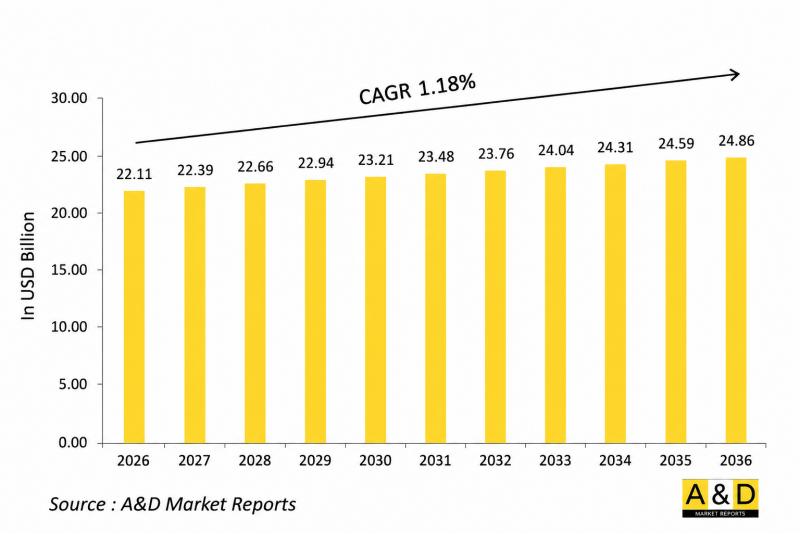
The Global Defense MRO - Air Platforms Market is estimated at USD 22.11 billion in 2026, projected to grow to USD 24.86 billion by 2036 at a Compound Annual Growth Rate (CAGR) of 1.18% over the forecast period 2026-2036.
1. Introduction
The Global Defense MRO - Air Platforms Market plays a critical role in ensuring the operational readiness, safety, and lifecycle sustainability of military aircraft. This market encompasses maintenance, repair, and overhaul activities across fighter jets, transport aircraft, helicopters, and unmanned aerial systems. As modern air forces increasingly rely on complex and high-value platforms, continuous maintenance support has become essential for mission success.
The growing sophistication of avionics, propulsion systems, and electronic warfare capabilities has significantly expanded the scope of MRO services. In addition, rising operational tempo and extended deployment cycles place additional stress on air platforms, increasing the need for timely maintenance interventions. Governments worldwide are prioritizing fleet availability while optimizing lifecycle costs, which has strengthened the importance of structured MRO ecosystems.
The market is also evolving toward integrated service models, where original equipment manufacturers and third-party providers collaborate to deliver end-to-end sustainment solutions. This shift is transforming MRO from a reactive function into a strategic capability within defense planning.
2. Technology Impact in Air Platforms MRO Market
Technology is reshaping the air platforms MRO landscape into a data-driven and predictive ecosystem. Advanced health monitoring systems and sensors embedded in aircraft generate continuous operational data, enabling predictive maintenance strategies that reduce unexpected failures and downtime.
Digital twin technology allows virtual modeling of aircraft systems, supporting lifecycle assessment, maintenance planning, and performance optimization. This innovation is particularly valuable for aging fleets, where structural integrity and component fatigue must be closely monitored.
Non-destructive testing methods such as ultrasonic inspection and thermography have improved diagnostic accuracy while minimizing disassembly requirements. Additive manufacturing is also emerging as a key enabler, allowing rapid production of spare parts, especially for legacy aircraft where supply chains are limited.
Augmented and virtual reality tools are enhancing technician training and enabling remote maintenance assistance, reducing human error and improving efficiency. Additionally, software sustainment has become critical as modern aircraft rely heavily on digital systems, requiring regular updates and cybersecurity integration.
Overall, these technologies are improving turnaround time, reducing costs, and enhancing aircraft availability.
3. Key Drivers in Air Platforms MRO Market
A major driver of the air platforms MRO market is the continued operation of aging aircraft fleets. Many military aircraft remain in service for extended periods, requiring frequent structural repairs, engine overhauls, and avionics upgrades to remain mission-capable.
Increasing defense budgets and modernization programs are also driving demand for advanced MRO services. While new aircraft acquisitions continue, most countries prioritize sustaining existing fleets due to cost constraints. This creates strong demand for life-extension programs and mid-life upgrades.
The rising complexity of modern aircraft systems, including stealth features, advanced sensors, and network-centric capabilities, further fuels the need for specialized MRO expertise. Maintenance now requires highly skilled personnel, advanced diagnostic tools, and integrated digital systems.
Another key driver is the shift toward predictive and performance-based logistics models, where MRO providers are responsible for ensuring operational readiness rather than just performing repairs. This approach encourages efficiency and long-term service contracts.
Additionally, increasing operational tempo, especially in surveillance, border security, and combat missions, accelerates wear and tear, boosting maintenance frequency. The growing use of unmanned aerial systems also adds a new dimension to MRO demand.
Finally, globalization of MRO services and outsourcing to cost-effective regions is expanding market opportunities and improving service accessibility.
4. Regional Trends in Air Platforms MRO Market
North America remains a dominant region due to its extensive military aviation fleet and advanced sustainment infrastructure. The region emphasizes performance-based logistics, digital maintenance solutions, and strong collaboration between defense agencies and private industry.
Europe is characterized by multinational defense programs and collaborative maintenance frameworks. Regional partnerships enable shared MRO facilities and standardized processes, improving efficiency and interoperability across allied forces.
Asia-Pacific is witnessing rapid growth driven by expanding air fleets, rising defense spending, and increasing focus on indigenous capabilities. Countries in this region are investing heavily in domestic MRO infrastructure to reduce reliance on foreign service providers and strengthen strategic autonomy.
The Middle East exhibits strong demand due to harsh environmental conditions that accelerate aircraft wear and require intensive maintenance cycles. Governments in the region are investing in advanced MRO hubs to support high operational readiness.
Latin America and Africa are primarily focused on sustaining aging fleets, with gradual development of localized MRO capabilities through international collaborations. These regions present long-term growth opportunities as defense modernization efforts continue.
5. Key Air Platforms MRO Program
A notable program in the air platforms MRO market is the acquisition of Air Works by Adani Defence Systems & Technologies Ltd.. This strategic move aims to strengthen domestic MRO capabilities and enhance India's aerospace sustainment ecosystem. Air Works has established itself as a leading aviation MRO provider with capabilities spanning line maintenance, heavy maintenance checks, avionics support, and asset management. Its infrastructure supports a wide range of aircraft, including fixed-wing and rotary platforms.
The program reflects a broader trend toward indigenization, where countries seek to develop local MRO capabilities to reduce dependency on foreign providers. It also highlights the growing role of private sector participation in defense sustainment.
Through such initiatives, governments aim to improve fleet availability, reduce turnaround time, and ensure long-term operational readiness. These programs also foster technology transfer, skill development, and industrial growth within domestic defense ecosystems.
Overall, strategic partnerships and acquisitions are becoming central to strengthening global MRO capabilities in the air platforms segment.
Table of Contents
Defense MRO - Air Platforms Market - Table of Contents
Defense MRO - Air Platforms Market Report Definition
Defense MRO - Air Platforms Market Segmentation
By Region
By Component
By Aircraft Type
Defense MRO - Air Platforms Market Analysis for next 10 Years
The 10-year Defense MRO - Air Platforms Market analysis would give a detailed overview of Defense MRO - Air Platforms Market growth, changing dynamics, technology adoption overviews and the overall market attractiveness is covered in this chapter.
Market Technologies of Defense MRO - Air Platforms Market
This segment covers the top 10 technologies that is expected to impact this market and the possible implications these technologies would have on the overall market.
Global Defense MRO - Air Platforms Market Forecast
The 10-year Defense MRO - Air Platforms Market forecast of this market is covered in detailed across the segments which are mentioned above.
Regional Defense MRO - Air Platforms Market Trends & Forecast
The regional Defense MRO - Air Platforms Market trends, drivers, restraints and Challenges of this market, the Political, Economic, Social and Technology aspects are covered in this segment. The market forecast and scenario analysis across regions are also covered in detailed in this segment. The last part of the regional analysis includes profiling of the key companies, supplier landscape and company benchmarking. The current market size is estimated based on the normal scenario.
North America
Drivers, Restraints and Challenges
PEST
Market Forecast & Scenario Analysis
Key Companies
Supplier Tier Landscape
Company Benchmarking
Europe
Middle East
APAC
South America
Country Analysis of Defense MRO - Air Platforms Market
This chapter deals with the key defense programs in this market, it also covers the latest news and patents which have been filed in this market. Country level 10 year market forecast and scenario analysis are also covered in this chapter.
US
Defense Programs
Latest News
Patents
Current levels of technology maturation in this market
Market Forecast & Scenario Analysis
Canada
Italy
France
Germany
Netherlands
Belgium
Spain
Sweden
Greece
Australia
South Africa
India
China
Russia
South Korea
Japan
Malaysia
Singapore
Brazil
Opportunity Matrix for Defense MRO - Air Platforms Market
The opportunity matrix helps the readers understand the high opportunity segments in this market.
Expert Opinions on Defense MRO - Air Platforms Market Report
Hear from our experts their opinion of the possible analysis for this market.
Conclusions
About Aviation and Defense Market Reports
List of Tables
- Table 1: 10 Year Market Outlook, 2026-2036
- Table 2: Drivers, Impact Analysis, North America
- Table 3: Restraints, Impact Analysis, North America
- Table 4: Challenges, Impact Analysis, North America
- Table 5: Drivers, Impact Analysis, Europe
- Table 6: Restraints, Impact Analysis, Europe
- Table 7: Challenges, Impact Analysis, Europe
- Table 8: Drivers, Impact Analysis, Middle East
- Table 9: Restraints, Impact Analysis, Middle East
- Table 10: Challenges, Impact Analysis, Middle East
- Table 11: Drivers, Impact Analysis, Apac
- Table 12: Restraints, Impact Analysis, Apac
- Table 13: Challenges, Impact Analysis, Apac
- Table 14: Drivers, Impact Analysis, South America
- Table 15: Restraints, Impact Analysis, South America
- Table 16: Challenges, Impact Analysis, South America
- Table 17: Scenario Analysis, Scenario 1, By Region, 2026-2036
- Table 18: Scenario Analysis, Scenario 1, By Component 2026-2036
- Table 19: Scenario Analysis, Scenario 1, By Aircraft Type, 2026-2036
- Table 20: Scenario Analysis, Scenario 2, By Region, 2026-2036
- Table 21: Scenario Analysis, Scenario 2, By Component2026-2036
- Table 22: Scenario Analysis, Scenario 2, By Aircraft Type, 2026-2036
List of Figures
- Figure 1: Global Defense Mro - Air Platforms Market Forecast, 2026-2036
- Figure 2: Global Defense Mro - Air Platforms Market Forecast, By Region, 2026-2036
- Figure 3: Global Defense Mro - Air Platforms Market Forecast, By Component 2026-2036
- Figure 4: Global Defense Mro - Air Platforms Market Forecast, By Aircraft Type, 2026-2036
- Figure 5: North America, Defense Mro - Air Platforms Market , Market Forecast, 2026-2036
- Figure 6: Europe, Defense Mro - Air Platforms Market , Market Forecast, 2026-2036
- Figure 7: Middle East, Defense Mro - Air Platforms Market , Market Forecast, 2026-2036
- Figure 8: Apac, Defense Mro - Air Platforms Market , Market Forecast, 2026-2036
- Figure 9: South America, Defense Mro - Air Platforms Market , Market Forecast, 2026-2036
- Figure 10: United States, Defense Mro - Air Platforms Market , Region Maturation, 2026-2036
- Figure 11: United States, Defense Mro - Air Platforms Market , Market Forecast, 2026-2036
- Figure 12: Canada, Defense Mro - Air Platforms Market , Region Maturation, 2026-2036
- Figure 13: Canada, Defense Mro - Air Platforms Market , Market Forecast, 2026-2036
- Figure 14: Italy, Defense Mro - Air Platforms Market , Region Maturation, 2026-2036
- Figure 15: Italy, Defense Mro - Air Platforms Market , Market Forecast, 2026-2036
- Figure 16: France, Defense Mro - Air Platforms Market , Region Maturation, 2026-2036
- Figure 17: France, Defense Mro - Air Platforms Market , Market Forecast, 2026-2036
- Figure 18: Germany, Defense Mro - Air Platforms Market , Region Maturation, 2026-2036
- Figure 19: Germany, Defense Mro - Air Platforms Market , Market Forecast, 2026-2036
- Figure 20: Netherlands, Defense Mro - Air Platforms Market , Region Maturation, 2026-2036
- Figure 21: Netherlands, Defense Mro - Air Platforms Market , Market Forecast, 2026-2036
- Figure 22: Belgium, Defense Mro - Air Platforms Market , Region Maturation, 2026-2036
- Figure 23: Belgium, Defense Mro - Air Platforms Market , Market Forecast, 2026-2036
- Figure 24: Spain, Defense Mro - Air Platforms Market , Region Maturation, 2026-2036
- Figure 25: Spain, Defense Mro - Air Platforms Market , Market Forecast, 2026-2036
- Figure 26: Sweden, Defense Mro - Air Platforms Market , Region Maturation, 2026-2036
- Figure 27: Sweden, Defense Mro - Air Platforms Market , Market Forecast, 2026-2036
- Figure 28: Brazil, Defense Mro - Air Platforms Market , Region Maturation, 2026-2036
- Figure 29: Brazil, Defense Mro - Air Platforms Market , Market Forecast, 2026-2036
- Figure 30: Australia, Defense Mro - Air Platforms Market , Region Maturation, 2026-2036
- Figure 31: Australia, Defense Mro - Air Platforms Market , Market Forecast, 2026-2036
- Figure 32: India, Defense Mro - Air Platforms Market , Region Maturation, 2026-2036
- Figure 33: India, Defense Mro - Air Platforms Market , Market Forecast, 2026-2036
- Figure 34: China, Defense Mro - Air Platforms Market , Region Maturation, 2026-2036
- Figure 35: China, Defense Mro - Air Platforms Market , Market Forecast, 2026-2036
- Figure 36: Saudi Arabia, Defense Mro - Air Platforms Market , Region Maturation, 2026-2036
- Figure 37: Saudi Arabia, Defense Mro - Air Platforms Market , Market Forecast, 2026-2036
- Figure 38: South Korea, Defense Mro - Air Platforms Market , Region Maturation, 2026-2036
- Figure 39: South Korea, Defense Mro - Air Platforms Market , Market Forecast, 2026-2036
- Figure 40: Japan, Defense Mro - Air Platforms Market , Region Maturation, 2026-2036
- Figure 41: Japan, Defense Mro - Air Platforms Market , Market Forecast, 2026-2036
- Figure 42: Malaysia, Defense Mro - Air Platforms Market , Region Maturation, 2026-2036
- Figure 43: Malaysia, Defense Mro - Air Platforms Market , Market Forecast, 2026-2036
- Figure 44: Singapore, Defense Mro - Air Platforms Market , Region Maturation, 2026-2036
- Figure 45: Singapore, Defense Mro - Air Platforms Market , Market Forecast, 2026-2036
- Figure 46: United Kingdom, Defense Mro - Air Platforms Market , Region Maturation, 2026-2036
- Figure 47: United Kingdom, Defense Mro - Air Platforms Market , Market Forecast, 2026-2036
- Figure 48: Opportunity Analysis, Defense Mro - Air Platforms Market , By Region (Cumulative Market), 2026-2036
- Figure 49: Opportunity Analysis, Defense Mro - Air Platforms Market , By Region (Cagr), 2026-2036
- Figure 50: Opportunity Analysis, Defense Mro - Air Platforms Market , By Component Cumulative Market), 2026-2036
- Figure 51: Opportunity Analysis, Defense Mro - Air Platforms Market , By Component(Cagr), 2026-2036
- Figure 52: Opportunity Analysis, Defense Mro - Air Platforms Market , By Aircraft Type(Cumulative Market), 2026-2036
- Figure 53: Opportunity Analysis, Defense Mro - Air Platforms Market , By Aircraft Type(Cagr), 2026-2036
- Figure 54: Scenario Analysis, Defense Mro - Air Platforms Market , Cumulative Market, 2026-2036
- Figure 55: Scenario Analysis, Defense Mro - Air Platforms Market , Global Market, 2026-2036
- Figure 56: Scenario 1, Defense Mro - Air Platforms Market , Total Market, 2026-2036
- Figure 57: Scenario 1, Defense Mro - Air Platforms Market , By Region, 2026-2036
- Figure 58: Scenario 1, Defense Mro - Air Platforms Market , By Component 2026-2036
- Figure 59: Scenario 1, Defense Mro - Air Platforms Market , By Aircraft Type, 2026-2036
- Figure 60: Scenario 2, Defense Mro - Air Platforms Market , Total Market, 2026-2036
- Figure 61: Scenario 2, Defense Mro - Air Platforms Market , By Region, 2026-2036
- Figure 62: Scenario 2, Defense Mro - Air Platforms Market , By Component 2026-2036
- Figure 63: Scenario 2, Defense Mro - Air Platforms Market , By Aircraft Type, 2026-2036
- Figure 64: Company Benchmark, Defense Mro - Air Platforms Market , 2026-2036

