
PUBLISHER: Global Market Insights Inc. | PRODUCT CODE: 1913370

PUBLISHER: Global Market Insights Inc. | PRODUCT CODE: 1913370
Scissor Lift Market Opportunity, Growth Drivers, Industry Trend Analysis, and Forecast 2026 - 2035
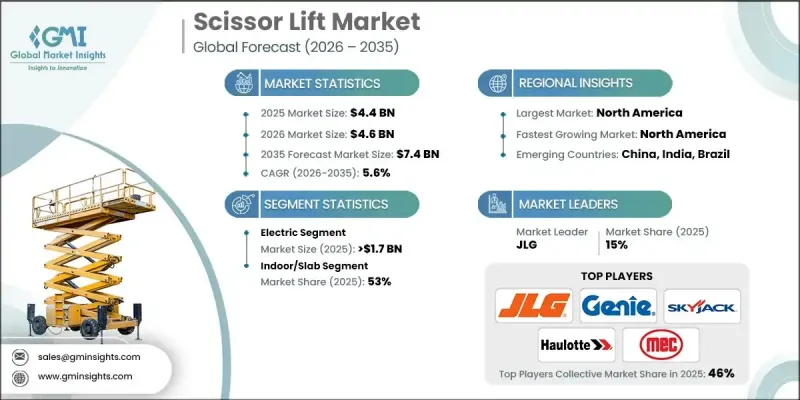
The Global Scissor Lift Market was valued at USD 4.4 billion in 2025 and is estimated to grow at a CAGR of 5.6% to reach USD 7.4 billion by 2035.
Growth in the market is driven by the expanding adoption of scissor lifts across industries such as construction, manufacturing, and maintenance, where safety and efficiency are top priorities. Companies are increasingly relying on scissor lifts for their versatility, ease of use, and ability to operate in confined spaces, offering effective solutions for both indoor and outdoor tasks. The market has shifted focus from purely functional requirements to features that enhance operator comfort, safety, and environmental performance. Rising demand for sustainable solutions and compliance with regulations regarding noise and air quality have pushed manufacturers to innovate, producing electric and hybrid models with more compact designs and advanced operator control systems. Additionally, rental services are gaining popularity, providing cost-effective options for businesses without long-term ownership commitments.
| Market Scope | |
|---|---|
| Start Year | 2025 |
| Forecast Year | 2026-2035 |
| Start Value | $4.4 Billion |
| Forecast Value | $7.4 Billion |
| CAGR | 5.6% |
The electric scissor lift segment reached USD 1.7 billion in 2025, driven by increasing regulations on off-road emissions and growing concerns about indoor air quality. These factors are encouraging the adoption of fully electric scissor lifts, while diesel and internal combustion models are expected to maintain a smaller, stable presence with limited value growth.
The indoor/slab segment held a 53% share in 2025, reflecting its extensive use in controlled environments such as warehouses, factories, and distribution centers. The need for compact, agile platforms that offer stability and safe navigation across uneven surfaces makes indoor applications the dominant segment.
U.S. Scissor Lift Market held 82% share, generating USD 1.34 billion in 2025. High demand is supported by a mature construction sector, ongoing infrastructure projects, and the availability of advanced equipment. Strong support from major rental companies and domestic manufacturers has further reinforced market growth.
Key players operating in the Global Scissor Lift Market include JLG Industries, Inc. (Oshkosh Corporation), Terex Corporation (Genie Brand), Linamar Corporation (Skyjack Brand), Haulotte Group, MEC Aerial Work Platforms, Aichi Corporation (Toyota Industries), Manitou Group, Zhejiang Dingli Machinery Co., Ltd., Hy-Brid Lifts, AXCS Equipment, Zoomlion Heavy Industry (Zoomlion Access), XCMG (Xuzhou Construction Machinery Group), Sinoboom Intelligent Equipment Co., Ltd., Almac S.p.A., and Hangcha (Hangzhou Hangcha Aerial Platform Equipment). To strengthen their foothold, companies in the Scissor Lift Market are focusing on innovation and sustainability, developing electric and hybrid models with advanced control systems and compact designs to meet regulatory and environmental demands. Strategic partnerships with construction and industrial service providers expand distribution networks and increase rental opportunities. Companies are also investing in R&D to enhance safety features, improve operator comfort, and optimize platform versatility.
Table of Contents
Chapter 1 Methodology and Scope
- 1.1 Market scope and definition
- 1.2 Research design
- 1.2.1 Research approach
- 1.2.2 Data collection methods
- 1.3 Data mining sources
- 1.3.1 Global
- 1.3.2 Regional/Country
- 1.4 Base estimates and calculations
- 1.4.1 Base year calculation
- 1.4.2 Key trends for market estimation
- 1.5 Primary research and validation
- 1.5.1 Primary sources
- 1.6 Forecast model
- 1.7 Research assumptions and limitations
Chapter 2 Executive Summary
- 2.1 Industry 3600 synopsis
- 2.2 Key market trends
- 2.2.1 By regional
- 2.2.2 By power source
- 2.2.3 By operating environment
- 2.2.4 By size
- 2.2.5 By platform height
- 2.2.6 By capacity/load rating
- 2.2.7 By end use industry
- 2.2.8 By distribution channel
- 2.3 CXO perspectives: Strategic imperatives
- 2.3.1 Key decision points for industry executives
- 2.3.2 Critical success factors for market players
- 2.4 Future outlook and strategic recommendations
Chapter 3 Industry Insights
- 3.1 Industry ecosystem analysis
- 3.1.1 Supplier landscape
- 3.1.2 Profit margin
- 3.1.3 Value addition at each stage
- 3.1.4 Factor affecting the value chain
- 3.2 Industry impact forces
- 3.2.1 Growth drivers
- 3.2.1.1 Rising demand for safe working platforms
- 3.2.1.2 Growth in construction and infrastructure projects
- 3.2.1.3 Shift toward electric and eco-friendly models
- 3.2.2 Industry pitfalls & challenges
- 3.2.2.1 High initial investment and maintenance costs
- 3.2.2.2 Operational limitations in extreme conditions
- 3.2.3 Opportunities
- 3.2.3.1 Expansion of rental services
- 3.2.3.2 Integration of smart technologies
- 3.2.1 Growth drivers
- 3.3 Growth potential analysis
- 3.4 Major market trends and disruptions
- 3.5 Future market trends
- 3.6 Risk and mitigation Analysis
- 3.7 Technology and innovation landscape
- 3.7.1 Current technological trends
- 3.7.2 Emerging technologies
- 3.8 Price trends
- 3.8.1 By region
- 3.8.2 By power source
- 3.9 Regulatory landscape
- 3.9.1 North America
- 3.9.2 Europe
- 3.9.3 Asia-Pacific
- 3.9.4 Middle East and Africa
- 3.9.5 Latin America
- 3.10 Porter's analysis
- 3.11 PESTEL analysis
Chapter 4 Competitive Landscape, 2025
- 4.1 Introduction
- 4.2 Company market share analysis
- 4.2.1 By region
- 4.2.1.1 North America
- 4.2.1.2 Europe
- 4.2.1.3 Asia Pacific
- 4.2.1.4 Latin America
- 4.2.1.5 Middle East and Africa
- 4.2.1 By region
- 4.3 Company matrix analysis
- 4.4 Competitive analysis of major market players
- 4.5 Competitive positioning matrix
- 4.6 Key developments
- 4.6.1 Mergers & acquisitions
- 4.6.2 Partnerships & collaborations
- 4.6.3 New product launches
- 4.6.4 Expansion plans
Chapter 5 Market Estimates & Forecast, By Power Source, 2022-2035 (USD Billion) (Thousand Units)
- 5.1 Key trends
- 5.2 Electric scissor lifts
- 5.3 Diesel/internal combustion engine lifts
- 5.4 Hybrid scissor lifts
- 5.5 Hydraulic scissor lifts
- 5.6 Pneumatic scissor lifts
Chapter 6 Market Estimates & Forecast, By Operating Environment, 2022-2035 (USD Billion) (Thousand Units)
- 6.1 Key trends
- 6.2 Indoor/slab scissor lifts
- 6.3 Rough terrain scissor lifts
- 6.4 Multi-terrain scissor lifts
Chapter 7 Market Estimates & Forecast, By Size, 2022-2035 (USD Billion) (Thousand Units)
- 7.1 Key trends
- 7.2 Compact/micro scissor lifts
- 7.3 Standard scissor lifts
- 7.4 Large scissor lifts
- 7.5 Heavy-duty/high-capacity lifts
Chapter 8 Market Estimates & Forecast, By Platform Height, 2022-2035 (USD Billion) (Thousand Units)
- 8.1 Key trends
- 8.2 Low-level access
- 8.3 Mid-level access
- 8.4 High-level access
- 8.5 Ultra-high access
Chapter 9 Market Estimates & Forecast, By Capacity, 2022-2035 (USD Billion) (Thousand Units)
- 9.1 Key trends
- 9.2 Light-duty
- 9.3 Standard-duty
- 9.4 Heavy-duty
- 9.5 Extra heavy-duty
Chapter 10 Market Estimates & Forecast, By End Use Industry, 2022-2035 (USD Billion) (Thousand Units)
- 10.1 Key trends
- 10.2 Construction & infrastructure
- 10.3 Warehousing & logistics
- 10.4 Manufacturing & industrial
- 10.5 Facilities maintenance & property management
- 10.6 Retail & commercial
- 10.7 Aerospace & aviation
Chapter 11 Market Estimates & Forecast, By Distribution Channel, 2022-2035 (USD Billion) (Thousand Units)
- 11.1 Key trends
- 11.2 Direct sales
- 11.3 Indirect sales
Chapter 12 Market Estimates and Forecast, By Region, 2022 - 2035 (USD Billion) (Thousand Units)
- 12.1 Key trends
- 12.2 North America
- 12.2.1 U.S.
- 12.2.2 Canada
- 12.3 Europe
- 12.3.1 Germany
- 12.3.2 UK
- 12.3.3 France
- 12.3.4 Italy
- 12.3.5 Spain
- 12.3.6 Turkey
- 12.4 Asia Pacific
- 12.4.1 China
- 12.4.2 Japan
- 12.4.3 India
- 12.4.4 Australia
- 12.4.5 South Korea
- 12.5 Latin America
- 12.5.1 Brazil
- 12.5.2 Mexico
- 12.5.3 Argentina
- 12.6 Middle East and Africa
- 12.6.1 South Africa
- 12.6.2 Saudi Arabia
- 12.6.3 UAE
Chapter 13 Company Profiles
- 13.1 JLG Industries, Inc. (Oshkosh Corporation)
- 13.2 Terex Corporation (Genie Brand)
- 13.3 Linamar Corporation (Skyjack Brand)
- 13.4 Haulotte Group
- 13.5 MEC Aerial Work Platforms
- 13.6 Aichi Corporation (Toyota Industries)
- 13.7 Manitou Group
- 13.8 Zhejiang Dingli Machinery Co., Ltd.
- 13.9 Hy-Brid Lifts
- 13.10 AXCS Equipment
- 13.11 Zoomlion Heavy Industry (Zoomlion Access)
- 13.12 XCMG (Xuzhou Construction Machinery Group)
- 13.13 Sinoboom Intelligent Equipment Co., Ltd.
- 13.14 Almac S.p.A.
- 13.15 Hangcha (Hangzhou Hangcha Aerial Platform Equipment)

