
PUBLISHER: Global Market Insights Inc. | PRODUCT CODE: 1928890

PUBLISHER: Global Market Insights Inc. | PRODUCT CODE: 1928890
Skin Lightening Products Market Opportunity, Growth Drivers, Industry Trend Analysis, and Forecast 2026 - 2035
The Global Skin Lightening Products Market was valued at USD 17.9 billion in 2025 and is estimated to grow at a CAGR of 11% to reach USD 49.9 billion by 2035.
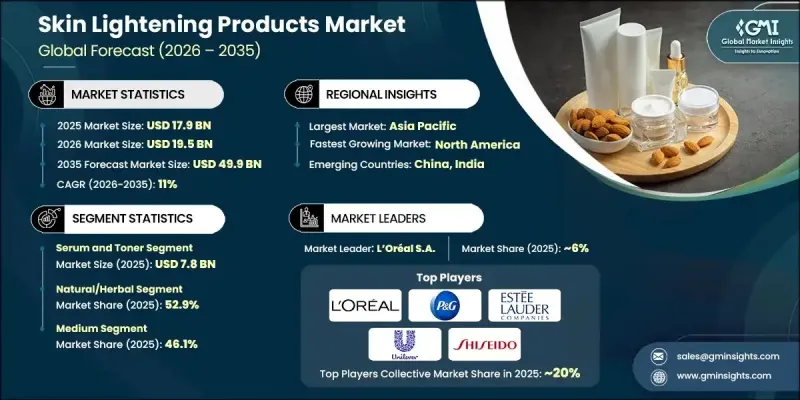
Market growth is supported by the rapid expansion of e-commerce and direct-to-consumer sales channels, which have transformed how consumers discover and purchase beauty and grooming products. Online platforms provide broader product availability and convenience, particularly benefiting consumers in regions with limited access to physical retail outlets. Digital engagement has also reshaped purchasing behavior, as brand-led online communities and influencer-driven promotion strengthen consumer trust and brand visibility. These dynamics have increased product accessibility while fostering deeper relationships between brands and consumers. At the same time, innovation in formulations and performance-driven claims continues to accelerate demand. Consumers increasingly gravitate toward solutions that offer multiple benefits in a single product, valuing both effectiveness and convenience. This shift toward multifunctional offerings reflects evolving lifestyle needs and reinforces sustained market expansion across global regions.
| Market Scope | |
|---|---|
| Start Year | 2025 |
| Forecast Year | 2026-2035 |
| Start Value | $17.9 Billion |
| Forecast Value | $49.9 Billion |
| CAGR | 11% |
The serum and toner segment generated USD 7.8 billion in 2025 and is expected to grow at a CAGR of 10.9% from 2026 to 2035. This category has gained strong traction due to its targeted application and concentrated formulations. Lightweight textures and regimen compatibility have increased consumer preference, supporting continued dominance within the broader product landscape.
The medium-priced segment held a 46.1% share in 2025 and is forecast to grow at a CAGR of 10.9% through 2035. These offerings appeal to a wide consumer base by balancing cost and perceived quality. Positioned between mass-market and premium categories, mid-tier products attract consumers seeking dependable results without premium pricing, supporting strong demand across urban and semi-urban markets.
United States Skin Lightening Products Market reached USD 2.1 billion in 2025 and is projected to grow at a CAGR of 9.9% from 2026 to 2035. Market demand is shaped by a focus on skin tone balance and radiance rather than traditional positioning, reflecting inclusive beauty preferences. Consumers emphasize product safety, transparency, and regulatory compliance, while strong digital retail penetration and online promotion support market growth.
Key companies operating in the Global Skin Lightening Products Market include L'Oreal S.A., Unilever PLC, Estee Lauder Companies Inc., Procter & Gamble, Beiersdorf AG, Shiseido Co., Ltd., Clarins Group, Avon Products, Inc., Himalaya Global Holdings Ltd., VLCC Health Care Limited, Lotus Herbals Pvt. Ltd., Kaya Limited, Eveline Cosmetics, Bio Veda Action Research Private Limited, Sabinsa Corporation, Civant LLC, RichFeel Hair & Beauty Pvt. Ltd., Sanora Beauty Products, and Rozge Cosmeceutical. Companies in the Skin Lightening Products Market strengthen their market position through continuous formulation innovation and portfolio diversification. Many brands focus on developing multifunctional products that address multiple skin concerns while simplifying daily routines. Expansion of direct-to-consumer platforms and digital engagement strategies improves customer reach and brand loyalty.
Table of Contents
Chapter 1 Methodology & Scope
- 1.1 Market scope & definitions
- 1.2 Research design
- 1.2.1 Research approach
- 1.2.2 Data collection methods
- 1.3 Base estimates and calculations
- 1.3.1 Base year calculation
- 1.3.2 Market estimates & forecasts parameters
- 1.4 Forecast Model
- 1.4.1 Key trends for market estimates
- 1.4.2 Quantified market impact analysis
- 1.4.2.1 Mathematical impact of growth parameters on forecast
- 1.4.3 Scenario analysis framework
- 1.5 Primary research and validation
- 1.5.1 Some of the primary sources (but not limited to)
- 1.6 Data mining sources
- 1.6.1 Paid Sources
- 1.7 Primary research and validation
- 1.7.1 Primary sources
- 1.8 Research Trail & confidence scoring
- 1.8.1 Research trail components
- 1.8.2 Scoring components
- 1.9 Research transparency addendum
- 1.9.1 Source attribution framework
- 1.9.2 Quality assurance metrics
- 1.9.3 Our commitment to trust
- 1.10 Market Definitions
Chapter 2 Executive Summary
- 2.1 Industry 3600 synopsis
- 2.2 Key market trends
- 2.2.1 Regional
- 2.2.2 Product
- 2.2.3 Nature
- 2.2.4 Price Range
- 2.2.5 End Use
- 2.2.6 Distribution channels
- 2.3 CXO perspectives: Strategic imperatives
- 2.3.1 Key decision points for industry executives
- 2.3.2 Critical success factors for market players
- 2.4 Future outlook and strategic recommendations
Chapter 3 Industry Insights
- 3.1 Industry ecosystem analysis
- 3.1.1 Supplier landscape
- 3.1.2 Profit margin
- 3.1.3 Value addition at each stage
- 3.1.4 Factor affecting the value chain
- 3.2 Industry impact forces
- 3.2.1 Growth drivers
- 3.2.1.1 Rising beauty & grooming awareness
- 3.2.1.2 Expansion of E-commerce & D2C channels
- 3.2.1.3 Innovation in formulations & claims
- 3.2.2 Pitfalls & Challenges
- 3.2.2.1 Regulatory and ethical risks
- 3.2.2.2 Ingredient safety concerns
- 3.2.3 Opportunities
- 3.2.3.1 Shift toward natural & clean beauty
- 3.2.3.2 Personalization and tech integration
- 3.2.1 Growth drivers
- 3.3 Growth potential analysis
- 3.4 Future market trends
- 3.5 Technology and innovation landscape
- 3.5.1 Current technological trends
- 3.5.2 Emerging technologies
- 3.6 Price trends
- 3.6.1 By region
- 3.6.2 By product
- 3.7 Regulatory landscape
- 3.7.1 North America
- 3.7.1.1 US: Consumer Product Safety Commission (CPSC) 16 Code of Federal Regulations (CFR) part 1512
- 3.7.1.2 Canada: International Organization for Standardization (ISO) 4210
- 3.7.2 Europe
- 3.7.2.1 Germany: Deutsches Institut fur Normung (DIN) European Norm (EN) ISO 4210
- 3.7.2.2 UK: European Norm (EN) ISO 4210 / United Kingdom Conformity Assessed (UKCA)
- 3.7.2.3 France: European Norm (EN) ISO 4210
- 3.7.3 Asia Pacific
- 3.7.3.1 China: Guobiao (GB) 3565
- 3.7.3.2 India: Indian Standard (IS) 10613
- 3.7.3.3 Japan: Japanese Industrial Standard (JIS) D 9110
- 3.7.4 Latin America
- 3.7.4.1 Brazil: Associacao Brasileira de Normas Tecnicas (ABNT) Norma Brasileira (NBR) ISO 4210
- 3.7.4.2 Mexico: International Organization for Standardization (ISO) 4210
- 3.7.5 Middle East & Africa
- 3.7.5.1 South Africa: South African National Standard (SANS) 311
- 3.7.5.2 Saudi Arabia: Saudi Standards, Metrology and Quality Organization (SASO) Gulf Standardization Organization (GSO) ISO 4210
- 3.7.1 North America
- 3.8 Trade statistics (HS Code - 33049920)
- 3.8.1 Major importing countries
- 3.8.2 Major exporting countries
- 3.9 Porter';s analysis
- 3.10 PESTEL analysis
Chapter 4 Competitive Landscape, 2025
- 4.1 Introduction
- 4.2 Company market share analysis
- 4.2.1 By Region
- 4.2.1.1 North America
- 4.2.1.2 Europe
- 4.2.1.3 Asia Pacific
- 4.2.1.4 Latin America
- 4.2.1.5 Middle East & Africa
- 4.2.1 By Region
- 4.3 Company matrix analysis
- 4.4 Competitive analysis of major market players
- 4.5 Competitive positioning matrix
- 4.6 Key developments
- 4.6.1 Mergers & acquisitions
- 4.6.2 Partnerships & collaborations
- 4.6.3 New product launches
- 4.6.4 Expansion plans
Chapter 5 Market Estimates & Forecast, By Product Type, 2022 - 2035, (USD Billion) (Million Units)
- 5.1 Key trends
- 5.2 Serum & toner
- 5.3 Cream & lotion
- 5.4 Cleanser
- 5.5 Mask
- 5.6 Others (scrub, gels)
Chapter 6 Market Estimates & Forecast, By Nature, 2022 - 2035, (USD Billion) (Million Units)
- 6.1 Key trends
- 6.2 Natural/Herbal
- 6.3 Synthetic
- 6.4 Organic
Chapter 7 Market Estimates & Forecast, By Price Range, 2022 - 2035, (USD Billion) (Million Units)
- 7.1 Key trends
- 7.2 Low
- 7.3 Medium
- 7.4 High
Chapter 8 Market Estimates & Forecast, By End Use, 2022 - 2035, (USD Billion) (Million Units)
- 8.1 Key trends
- 8.2 Women
- 8.3 Men
- 8.4 Unisex
Chapter 9 Market Estimates & Forecast, By Distribution Channel, 2022 - 2035, (USD Billion) (Million Units)
- 9.1 Key trends
- 9.2 Online
- 9.2.1 E-commerce
- 9.2.2 Company websites
- 9.3 Offline
- 9.3.1 Specialty beauty stores
- 9.3.2 Pharmacies & drugstores
- 9.3.3 Dermatology clinics
- 9.3.4 Others (aesthetic centers, etc.)
Chapter 10 Market Estimates & Forecast, By Region, 2022 - 2035, (USD Billion) (Million Units)
- 10.1 Key trends
- 10.2 North America
- 10.2.1 U.S.
- 10.2.2 Canada
- 10.3 Europe
- 10.3.1 Germany
- 10.3.2 UK
- 10.3.3 France
- 10.3.4 Italy
- 10.3.5 Spain
- 10.4 Asia Pacific
- 10.4.1 China
- 10.4.2 India
- 10.4.3 Japan
- 10.4.4 South Korea
- 10.4.5 Australia
- 10.5 Latin America
- 10.5.1 Brazil
- 10.5.2 Mexico
- 10.5.3 Argentina
- 10.6 MEA
- 10.6.1 Saudi Arabia
- 10.6.2 UAE
- 10.6.3 South Africa
Chapter 11 Company Profiles
- 11.1 Avon Products, Inc.
- 11.2 Beiersdorf AG
- 11.3 Bio Veda Action Research Private Limited
- 11.4 Civant LLC
- 11.5 Clarins Group
- 11.6 Estee Lauder Companies Inc.
- 11.7 Eveline Cosmetics
- 11.8 Himalaya Global Holdings Ltd.
- 11.9 Kaya Limited
- 11.10 L’Oreal S.A.
- 11.11 Lotus Herbals Pvt. Ltd.
- 11.12 Procter & Gamble
- 11.13 RichFeel Hair & Beauty Pvt. Ltd.
- 11.14 Rozge Cosmeceutical
- 11.15 Sabinsa Corporation
- 11.16 Sanora Beauty Products
- 11.17 Shiseido Co., Ltd.
- 11.18 Unilever PLC
- 11.19 VLCC Health Care Limited

