
PUBLISHER: Global Market Insights Inc. | PRODUCT CODE: 1959607

PUBLISHER: Global Market Insights Inc. | PRODUCT CODE: 1959607
Derma Roller Market Opportunity, Growth Drivers, Industry Trend Analysis, and Forecast 2026 - 2035
The Global Derma Roller Market was valued at USD 348.8 million in 2025 and is estimated to grow at a CAGR of 5.8% to reach USD 610.1 million by 2035.
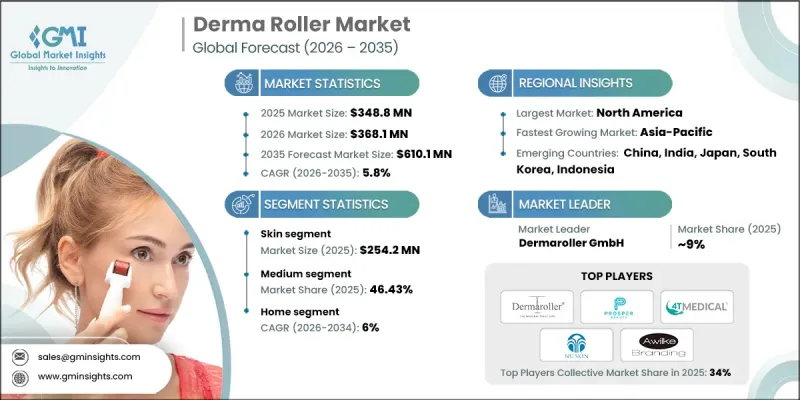
The market's expansion is fueled by increasing consumer awareness of skin rejuvenation, anti-aging treatments, and minimally invasive cosmetic procedures. Consumers are actively seeking solutions to improve skin texture, reduce fine lines, and achieve a more youthful appearance, making derma rollers a popular choice. These devices stimulate collagen production, supporting the treatment of acne scars, uneven skin tone, and other skin imperfections. Beauty clinics and dermatology centers increasingly recommend derma rollers as an adjunct to professional treatments and at-home skincare routines, enhancing overall efficacy. Social media, influencer promotions, and educational campaigns have further amplified awareness of these tools. The rising trend of preventive skincare, coupled with growing availability through retail outlets and e-commerce platforms, has made derma rollers more accessible to a wider audience, driving consistent market growth. Manufacturers now offer devices with various needle sizes and quality levels to cater to diverse skin concerns.
| Market Scope | |
|---|---|
| Start Year | 2025 |
| Forecast Year | 2026-2035 |
| Start Value | $348.8 Million |
| Forecast Value | $610.1 Million |
| CAGR | 5.8% |
The skin segment generated USD 254.2 million in 2025 and is expected to grow at a CAGR of 6.1% between 2026 and 2035. The segment's dominance stems from its widespread application in both dermatology and cosmetic care. Skin-focused derma rollers are primarily used to address acne scars, uneven skin tone, fine lines, and improve the absorption of topical serums. Strong adoption in dermatology clinics, aesthetic centers, and home-use settings supports this segment. Increasing consumer preference for minimally invasive treatments and heightened awareness of personal appearance management continue to drive the prominence of skin-targeted derma rollers.
The medium-price segment held a 46.43% share in 2025 and is projected to grow at a CAGR of 6% through 2035. Medium-priced derma rollers strike a balance between affordability and perceived quality, making them popular among both home users and professionals. These products typically feature reliable needle materials, consistent needle lengths, and sufficient durability. Consumers often associate medium-tier devices with better safety standards and dependable performance compared to low-cost alternatives, without the high costs of premium clinical devices. This combination of quality, reliability, and accessibility continues to drive demand within this segment.
U.S. Derma Roller Market reached USD 90.2 million in 2025 and is expected to grow at a CAGR of 5.1% from 2026 to 2035. Growth is fueled by strong demand from consumers seeking cost-effective alternatives to professional cosmetic procedures. Derma rollers help address skin concerns such as acne scarring, fine lines, and uneven skin texture while enhancing the absorption of serums and anti-aging treatments. Medical-grade derma rollers are also used in controlled clinical microneedling sessions, further supporting demand. Aesthetic clinics and dermatologists play a significant role in promoting these products, combining professional endorsement with home-use convenience.
Key players in the Global Derma Roller Market include Nu Skin Enterprises, Helios Lifestyle Pvt Ltd., 4T Medical Ltd., Dermaroller GmbH, C Cube Advanced Technologies, DS Healthcare Group Inc., ProsperBeauty, JJ Online Mall Ltd., Tecan Ltd., Awilke Biotech Co., Ltd., Mars by GHC, NEA BRANDS LLC, Sdara Skincare, Claster LLC, Linduray Skincare, and Daejong Medical Co., Ltd. Companies in the derma roller market are adopting multiple strategies to strengthen their presence and expand market share. Product innovation is a key focus, with firms introducing devices featuring improved needle technology, enhanced durability, and user-friendly designs. Strategic partnerships with dermatology clinics and aesthetic centers facilitate wider adoption and credibility. Expanding distribution networks, including e-commerce platforms and retail chains, ensures greater accessibility. Targeted marketing campaigns through social media, influencer collaborations, and educational initiatives raise consumer awareness.
Table of Contents
Chapter 1 Methodology & Scope
- 1.1 Market scope and definition
- 1.2 Research design
- 1.2.1 Research approach
- 1.2.2 Data collection methods
- 1.3 Data mining sources
- 1.3.1 Global
- 1.3.2 Regional/Country
- 1.4 Base estimates and calculations
- 1.4.1 Base year calculation
- 1.4.2 Key trends for market estimation
- 1.5 Primary research and validation
- 1.5.1 Primary sources
- 1.6 Forecast model
- 1.7 Research assumptions and limitations
Chapter 2 Executive Summary
- 2.1 Industry 360° synopsis
- 2.2 Key market trends
- 2.2.1 Regional
- 2.2.2 Burner design
- 2.2.3 Installation
- 2.2.4 Power Range
- 2.2.5 End Use Industry
- 2.3 CXO perspectives: Strategic imperatives
- 2.3.1 Key decision points for industry executives
- 2.3.2 Critical success factors for market players
- 2.4 Future outlook and strategic recommendations
Chapter 3 Industry Insights
- 3.1 Industry ecosystem analysis
- 3.1.1 Supplier landscape
- 3.1.2 Profit margin
- 3.1.3 Value addition at each stage
- 3.1.4 Factor affecting the value chain
- 3.2 Industry impact forces
- 3.2.1 Growth drivers
- 3.2.1.1 Rising awareness of skin rejuvenation and anti-aging treatments
- 3.2.1.2 Growth of e-commerce and online beauty product sales
- 3.2.1.3 Expansion of cosmetic and dermatology clinics offering micro-needling therapies
- 3.2.2 Pitfalls & Challenges
- 3.2.2.1 Risk of improper use leading to skin irritation or infection
- 3.2.2.2 High competition from alternative skin treatment devices
- 3.2.3 Opportunities
- 3.2.3.1 Rising demand for premium and multi-length needle derma rollers
- 3.2.3.2 Growing adoption in male grooming and diverse demographic segments
- 3.2.1 Growth drivers
- 3.3 Growth potential analysis
- 3.4 Future market trends
- 3.5 Technology and innovation landscape
- 3.5.1 Current technological trends
- 3.5.2 Emerging technologies
- 3.6 Price trends
- 3.6.1 By region
- 3.6.2 By product
- 3.7 Regulatory landscape
- 3.7.1 Standards and compliance requirements
- 3.7.2 Regional regulatory frameworks
- 3.7.3 Certification standards
- 3.8 Porter’s analysis
- 3.9 PESTEL analysis
Chapter 4 Competitive Landscape, 2025
- 4.1 Introduction
- 4.2 Company market share analysis
- 4.2.1 By Region
- 4.2.1.1 North America
- 4.2.1.2 Europe
- 4.2.1.3 Asia Pacific
- 4.2.1.4 Latin America
- 4.2.1.5 Middle East & Africa
- 4.2.1 By Region
- 4.3 Company matrix analysis
- 4.4 Competitive analysis of major market players
- 4.5 Competitive positioning matrix
- 4.6 Key developments
- 4.6.1 Mergers & acquisitions
- 4.6.2 Partnerships & collaborations
- 4.6.3 New product launches
- 4.6.4 Expansion plans
Chapter 5 Market Estimates & Forecast, By Type, 2022 - 2035, (USD Million) (Thousand Units)
- 5.1 Key trends
- 5.2 Skin
- 5.3 Hair
Chapter 6 Market Estimates & Forecast, By Price, 2022 - 2035, (USD Million) (Thousand Units)
- 6.1 Key trends
- 6.2 Low
- 6.3 Medium
- 6.4 High
Chapter 7 Market Estimates & Forecast, By Size, 2022 - 2035, (USD Million) (Thousand Units)
- 7.1 Key trends
- 7.2 0.2 mm - 0.5 mm
- 7.3 0.75 mm - 1.5 mm
- 7.4 1.5 mm - 2.5 mm
Chapter 8 Market Estimates & Forecast, By Application, 2022 - 2035, (USD Million) (Thousand Units)
- 8.1 Key trends
- 8.2 Home
- 8.3 Commercial
Chapter 9 Market Estimates & Forecast, By Distribution Channel, 2022 - 2035, (USD Million) (Thousand Units)
- 9.1 Key trends
- 9.2 Online channels
- 9.3 Offline channels
Chapter 10 Market Estimates & Forecast, By Region, 2022 - 2035, (USD Million) (Thousand Units)
- 10.1 Key trends
- 10.2 North America
- 10.2.1 U.S.
- 10.2.2 Canada
- 10.3 Europe
- 10.3.1 Germany
- 10.3.2 UK
- 10.3.3 France
- 10.3.4 Italy
- 10.3.5 Spain
- 10.4 Asia Pacific
- 10.4.1 China
- 10.4.2 India
- 10.4.3 Japan
- 10.4.4 South Korea
- 10.4.5 Australia
- 10.5 Latin America
- 10.5.1 Brazil
- 10.5.2 Mexico
- 10.5.3 Argentina
- 10.6 MEA
- 10.6.1 Saudi Arabia
- 10.6.2 UAE
- 10.6.3 South Africa
Chapter 11 Company Profiles
- 11.1 4T Medical Ltd.
- 11.2 Awilke Biotech Co., Ltd.
- 11.3 C Cube Advanced Technologies
- 11.4 Claster LLC Linduray Skincare
- 11.5 Daejong Medical Co., Ltd.
- 11.6 Dermaroller GmbH
- 11.7 DS Healthcare Group Inc.
- 11.8 Helios Lifestyle Pvt Ltd.
- 11.9 JJ online mall Ltd.
- 11.10 Mars by GHC
- 11.11 NEA BRANDS LLC
- 11.12 Nu Skin Enterprises
- 11.13 ProsperBeauty
- 11.14 Sdara Skincare
- 11.15 Tecan Ltd.

