
PUBLISHER: Global Market Insights Inc. | PRODUCT CODE: 2019187

PUBLISHER: Global Market Insights Inc. | PRODUCT CODE: 2019187
Hybrid Textile Market Opportunity, Growth Drivers, Industry Trend Analysis, and Forecast 2026 - 2035
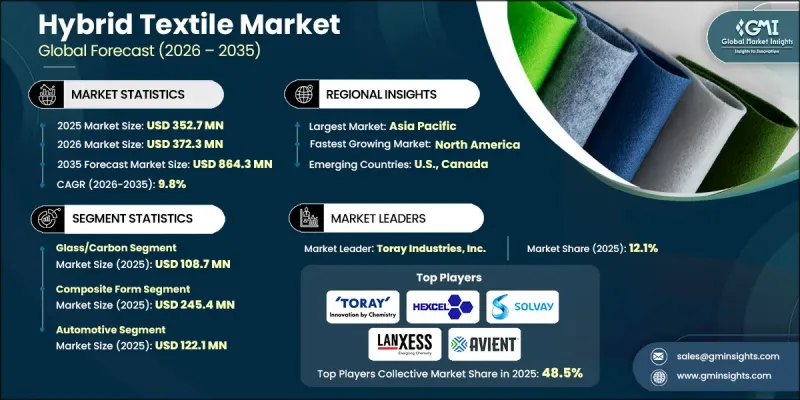
The Global Hybrid Textile Market was valued at USD 352.7 million in 2025 and is estimated to grow at a CAGR of 9.8% to reach USD 864.3 million by 2035.
Hybrid textiles refer to advanced fabric solutions that combine different fiber types, material compositions, and functional properties into a single structure. These materials are engineered to deliver enhanced performance, durability, comfort, and cost efficiency by integrating both natural and synthetic components. Their ability to offer multiple functional advantages within one fabric makes them increasingly attractive compared to conventional single-material textiles. Rising demand across industries is driven by the need for versatile materials capable of meeting diverse performance requirements without relying on entirely new fiber innovations. The balance of strength, flexibility, breathability, and resistance characteristics enables manufacturers to design tailored solutions for a wide range of applications. This adaptability supports usage across multiple industries, reinforcing the role of hybrid textiles as a key innovation in modern material science. Continuous progress in fiber blending techniques and fabric engineering, along with advancements in manufacturing technologies, is further strengthening the development and scalability of these materials.
| Market Scope | |
|---|---|
| Start Year | 2025 |
| Forecast Year | 2026-2035 |
| Start Value | $352.7 Million |
| Forecast Value | $864.3 Million |
| CAGR | 9.8% |
Advancements in production processes, including spinning, weaving, knitting, and bonding technologies, are enabling greater control over material composition and structural performance. These innovations allow manufacturers to precisely engineer fabrics that meet specific functional and performance requirements, enhancing the overall efficiency and application scope of hybrid textiles.
The glass/carbon segment accounted for USD 108.7 million in 2025. This segment is gaining traction due to its ability to deliver a balance of strength and stiffness while maintaining cost efficiency for industrial and structural uses. At the same time, glass/aramid combinations continue to see consistent demand, supported by their durability and resistance characteristics, making them suitable for applications requiring enhanced impact performance and long-term reliability.
The automotive segment reached USD 122.1 million in 2025. Increasing adoption of hybrid textiles in this segment is driven by the need for lightweight materials, improved durability, and multifunctional integration within structural and interior components. The aerospace sector is also expanding its use of hybrid textiles, leveraging their favorable strength-to-weight ratio, thermal stability, and structural dependability. In addition, broader transportation applications are incorporating these materials to improve vibration control, extend service life, and enhance material efficiency in structural and interior systems.
North America Hybrid Textile Market is anticipated to witness strong growth, increasing from USD 97.6 million in 2025 to USD 242.3 million by 2035. This regional expansion is supported by growing demand for multifunctional materials and continuous advancements in textile technologies. Manufacturers in the region are focusing on achieving an optimal balance of durability, comfort, and efficiency across various product categories. The United States market is experiencing rising adoption of hybrid textiles in both technical and industrial applications, driven by evolving performance requirements and ongoing material innovation trends.
Key companies operating in the Global Hybrid Textile Market include Solvay, LANXESS, TORAY INDUSTRIES, INC., Hexcel Corporation, Avient Corporation, COLAN AUSTRALIA, Exel Fabric, Rock West Fabric, Talon Technology, Urja Fabrics, and Quantum Fabric. Companies in the Global Hybrid Textile Market are strengthening their market presence through continuous innovation, strategic collaborations, and expansion of production capabilities. They are investing in research and development to enhance fiber integration techniques, improve material performance, and develop application-specific solutions. Partnerships with end-use industries are enabling the creation of customized products that meet evolving performance standards. Manufacturers are also optimizing their supply chains and scaling up production to achieve cost efficiency and meet growing demand. Additionally, firms are expanding into new geographic markets while focusing on sustainable material development and advanced manufacturing technologies to maintain competitiveness and support long-term growth.
Table of Contents
Chapter 1 Methodology & Scope
- 1.1 Market scope and definition
- 1.2 Research design
- 1.2.1 Research approach
- 1.2.2 Data collection methods
- 1.3 Data mining sources
- 1.3.1 Global
- 1.3.2 Regional/Country
- 1.4 Base estimates and calculations
- 1.4.1 Base year calculation
- 1.4.2 Key trends for market estimation
- 1.5 Primary research and validation
- 1.5.1 Primary sources
- 1.6 Forecast model
- 1.7 Research assumptions and limitations
Chapter 2 Executive Summary
- 2.1 Industry 360° synopsis
- 2.2 Key market trends
- 2.2.1 Form
- 2.2.2 Fiber Type
- 2.2.3 End Use
- 2.2.4 Regional
- 2.3 TAM Analysis, 2026-2035
- 2.4 CXO perspectives: Strategic imperatives
- 2.5 Future outlook and strategic recommendations
Chapter 3 Industry Insights
- 3.1 Industry ecosystem analysis
- 3.1.1 Supplier landscape
- 3.1.2 Profit margin
- 3.1.3 Value addition at each stage
- 3.1.4 Factor affecting the value chain
- 3.1.5 Disruptions
- 3.2 Industry impact forces
- 3.2.1 Growth drivers
- 3.2.1.1 Increasing demand for multifunctional and performance-based textile materials
- 3.2.1.2 Expansion of technical textiles across diverse industrial applications
- 3.2.1.3 Rising focus on material efficiency and functional integration
- 3.2.2 Pitfalls/challenge
- 3.2.2.1 Complex manufacturing processes increase production coordination challenges
- 3.2.2.2 Higher development costs restrict adoption among cost-sensitive buyers
- 3.2.3 Opportunities
- 3.2.3.1 Integration of smart functionalities within hybrid textile structures
- 3.2.3.2 Growing use of hybrid textiles in product design
- 3.2.1 Growth drivers
- 3.3 Growth potential analysis
- 3.4 Regulatory landscape
- 3.4.1 North America
- 3.4.2 Europe
- 3.4.3 Asia Pacific
- 3.4.4 Latin America
- 3.4.5 Middle East & Africa
- 3.5 Porter's analysis
- 3.6 PESTEL analysis
- 3.7 Technology and innovation landscape
- 3.7.1 Current technological trends
- 3.7.2 Emerging technologies
- 3.8 Price trends
- 3.8.1 By region
- 3.8.2 By form
- 3.9 Future market trends
- 3.10 Technology and innovation landscape
- 3.10.1 Current technological trends
- 3.10.2 Emerging technologies
- 3.11 Patent landscape
- 3.12 Trade statistics (HS code)
- 3.12.1 Major importing countries
- 3.12.2 Major exporting countries
- 3.13 Sustainability and environmental aspects
- 3.13.1 Sustainable practices
- 3.13.2 Waste reduction strategies
- 3.13.3 Energy efficiency in production
- 3.13.4 Eco-friendly initiatives
- 3.14 Carbon footprint consideration
Chapter 4 Competitive Landscape, 2025
- 4.1 Introduction
- 4.2 Company market share analysis
- 4.2.1 By region
- 4.2.1.1 North America
- 4.2.1.2 Europe
- 4.2.1.3 Asia Pacific
- 4.2.1.4 LATAM
- 4.2.1.5 MEA
- 4.2.1 By region
- 4.3 Company matrix analysis
- 4.4 Competitive analysis of major market players
- 4.5 Competitive positioning matrix
- 4.6 Key developments
- 4.6.1 Mergers & acquisitions
- 4.6.2 Partnerships & collaborations
- 4.6.3 New product launches
- 4.6.4 Expansion plans
Chapter 5 Market Estimates and Forecast, By Form, 2022-2035 (USD Million) (Kilo Tons)
- 5.1 Key trends
- 5.2 Composite form
- 5.3 Non-composite form
Chapter 6 Market Estimates and Forecast, By Fiber Type, 2022-2035 (USD Million) (Kilo Tons)
- 6.1 Key trends
- 6.2 Glass/carbon
- 6.3 Glass/aramid
- 6.4 Carbon/UHMWPE
- 6.5 Carbon/aramid
- 6.6 Others (basalt/carbon, glass/nylon)
Chapter 7 Market Estimates and Forecast, By End Use, 2022-2035 (USD Million) (Kilo Tons)
- 7.1 Key trends
- 7.2 Automotive
- 7.3 Aerospace
- 7.4 Transportation
- 7.5 Construction
- 7.6 Consumer goods
- 7.7 Others (energy, marine)
Chapter 8 Market Estimates and Forecast, By Region, 2022-2035 (USD Million) (Kilo Tons)
- 8.1 Key trends
- 8.2 North America
- 8.2.1 U.S.
- 8.2.2 Canada
- 8.3 Europe
- 8.3.1 Germany
- 8.3.2 UK
- 8.3.3 France
- 8.3.4 Spain
- 8.3.5 Italy
- 8.3.6 Rest of Europe
- 8.4 Asia Pacific
- 8.4.1 China
- 8.4.2 India
- 8.4.3 Japan
- 8.4.4 Australia
- 8.4.5 South Korea
- 8.4.6 Rest of Asia Pacific
- 8.5 Latin America
- 8.5.1 Brazil
- 8.5.2 Mexico
- 8.5.3 Argentina
- 8.5.4 Rest of Latin America
- 8.6 Middle East and Africa
- 8.6.1 Saudi Arabia
- 8.6.2 South Africa
- 8.6.3 UAE
- 8.6.4 Rest of Middle East and Africa
Chapter 9 Company Profiles
- 9.1 TORAY INDUSTRIES, INC.
- 9.2 Avient Corporation
- 9.3 COLAN AUSTRALIA
- 9.4 Exel Fabric
- 9.5 Hexcel Corporation
- 9.6 LANXESS
- 9.7 Quantum Fabric
- 9.8 Rock West Fabric
- 9.9 Solvay
- 9.10 Talon Technology
- 9.11 Urja Fabrics

