
PUBLISHER: Global Market Insights Inc. | PRODUCT CODE: 1822554

PUBLISHER: Global Market Insights Inc. | PRODUCT CODE: 1822554
Military Protective Eyewear Market Opportunity, Growth Drivers, Industry Trend Analysis, and Forecast 2025 - 2034
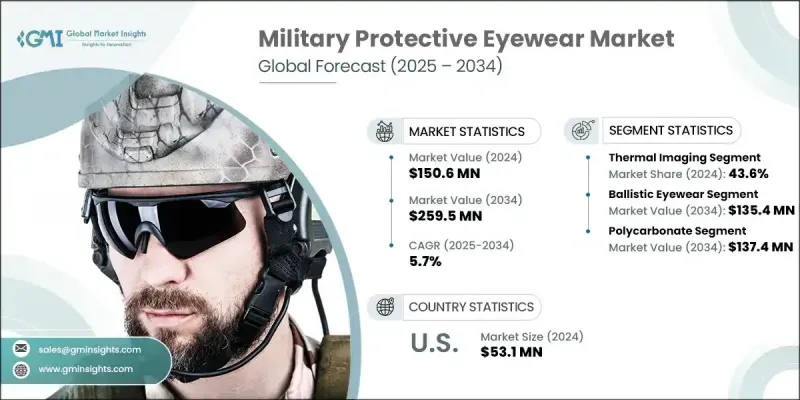
The Global Military Protective Eyewear Market was valued at USD 150.6 million in 2024 and is estimated to grow at a CAGR of 5.7% to reach USD 259.5 million by 2034.
Rising military budgets across nations and increasing integration of smart technologies such as augmented reality into combat systems are key factors driving market demand. Military organizations are placing higher importance on soldier safety and operational readiness, leading to increased focus on advanced eyewear. Procurement patterns are evolving toward long-term partnerships that prioritize lifecycle cost-efficiency, sustained performance, and continuous R&D in protective eyewear systems. Armed forces are collaborating with private tech developers to advance innovations via joint programs, especially for next-gen tactical optics. There's also a rising interest in additive manufacturing and rapid prototyping techniques, enabling on-demand creation of eyewear parts in mobile field environments. These advancements are reshaping logistics strategies and are expected to become central to future operations, particularly among special forces, by the next decade.
| Market Scope | |
|---|---|
| Start Year | 2024 |
| Forecast Year | 2025-2034 |
| Start Value | $150.6 Million |
| Forecast Value | $259.5 Million |
| CAGR | 5.7% |
The thermal imaging systems held a 43.6% share in 2024. The adoption of thermal optics is rising in operations requiring visibility in low-light or obscured conditions, such as night missions, reconnaissance, and target tracking. With a push to reduce the size and weight of components, developers are working on compact thermal modules that integrate with helmets and AR-enabled headgear. Manufacturers are encouraged to innovate lightweight thermal units that maintain low power consumption and work seamlessly with heads-up displays. These enhanced systems are becoming essential tools for elite combat units who require efficient, tech-enabled field vision without compromising comfort or battery performance during extended missions.
The ballistic protective eyewear segment will reach USD 135.4 million by 2034. This segment is witnessing higher uptake due to escalating exposure to high-velocity threats, blast debris, and hostile projectiles in active combat zones. Lighter frame designs, modular fit options, and upgraded lenses with high-impact resistance are all contributing to product appeal. Compliance with updated military and safety certification standards is helping drive product deployment across global defense forces. Widespread implementation of standards like MIL-PRF and ANSI Z87.1+ is accelerating across defense agencies. To retain a competitive edge, companies in this segment are increasingly focused on developing interchangeable lens platforms and working toward high-grade impact compliance to win multi-year government supply contracts.
North America Military Protective Eyewear Market held 42.4% share in 2024 and is expected to grow at a CAGR of 6.7% through 2034. A strong culture of defense spending, robust innovation ecosystems, and early tech adoption in protective gear have allowed the region to maintain leadership. Defense modernization initiatives and evolving battlefield requirements are pushing procurement of advanced protective optics, including laser-resistant, ballistic-grade, and AR-integrated eyewear. The region's focus on warfighter survivability, combined with extensive R&D support, is laying the groundwork for next-gen eyewear capable of enhancing situational awareness, real-time targeting, and threat mitigation under varied environmental conditions.
Key players shaping the Global Military Protective Eyewear Market landscape include Honeywell, Oakley, Wiley X, 3M, and Revision Military. Leading companies in the military protective eyewear market are focusing on multi-faceted strategies to solidify their presence. Prioritizing R&D investment, they are designing lightweight, modular systems with enhanced ballistic and optical capabilities to meet the specific needs of evolving military operations. Several firms are aligning with government procurement protocols and certifications to secure high-value, long-term defense contracts. Strategic collaborations with tech partners are also enabling the integration of AR, thermal, and HUD systems into eyewear. Companies are expanding their footprint in high-spending regions by establishing supply chain hubs and regional manufacturing units to ensure consistent delivery
Table of Contents
Chapter 1 Methodology
- 1.1 Market scope and definition
- 1.2 Research design
- 1.2.1 Research approach
- 1.2.2 Data collection methods
- 1.3 Data mining sources
- 1.3.1 Global
- 1.3.2 Regional/Country
- 1.4 Base estimates and calculations
- 1.4.1 Base year calculation
- 1.4.2 Key trends for market estimation
- 1.5 Primary research and validation
- 1.5.1 Primary sources
- 1.6 Forecast model
- 1.7 Research assumptions and limitations
Chapter 2 Executive Summary
- 2.1 Industry 360° synopsis, 2021 - 2034
- 2.2 Key market trends
- 2.2.1 Product type trends
- 2.2.2 Material trends
- 2.2.3 Technology trends
- 2.2.4 End use application trends
- 2.2.5 Regional trends
- 2.3 TAM analysis, 2025-2034
- 2.4 CXO perspectives: Strategic imperatives
- 2.4.1 Executive decision points
- 2.4.2 Critical success factors
- 2.5 Future outlook and strategic recommendations
Chapter 3 Industry Insights
- 3.1 Industry ecosystem analysis
- 3.1.1 Supplier landscape
- 3.1.2 Profit margin analysis
- 3.1.3 Cost structure
- 3.1.4 Value addition at each stage
- 3.1.5 Factor affecting the value chain
- 3.1.6 Disruptions
- 3.2 Industry impact forces
- 3.2.1 Growth drivers
- 3.2.1.1 Rising global defense expenditures
- 3.2.1.2 Military modernization and equipment upgrades
- 3.2.1.3 Integration of augmented reality and smart eyewear systems
- 3.2.1.4 Adoption of lightweight and ergonomic designs
- 3.2.1.5 Rising procurement from law enforcement and paramilitary forces
- 3.2.2 Industry pitfalls and challenges
- 3.2.2.1 High costs of advanced protective eyewear
- 3.2.2.2 Budget constraints in developing nations
- 3.2.3 Market opportunities
- 3.2.3.1 Integration into soldier modernization programs
- 3.2.3.2 Growing demand from law enforcement and homeland security
- 3.2.3.3 Advancements in material science and lens technology
- 3.2.3.4 Increased focus on laser and radiation eye protection
- 3.2.1 Growth drivers
- 3.3 Growth potential analysis
- 3.4 Regulatory landscape
- 3.4.1 North America
- 3.4.2 Europe
- 3.4.3 Asia Pacific
- 3.4.4 Latin America
- 3.4.5 Middle East & Africa
- 3.5 Porter's analysis
- 3.6 PESTEL analysis
- 3.7 Technology and Innovation landscape
- 3.7.1 Current technological trends
- 3.7.2 Emerging technologies
- 3.8 Emerging business models
- 3.9 Compliance requirements
- 3.10 Defense budget analysis
- 3.11 Global defense spending trends
- 3.12 Regional defense budget allocation
- 3.12.1 North America
- 3.12.2 Europe
- 3.12.3 Asia Pacific
- 3.12.4 Middle East and Africa
- 3.12.5 Latin America
- 3.13 Key defense modernization programs
- 3.14 Budget forecast (2025-2034)
- 3.14.1 Impact on industry growth
- 3.14.2 Defense budgets by country
- 3.15 Supply chain resilience
- 3.16 Geopolitical analysis
- 3.17 Workforce analysis
- 3.18 Digital transformation
- 3.19 Mergers, acquisitions, and strategic partnerships landscape
- 3.20 Risk assessment and management
- 3.21 Major contract awards (2021-2024)
Chapter 4 Competitive Landscape, 2024
- 4.1 Introduction
- 4.2 Company market share analysis
- 4.2.1 By region
- 4.2.1.1 North America
- 4.2.1.2 Europe
- 4.2.1.3 Asia Pacific
- 4.2.1.4 Latin America
- 4.2.1.5 Middle East & Africa
- 4.2.1 By region
- 4.3 Competitive benchmarking of key players
- 4.3.1 Financial performance comparison
- 4.3.1.1 Revenue
- 4.3.1.2 Profit margin
- 4.3.1.3 R&D
- 4.3.2 Product portfolio comparison
- 4.3.2.1 Product range breadth
- 4.3.2.2 Technology
- 4.3.2.3 Innovation
- 4.3.3 Geographic presence comparison
- 4.3.3.1 Global footprint analysis
- 4.3.3.2 Service network coverage
- 4.3.3.3 Market penetration by region
- 4.3.4 Competitive positioning matrix
- 4.3.4.1 Leaders
- 4.3.4.2 Challengers
- 4.3.4.3 Followers
- 4.3.4.4 Niche players
- 4.3.5 Strategic outlook matrix
- 4.3.1 Financial performance comparison
- 4.4 Key developments, 2021-2024
- 4.4.1 Mergers and acquisitions
- 4.4.2 Partnerships and collaborations
- 4.4.3 Technological advancements
- 4.4.4 Expansion and investment strategies
- 4.4.5 Sustainability initiatives
- 4.4.6 Digital transformation initiatives
- 4.5 Emerging/ startup competitors landscape
Chapter 5 Market Estimates and Forecast, By Product Type, 2021 - 2034 (USD Million & Thousand Units)
- 5.1 Key trends
- 5.2 Ballistic eyewear
- 5.3 Laser protection eyewear
- 5.4 Chemical and biological protection eyewear
- 5.5 Night vision-compatible eyewear
- 5.6 Standard protective eyewear
- 5.7 Others
Chapter 6 Market Estimates and Forecast, By Material, 2021 - 2034 (USD Million & Thousand Units)
- 6.1 Key trends
- 6.2 Quartz
- 6.3 Polycarbonate
- 6.4 Glass Fiber
- 6.5 Sapphire
- 6.6 Others
Chapter 7 Market Estimates and Forecast, By Technology, 2021 - 2034 (USD Million & Thousand Units)
- 7.1 Key trends
- 7.2 Thermal imaging
- 7.3 Image intensifier
Chapter 8 Market Estimates and Forecast, By End Use Application, 2021 - 2034 (USD Million & Thousand Units)
- 8.1 Key trends
- 8.2 Gunner sights
- 8.3 Naval trackers
- 8.4 Driving sights
- 8.5 Infantry weapon sight
- 8.6 Others
Chapter 9 Market Estimates & Forecast, By Region, 2021 - 2034 (Million & Thousand Units)
- 9.1 Key trends
- 9.2 North America
- 9.2.1 U.S.
- 9.2.2 Canada
- 9.3 Europe
- 9.3.1 Germany
- 9.3.2 UK
- 9.3.3 France
- 9.3.4 Italy
- 9.3.5 Spain
- 9.3.6 Netherlands
- 9.4 Asia Pacific
- 9.4.1 China
- 9.4.2 India
- 9.4.3 Japan
- 9.4.4 Australia
- 9.4.5 South Korea
- 9.5 Latin America
- 9.5.1 Brazil
- 9.5.2 Mexico
- 9.5.3 Argentina
- 9.6 MEA
- 9.6.1 South Africa
- 9.6.2 Saudi Arabia
- 9.6.3 UAE
Chapter 10 Company Profiles
- 10.1 Global Key Players
- 10.1.1 3M
- 10.1.2 Honeywell International
- 10.1.3 Oakley
- 10.1.4 Revision Military
- 10.1.5 Wiley X
- 10.2 Regional Key Players
- 10.2.1 North America
- 10.2.1.1 ESS Eyewear
- 10.2.1.2 Gentex
- 10.2.1.3 Smith Optics
- 10.2.2 Europe
- 10.2.2.1 BAE Systems
- 10.2.2.2 Bolle Safety
- 10.2.2.3 Thales
- 10.2.3 APAC
- 10.2.3.1 Bharat Electronics
- 10.2.3.2 Day Sun Industrial
- 10.2.3.3 Univet Optical Technologies
- 10.2.1 North America
- 10.3 Niche Players / Disruptors
- 10.3.1 Elbit Systems
- 10.3.2 Kentek
- 10.3.3 Meopta
- 10.3.4 NoIR Laser
- 10.3.5 Philips Safety Products
- 10.3.6 Uvex Safety Group

