
PUBLISHER: Global Market Insights Inc. | PRODUCT CODE: 1858836

PUBLISHER: Global Market Insights Inc. | PRODUCT CODE: 1858836
Europe Calciners Market Opportunity, Growth Drivers, Industry Trend Analysis, and Forecast 2025 - 2034
Europe Calciners Market was valued at USD 966.7 million in 2024 and is estimated to grow at a CAGR of 7.2% to reach USD 1.86 billion by 2034.
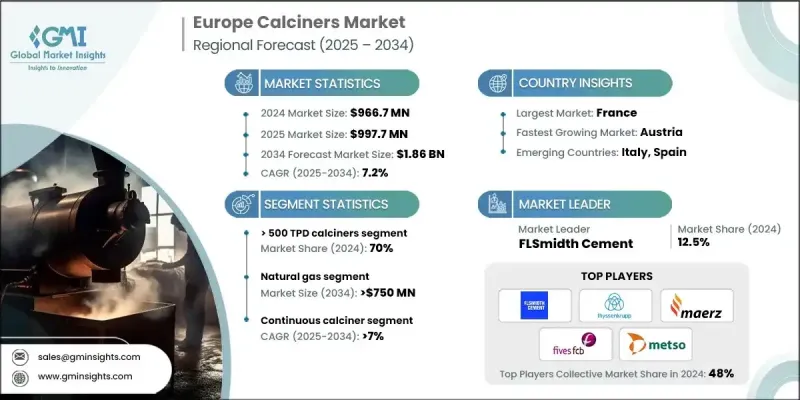
The market is experiencing growth due to the expansion of industrial activities in sectors like cement, lime, and chemicals. Increased demand for infrastructure development and construction projects is driving this growth. Calciners, which are essential for heating solid materials to high temperatures in controlled environments, play a critical role in ensuring consistent product quality, improving production throughput, and minimizing operational inefficiencies. These heating units are vital in sectors such as cement, lime, and specialty mineral production, helping to optimize energy efficiency and improve product consistency. Their role in providing precise temperature control and uniform heat distribution supports superior material properties. The market is also benefiting from rising demand in non-traditional applications such as automotive, pharmaceutical, and agrochemical industries. Additionally, with increasing energy prices across Europe, there is a rising focus on adopting energy-efficient calcination solutions to minimize costs. Government support for sustainable construction practices further boosts the market's expansion.
| Market Scope | |
|---|---|
| Start Year | 2024 |
| Forecast Year | 2025-2034 |
| Start Value | $966.7 Million |
| Forecast Value | $1.86 Billion |
| CAGR | 7.2% |
The > 100 TPD - 500 TPD segment is projected to reach USD 300 million by 2034. This segment primarily serves medium-scale producers in cement, lime, and specialty minerals who are looking for a balance between energy optimization, throughput, and operational efficiency. These units are favored for their ability to provide consistent performance while maintaining precise temperature control, making them ideal for industrial sectors that prioritize both quality and sustainability. As regional construction and industrial activities continue to grow, the demand for mid-capacity calciners is expected to rise.
In 2024, the natural gas-fired calciners segment held a 42.4% share and is anticipated to reach USD 750 million by 2034. Their popularity is largely due to the cleaner combustion process, high thermal efficiency, and cost-effectiveness they offer compared to other fuels. With the increasing pressure on industries to reduce carbon emissions and comply with stringent environmental regulations, natural gas remains the preferred fuel for calcination processes, especially in sectors like cement and lime. The demand for energy-efficient and sustainable production methods further drives the adoption of these calciners.
UK Calciners Market is projected to reach USD 225 million by 2034, driven by an increase in demand for calciners across cement, lime, and specialty mineral industries. Government initiatives aimed at promoting sustainable manufacturing, infrastructure updates, and green building projects are fueling investments in advanced calcination technologies. These technologies not only boost energy efficiency but also help reduce emissions, contributing to the market's upward trajectory.
Key players in the Europe Calciners Market include companies such as FLSmidth Cement, FEECO International, ANDRITZ GROUP, Bonis Kilns, and Carrier Europe, along with others like Cimprogetti, Metso, and THERM-TECH GROUP. These companies are constantly innovating to cater to the evolving needs of the market. To secure their position in the competitive Europe Calciners Market, companies are adopting several strategies. They focus on providing energy-efficient solutions to help customers reduce operational costs, particularly in response to rising energy prices. Many companies are also investing in advanced technologies, such as automated systems that ensure more precise control over the calcination process, leading to improved product quality and energy savings. Additionally, companies are expanding their product offerings to include a variety of calcination systems tailored to different industrial needs. Partnerships with key players in the cement, lime, and specialty mineral industries are helping companies secure long-term contracts and enhance their market reach.
Table of Contents
Chapter 1 Methodology & Scope
- 1.1 Research design
- 1.1.1 Research approach
- 1.1.2 Data collection methods
- 1.2 Base estimates and calculations
- 1.2.1 Base year calculation
- 1.2.2 Market estimates & forecast parameters
- 1.3 Forecast model
- 1.3.1 Key trends for market estimates
- 1.3.2 Quantified market impact analysis
- 1.3.2.1 Mathematical impact of growth parameters on forecast
- 1.3.3 Scenario analysis framework
- 1.4 Primary research and validation
- 1.4.1 Some of the primary sources (but not limited to)
- 1.5 Data mining sources
- 1.5.1 Paid Sources
- 1.5.2 Sources, by region
- 1.6 Research trail & scoring components
- 1.6.1 Research trail components
- 1.6.2 Scoring components
- 1.7 Research transparency addendum
- 1.7.1 Source attribution framework
- 1.7.2 Quality assurance metrics
- 1.7.3 Our commitment to trust
- 1.8 Market definitions
Chapter 2 Executive Summary
- 2.1 Industry synopsis, 2021 - 2034
- 2.1.1 Business trends
- 2.1.2 Capacity trends
- 2.1.3 Fuel trends
- 2.1.4 Application trends
- 2.1.5 Process mode trends
- 2.1.6 Technology trends
- 2.1.7 Country trends
Chapter 3 Industry Insights
- 3.1 Industry ecosystem analysis
- 3.1.1 Raw material availability & sourcing analysis
- 3.1.2 Manufacturing capacity assessment
- 3.1.3 Supply chain resilience & risk factors
- 3.1.4 Distribution network analysis
- 3.2 Regulatory landscape
- 3.3 Industry impact forces
- 3.3.1 Growth drivers
- 3.3.2 Industry pitfalls & challenges
- 3.4 Growth potential analysis
- 3.5 Porter's analysis
- 3.5.1 Bargaining power of suppliers
- 3.5.2 Bargaining power of buyers
- 3.5.3 Threat of new entrants
- 3.5.4 Threat of substitutes
- 3.6 PESTEL analysis
- 3.6.1 Political factors
- 3.6.2 Economic factors
- 3.6.3 Social factors
- 3.6.4 Technological factors
- 3.6.5 Legal factors
- 3.6.6 Environmental factors
- 3.7 Cost structure analysis of calciners
- 3.8 Price trend analysis (USD/Unit)
- 3.8.1 By capacity
- 3.8.2 By fuel
- 3.9 Emerging opportunities & industry trends
- 3.10 Investment insights and future growth prospects
- 3.11 Digital transformation & industry 4.0 implementation
- 3.12 Sustainability strategies and regulatory compliance
Chapter 4 Competitive Landscape, 2025
- 4.1 Introduction
- 4.2 Strategic dashboard
- 4.3 Strategic initiatives
- 4.3.1 Key partnerships & collaborations
- 4.3.2 Major M&A activities
- 4.3.3 Product innovations & launches
- 4.3.4 Market expansion strategies
- 4.4 Competitive benchmarking
- 4.5 Innovation & sustainability landscape
Chapter 5 Market Size and Forecast, By Capacity, 2021 - 2034 (USD Million & Units)
- 5.1 Key trends
- 5.2 ≤ 100 TPD
- 5.3 > 100 TPD - 500 TPD
- 5.4 > 500 TPD
Chapter 6 Market Size and Forecast, By Fuel, 2021 - 2034 (USD Million & Units)
- 6.1 Key trends
- 6.2 Natural gas
- 6.3 Oil
- 6.4 Biomass
- 6.5 Electric
- 6.6 Others
Chapter 7 Market Size and Forecast, By Application, 2021 - 2034 (USD Million & Units)
- 7.1 Key trends
- 7.2 Food processing
- 7.3 Pulp & paper
- 7.4 Chemical
- 7.5 Refinery
- 7.6 Primary metal
- 7.7 Cement
- 7.8 Others
Chapter 8 Market Size and Forecast, By Process Mode, 2021 - 2034 (USD Million & Units)
- 8.1 Key trends
- 8.2 Continuous
- 8.3 Batch
Chapter 9 Market Size and Forecast, By Technology, 2021 - 2034 (USD Million & Units)
- 9.1 Key trends
- 9.2 Rotary
- 9.3 Fluidized bed
- 9.4 Shaft/vertical
- 9.5 Flash/spray
- 9.6 Tunnel/conveyor
- 9.7 Hybrid/multi-stage
Chapter 10 Market Size and Forecast, By Country, 2021 - 2034 (USD Million & Units)
- 10.1 Key trends
- 10.2 France
- 10.3 UK
- 10.4 Poland
- 10.5 Italy
- 10.6 Spain
- 10.7 Austria
- 10.8 Germany
- 10.9 Sweden
Chapter 11 Company Profiles
- 11.1 ANDRITZ GROUP
- 11.2 Bonis Kilns S.A.
- 11.3 Carrier Europe
- 11.4 Cimprogetti
- 11.5 FEECO International
- 11.6 Fives FCB
- 11.7 FLSmidth Cement A/S
- 11.8 Helmut ROHDE GmbH
- 11.9 IDRECO S.r.l.
- 11.10 IKN GmbH
- 11.11 Kilncare Ltd.
- 11.12 KITTEC
- 11.13 Langley Holdings plc
- 11.14 Maerz
- 11.15 Metso
- 11.16 Nabertherm GmbH
- 11.17 Northern Kilns Ltd.
- 11.18 ONEJOON
- 11.19 Potclays Ltd.
- 11.20 Potterycrafts Ltd.
- 11.21 Riedhammer GmbH
- 11.22 SACMI
- 11.23 THERM-TECH GROUP
- 11.24 thyssenkrupp Polysius GmbH

