
PUBLISHER: Global Market Insights Inc. | PRODUCT CODE: 1858851

PUBLISHER: Global Market Insights Inc. | PRODUCT CODE: 1858851
Ionic Liquids for Battery Applications Market Opportunity, Growth Drivers, Industry Trend Analysis, and Forecast 2025 - 2034
The Global Ionic Liquids for Battery Applications Market was valued at USD 111 million in 2024 and is estimated to grow at a CAGR of 10.2% to reach USD 314.2 million by 2034.
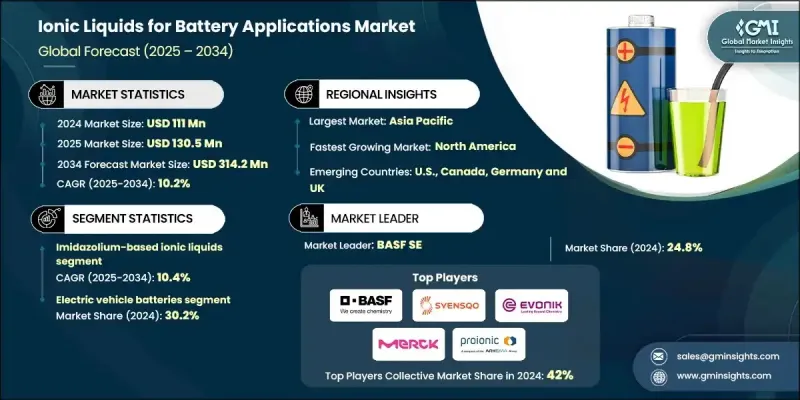
Rising demand for advanced energy storage systems is fueling market expansion. Ionic liquids, known as organic salts in liquid form at low temperatures, are recognized for their outstanding ionic conductivity, high thermal stability, low volatility, and broad electrochemical windows. These properties make them highly suitable as electrolytes in various battery types, including lithium-ion, sodium-ion, and solid-state formats. Their ability to enable high-voltage operation and maintain performance across wide temperature ranges makes them especially valuable in electric vehicles, renewable energy storage, and portable electronics. Growing adoption of electric mobility and the increasing use of renewables in the power grid are driving the need for safer, longer-lasting batteries further elevating the relevance of ionic liquid electrolytes. Ongoing innovations are focusing on improving conductivity and reducing manufacturing costs, which continues to support market acceleration. As more industries seek reliable, high-performance battery technologies, ionic liquids are gaining significant traction for their ability to extend battery lifespan and enhance safety across diverse use cases.
| Market Scope | |
|---|---|
| Start Year | 2024 |
| Forecast Year | 2025-2034 |
| Start Value | $111 Million |
| Forecast Value | $314.2 Million |
| CAGR | 10.2% |
The imidazolium-based ionic liquids segment held a substantial 45.2% share in 2024. Their widespread commercial availability and production scalability give them a distinct edge in maintaining cost efficiency and reliable supply. These factors, along with ongoing research investments, are helping imidazolium compounds maintain their dominance across multiple battery chemistries. The segment is expected to receive further momentum through consistent R&D support aimed at unlocking even greater efficiency and versatility in energy storage systems.
The electric vehicle batteries segment held a 30.2% share in 2024. This share is driven by the continued transition to e-mobility and heightened safety expectations within the automotive sector. The expansion of EV production, stricter regulatory frameworks, and consumer preferences for better battery performance are all contributing to growth in this segment. With next-generation battery technologies under development, many automotive manufacturers are allocating significant resources toward adopting ionic liquid electrolytes to improve battery safety and functionality.
North America Ionic Liquids for Battery Applications Market held a 28.2% share in 2024, as demand for battery-related ionic liquids continues to rise across the region. This growth is being propelled by the widespread adoption of electric vehicles, integration of clean energy sources, and an increasing emphasis on grid stability. Technological innovation, alongside government initiatives to support advanced energy storage infrastructure, is contributing to the rising use of ionic liquids. The region remains highly responsive to new energy technologies, creating favorable conditions for sustained market development.
Key companies actively shaping the Global Ionic Liquids for Battery Applications Market include Solvionic SA, Merck KGaA, Richman Chemical Inc., Syensqo, NOHMs Technologies, Inc., Evonik Industries AG, BASF SE, Proionic GmbH - Arkema Group, Tokyo Chemical Industry Co., Ltd., and IoLiTec - Ionic Liquids Technologies GmbH. To strengthen their position, companies are focusing on key strategies such as expanding their product portfolios with custom-formulated ionic liquids tailored to different battery chemistries. Many are prioritizing cost reduction through process innovation and scaling production to improve commercial viability. Collaborative R&D initiatives with battery developers and OEMs are also being pursued to speed up the integration of ionic liquids into emerging battery technologies.
Table of Contents
Chapter 1 Methodology & Scope
- 1.1 Market scope and definition
- 1.2 Research design
- 1.2.1 Research approach
- 1.2.2 Data collection methods
- 1.3 Data mining sources
- 1.3.1 Global
- 1.3.2 Regional/Country
- 1.4 Base estimates and calculations
- 1.4.1 Base year calculation
- 1.4.2 Key trends for market estimation
- 1.5 Primary research and validation
- 1.5.1 Primary sources
- 1.6 Forecast model
- 1.7 Research assumptions and limitations
Chapter 2 Executive Summary
- 2.1 Industry 360° synopsis
- 2.2 Key market trends
- 2.2.1 Regional
- 2.2.2 Ionic liquids type
- 2.2.3 Application
- 2.3 TAM Analysis, 2025-2034
- 2.4 CXO perspectives: Strategic imperatives
- 2.4.1 Executive decision points
- 2.4.2 Critical success factors
- 2.5 Future Outlook and Strategic Recommendations
Chapter 3 Industry Insights
- 3.1 Industry ecosystem analysis
- 3.1.1 Supplier landscape
- 3.1.2 Profit margin
- 3.1.3 Value addition at each stage
- 3.1.4 Factor affecting the value chain
- 3.1.5 Disruptions
- 3.2 Industry impact forces
- 3.2.1 Growth drivers
- 3.2.2 Industry pitfalls and challenges
- 3.2.3 Market opportunities
- 3.3 Growth potential analysis
- 3.4 Regulatory landscape
- 3.4.1 North America
- 3.4.2 Europe
- 3.4.3 Asia Pacific
- 3.4.4 Latin America
- 3.4.5 Middle East & Africa
- 3.5 Porter's analysis
- 3.6 PESTEL analysis
- 3.7 Price trends
- 3.7.1 By region
- 3.7.2 By application
- 3.8 Future market trends
- 3.9 Technology and Innovation landscape
- 3.9.1 Current technological trends
- 3.9.2 Emerging technologies
- 3.10 Patent Landscape
- 3.11 Trade statistics (HS code Note: the trade statistics will be provided for key countries only)
- 3.11.1 Major importing countries
- 3.11.2 Major exporting countries
- 3.12 Sustainability and environmental aspects
- 3.12.1 Sustainable practices
- 3.12.2 Waste reduction strategies
- 3.12.3 Energy efficiency in production
- 3.12.4 Eco-friendly initiatives
- 3.13 Carbon footprint consideration
Chapter 4 Competitive Landscape, 2024
- 4.1 Introduction
- 4.2 Company market share analysis
- 4.2.1 By region
- 4.2.1.1 North America
- 4.2.1.2 Europe
- 4.2.1.3 Asia Pacific
- 4.2.1.4 LATAM
- 4.2.1.5 MEA
- 4.2.1 By region
- 4.3 Company matrix analysis
- 4.4 Competitive analysis of major market players
- 4.5 Competitive positioning matrix
- 4.6 Key developments
- 4.6.1 Mergers & acquisitions
- 4.6.2 Partnerships & collaborations
- 4.6.3 New Product Launches
- 4.6.4 Expansion Plans
Chapter 5 Market Estimates and Forecast, By Ionic Liquids Type, 2021-2034 (USD Million & Tons)
- 5.1 Key trends
- 5.2 Imidazolium-based ionic liquids
- 5.3 Pyrrolidinium-based ionic liquids
- 5.4 Phosphonium-based ionic liquids
- 5.5 Quaternary ammonium-based ionic liquids
Chapter 6 Market Estimates and Forecast, By Application, 2021-2034 (USD Million & Tons)
- 6.1 Key trends
- 6.2 Electric vehicle batteries
- 6.2.1 Automotive traction batteries
- 6.2.2 Hybrid vehicle systems
- 6.2.3 Fast charging applications
- 6.3 Grid energy storage
- 6.3.1 Utility-scale storage systems
- 6.3.2 Frequency regulation applications
- 6.3.3 Long-duration storage solutions
- 6.4 Consumer electronics
- 6.4.1 Smartphone applications
- 6.4.2 Laptop & portable devices
- 6.4.3 Wearable technology
- 6.5 Aerospace & defense
- 6.5.1 Satellite battery systems
- 6.5.2 Military applications
Chapter 7 Market Estimates and Forecast, By Region, 2021-2034 (USD Million & Tons)
- 7.1 Key trends
- 7.2 North America
- 7.2.1 U.S.
- 7.2.2 Canada
- 7.3 Europe
- 7.3.1 Germany
- 7.3.2 UK
- 7.3.3 France
- 7.3.4 Spain
- 7.3.5 Italy
- 7.3.6 Rest of Europe
- 7.4 Asia Pacific
- 7.4.1 China
- 7.4.2 India
- 7.4.3 Japan
- 7.4.4 Australia
- 7.4.5 South Korea
- 7.4.6 Rest of Asia Pacific
- 7.5 Latin America
- 7.5.1 Brazil
- 7.5.2 Mexico
- 7.5.3 Argentina
- 7.5.4 Rest of Latin America
- 7.6 Middle East and Africa
- 7.6.1 Saudi Arabia
- 7.6.2 South Africa
- 7.6.3 UAE
- 7.6.4 Rest of Middle East and Africa
Chapter 8 Company Profiles
- 8.1 BASF SE
- 8.2 Syensqo
- 8.3 Evonik Industries AG
- 8.4 Merck KGaA
- 8.5 Proionic GmbH - Arkema Group
- 8.6 Solvionic SA
- 8.7 IoLiTec - Ionic Liquids Technologies GmbH
- 8.8 Tokyo Chemical Industry Co., Ltd.
- 8.9 NOHMs Technologies, Inc.
- 8.10 Richman Chemical Inc.

