PUBLISHER: Global Market Insights Inc. | PRODUCT CODE: 1859027

PUBLISHER: Global Market Insights Inc. | PRODUCT CODE: 1859027
Climbing Gym Market Opportunity, Growth Drivers, Industry Trend Analysis, and Forecast 2025 - 2034
The Global Climbing Gym Market was valued at USD 3 billion in 2024 and is estimated to grow at a CAGR of 9.9% to reach USD 7.6 billion by 2034.
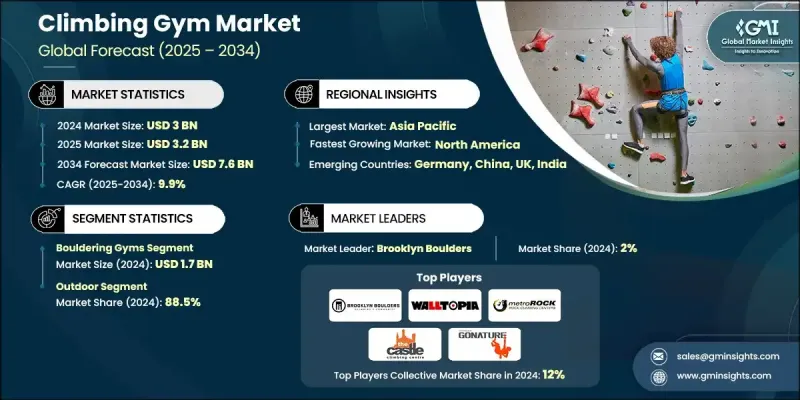
This growth is fueled by the rising global interest in indoor climbing as both a fitness routine and a recreational pursuit. These gyms offer climbers of all levels, from novice to elite, a safe, engaging space to develop skills and build community. Facilities now commonly feature a wide range of climbing environments, such as bouldering areas, lead climbing routes, auto-belay systems, and specialized training sections outfitted with hangboards, campus boards, and other performance tools. The evolution of climbing gyms from simple wall spaces to multifaceted fitness and social hubs has widened their appeal and enhanced the user experience. Beyond physical activity, these venues are fostering strong communities centered around shared progress and social interaction, making them increasingly attractive to new members. The unique combination of full-body exercise and mental engagement offered by climbing is driving a shift away from traditional gyms, with many health-conscious individuals now gravitating toward this dynamic and immersive alternative.
| Market Scope | |
|---|---|
| Start Year | 2024 |
| Forecast Year | 2025-2034 |
| Start Value | $3 Billion |
| Forecast Value | $7.6 Billion |
| CAGR | 9.9% |
Health and wellness trends are among the strongest growth drivers of the market. Climbing gyms offer a full-body workout that challenges strength, balance, and problem-solving in ways that traditional fitness centers cannot replicate. As public awareness of physical activity's role in disease prevention and mental well-being grows, more consumers are turning to climbing as an engaging fitness option. Reports from health authorities consistently link climbing and similar exercises with improved mental health, stronger cardiovascular performance, and reduced risk of chronic disease, supporting ongoing membership growth.
The bouldering gyms segment generated USD 1.7 billion in 2024. Their popularity stems from both accessibility and simplicity, requiring only climbing shoes and chalk, eliminating the need for ropes or harnesses. This not only reduces initial costs for gym-goers but also cuts operational complexity for owners. Bouldering appeals to a wide user base thanks to its approachable learning curve and the physical challenge it provides for experienced climbers. Its fast-paced, social nature makes it particularly popular in urban areas and among younger demographics, contributing to the segment's rapid expansion and community-driven growth.
United States Climbing Gym Market held a 72.1% share in 2024. With an ingrained culture of adventure and physical activity, the country has seen gyms flourish in major cities and university towns alike. The addition of climbing as an Olympic sport has further elevated its profile, particularly among younger athletes. Facilities are now blending modern technologies like interactive smart walls with hybrid fitness offerings and community-based events to enhance member engagement and retention.
Prominent players shaping the Global Climbing Gym Industry include Walltopia, Brooklyn Boulders, Momentum Climbing, Boulderklub Kreuzberg, Sputnik Climbing Centre, Klattercentret, DAV Climbing and Bouldering Centre of Munich, The Glasgow Climbing Centre, Castle Climbing Centre, Edinburgh International Climbing Arena, Climb So iLL, Go Nature, MetroRock, BETA BOULDERS, and CopenHill. To expand their presence, climbing gym operators are implementing strategies focused on facility innovation, brand expansion, and community engagement. Many are investing in larger multi-purpose spaces with advanced training equipment and integrated fitness zones to attract a wider audience. Strategic location selection in high-footfall urban areas is helping capture new members. Operators are also launching loyalty programs, hosting events, and fostering inclusive atmospheres to build strong customer relationships.
Table of Contents
Chapter 1 Methodology and Scope
- 1.1 Market scope and definition
- 1.2 Research design
- 1.2.1 Research approach
- 1.2.2 Data collection methods
- 1.3 Data mining sources
- 1.3.1 Global
- 1.3.2 Regional
- 1.4 Base estimates and calculations
- 1.4.1 Base year calculation
- 1.4.2 Key trends for market estimation
- 1.5 Primary research and validation
- 1.5.1 Primary sources
- 1.6 Forecast model
- 1.7 Research assumptions and limitations
Chapter 2 Executive Summary
- 2.1 Industry 360° synopsis
- 2.2 Key market trends
- 2.2.1 Regional
- 2.2.2 Gym type
- 2.2.3 Location
- 2.2.4 Course
- 2.2.5 End use
- 2.3 CXO perspectives: Strategic imperatives
- 2.3.1 Key decision points for industry executives
- 2.3.2 Critical success factors for market players
- 2.4 Future outlook and strategic recommendations
Chapter 3 Industry Insights
- 3.1 Industry ecosystem analysis
- 3.1.1 Supplier landscape
- 3.1.2 Profit margin
- 3.1.3 Value addition at each stage
- 3.1.4 Factor affecting the value chain
- 3.2 Industry impact forces
- 3.2.1 Growth drivers
- 3.2.1.1 Rising popularity of indoor recreational activities
- 3.2.1.2 Olympic inclusion and competitive growth
- 3.2.1.3 Advancements in climbing wall technology and safety equipment
- 3.2.2 Industry pitfalls & challenges
- 3.2.2.1 High initial investment and maintenance costs
- 3.2.2.2 Limited accessibility and space constraints
- 3.2.3 Opportunities
- 3.2.3.1 Expansion in Tier 2 and Tier 3 cities
- 3.2.3.2 Integration of digital platforms for engagement & training
- 3.2.1 Growth drivers
- 3.3 Growth potential analysis
- 3.4 Future market trends
- 3.5 Technology and innovation landscape
- 3.5.1 Current technological trends
- 3.5.2 Emerging technologies
- 3.6 Regulatory landscape
- 3.6.1 Standards and compliance requirements
- 3.6.2 Regional regulatory frameworks
- 3.6.3 Certification standards
- 3.7 Porter's analysis
- 3.8 PESTEL analysis
Chapter 4 Competitive Landscape, 2024
- 4.1 Introduction
- 4.2 Company market share analysis
- 4.2.1 By region
- 4.2.1.1 North America
- 4.2.1.2 Europe
- 4.2.1.3 Asia Pacific
- 4.2.1.4 Latin America
- 4.2.1.5 Middle East and Africa
- 4.2.1 By region
- 4.3 Company matrix analysis
- 4.4 Competitive analysis of major market players
- 4.5 Competitive positioning matrix
- 4.6 Key developments
- 4.6.1 Mergers & acquisitions
- 4.6.2 Partnerships & collaborations
- 4.6.3 New product launches
- 4.6.4 Expansion plans
Chapter 5 Market Estimates and Forecast, By Gym Type, 2021 - 2034 (USD Billion)
- 5.1 Key trends
- 5.2 Bouldering gyms
- 5.3 Top rope climbing gyms
- 5.4 Lead climbing gyms
- 5.5 Speed climbing gyms
Chapter 6 Market Estimates and Forecast, By Location, 2021 - 2034 (USD Billion)
- 6.1 Key trends
- 6.2 Indoor
- 6.3 Outdoor
Chapter 7 Market Estimates and Forecast, By Course, 2021 - 2034 (USD Billion)
- 7.1 Key trends
- 7.2 Beginner
- 7.3 Advanced
Chapter 8 Market Estimates and Forecast, By Membership Model, 2021 - 2034 (USD Billion)
- 8.1 Key trends
- 8.2 Monthly/annual memberships
- 8.3 Pay-per-visit (drop-in)
- 8.4 Punch passes
- 8.5 Corporate memberships
- 8.6 Others (trial memberships, student memberships, etc.)
Chapter 9 Market Estimates and Forecast, By End Use, 2021 - 2034 (USD Billion)
- 9.1 Key trends
- 9.2 Adult
- 9.3 Children
- 9.4 Corporate/group training
- 9.5 Schools & educational institutions
- 9.6 Therapeutic/rehabilitation use
Chapter 10 Market Estimates and Forecast, By Region, 2021 - 2034 (USD Billion)
- 10.1 Key trends
- 10.2 North America
- 10.2.1 U.S.
- 10.2.2 Canada
- 10.3 Europe
- 10.3.1 Germany
- 10.3.2 UK
- 10.3.3 France
- 10.3.4 Spain
- 10.3.5 Italy
- 10.4 Asia Pacific
- 10.4.1 China
- 10.4.2 Japan
- 10.4.3 India
- 10.4.4 Australia
- 10.4.5 South Korea
- 10.5 Latin America
- 10.5.1 Brazil
- 10.5.2 Mexico
- 10.5.3 Argentina
- 10.6 Middle East and Africa
- 10.6.1 South Africa
- 10.6.2 Saudi Arabia
- 10.6.3 UAE
Chapter 11 Company Profiles
- 11.1 BETA BOULDERS
- 11.2 Boulderklub Kreuzberg
- 11.3 Brooklyn Boulders
- 11.4 Castle Climbing Centre
- 11.5 Climb So iLL
- 11.6 CopenHill
- 11.7 DAV Climbing and Bouldering Centre of Munich
- 11.8 Edinburgh International Climbing Arena
- 11.9 Go Nature
- 11.10 Klattercentret
- 11.11 MetroRock
- 11.12 Momentum Climbing
- 11.13 Sputnik Climbing Centre
- 11.14 The Glasgow Climbing Centre
- 11.15 Walltopia

