
PUBLISHER: Global Market Insights Inc. | PRODUCT CODE: 1871135

PUBLISHER: Global Market Insights Inc. | PRODUCT CODE: 1871135
Biodegradable Electronics for Packaging Market Opportunity, Growth Drivers, Industry Trend Analysis, and Forecast 2025 - 2034
The Global Biodegradable Electronics for Packaging Market was valued at USD 210.3 million in 2024 and is estimated to grow at a CAGR of 17.3% to reach USD 992.5 million by 2034.
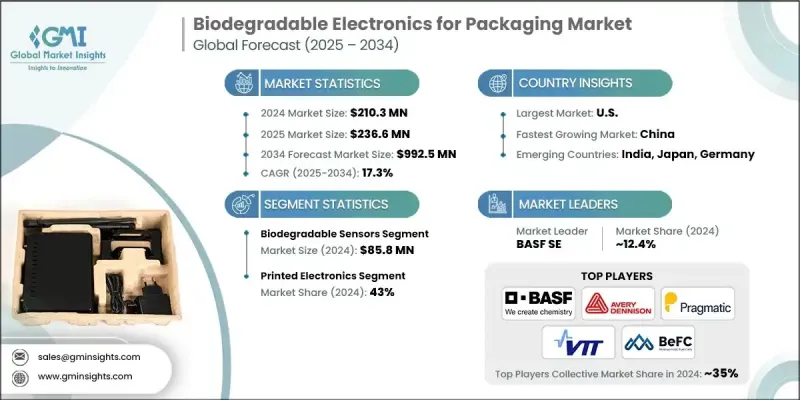
The market represents a groundbreaking fusion of eco-friendly materials, advanced electronics, and sustainability-driven innovation, fueled by stringent regulatory mandates and corporate commitments to reduce environmental impact. Biodegradable electronics utilize organic semiconductors, bio-based substrates, and transient components that naturally decompose after their operational life, tackling the mounting challenge of electronic waste in packaging. Core materials such as silk proteins, cellulose-based films, and organic photovoltaic cells retain functionality while biodegrading within weeks to months. The market features a dynamic ecosystem of startups, materials firms, electronics manufacturers, and packaging companies collaborating across sectors. Emerging technological pathways include self-assembling systems that adapt performance and degradation timing based on environmental conditions, showcasing the potential of intelligent, sustainable packaging solutions.
| Market Scope | |
|---|---|
| Start Year | 2024 |
| Forecast Year | 2025-2034 |
| Start Value | $210.3 Million |
| Forecast Value | $992.5 Million |
| CAGR | 17.3% |
In 2024, the biodegradable sensors segment generated USD 85.8 million and is expected to grow at a CAGR of 17.3% through 2034. These sensors are widely adopted across industries for monitoring conditions like temperature, humidity, freshness, and contamination in perishable and sensitive goods. Their ability to naturally degrade after use eliminates the need for collection or recycling, making them ideal for single-use packaging and positioning them as the most commercially scalable component of the biodegradable electronics ecosystem.
The printed electronics segment reached USD 90.3 million, representing a 43% share in 2024. Printed electronics provide cost-effective and scalable solutions when integrated with biodegradable substrates. Techniques such as inkjet, screen, or gravure printing allow manufacturers to directly produce circuits on compostable, flexible materials like cellulose films, reducing assembly complexity and material waste. In 2024, printed electronics were prioritized for their compatibility with high-throughput production while meeting the growing demand for sustainable packaging solutions.
U.S. Biodegradable Electronics for Packaging Market was valued at USD 36.6 million in 2024 and is anticipated to grow at a CAGR of 18.1% from 2025 to 2034. The strong U.S. demand is driven by initiatives promoting sustainable materials management and reducing packaging waste. With stagnant recycling rates and high landfill contributions, regulatory strategies encourage the adoption of compostable and recyclable packaging solutions, including integrated electronics. Biodegradable sensors and RFID tags help reduce environmental impact while enhancing packaging functionality, aligning with national sustainability goals.
Key players in the Biodegradable Electronics for Packaging Market include BeFC, Stora Enso, Avery Dennison Corporation, Dai Nippon Printing, LG Chem, Infineon Technologies & Jiva Materials, PulpaTronics, Henkel AG, EcoCortec, BASF SE, PragmatIC Semiconductor, VTT Technical Research, Printed Electronics Ltd, Eastman Chemical Company, and Empa. Companies in the Biodegradable Electronics for Packaging Market are employing innovation-driven and collaborative strategies to strengthen their market position. They are investing heavily in R&D to develop advanced organic semiconductors, biodegradable substrates, and self-degrading electronic systems. Partnerships with packaging firms and electronics manufacturers facilitate integration of solutions across supply chains. Firms focus on scalable manufacturing techniques like printed electronics to optimize cost-efficiency and throughput. Sustainability certifications and compliance with environmental regulations are prioritized to enhance credibility and market acceptance.
Table of Contents
Chapter 1 Methodology & Scope
- 1.1 Market scope and definition
- 1.2 Research design
- 1.2.1 Research approach
- 1.2.2 Data collection methods
- 1.3 Data mining sources
- 1.3.1 Global
- 1.3.2 Regional/Country
- 1.4 Base estimates and calculations
- 1.4.1 Base year calculation
- 1.4.2 Key trends for market estimation
- 1.5 Primary research and validation
- 1.5.1 Primary sources
- 1.6 Forecast model
- 1.7 Research assumptions and limitations
Chapter 2 Executive Summary
- 2.1 Industry 360° synopsis
- 2.2 Key market trends
- 2.2.1 Component trends
- 2.2.2 Technology trends
- 2.2.3 Material trends
- 2.2.4 End Use Industry trends
- 2.2.5 Distribution channel trends
- 2.2.6 Regional trends
- 2.3 CXO perspective: Strategic imperatives
- 2.3.1 Key decision points for industry executives
- 2.3.2 Critical success factors for market players
- 2.4 Future outlook and strategic recommendations
- 2.5 Strategic recommendations
- 2.5.1 Supply chain diversification strategy
- 2.5.2 Product portfolio enhancement
- 2.5.3 Partnership and alliance opportunities
- 2.5.4 Cost management and pricing strategy
- 2.6 Decision framework
- 2.6.1 Investment priority matrix
- 2.6.2 Risk-adjusted ROI analysis
Chapter 3 Industry Insights
- 3.1 Industry ecosystem analysis
- 3.1.1 Supplier Landscape
- 3.1.2 Profit Margin
- 3.1.3 Value addition at each stage
- 3.1.4 Factor affecting the value chain
- 3.1.5 Disruptions
- 3.2 Industry Impact forces
- 3.2.1 Growth drivers
- 3.2.2 Industry pitfalls & challenges
- 3.2.3 Opportunities
- 3.3 Growth potential analysis
- 3.4 Pricing analysis, 2024
- 3.4.1 By region and component
- 3.4.2 Raw material cost
- 3.5 Future market trends
- 3.6 Risk assessment and mitigation
- 3.6.1 Regulatory compliance risks
- 3.6.2 Material constraint impact analysis
- 3.6.3 Technology transition risks
- 3.6.4 Pricing volatility and cost escalation risks
- 3.7 Porter's analysis
- 3.8 PESTEL analysis
Chapter 4 Competitive Landscape, 2024
- 4.1 Introduction
- 4.2 Company market share analysis
- 4.2.1 By Region
- 4.2.1.1 North America
- 4.2.1.2 Europe
- 4.2.1.3 Asia Pacific
- 4.2.1.4 Latin America
- 4.2.1.5 Middle East and Africa
- 4.2.1 By Region
- 4.3 Company matrix analysis
- 4.4 Competitive analysis of major market players
- 4.5 Competitive positioning matrix
- 4.6 Key developments
- 4.6.1 Mergers & acquisitions
- 4.6.2 Partnerships & collaborations
- 4.6.3 New Product Launches
- 4.6.4 Expansion Plans
Chapter 5 Market Estimates & Forecast, By Component, 2021 - 2034 (USD Million) (Units)
- 5.1 Key trends
- 5.2 Biodegradable sensors
- 5.3 Biodegradable RFID/NFC tags
- 5.4 Biodegradable printed electronics
- 5.5 Biodegradable power sources
Chapter 6 Market Estimates & Forecast, By Technology, 2021 - 2034 (USD Million) (Units)
- 6.1 Key trends
- 6.2 Printed electronics
- 6.3 Organic electronics integration
- 6.4 Hybrid inorganic-organic systems
Chapter 7 Market Estimates & Forecast, By Material, 2021 - 2034 (USD Million) (Units)
- 7.1 Key trends
- 7.2 Polymer substrate materials
- 7.3 Conductive materials
- 7.4 Encapsulation materials
- 7.5 Functional materials
Chapter 8 Market Estimates & Forecast, By End Use Industry, 2021 - 2034 (USD Million) (Units)
- 8.1 Key trends
- 8.2 Food and beverages
- 8.3 Pharmaceutical and healthcare
- 8.4 Consumer goods
- 8.5 E-commerce & logistics
Chapter 9 Market Estimates & Forecast, By Distribution Channel, 2021 - 2034, (USD Million) (Units)
- 9.1 Key trends
- 9.2 Direct sales
- 9.3 Indirect sales
Chapter 10 Market Estimates & Forecast, By Region, 2021 - 2034, (USD Million) (Units)
- 10.1 Key trends
- 10.2 North America
- 10.2.1 U.S.
- 10.2.2 Canada
- 10.3 Europe
- 10.3.1 Germany
- 10.3.2 U.K.
- 10.3.3 France
- 10.3.4 Italy
- 10.3.5 Spain
- 10.3.6 Netherlands
- 10.4 Asia Pacific
- 10.4.1 China
- 10.4.2 India
- 10.4.3 Japan
- 10.4.4 South Korea
- 10.4.5 Australia
- 10.5 Latin America
- 10.5.1 Brazil
- 10.5.2 Mexico
- 10.5.3 Argentina
- 10.6 MEA
- 10.6.1 UAE
- 10.6.2 Saudi Arabia
- 10.6.3 South Africa
Chapter 11 Company Profiles (Business Overview, Financial Data, Product Landscape, Strategic Outlook, SWOT Analysis)
- 11.1 Avery Dennison Corporation
- 11.2 BASF SE
- 11.3 BeFC
- 11.4 Dai Nippon Printing
- 11.5 Eastman Chemical Company
- 11.6 EcoCortec
- 11.7 Empa
- 11.8 Henkel AG
- 11.9 Infineon Technologies & Jiva Materials
- 11.10 LG Chem
- 11.11 PragmatIC Semiconductor
- 11.12 Printed Electronics Ltd
- 11.13 PulpaTronics
- 11.14 Stora Enso
- 11.15 VTT Technical Research

