
PUBLISHER: Global Market Insights Inc. | PRODUCT CODE: 1876552

PUBLISHER: Global Market Insights Inc. | PRODUCT CODE: 1876552
Automotive Air Purification System Market Opportunity, Growth Drivers, Industry Trend Analysis, and Forecast 2025 - 2034
The Global Automotive Air Purification System Market was valued at USD 3.1 billion in 2024 and is estimated to grow at a CAGR of 16.8% to reach USD 13.7 billion by 2034.
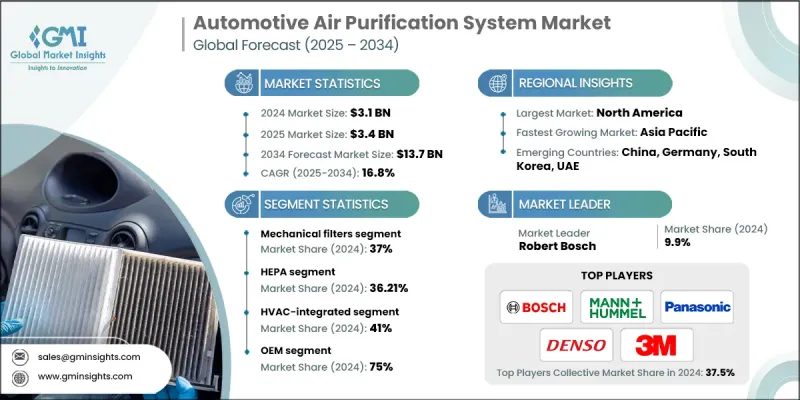
Market growth is fueled by advancements in sensor technology, AI-enabled air quality management, and the development of eco-friendly filtration materials. Leading manufacturers are heavily investing in energy-efficient, space-saving, and intelligent purification modules that can seamlessly integrate with modern HVAC systems and vehicle electronics. Industry leaders such as Denso, 3M, Panasonic, Robert Bosch, and MANN+HUMMEL are driving innovation in multi-stage purification systems that incorporate HEPA filters, activated carbon, ionization, and UV sterilization technologies. These systems not only improve passenger comfort but also support sustainability initiatives through recyclable filter materials and low-power electronic controls. Growing urbanization, increasing air pollution, and rising consumer awareness of in-cabin air quality are driving demand globally, while automakers are incorporating sensor-driven air management units in new vehicles to meet the rising need for safer and healthier mobility experiences.
| Market Scope | |
|---|---|
| Start Year | 2024 |
| Forecast Year | 2025-2034 |
| Start Value | $3.1 Billion |
| Forecast Value | $13.7 Billion |
| CAGR | 16.8% |
The mechanical filters segment held a 37% share in 2024 and is expected to grow at a CAGR of 13% from 2025 to 2034. These filters efficiently capture fine particulate matter (PM2.5 and PM10) and are widely used in both OEM and aftermarket systems due to their affordability and reliability.
The HEPA filtration segment held a 36.21% share in 2024 and is projected to grow at a CAGR of 14.3% through 2034. HEPA filters remain the preferred choice for their proven ability to trap allergens and fine particles, offering an optimal balance between cost and performance, even as hybrid systems incorporating multiple technologies gain popularity.
Asia-Pacific Automotive Air Purification System Market held a 48.1% share in 2024. The region is expected to achieve the fastest growth at a CAGR of 17.9%, reaching USD 7.22 billion by 2034. Strong automotive production, rapid urbanization, and high pollution levels in major cities are key factors driving adoption. Rising environmental awareness, higher disposable incomes, and active investments from both local and international manufacturers in air purification technologies are further boosting market expansion.
Key players in the Automotive Air Purification System Market include 3M, Sharp, MANN+HUMMEL, Robert Bosch, Panasonic, Denso, Marelli, CabinAir Sweden, SKF, and Honeywell. Companies in the Automotive Air Purification System Market are employing multiple strategies to enhance their market position and expand their footprint. They are investing heavily in R&D to develop multi-stage purification systems, energy-efficient modules, and compact designs suitable for modern vehicle architectures. Strategic partnerships with automotive OEMs ensure seamless integration of advanced air purification units in new vehicle models. Manufacturers are also focusing on expanding their global distribution networks and strengthening aftermarket offerings to capture recurring demand. Adoption of AI-enabled air quality management and hybrid filtration solutions is another key strategy to differentiate products and offer added value to consumers.
Table of Contents
Chapter 1 Methodology
- 1.1 Market scope and definition
- 1.2 Research design
- 1.2.1 Research approach
- 1.2.2 Data collection methods
- 1.3 Data mining sources
- 1.3.1 Global
- 1.3.2 Regional/Country
- 1.4 Base estimates and calculations
- 1.4.1 Base year calculation
- 1.4.2 Key trends for market estimation
- 1.5 Primary research and validation
- 1.5.1 Primary sources
- 1.6 Forecast model
- 1.7 Research assumptions and limitations
Chapter 2 Executive Summary
- 2.1 Industry 3600 synopsis, 2021 - 2034
- 2.2 Key market trends
- 2.2.1 Regional
- 2.2.2 Product
- 2.2.3 Technology
- 2.2.4 Mounting
- 2.2.5 End use
- 2.2.6 Sales Channel
- 2.3 TAM Analysis, 2025-2034
- 2.4 CXO perspectives: Strategic imperatives
- 2.4.1 Executive decision points
- 2.4.2 Critical success factors
- 2.5 Future outlook and strategic recommendations
Chapter 3 Industry Insights
- 3.1 Industry ecosystem analysis
- 3.1.1 Supplier landscape
- 3.1.2 Profit margin analysis
- 3.1.3 Cost structure
- 3.1.4 Value addition at each stage
- 3.1.5 Factor affecting the value chain
- 3.1.6 Disruptions
- 3.2 Industry impact forces
- 3.2.1 Growth drivers
- 3.2.1.1 Increasing Air pollution levels & health awareness
- 3.2.1.2 Stringent vehicle emissions regulations & interior air quality standards
- 3.2.1.3 Rising consumer demand for premium vehicle features
- 3.2.1.4 Electric vehicle adoption & unique HVAC requirements
- 3.2.2 Industry pitfalls and challenges
- 3.2.2.1 High Initial Investment Costs for Advanced Purification Technologies
- 3.2.2.2 Integration Complexity with Existing HVAC Systems
- 3.2.2.3 Maintenance Requirements & Filter Replacement Costs
- 3.2.2.4 Limited Consumer Awareness in Emerging Markets
- 3.2.3 Market opportunities
- 3.2.3.1 Heavy equipment & mining industry compliance with iso 23875
- 3.2.3.2 Aftermarket retrofit solutions for existing vehicle fleets
- 3.2.3.3 Integration with connected vehicle technologies & iot systems
- 3.2.3.4 Emerging markets motorization & urban air quality concerns
- 3.2.1 Growth drivers
- 3.3 Growth potential analysis
- 3.4 Regulatory landscape
- 3.4.1 Regional integration regulations
- 3.4.2 International standards harmonization
- 3.5 Porter's analysis
- 3.6 PESTEL analysis
- 3.7 Technology and innovation landscape
- 3.7.1 Current technological trends
- 3.7.2 Emerging technologies
- 3.7.3 Technology Lifecycle & Maturity Assessment
- 3.7.3.1 Technology readiness levels by purification method
- 3.7.3.2 Innovation pipeline & emerging technologies
- 3.7.3.3 Patent expiration timeline & technology commoditization
- 3.7.3.4 Disruptive technology threats & market disruption potential
- 3.8 Patent analysis
- 3.9 Cost breakdown analysis
- 3.10 Sustainability and environmental aspects
- 3.10.1 Sustainable practices
- 3.10.2 Waste reduction strategies
- 3.10.3 Energy efficiency in production
- 3.10.4 Eco-friendly Initiatives
- 3.11 Carbon footprint considerations
- 3.12 Customer Behavior & Purchasing Decision Analysis
- 3.12.1 OEM decision-making criteria & vendor selection process
- 3.12.2 Aftermarket consumer preferences & price sensitivity
- 3.12.3 Fleet operator requirements & roi considerations
- 3.12.4 Regional variations in customer priorities
Chapter 4 Competitive Landscape, 2024
- 4.1 Introduction
- 4.2 Company market share analysis
- 4.2.1 North America
- 4.2.2 Europe
- 4.2.3 Asia Pacific
- 4.2.4 LATAM
- 4.2.5 MEA
- 4.3 Competitive analysis of major market players
- 4.4 Competitive positioning matrix
- 4.5 Strategic outlook matrix
- 4.6 Key developments
- 4.6.1 Mergers & acquisitions
- 4.6.2 Partnerships & collaborations
- 4.6.3 New Product Launches
- 4.6.4 Expansion Plans and funding
Chapter 5 Market Estimates & Forecast, By Product, 2021 - 2034 (USD Mn, Units)
- 5.1 Key trends
- 5.2 Mechanical filters
- 5.3 Adsorption
- 5.4 Active sterilization
- 5.5 Ionization & electrostatic systems
- 5.6 Integrated systems
- 5.7 Sensors & electronics
Chapter 6 Market Estimates & Forecast, By Technology, 2021 - 2034 (USD Mn, Units)
- 6.1 Key trends
- 6.2 HEPA
- 6.3 Adsorption
- 6.4 Electrostatic
- 6.5 UV / photocatalysis
- 6.6 Hybrid
Chapter 7 Market Estimates & Forecast, By Mounting, 2021 - 2034 (USD Mn, Units)
- 7.1 Key trends
- 7.2 HVAC-integrated
- 7.3 Dashboard
- 7.4 Overhead
- 7.5 Under-seat
- 7.6 Portable
Chapter 8 Market Estimates & Forecast, By End Use, 2021 - 2034 (USD Mn, Units)
- 8.1 Key trends
- 8.2 Individual consumers / retail
- 8.3 Fleet owners & rental operators
- 8.4 Public transport operators
- 8.5 Commercial enterprise
- 8.6 Government / emergency services
Chapter 9 Market Estimates & Forecast, By Sales Channel, 2021 - 2034 (USD Mn, Units)
- 9.1 Key trends
- 9.2 OEM
- 9.3 Aftermarket
Chapter 10 Market Estimates & Forecast, By Region, 2021 - 2034 (USD Mn, Units)
- 10.1 Key trends
- 10.2 North America
- 10.2.1 US
- 10.2.2 Canada
- 10.3 Europe
- 10.3.1 Germany
- 10.3.2 UK
- 10.3.3 France
- 10.3.4 Italy
- 10.3.5 Spain
- 10.3.6 Russia
- 10.3.7 Nordics
- 10.3.8 Portugal
- 10.3.9 Croatia
- 10.4 Asia Pacific
- 10.4.1 China
- 10.4.2 India
- 10.4.3 Japan
- 10.4.4 Australia
- 10.4.5 South Korea
- 10.4.6 Singapore
- 10.4.7 Thailand
- 10.4.8 Indonesia
- 10.5 Latin America
- 10.5.1 Brazil
- 10.5.2 Mexico
- 10.5.3 Argentina
- 10.6 MEA
- 10.6.1 South Africa
- 10.6.2 Saudi Arabia
- 10.6.3 UAE
- 10.6.4 Turkey
Chapter 11 Company Profiles
- 11.1 Global Players
- 11.1.1 Panasonic
- 11.1.2 Denso
- 11.1.3. 3 M
- 11.1.4 Honeywell
- 11.1.5 Robert Bosch
- 11.1.6 MANN+HUMMEL
- 11.1.7 Sharp
- 11.1.8 Marelli
- 11.1.9 CabinAir Sweden
- 11.1.10 SKF
- 11.1.11 Valeo
- 11.1.12 Freudenberg Filtration
- 11.1.13 BorgWarner
- 11.1.14 Donaldson
- 11.2 Regional Players
- 11.2.1 Hengst
- 11.2.2 Camfil
- 11.2.3 Hanon Systems
- 11.2.4 Visteon
- 11.2.5 Parker Hannifin
- 11.2.6 K&N Engineering
- 11.3 Emerging Players
- 11.3.1 Philips Automotive
- 11.3.2 Johnson Electric
- 11.3.3 Filtron
- 11.3.4 Sanden

