PUBLISHER: Global Market Insights Inc. | PRODUCT CODE: 1876589

PUBLISHER: Global Market Insights Inc. | PRODUCT CODE: 1876589
4D Printing Services for Consumer Applications Market Opportunity, Growth Drivers, Industry Trend Analysis, and Forecast 2025 - 2034
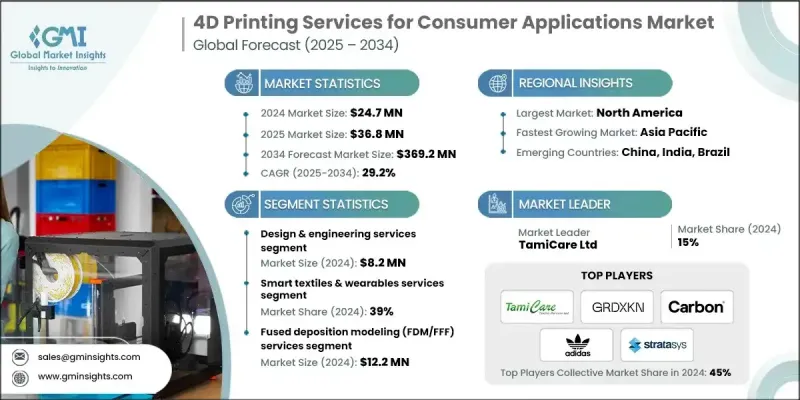
The Global 4D Printing Services for Consumer Applications Market was valued at USD 24.7 million in 2024 and is estimated to grow at a CAGR of 29.2% to reach USD 369.2 million by 2034.
The growth potential of 4D printing in consumer applications lies in the increasing interest in adaptive, personalized, and sustainable products. Unlike conventional 3D printing, 4D printing utilizes smart materials capable of transforming their shapes and functions in response to environmental factors such as temperature, light, or humidity. This technology is paving the way for consumer-oriented innovations in areas like adaptive apparel, self-assembling furniture, and responsive home products. As advancements continue, research institutions, startups, and established technology providers are exploring new materials and production processes aimed at improving functionality and efficiency. The market is gradually transitioning from conceptual development to practical implementation as issues related to scalability and cost have begun to ease. The growing consumer appetite for interactive and customizable products is expected to drive wider adoption of 4D printing technologies in the everyday consumer space.
| Market Scope | |
|---|---|
| Start Year | 2024 |
| Forecast Year | 2025-2034 |
| Start Value | $24.7 Million |
| Forecast Value | $369.2 Million |
| CAGR | 29.2% |
In 2024, the design and engineering services segment generated USD 8.2 million. This segment's leadership is attributed to the increasing number of project collaborations and the need for specialized expertise in materials science, transformation mechanics, and product design. Service providers are enhancing their technical capabilities to support evolving client demands as the industry progresses toward more complex applications. The growing interest in contract manufacturing services signals that the market is beginning to move toward production-scale operations, highlighting its path toward commercial maturity.
The smart textiles and wearables segment held a 39% share in 2024. This segment includes advanced textile applications designed to adapt to environmental stimuli or user-specific conditions. Products such as performance-based clothing, medical textiles, and adaptive fashion items are increasingly leveraging 4D printing technologies to deliver comfort, functionality, and efficiency. Consumer interest in responsive wearables is expanding, driven by the convergence of fashion, fitness, and technology, creating a growing commercial opportunity within this category.
U.S. 4D Printing Services for Consumer Applications Market held 84% share, generating USD 8 million in 2024. North America remains a leading hub for research, innovation, and commercialization of advanced materials and additive manufacturing technologies. The region benefits from strong investment in R&D, robust academic collaboration, and supportive government initiatives that encourage technology transfer and industrial development. Its advanced infrastructure, intellectual property protections, and commitment to next-generation manufacturing have positioned it as a key player in driving the expansion of 4D printing services for consumer markets.
Prominent companies participating in the Global 4D Printing Services for Consumer Applications Market include Carbon, Inc., Nervous System Inc., TamiCare Ltd., HP Inc., Mitsubishi Chemical Corporation, Formlabs Inc., Stratasys Ltd., GRDXKN, Self-Assembly Lab (MIT), and Adidas AG - Innovation Lab. These industry players are focusing on research, partnerships, and material innovations to deliver advanced 4D printing solutions tailored for consumer use. Companies operating in the 4D Printing Services for Consumer Applications Market are focusing on innovation and collaboration to strengthen their global presence. Many are investing heavily in research and development to advance smart material capabilities and improve shape-shifting responsiveness. Partnerships between technology providers, research institutions, and fashion or consumer goods brands are enabling faster commercialization of adaptive products. Firms are also emphasizing sustainable manufacturing processes and scalable production methods to meet growing consumer demand. Expanding service portfolios to include design consulting, prototyping, and contract manufacturing is another key strategy.
Table of Contents
Chapter 1 Methodology and Scope
- 1.1 Market scope and definition
- 1.2 Research design
- 1.2.1 Research approach
- 1.2.2 Data collection methods
- 1.3 Data mining sources
- 1.3.1 Global
- 1.3.2 Regional/Country
- 1.4 Base estimates and calculations
- 1.4.1 Base year calculation
- 1.4.2 Key trends for market estimation
- 1.5 Primary research and validation
- 1.5.1 Primary sources
- 1.6 Forecast model
- 1.7 Research assumptions and limitations
Chapter 2 Executive Summary
- 2.1 Industry 3600 synopsis
- 2.2 Key market trends
- 2.2.1 Regional
- 2.2.2 Service type
- 2.2.3 Technology
- 2.2.4 Application
- 2.2.5 Service delivery model
- 2.3 CXO perspectives: Strategic imperatives
- 2.3.1 Key decision points for industry executives
- 2.3.2 Critical success factors for market players
- 2.4 Future outlook and strategic recommendations
Chapter 3 Industry Insights
- 3.1 Industry ecosystem analysis
- 3.1.1 Supplier landscape
- 3.1.2 Profit margin
- 3.1.3 Value addition at each stage
- 3.1.4 Factor affecting the value chain
- 3.2 Industry impact forces
- 3.2.1 Growth drivers
- 3.2.1.1 Customization and smart adaptability of consumer products
- 3.2.1.2 Advancements in smart materials and printing technologies
- 3.2.1.3 Growing demand for sustainable and functional design
- 3.2.2 Industry pitfalls & challenges
- 3.2.2.1 High production costs and limited scalability
- 3.2.2.2 Lack of standardization and regulatory frameworks
- 3.2.3 Opportunities
- 3.2.3.1 Integration into wearable technology and smart textiles
- 3.2.3.2 Expansion into home automation and smart furniture
- 3.2.1 Growth drivers
- 3.3 Growth potential analysis
- 3.4 Future market trends
- 3.5 Technology and innovation landscape
- 3.5.1 Current technological trends
- 3.5.2 Emerging technologies
- 3.6 Regulatory landscape
- 3.6.1 Standards and compliance requirements
- 3.6.2 Regional regulatory frameworks
- 3.6.3 Certification standards
- 3.7 Porter's analysis
- 3.8 PESTEL analysis
Chapter 4 Competitive Landscape, 2024
- 4.1 Introduction
- 4.2 Company market share analysis
- 4.2.1 By region
- 4.2.1.1 North America
- 4.2.1.2 Europe
- 4.2.1.3 Asia Pacific
- 4.2.1.4 Latin America
- 4.2.1.5 Middle East and Africa
- 4.2.1 By region
- 4.3 Company matrix analysis
- 4.4 Competitive analysis of major market players
- 4.5 Competitive positioning matrix
- 4.6 Key developments
- 4.6.1 Mergers & acquisitions
- 4.6.2 Partnerships & collaborations
- 4.6.3 New product launches
- 4.6.4 Expansion plans
Chapter 5 Market Estimates and Forecast, By Service Type, 2021 - 2034 (USD Million)
- 5.1 Key trends
- 5.2 Design & engineering services
- 5.3 Contract manufacturing services
- 5.4 Material development services
- 5.5 Software & digital services
- 5.6 Regulatory compliance consulting
- 5.7 Maintenance & support services
Chapter 6 Market Estimates and Forecast, By Technology, 2021 - 2034 (USD Million)
- 6.1 Key trends
- 6.2 Fused deposition modeling (FDM/FFF) services
- 6.3 Stereolithography (SLA/DLP) services
- 6.4 Direct ink writing (DIW) services
- 6.5 Hybrid multi-technology services
Chapter 7 Market Estimates and Forecast, By Application, 2021 - 2034 (USD Million)
- 7.1 Key trends
- 7.2 Smart textiles & wearables services
- 7.3 Food application services
- 7.4 Consumer electronics services
- 7.5 Furniture & home goods services
- 7.6 Personal healthcare device services
Chapter 8 Market Estimates and Forecast, By Service Delivery Model, 2021 - 2034 (USD Million)
- 8.1 Key trends
- 8.2 On-demand services
- 8.3 Subscription-based services
- 8.4 Project-based services
- 8.5 Managed services
Chapter 9 Market Estimates and Forecast, By Region, 2021 - 2034 (USD Million)
- 9.1 Key trends
- 9.2 North America
- 9.2.1 U.S.
- 9.2.2 Canada
- 9.3 Europe
- 9.3.1 Germany
- 9.3.2 UK
- 9.3.3 France
- 9.3.4 Italy
- 9.3.5 Spain
- 9.4 Asia Pacific
- 9.4.1 China
- 9.4.2 Japan
- 9.4.3 India
- 9.4.4 Australia
- 9.4.5 South Korea
- 9.5 Latin America
- 9.5.1 Brazil
- 9.5.2 Mexico
- 9.5.3 Argentina
- 9.6 Middle East and Africa
- 9.6.1 South Africa
- 9.6.2 Saudi Arabia
- 9.6.3 UAE
Chapter 10 Company Profiles
- 10.1 Stratasys Ltd.
- 10.2 Carbon, Inc.
- 10.3 HP Inc.
- 10.4 Formlabs Inc.
- 10.5 GRDXKN
- 10.6 Mitsubishi Chemical Corporation
- 10.7 Adidas AG - Innovation Lab
- 10.8 Nervous System Inc.
- 10.9 Self-Assembly Lab (MIT)
- 10.10 TamiCare Ltd.

