PUBLISHER: Global Market Insights Inc. | PRODUCT CODE: 1876620

PUBLISHER: Global Market Insights Inc. | PRODUCT CODE: 1876620
Digital Stethoscope with AI Analysis Market Opportunity, Growth Drivers, Industry Trend Analysis, and Forecast 2025 - 2034
The Global Digital Stethoscope with AI Analysis Market was valued at USD 62.1 million in 2024 and is estimated to grow at a CAGR of 5.7% to reach USD 106.5 million by 2034.
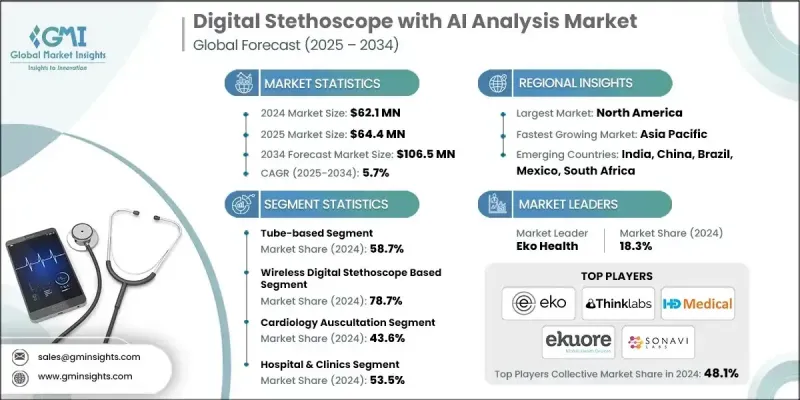
The market is expanding due to rising cases of cardiovascular and respiratory conditions, coupled with the integration of artificial intelligence, growth in telemedicine, increasing adoption of handheld diagnostic devices, and a stronger emphasis on preventive healthcare. Digital stethoscopes equipped with AI provide advanced diagnostic capabilities for healthcare professionals, supporting early disease detection, ongoing patient monitoring, and AI-assisted clinical decision-making. Products include both tube-type and tubeless models, with wired or wireless configurations, leveraging cloud-based or on-device AI for cardiology, pulmonary, and other applications. The surge in telemedicine and remote monitoring programs has made AI-enabled stethoscopes indispensable for remote consultations, chronic disease management, and home care. Wireless connectivity through Bluetooth or Wi-Fi facilitates real-time data transfer to cloud platforms, allowing physicians to make informed decisions quickly. Innovations in acoustic design, signal processing, and noise reduction have significantly improved the reliability and precision of these devices, surpassing traditional stethoscopes in diagnostic performance.
| Market Scope | |
|---|---|
| Start Year | 2024 |
| Forecast Year | 2025-2034 |
| Start Value | $62.1 Million |
| Forecast Value | $106.5 Million |
| CAGR | 5.7% |
The tubeless segment is projected to grow at a CAGR of 6.2% through 2034, driven by its portability, wireless functionality, and compatibility with telemedicine and home care programs. Tubeless stethoscopes maintain classical acoustic principles while incorporating AI-powered analysis and digital signal processing, combining innovation with reliable sound quality. These devices are widely adopted in hospitals, primary care centers, and specialty clinics where high-fidelity auscultation is essential for accurate cardiovascular and pulmonary diagnostics.
The wireless digital stethoscope segment held a 78.7% share in 2024 and is expected to reach USD 80.7 million during 2025-2034. Its dominance stems from seamless integration with Bluetooth, Wi-Fi, and hybrid connectivity, enabling real-time data transmission to cloud platforms and AI analytics systems. This connectivity supports telemedicine, remote monitoring, and continuous care, addressing the increasing burden of cardiovascular and pulmonary disorders.
North America Digital Stethoscope with AI Analysis Market held 35.5% share in 2024 owing to advanced healthcare infrastructure, high adoption of innovative medical devices, and a well-established telemedicine ecosystem. The prevalence of heart failure, arrhythmias, COPD, and asthma drives demand for early and accurate diagnostic tools. Technological advances, including high-fidelity microphones, AI auscultation algorithms, noise reduction, and wireless connectivity, enhance diagnostic capabilities across hospitals, primary care facilities, and home care programs.
Key players in the Global Digital Stethoscope with AI Analysis Market include Aevice Health, Ai Health Highway, Eko Health, eKuore Medical, HD Medical, Lapsi Health, M3DICINE, Minttihealth, Sensi Cardiac, Solventum, Sonavi Labs, Steth IO, StethoMe, and Thinklabs. Companies in the Digital Stethoscope with AI Analysis Market are strengthening their position through continuous innovation in AI algorithms, acoustic engineering, and wireless connectivity. They are forming strategic partnerships with hospitals and telemedicine providers to expand adoption and demonstrate clinical efficacy. Firms are also investing in regulatory approvals and reimbursement support to enhance accessibility and credibility. Product diversification, targeted marketing campaigns, and user-friendly mobile applications help increase device integration into routine care.
Table of Contents
Chapter 1 Methodology and Scope
- 1.1 Market scope and definitions
- 1.2 Research design
- 1.2.1 Research approach
- 1.2.2 Data collection methods
- 1.3 Data mining sources
- 1.3.1 Global
- 1.3.2 Regional/country
- 1.4 Base estimates and calculations
- 1.4.1 Base year calculation
- 1.4.2 Key trends for market estimation
- 1.5 Primary research and validation
- 1.5.1 Primary sources
- 1.6 Forecast model
- 1.7 Research assumptions and limitations
Chapter 2 Executive Summary
- 2.1 Industry 3600 synopsis
- 2.2 Key market trends
- 2.2.1 Regional trends
- 2.2.2 Design trends
- 2.2.3 Connectivity trends
- 2.2.4 Application trends
- 2.2.5 End Use trends
- 2.3 CXO perspectives: Strategic imperatives
- 2.3.1 Key decision points for industry executives
- 2.3.2 Critical success factors for market players
- 2.4 Future outlook and strategic recommendations
Chapter 3 Industry Insights
- 3.1 Industry ecosystem analysis
- 3.2 Industry impact forces
- 3.2.1 Growth drivers
- 3.2.1.1 Rising prevalence of cardiovascular and pulmonary diseases
- 3.2.1.2 Integration of AI for automated sound analysis and clinical decision support
- 3.2.1.3 Expansion of telemedicine and remote patient monitoring
- 3.2.1.4 Technological advancements in acoustics and noise cancellation
- 3.2.2 Industry pitfalls and challenges
- 3.2.2.1 High cost of AI-integrated digital stethoscopes
- 3.2.2.2 Limited clinical validation and regulatory standardization for AI algorithms
- 3.2.3 Market opportunities
- 3.2.3.1 Integration with multi-parameter AI diagnostic platforms
- 3.2.3.2 Emergence of low-cost, smartphone-compatible AI stethoscopes
- 3.2.1 Growth drivers
- 3.3 Growth potential analysis
- 3.4 Regulatory landscape
- 3.4.1 North America
- 3.4.2 Europe
- 3.4.3 Asia Pacific
- 3.4.4 LAMEA
- 3.5 Technology landscape
- 3.5.1 Current technological trends
- 3.5.1.1 Growth of portable and home-based digital stethoscopes with AI analysis
- 3.5.1.2 Digital health platforms enabling remote monitoring
- 3.5.1.3 Patient-friendly, non-invasive monitoring systems
- 3.5.2 Emerging technologies
- 3.5.2.1 AI-powered predictive analytics
- 3.5.2.2 Wearable connected devices
- 3.5.2.3 Smart devices with adaptive monitoring modes
- 3.5.1 Current technological trends
- 3.6 Gap analysis
- 3.7 Porter's analysis
- 3.8 PESTEL analysis
- 3.9 Future market trends
- 3.9.1 Convergence of AI, digital health, and connected devices
- 3.9.2 Expansion of homecare and remote monitoring solutions
- 3.9.3 Wearable and multi-parameter diagnostic integration
- 3.9.4 Enhanced AI algorithms and predictive analytics
Chapter 4 Competitive Landscape, 2024
- 4.1 Introduction
- 4.2 Company matrix analysis
- 4.3 Company market share analysis
- 4.4 Competitive positioning matrix
- 4.5 Competitive analysis of major market players
- 4.6 Key developments
- 4.6.1 Mergers & acquisitions
- 4.6.2 Partnerships & collaborations
- 4.6.3 New service type launches
- 4.6.4 Expansion plans
Chapter 5 Market Estimates and Forecast, By Design, 2021 - 2034 ($ Mn)
- 5.1 Key trends
- 5.2 Tube-based
- 5.3 Tubeless
Chapter 6 Market Estimates and Forecast, By Connectivity, 2021 - 2034 ($ Mn)
- 6.1 Key trends
- 6.2 Wireless digital stethoscope
- 6.3 Wired digital stethoscope
Chapter 7 Market Estimates and Forecast, By Application, 2021 - 2034 ($ Mn)
- 7.1 Key trends
- 7.2 Cardiology auscultation
- 7.3 Pulmonary auscultation
- 7.4 Pediatrics
- 7.5 Abdominal auscultation
- 7.6 Other applications
Chapter 8 Market Estimates and Forecast, By End Use, 2021 - 2034 ($ Mn)
- 8.1 Key trends
- 8.2 Hospital & clinics
- 8.3 Primary care centers
- 8.4 Ambulatory surgical centers
- 8.5 Other End use
Chapter 9 Market Estimates and Forecast, By Region, 2021 - 2034 ($ Mn)
- 9.1 Key trends
- 9.2 North America
- 9.2.1 U.S.
- 9.2.2 Canada
- 9.3 Europe
- 9.3.1 Germany
- 9.3.2 UK
- 9.3.3 France
- 9.3.4 Spain
- 9.3.5 Italy
- 9.3.6 Netherlands
- 9.4 Asia Pacific
- 9.4.1 China
- 9.4.2 Japan
- 9.4.3 India
- 9.4.4 Australia
- 9.4.5 South Korea
- 9.5 Latin America
- 9.5.1 Brazil
- 9.5.2 Mexico
- 9.5.3 Argentina
- 9.6 Middle East and Africa
- 9.6.1 South Africa
- 9.6.2 Saudi Arabia
- 9.6.3 UAE
Chapter 10 Company Profiles
- 10.1 Aevice Health
- 10.2 Ai Health Highway
- 10.3 Eko Health
- 10.4 eKuore Medical
- 10.5 HD Medical
- 10.6 Lapsi Health
- 10.7 M3DICINE
- 10.8 Minttihealth
- 10.9 Sensi Cardiac
- 10.10 Solventum
- 10.11 Sonavi Labs
- 10.12 Steth IO
- 10.13 StethoMe
- 10.14 Thinklabs

