
PUBLISHER: Global Market Insights Inc. | PRODUCT CODE: 1876632

PUBLISHER: Global Market Insights Inc. | PRODUCT CODE: 1876632
Smart Industrial Lighting Fixtures Market Opportunity, Growth Drivers, Industry Trend Analysis, and Forecast 2025 - 2034
The Global Smart Industrial Lighting Fixtures Market was valued at USD 3.2 billion in 2024 and is estimated to grow at a CAGR of 14.8% to reach USD 12.2 billion by 2034.
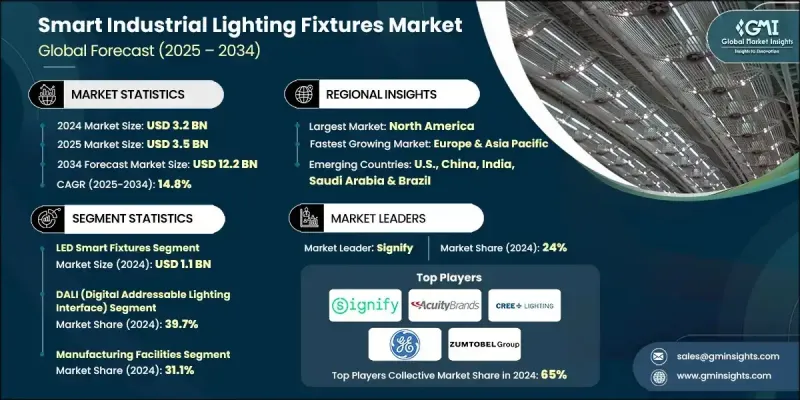
The surge is fueled by the growing demand for energy-efficient, cost-effective, and environmentally responsible lighting solutions in industrial settings. Industrial facilities face increasing pressure to cut operational expenses and reduce carbon emissions, and smart LED lighting systems provide an effective solution. These systems incorporate advanced technologies such as motion detection, automated dimming, and daylight harvesting, offering substantial energy savings and operational benefits. Rising energy costs and sustainability initiatives further drive adoption, as businesses aim to achieve long-term savings while meeting environmental targets. Governments worldwide are enforcing stricter energy efficiency standards, phasing out inefficient lighting, and offering incentives to encourage smart lighting adoption. These policies are especially impactful in industrial environments where compliance with energy regulations is critical for uninterrupted operations.
| Market Scope | |
|---|---|
| Start Year | 2024 |
| Forecast Year | 2025-2034 |
| Start Value | $3.2 Billion |
| Forecast Value | $12.2 Billion |
| CAGR | 14.8% |
The LED smart fixtures segment accounted for USD 1.1 billion in 2024 and is forecasted to grow at a CAGR of 15.1% from 2025 to 2034. The maturity of LED technology has enabled higher lumen output, reduced heat production, and lower maintenance demands compared to traditional lighting. Increasing integration with sensors and intelligent controllers allows features like motion sensing, daylight harvesting, and automated dimming, which together drive notable energy savings and operational efficiency. Falling costs of LED components and production have expanded accessibility to a wider range of industrial users, including smaller enterprises.
The manufacturing facilities segment held a 31.1% share and is expected to grow at a CAGR of 15.5% through 2034. Industrial manufacturing environments demand lighting systems that can endure harsh conditions, provide continuous operation, and adjust dynamically to workflow requirements. Smart lighting solutions with sensor integration enable automated adjustments based on occupancy, task-specific needs, and ambient lighting, reducing energy consumption while improving productivity and safety by ensuring consistent, optimal illumination for workers.
U.S. Smart Industrial Lighting Fixtures Market was valued at USD 1 billion in 2024 and is anticipated to grow at a CAGR of 15.3% from 2025 to 2034. Manufacturers and industrial operators are increasingly adopting intelligent lighting systems to enhance energy efficiency, cut operational costs, and comply with strict environmental regulations. National sustainability initiatives and carbon reduction goals are driving the transition from conventional lighting to IoT-enabled and smart LED solutions. The presence of major market players, robust research and development, and government incentives for energy-efficient upgrades have created favorable conditions for market expansion.
Key companies in the Global Smart Industrial Lighting Fixtures Market include Cima Lighting, Zumtobel Group, Holophane, Acuity Brands, Luminis Lighting, Eaton, Cree Lighting, AGC Lighting, LSI Industries, GE Current, Panasonic Lighting, Dialight, Osram (ams OSRAM), PureLiFi, Hubbell Lighting, Signify, SuperBrightLEDs, and Lumefficient. Companies in the Smart Industrial Lighting Fixtures Market are actively pursuing technology innovation and product differentiation to strengthen their competitive position. They are investing heavily in research and development to introduce energy-efficient, IoT-enabled, and intelligent lighting solutions that meet evolving industrial requirements. Strategic collaborations with industrial operators, system integrators, and government initiatives allow companies to accelerate market penetration and ensure regulatory compliance. Expanding regional manufacturing and distribution networks enhances their ability to meet rising demand efficiently. Firms are also leveraging sustainability-driven marketing, product customization, and smart lighting service offerings to attract enterprise clients.
Table of Contents
Chapter 1 Methodology & Scope
- 1.1 Market scope and definition
- 1.2 Research design
- 1.2.1 Research approach
- 1.2.2 Data collection methods
- 1.3 Data mining sources
- 1.3.1 Global
- 1.3.2 Regional/Country
- 1.4 Base estimates and calculations
- 1.4.1 Base year calculation
- 1.4.2 Key trends for market estimation
- 1.5 Primary research and validation
- 1.5.1 Primary sources
- 1.6 Forecast model
- 1.7 Research assumptions and limitations
Chapter 2 Executive Summary
- 2.1 Industry 360° synopsis
- 2.2 Key market trends
- 2.2.1 Regional
- 2.2.2 Product
- 2.2.3 Control protocol & connectivity
- 2.2.4 Smart features & capabilities
- 2.2.5 Application
- 2.3 CXO perspectives: Strategic imperatives
- 2.3.1 Key decision points for industry executives
- 2.3.2 Critical success factors for market players
- 2.4 Future outlook and strategic recommendations
Chapter 3 Industry Insights
- 3.1 Industry ecosystem analysis
- 3.1.1 Supplier landscape
- 3.1.2 Profit margin
- 3.1.3 Value addition at each stage
- 3.1.4 Factor affecting the value chain
- 3.2 Industry impact forces
- 3.2.1 Growth drivers
- 3.2.1.1 Energy efficiency & cost savings
- 3.2.1.2 Smart city & urbanization initiatives
- 3.2.1.3 Government regulations & sustainability mandates
- 3.2.1.4 Retrofit trends & infrastructure modernization
- 3.2.2 Industry pitfalls & challenges
- 3.2.2.1 Complex installation & retrofit challenges
- 3.2.2.2 High upfront costs & ROI concerns
- 3.2.1 Growth drivers
- 3.3 Growth potential analysis
- 3.4 Future market trends
- 3.5 Technology and innovation landscape
- 3.5.1 Current technological trends
- 3.5.2 Emerging technologies
- 3.6 Price trends
- 3.6.1 By region
- 3.6.2 By product
- 3.7 Regulatory landscape
- 3.7.1 Standards and compliance requirements
- 3.7.2 Regional regulatory frameworks
- 3.7.3 Certification standards
- 3.8 Trade statistics
- 3.8.1 Major importing countries
- 3.8.2 Major exporting countries
- 3.9 Porter's analysis
- 3.10 PESTEL analysis
Chapter 4 Competitive Landscape, 2024
- 4.1 Introduction
- 4.2 Company market share analysis
- 4.2.1 By Region
- 4.2.1.1 North America
- 4.2.1.2 Europe
- 4.2.1.3 Asia Pacific
- 4.2.1.4 Latin America
- 4.2.1.5 Middle East & Africa
- 4.2.1 By Region
- 4.3 Company matrix analysis
- 4.4 Competitive analysis of major market players
- 4.5 Competitive positioning matrix
- 4.6 Key developments
- 4.6.1 Mergers & acquisitions
- 4.6.2 Partnerships & collaborations
- 4.6.3 New product launches
- 4.6.4 Expansion plans
Chapter 5 Market Estimates & Forecast, By Product, 2021 - 2034, (USD Billion) (Million Units)
- 5.1 Key trends
- 5.2 LED smart fixtures
- 5.3 IoT-enabled systems
- 5.4 AI/ML-enabled fixtures
- 5.5 Human-centric lighting systems
- 5.6 LiFi-enabled fixtures
Chapter 6 Market Estimates & Forecast, By Control Protocol & Connectivity, 2021 - 2034, (USD Billion) (Thousand Units)
- 6.1 Key trends
- 6.2 DALI (Digital addressable lighting interface)
- 6.3 Wireless protocol
- 6.4 Power over Ethernet (PoE)
- 6.5 Matter/thread universal standard
Chapter 7 Market Estimates & Forecast, By Smart Features & Capabilities, 2021 - 2034, (USD Billion) (Thousand Units)
- 7.1 Key trends
- 7.2 Occupancy sensing & motion detection
- 7.3 Daylight harvesting systems
- 7.4 Energy monitoring & analytics
- 7.5 Predictive maintenance capabilities
- 7.6 Emergency & safety integration
Chapter 8 Market Estimates & Forecast, By Application, 2021 - 2034, (USD Billion) (Thousand Units)
- 8.1 Key trends
- 8.2 Manufacturing facilities
- 8.3 Warehousing & distribution centers
- 8.4 Food processing plants
- 8.5 Pharmaceutical manufacturing
- 8.6 Automotive plants
- 8.7 Heavy industrial applications
- 8.8 Hazardous location
Chapter 9 Market Estimates & Forecast, By Distribution Channel, 2021 - 2034, (USD Billion) (Thousand Units)
- 9.1 Key trends
- 9.2 Direct sales
- 9.3 Indirect sales
Chapter 10 Market Estimates & Forecast, By Region, 2021 - 2034, (USD Billion) (Thousand Units)
- 10.1 Key trends
- 10.2 North America
- 10.2.1 U.S.
- 10.2.2 Canada
- 10.3 Europe
- 10.3.1 Germany
- 10.3.2 UK
- 10.3.3 France
- 10.3.4 Italy
- 10.3.5 Spain
- 10.4 Asia Pacific
- 10.4.1 China
- 10.4.2 India
- 10.4.3 Japan
- 10.4.4 South Korea
- 10.4.5 Australia
- 10.4.6 Indonesia
- 10.4.7 Malaysia
- 10.5 Latin America
- 10.5.1 Brazil
- 10.5.2 Mexico
- 10.5.3 Argentina
- 10.6 MEA
- 10.6.1 Saudi Arabia
- 10.6.2 UAE
- 10.6.3 South Africa
Chapter 11 Company Profiles
- 11.1 Acuity Brands
- 11.2 AGC Lighting
- 11.3 Cima Lighting
- 11.4 Cree Lighting
- 11.5 Dialight
- 11.6 Eaton
- 11.7 GE Current
- 11.8 Holophane
- 11.9 Hubbell Lighting
.11.10. LSI Industries
- 11.11 Lumefficient
- 11.12 Luminis Lighting
- 11.13 Osram (ams OSRAM)
- 11.14 Panasonic Lighting
.11.15. PureLiFi
- 11.16 Signify
- 11.17 SuperBrightLEDs
- 11.18 Zumtobel Group

