PUBLISHER: Global Market Insights Inc. | PRODUCT CODE: 1876784

PUBLISHER: Global Market Insights Inc. | PRODUCT CODE: 1876784
Hospital Gowns Market Opportunity, Growth Drivers, Industry Trend Analysis, and Forecast 2025 - 2034
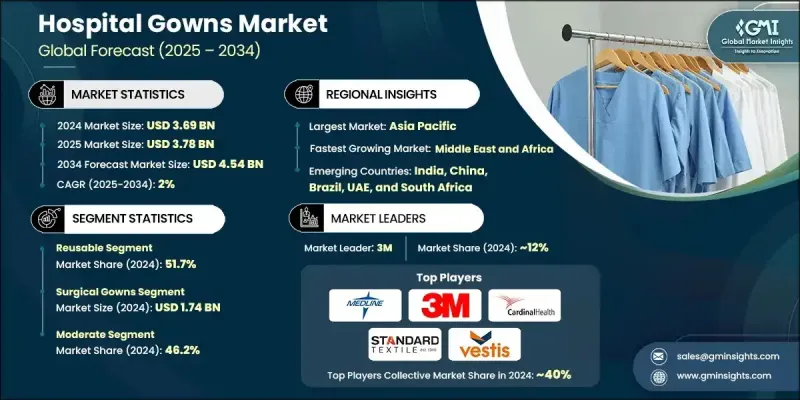
The Global Hospital Gowns Market was valued at USD 3.69 billion in 2024 and is estimated to grow at a CAGR of 2% to reach USD 4.54 billion by 2034.
Market growth is being propelled by the increasing number of surgical procedures, the rising incidence of hospital-acquired infections (HAIs), and the expanding elderly population. Mandatory government regulations on protective healthcare apparel, heightened emphasis on patient safety, and growing preference for single-use gowns are key drivers supporting industry expansion. Furthermore, stringent infection control standards set by healthcare regulatory agencies continue to encourage the use of gowns in medical environments. As awareness of infection prevention and control rises among both patients and medical staff, hospitals are prioritizing gown quality, compliance with hygiene protocols, and usage frequency, further stimulating market demand worldwide.
| Market Scope | |
|---|---|
| Start Year | 2024 |
| Forecast Year | 2025-2034 |
| Start Value | $3.69 Billion |
| Forecast Value | $4.54 Billion |
| CAGR | 2% |
The consistent rise in surgeries across multiple categories, including elective and emergency operations, is significantly boosting the need for hospital gowns. This increase is largely attributed to the aging global population, growing rates of chronic diseases, and improved access to healthcare infrastructure. During medical and surgical procedures, sterile gowns are essential to protect patients and healthcare workers from potential contamination. Consequently, the steady growth in surgical volume is expected to reinforce product demand through the forecast period.
The reusable gowns segment held a 51.7% share in 2024. Reusable gowns are gaining popularity due to their cost efficiency and environmental sustainability. They are made from durable fabrics that can withstand numerous washing and sterilization cycles while maintaining effective protection. Many healthcare institutions aiming to minimize medical waste and operational costs are increasingly transitioning toward reusable gowns as a practical, eco-friendly solution.
The surgical gowns segment generated USD 1.74 billion in 2024. The growing frequency of surgical interventions and strict infection prevention standards is driving the demand for high-quality surgical gowns. These gowns are designed to provide maximum protection against fluids and pathogens, and hospitals tend to select them based on sterility, durability, and compliance with safety guidelines. The rise in surgical cases across orthopedics, cardiology, and oncology is further strengthening the demand for sterile and high-performance surgical gowns across global healthcare systems.
North America Hospital Gowns Market accounted for a 29.5% share in 2024. The region's dominance is supported by advanced healthcare infrastructure, high surgical volumes, and rigorous infection control regulations. Hospitals across North America show a growing preference for disposable gowns due to their convenience and effectiveness in preventing cross-contamination. The introduction of antimicrobial fabric technology in certain medical institutions further enhances product innovation. Additionally, the expanding elderly population and higher incidence of chronic diseases are bolstering the market's progress in this region.
Leading companies operating in the Global Hospital Gowns Market include Surgiene Healthcare, Cardinal Health, 3M, MEDLINE, HALYARD, STANDARD TEXTILE, HARTMANN, Molnlycke, KIMTECH (Ansell), PRI-MED MEDICAL PRODUCTS, STERIS, Vestis, TIDI, VYGON, Lohmann & Rauscher, JPS MEDICAL, Sara+Care, and ANGGIA CORPORATION. Key market players in the Hospital Gowns Market are implementing several strategies to enhance their market foothold. Many companies are expanding production capacities and adopting automation to improve efficiency and meet growing demand. They are also investing in research and development to introduce gowns with improved barrier protection, comfort, and antimicrobial properties. Strategic collaborations with hospitals and healthcare distributors are helping strengthen distribution networks. In addition, several players are focusing on sustainability initiatives by developing reusable gowns and eco-friendly materials, aligning with global waste reduction goals while maintaining regulatory compliance and product innovation.
Table of Contents
Chapter 1 Methodology and Scope
- 1.1 Market scope and definition
- 1.2 Research design
- 1.2.1 Research approach
- 1.2.2 Data collection methods
- 1.3 Data mining sources
- 1.3.1 Global
- 1.3.2 Regional/Country
- 1.4 Base estimates and calculations
- 1.4.1 Base year calculation
- 1.4.2 Key trends for market estimation
- 1.5 Primary research and validation
- 1.5.1 Primary sources
- 1.6 Forecast model
- 1.7 Research assumptions and limitations
Chapter 2 Executive Summary
- 2.1 Industry 360° synopsis
- 2.2 Key market trends
- 2.2.1 Regional trends
- 2.2.2 Usability trends
- 2.2.3 Gown type trends
- 2.2.4 Protection level trends
- 2.3 CXO perspectives: Strategic imperatives
- 2.3.1 Key decision points for industry executives
- 2.3.2 Critical success factors for market players
- 2.4 Future outlook and strategic recommendations
Chapter 3 Industry Insights
- 3.1 Industry ecosystem analysis
- 3.2 Industry impact forces
- 3.2.1 Growth drivers
- 3.2.1.1 Rise in number of surgeries across the world
- 3.2.1.2 Growing instances of hospital acquired infections (HAIs)
- 3.2.1.3 Recent technological advancements
- 3.2.1.4 Rise in the number of hospitalizations due to chronic diseases
- 3.2.2 Industry pitfalls and challenges
- 3.2.2.1 Growing demand for homecare services
- 3.2.2.2 Rise in robotic surgeries
- 3.2.3 Opportunities
- 3.2.3.1 Expansion of healthcare infrastructure in emerging countries
- 3.2.3.2 Antimicrobial technology integration
- 3.2.1 Growth drivers
- 3.3 Growth potential analysis
- 3.4 Regulatory landscape
- 3.4.1 North America
- 3.4.2 Europe
- 3.4.3 Asia Pacific
- 3.5 Technology and innovation landscape
- 3.5.1 Current technological trends
- 3.5.2 Emerging technologies
- 3.6 Investment landscape
- 3.7 Sustainable Material Innovation
- 3.7.1 Biodegradable polymer development
- 3.7.2 Circular economy integration
- 3.7.3 Waste reduction technologies
- 3.8 Porter's analysis
- 3.9 PESTEL analysis
- 3.10 Gap analysis
- 3.11 Future market trends
Chapter 4 Competitive Landscape, 2024
- 4.1 Introduction
- 4.2 Company matrix analysis
- 4.3 Company market share analysis
- 4.3.1 Global
- 4.3.2 North America
- 4.3.3 Europe
- 4.3.4 Asia Pacific
- 4.4 Competitive analysis of major market players
- 4.5 Competitive positioning matrix
- 4.6 Key developments
- 4.6.1 Mergers & acquisitions
- 4.6.2 Partnerships & collaborations
- 4.6.3 New product launches
- 4.6.4 Expansion plans
Chapter 5 Market Estimates and Forecast, By Usability, 2021 - 2034 ($ Mn)
- 5.1 Key trends
- 5.2 Disposable
- 5.3 Reusable
Chapter 6 Market Estimates and Forecast, By Gown Type, 2021 - 2034 ($ Mn)
- 6.1 Key trends
- 6.2 Surgical gowns
- 6.3 Non-surgical gowns
- 6.4 Patient gowns
Chapter 7 Market Estimates and Forecast, By Protection Level, 2021 - 2034 ($ Mn)
- 7.1 Key trends
- 7.2 Minimal
- 7.3 Low
- 7.4 Moderate
- 7.5 High
Chapter 8 Market Estimates and Forecast, By Region, 2021 - 2034 ($ Mn)
- 8.1 Key trends
- 8.2 North America
- 8.2.1 U.S.
- 8.2.2 Canada
- 8.3 Europe
- 8.3.1 Germany
- 8.3.2 UK
- 8.3.3 France
- 8.3.4 Spain
- 8.3.5 Italy
- 8.3.6 Netherlands
- 8.4 Asia Pacific
- 8.4.1 China
- 8.4.2 Japan
- 8.4.3 India
- 8.4.4 Australia
- 8.4.5 South Korea
- 8.5 Latin America
- 8.5.1 Brazil
- 8.5.2 Mexico
- 8.5.3 Argentina
- 8.6 MEA
- 8.6.1 South Africa
- 8.6.2 Saudi Arabia
- 8.6.3 UAE
Chapter 9 Company Profiles
- 9.1 3M
- 9.2 ANGGIA CORPORATION
- 9.3 Cardinal Health
- 9.4 HALYARD
- 9.5 HARTMANN
- 9.6 JPS MEDICAL
- 9.7 KIMTECH (Ansell)
- 9.8 Lohmann & Rauscher
- 9.9 MEDLINE
- 9.10 Molnlycke
- 9.11 PRI-MED MEDICAL PRODUCTS
- 9.12 Sara+Care
- 9.13 STANDARD TEXTILE
- 9.14 STERIS
- 9.15 Surgiene Healthcare
- 9.16 TIDI
- 9.17 vestis
- 9.18 VYGON

