
PUBLISHER: Global Market Insights Inc. | PRODUCT CODE: 1876787

PUBLISHER: Global Market Insights Inc. | PRODUCT CODE: 1876787
Phase Change Materials Market Opportunity, Growth Drivers, Industry Trend Analysis, and Forecast 2025 - 2034
The Global Phase Change Materials Market was valued at USD 2.6 billion in 2024 and is estimated to grow at a CAGR of 11.4% to reach USD 7.9 billion by 2034.
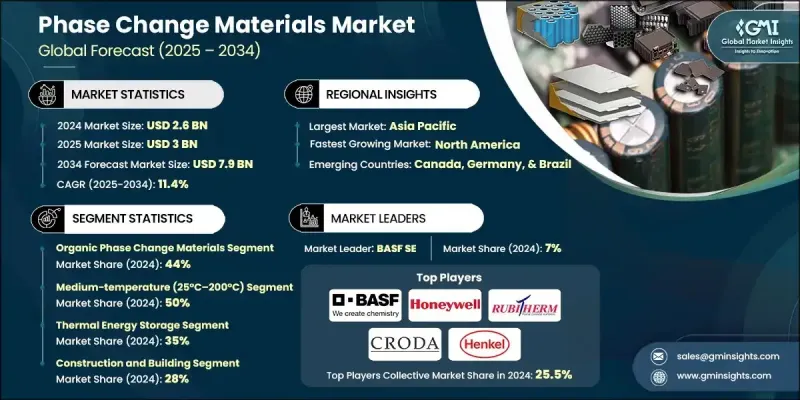
The market's growth is attributed to increasing demand for energy-efficient products, evolving energy regulations, and the accelerating transition toward renewable and sustainable technologies. Phase change materials are becoming integral to thermal energy storage applications, where they help reduce energy peaks, enhance performance, and optimize resource utilization across buildings, electronics, automotive, and industrial sectors. Medium-temperature PCMs, ranging from 25°C to 200°C, account for around 55% of total demand due to their widespread use in thermal management systems for buildings, electronic devices, and electric vehicle batteries. Meanwhile, low-temperature PCMs are advancing rapidly in refrigeration and cold-chain logistics, while high-temperature variants are gaining prominence in industrial waste-heat recovery and concentrated solar power projects. With growing global attention on sustainability and temperature-sensitive logistics, PCMs are increasingly deployed in cold chain systems to maintain temperature stability, improve product safety, and comply with regulatory standards. The surge in e-commerce, vaccine distribution, and perishable goods logistics is also propelling innovation in encapsulation and formulation technologies, making PCMs an indispensable part of modern supply chains.
| Market Scope | |
|---|---|
| Start Year | 2024 |
| Forecast Year | 2025-2034 |
| Start Value | $2.6 Billion |
| Forecast Value | $7.9 Billion |
| CAGR | 11.4% |
The composite and hybrid phase change materials segment will grow at a CAGR of 17.9% through 2034. These advanced materials are essential in managing thermal loads in electronics, electric vehicles, textiles, and emerging aerospace applications. Shape-stabilized PCMs are also experiencing growing adoption due to their superior reliability and compatibility with complex thermal environments. Their ability to retain structural integrity while delivering consistent energy storage performance has made them particularly useful in high-performance and safety-critical applications.
The cold chain industry is expected to reach USD 716 million by 2034, with PCMs offering an eco-friendly, reusable, and non-toxic solution for maintaining precise temperature control during transportation and storage. Their growing adoption across pharmaceuticals, food, and healthcare industries ensures better quality assurance and reduced spoilage. Moreover, in industrial settings, PCMs are increasingly integrated into systems for process optimization, energy recovery, and machinery protection, resulting in significant improvements in efficiency and sustainability.
North America Phase Change Materials Market generated USD 689 million in 2024 and is expected to grow at a CAGR of 10.5% through 2034. The United States dominates the regional market, driven by a strong focus on sustainable construction practices, energy-efficient building materials, and electric vehicle thermal management. Additionally, the rapid expansion of renewable energy infrastructure is creating opportunities for PCM-based energy storage systems. Advances in bio-based PCM formulations and encapsulation technologies are key factors shaping product differentiation across the North American market.
Leading companies operating in the Global Phase Change Materials Market include Sunamp Ltd., Henkel AG & Co. KGaA, BASF SE, Microtek Laboratories Inc., Outlast Technologies LLC, Rubitherm Technologies GmbH, Sasol Limited, Climator Sweden AB, Croda International Plc, Thermory AS, Honeywell International Inc., Phase Change Energy Solutions, Entropy Solutions Inc., PCM Energy Pvt. Ltd., Pluss Advanced Technologies Pvt. Ltd., va-Q-tec AG, Vikram Solar Ltd., and Zeon Corporation. Key players in the phase change materials market are adopting several strategies to strengthen their global presence. These include investing in R&D to develop bio-based and recyclable PCM formulations with improved thermal conductivity and long-term stability. Companies are also expanding their product portfolios through composite and hybrid PCM technologies aimed at the automotive, energy, and construction sectors. Strategic partnerships and collaborations with HVAC, renewable energy, and cold chain firms are being leveraged to enhance application integration. Furthermore, market leaders are optimizing manufacturing efficiency and expanding geographically to capture emerging opportunities in Asia-Pacific and North America.
Table of Contents
Chapter 1 Methodology & Scope
- 1.1 Market scope and definition
- 1.2 Research design
- 1.2.1 Research approach
- 1.2.2 Data collection methods
- 1.3 Data mining sources
- 1.3.1 Global
- 1.3.2 Regional/Country
- 1.4 Base estimates and calculations
- 1.4.1 Base year calculation
- 1.4.2 Key trends for market estimation
- 1.5 Primary research and validation
- 1.5.1 Primary sources
- 1.6 Forecast model
- 1.7 Research assumptions and limitations
Chapter 2 Executive Summary
- 2.1 Industry 360° synopsis
- 2.2 Key market trends
- 2.2.1 Regional
- 2.2.2 Material type
- 2.2.3 Temperature range
- 2.2.4 Application
- 2.2.5 End Use
- 2.3 TAM Analysis, 2025-2034
- 2.4 CXO perspectives: Strategic imperatives
- 2.4.1 Executive decision points
- 2.4.2 Critical success factors
- 2.5 Future Outlook and Strategic Recommendations
Chapter 3 Industry Insights
- 3.1 Industry ecosystem analysis
- 3.1.1 Supplier landscape
- 3.1.2 Profit margin
- 3.1.3 Value addition at each stage
- 3.1.4 Factor affecting the value chain
- 3.1.5 Disruptions
- 3.2 Industry impact forces
- 3.2.1 Growth drivers
- 3.2.2 Industry pitfalls and challenges
- 3.2.3 Market opportunities
- 3.3 Growth potential analysis
- 3.4 Regulatory landscape
- 3.4.1 North America
- 3.4.2 Europe
- 3.4.3 Asia Pacific
- 3.4.4 Latin America
- 3.4.5 Middle East & Africa (MEA)
- 3.5 Porter's analysis
- 3.6 PESTEL analysis
- 3.7 Price trends
- 3.7.1 By region
- 3.7.2 By material type
- 3.8 Future market trends
- 3.9 Technology and innovation landscape
- 3.9.1 Current technological trends
- 3.9.2 Emerging technologies
- 3.10 Patent landscape
- 3.11 Trade statistics (HS code) ( Note: the trade statistics will be provided for key countries only
- 3.11.1 Major importing countries
- 3.11.2 Major exporting countries
- 3.12 Sustainability and environmental aspects
- 3.12.1 Sustainable practices
- 3.12.2 Waste reduction strategies
- 3.12.3 Energy efficiency in production
- 3.12.4 Eco-friendly initiatives
- 3.13 Carbon footprint consideration
Chapter 4 Competitive Landscape, 2024
- 4.1 Introduction
- 4.2 Company market share analysis
- 4.2.1 By region
- 4.2.1.1 North America
- 4.2.1.2 Europe
- 4.2.1.3 Asia Pacific
- 4.2.1.4 LATAM
- 4.2.1.5 MEA
- 4.2.1 By region
- 4.3 Company matrix analysis
- 4.4 Competitive analysis of major market players
- 4.5 Competitive positioning matrix
- 4.6 Key developments
- 4.6.1 Mergers & acquisitions
- 4.6.2 Partnerships & collaborations
- 4.6.3 New Product Launches
- 4.6.4 Expansion Plans
Chapter 5 Market Estimates and Forecast, By Material Type, 2021-2034 (USD Billion & Tons)
- 5.1 Key trends
- 5.2 Organic PCMs
- 5.2.1 Paraffins
- 5.2.2 Fatty acids
- 5.2.3 Fatty acid derivatives
- 5.3 Inorganic PCMs
- 5.3.1 Salt hydrates
- 5.3.2 Nitrate salts
- 5.3.3 Fluoride salts
- 5.3.4 Hydroxide salts
- 5.4 Composite/hybrid PCMs
- 5.4.1 Polymer composites
- 5.4.2 Microencapsulated
- 5.4.3 Shape-stabilized
Chapter 6 Market Estimates and Forecast, By Temperature Range, 2021-2034 (USD Billion & Tons)
- 6.1 Key trends
- 6.2 Low temperature (-50°c to 25°c)
- 6.3 Medium temperature (25°c to 200°c)
- 6.4 High temperature (200°c to 1500°c)
Chapter 7 Market Estimates and Forecast, By Application, 2021-2034 (USD Billion & Tons)
- 7.1 Key trends
- 7.2 Thermal energy storage
- 7.2.1 Building energy storage
- 7.2.2 Industrial process storage
- 7.2.3 Grid-scale energy storage
- 7.3 Thermal regulation & control
- 7.3.1 Electronics thermal
- 7.3.2 Battery thermal
- 7.3.3 Process temperature control
- 7.4 Comfort & conditioning
- 7.4.1 Building climate control
- 7.4.2 Automotive cabin comfort
- 7.4.3 Textile temperature
- 7.5 Cold chain & preservation
- 7.5.1 Food & beverage cold chain
- 7.5.2 Pharmaceutical cold chain
- 7.5.3 Medical device
- 7.6 Industrial process applications
- 7.6.1 Waste heat recovery
- 7.6.2 Process heating/cooling
- 7.6.3 Equipment protection
Chapter 8 Market Estimates and Forecast, By End Use, 2021-2034 (USD Billion & Tons)
- 8.1 Key trends
- 8.2 Construction & buildings
- 8.3 Electronics & semiconductors
- 8.4 Automotive & transportation
- 8.5 Textiles & apparel
- 8.6 Energy & utilities
- 8.7 Healthcare & pharmaceuticals
- 8.8 Food & beverage
- 8.9 Industrial manufacturing
- 8.10 Aerospace & defense
Chapter 9 Market Estimates and Forecast, By Region, 2021-2034 (USD Billion & Tons)
- 9.1 Key trends
- 9.2 North America
- 9.2.1 U.S.
- 9.2.2 Canada
- 9.3 Europe
- 9.3.1 Germany
- 9.3.2 UK
- 9.3.3 France
- 9.3.4 Spain
- 9.3.5 Italy
- 9.3.6 Rest of Europe
- 9.4 Asia Pacific
- 9.4.1 China
- 9.4.2 India
- 9.4.3 Japan
- 9.4.4 Australia
- 9.4.5 South Korea
- 9.4.6 Rest of Asia Pacific
- 9.5 Latin America
- 9.5.1 Brazil
- 9.5.2 Mexico
- 9.5.3 Argentina
- 9.5.4 Rest of Latin America
- 9.6 Middle East and Africa
- 9.6.1 Saudi Arabia
- 9.6.2 South Africa
- 9.6.3 UAE
- 9.6.4 Rest of Middle East and Africa
Chapter 10 Company Profiles
- 10.1 BASF SE
- 10.2 Climator Sweden AB
- 10.3 Croda International Plc
- 10.4 Entropy Solutions Inc.
- 10.5 Henkel AG & Co. KGaA
- 10.6 Honeywell International Inc.
- 10.7 Microtek Laboratories Inc.
- 10.8 Outlast Technologies LLC
- 10.9 PCM Energy Pvt. Ltd.
- 10.10 Phase Change Energy Solutions
- 10.11 Pluss Advanced Technologies Pvt. Ltd.
- 10.12 Rubitherm Technologies GmbH
- 10.13 Sasol Limited
- 10.14 Sunamp Ltd.
- 10.15 Thermory AS
- 10.16 va-Q-tec AG
- 10.17 Vikram Solar Ltd.
- 10.18 Zeon Corporation

