
PUBLISHER: Global Market Insights Inc. | PRODUCT CODE: 1876817

PUBLISHER: Global Market Insights Inc. | PRODUCT CODE: 1876817
Shape Memory Polymers Market Opportunity, Growth Drivers, Industry Trend Analysis, and Forecast 2025 - 2034
The Global Shape Memory Polymers Market was valued at USD 720 million in 2024 and is estimated to grow at a CAGR of 11.6% to reach USD 2.1 billion by 2034.
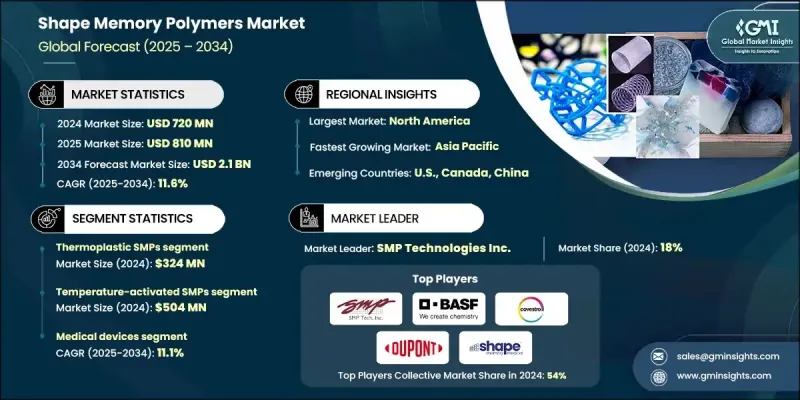
The market is expanding as industries increasingly focus on the use of smart and responsive materials. The unique ability of shape memory polymers (SMPs) to return to their original form when exposed to external stimuli has led to their adoption in advanced sectors requiring high-performance and adaptive materials. Growing emphasis on intelligent material design is promoting their use across manufacturing, healthcare, automotive, and aerospace industries. These polymers support innovations in sustainability, energy efficiency, and self-healing capabilities, allowing manufacturers to design lighter and more durable structures. In the biomedical field, SMPs are increasingly being used for advanced medical devices, self-expanding stents, and minimally invasive implants, offering enhanced performance and patient recovery. The aerospace and defense sectors are also investing heavily in SMP-based materials due to their low weight, fatigue resistance, and programmable mechanical behavior, all of which contribute to operational efficiency and long-term reliability. With ongoing R&D initiatives and material breakthroughs, SMPs are steadily becoming a cornerstone of next-generation material technology.
| Market Scope | |
|---|---|
| Start Year | 2024 |
| Forecast Year | 2025-2034 |
| Start Value | $720 Million |
| Forecast Value | $2.1 Billion |
| CAGR | 11.6% |
Thermoplastic shape memory polymers segment generated USD 324 million in 2024. These materials are gaining popularity due to their recyclability, ease of processing, and potential in sustainable product development. Although thermoplastic SMPs generally have lower strength and limited temperature tolerance, innovations in formulation and the introduction of hybrid and multi-responsive variants are improving their performance. The market is also witnessing growing interest in biodegradable and composite SMPs, as sustainability becomes a key factor in design and manufacturing. With continuous advancements in polymer chemistry and processing, the demand for reprogrammable SMPs with superior functionality is expected to expand across industrial applications.
The temperature-activated shape memory polymers segment generated USD 504 million in 2024. This category dominates due to its simple activation process and compatibility with standard production techniques. These materials respond efficiently to thermal triggers and are widely used in automotive, aerospace, and biomedical applications. Their thermal activation enables superior control over shape recovery, flexibility, and self-healing behavior, making them suitable for multiple engineering and structural applications.
North America Shape Memory Polymers Market accounted for USD 288 million in 2024 and held 40% share. The United States holds the largest share in the region, supported by a strong industrial foundation, technological innovation, and a well-established R&D framework. Extensive usage in key sectors such as aerospace, medical devices, and automotive continues to drive market growth. Additionally, the region is home to several advanced material producers and polymer developers focusing on the commercialization of adaptive polymers for industrial and medical use. The presence of major polymer manufacturers and ongoing investments in research are further enhancing the region's leadership position in the Global Shape Memory Polymers Market.
Major companies active in the Global Shape Memory Polymers Market include Coating Place Inc., Evonik Industries AG, 3M Company, DSM N.V., Syngenta AG, Aveka Inc., BASF SE, Ashland Global Holdings Inc., DOW Corning, Balchem Corporation, and Capsugel (Lonza Group). Leading companies in the Global Shape Memory Polymers Market are adopting multiple strategies to strengthen their market foothold. These include investments in R&D to enhance polymer properties such as flexibility, reprogramming capability, and biodegradability. Strategic collaborations with academic institutions and industrial partners are being pursued to accelerate material innovation and application expansion. Many firms are focusing on product diversification by developing multi-stimuli-responsive SMPs and integrating them into high-growth sectors like healthcare and aerospace.
Table of Contents
Chapter 1 Methodology & Scope
- 1.1 Market scope and definition
- 1.2 Research design
- 1.2.1 Research approach
- 1.2.2 Data collection methods
- 1.3 Data mining sources
- 1.3.1 Global
- 1.3.2 Regional/Country
- 1.4 Base estimates and calculations
- 1.4.1 Base year calculation
- 1.4.2 Key trends for market estimation
- 1.5 Primary research and validation
- 1.5.1 Primary sources
- 1.6 Forecast model
- 1.7 Research assumptions and limitations
Chapter 2 Executive Summary
- 2.1 Industry 3600 synopsis
- 2.2 Key market trends
- 2.2.1 Regional
- 2.2.2 Material Type
- 2.2.3 Stimulus Type
- 2.2.4 Application
- 2.3 TAM Analysis, 2025-2034
- 2.4 CXO perspectives: Strategic imperatives
- 2.4.1 Executive decision points
- 2.4.2 Critical success factors
- 2.5 Future Outlook and Strategic Recommendations
Chapter 3 Industry Insights
- 3.1 Industry ecosystem analysis
- 3.1.1 Supplier Landscape
- 3.1.2 Profit Margin
- 3.1.3 Value addition at each stage
- 3.1.4 Factor affecting the value chain
- 3.1.5 Disruptions
- 3.2 Industry impact forces
- 3.2.1 Growth drivers
- 3.2.1.1 Rising demand for smart materials
- 3.2.1.2 Advancements in biomedical applications
- 3.2.1.3 Growing aerospace and defense sector
- 3.2.2 Industry pitfalls and challenges
- 3.2.2.1 Limited recovery force compared to shape memory alloys
- 3.2.2.2 High production costs for specialty formulations
- 3.2.2.3 Temperature sensitivity & environmental stability challenges
- 3.2.3 Market opportunities
- 3.2.3.1 Climate-adaptive building envelope systems
- 3.2.3.2 Sustainable & bio-based formulation development
- 3.2.3.3 IoT integration & smart infrastructure applications
- 3.2.1 Growth drivers
- 3.3 Growth potential analysis
- 3.4 Regulatory landscape
- 3.4.1 North America
- 3.4.2 Europe
- 3.4.3 Asia Pacific
- 3.4.4 Latin America
- 3.4.5 Middle East & Africa
- 3.5 Porter's analysis
- 3.6 PESTEL analysis
- 3.6.1 Technology and Innovation Landscape
- 3.6.2 Current technological trends
- 3.6.3 Emerging technologies
- 3.7 Price trends
- 3.7.1 By region
- 3.7.2 Material Type
- 3.7.3 Stimulus Type
- 3.7.4 Application
- 3.8 Future market trends
- 3.9 Technology and Innovation Landscape
- 3.9.1 Current technological trends
- 3.9.2 Emerging technologies
- 3.10 Patent Landscape
- 3.11 Trade statistics (HS code) (Note: the trade statistics will be provided for key countries only)
- 3.11.1 Major importing countries
- 3.11.2 Major exporting countries
- 3.12 Sustainability and environmental aspects
- 3.12.1 Sustainable practices
- 3.12.2 Waste reduction strategies
- 3.12.3 Energy efficiency in production
- 3.12.4 Eco-friendly initiatives
- 3.13 Carbon footprint considerations
Chapter 4 Competitive Landscape, 2024
- 4.1 Introduction
- 4.2 Company market share analysis
- 4.2.1 By region
- 4.2.1.1 North America
- 4.2.1.2 Europe
- 4.2.1.3 Asia Pacific
- 4.2.1.4 LATAM
- 4.2.1.5 MEA
- 4.2.1 By region
- 4.3 Company matrix analysis
- 4.4 Competitive analysis of major market players
- 4.5 Competitive positioning matrix
- 4.6 Key developments
- 4.6.1 Mergers & acquisitions
- 4.6.2 Partnerships & collaborations
- 4.6.3 New product launches
- 4.6.4 Expansion plans
Chapter 5 Market Estimates and Forecast, By Material Type, 2021 - 2034 (USD Million) (Kilo Tons)
- 5.1 Key trends
- 5.2 Thermoplastic SMPs
- 5.2.1 Polyurethane-based systems
- 5.2.2 Polyester-based systems
- 5.2.3 Polycaprolactone systems
- 5.3 Thermoset SMPs
- 5.3.1 Epoxy-based systems
- 5.3.2 Cyanate ester systems
- 5.3.3 Polyimide systems
- 5.4 Biodegradable SMPs
- 5.4.1 Poly(ε-caprolactone) based
- 5.4.2 PLGA-based systems
- 5.4.3 PHA-based systems
- 5.5 Composite SMPs
- 5.5.1 Carbon fiber reinforced
- 5.5.2 Glass fiber reinforced
- 5.5.3 Nanoparticle enhanced
Chapter 6 Market Estimates and Forecast, By Stimulus Type, 2021 - 2034 (USD Million) (Kilo Tons)
- 6.1 Key trends
- 6.2 Temperature-activated SMPs
- 6.2.1 Glass transition triggered systems
- 6.2.2 Melting temperature triggered systems
- 6.2.3 Body temperature activated systems
- 6.3 Light-activated SMPs
- 6.3.1 UV-triggered systems
- 6.3.2 Visible light systems
- 6.3.3 Nir-activated systems
- 6.4 Electrically activated SMPs
- 6.4.1 Joule heating systems
- 6.4.2 Conductive filler integration
- 6.4.3 Resistive heating applications
- 6.5 Magnetically activated SMPs
- 6.5.1 Iron oxide nanoparticle systems
- 6.5.2 Ferromagnetic filler integration
- 6.5.3 Remote activation applications
Chapter 7 Market Estimates and Forecast, By Application, 2021 - 2034 (USD Million) (Kilo Tons)
- 7.1 Key trends
- 7.2 Medical devices
- 7.2.1 Vascular embolization devices
- 7.2.2 Stents & catheters
- 7.2.3 Orthopedic implants
- 7.2.4 Surgical instruments
- 7.2.5 Drug delivery systems
- 7.3 Aerospace & defense
- 7.3.1 Deployable structures
- 7.3.2 Morphing aircraft components
- 7.3.3 Space applications
- 7.3.4 Self-healing composites
- 7.3.5 Actuator systems
- 7.4 Automotive
- 7.4.1 Self-repairable components
- 7.4.2 Adaptive aerodynamics
- 7.4.3 Interior applications
- 7.4.4 Safety systems
- 7.4.5 Lightweighting applications
- 7.5 Construction & infrastructure
- 7.5.1 Pipeline renovation systems
- 7.5.2 Adaptive building envelopes
- 7.5.3 Seismic resilience applications
- 7.5.4 Smart infrastructure systems
- 7.5.5 Self-healing concrete
- 7.6 Industrial & manufacturing
- 7.6.1 Actuator systems
- 7.6.2 Smart components
- 7.6.3 Process equipment
- 7.6.4 Automation applications
- 7.6.5 Textile applications
Chapter 8 Market Estimates and Forecast, By Region, 2021 - 2034 (USD million) (Kilo Tons)
- 8.1 Key trends
- 8.2 North America
- 8.2.1 U.S.
- 8.2.2 Canada
- 8.3 Europe
- 8.3.1 Germany
- 8.3.2 UK
- 8.3.3 France
- 8.3.4 Spain
- 8.3.5 Italy
- 8.3.6 Rest of Europe
- 8.4 Asia Pacific
- 8.4.1 China
- 8.4.2 India
- 8.4.3 Japan
- 8.4.4 Australia
- 8.4.5 South Korea
- 8.4.6 Rest of Asia Pacific
- 8.5 Latin America
- 8.5.1 Brazil
- 8.5.2 Mexico
- 8.5.3 Rest of Latin America
- 8.6 Middle East and Africa
- 8.6.1 Saudi Arabia
- 8.6.2 South Africa
- 8.6.3 UAE
- 8.6.4 Rest of Middle East and Africa
Chapter 9 Company Profiles
- 9.1 Shape Memory Medical Inc.
- 9.2 Covestro AG
- 9.3 BASF SE
- 9.4 SMP Technologies Inc.
- 9.5 Dupont De Nemours, Inc.
- 9.6 Natureworks LLC
- 9.7 Lubrizol Corporation
- 9.8 Evonik Industries AG
- 9.9 Spintech, LLC
- 9.10 Huntsman International LLC

