
PUBLISHER: Global Market Insights Inc. | PRODUCT CODE: 1885783

PUBLISHER: Global Market Insights Inc. | PRODUCT CODE: 1885783
Robotic Packaging System Market Opportunity, Growth Drivers, Industry Trend Analysis, and Forecast 2025 - 2034
The Global Robotic Packaging Systems Market was valued at USD 6.4 billion in 2024 and is estimated to grow at a CAGR of 5.3% to reach USD 10.5 billion by 2034.
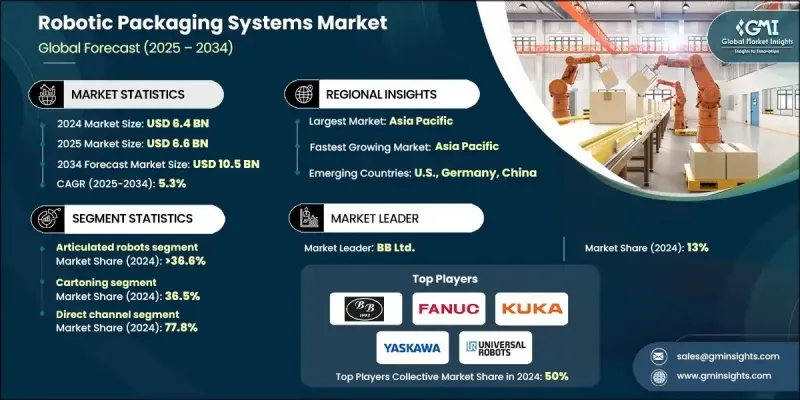
Growth is driven by rapid advancements in automation technologies, where machine vision, artificial intelligence, flexible gripping tools, and collaborative robotics are making packaging operations faster, safer, and more precise. Greater integration of Industry 4.0 capabilities allows robots to coordinate with connected devices, enabling predictive maintenance and real-time optimization across production lines. Collaborative robots continue to gain traction as manufacturers adopt flexible systems that can be redeployed across different workflows and reprogrammed with minimal downtime. These solutions enhance human-robot interaction and contribute to better throughput, improved workplace safety, and higher reliability. Modern robotic packaging platforms now combine advanced vision systems, machine-learning-powered optimization, IoT-enabled remote monitoring, and cloud-driven analytics to maximize uptime and operational efficiency. This technological convergence supports continuous performance improvements and allows manufacturers to adjust packaging processes instantly based on live production data.
| Market Scope | |
|---|---|
| Start Year | 2024 |
| Forecast Year | 2025-2034 |
| Start Value | $6.4 Billion |
| Forecast Value | $10.5 Billion |
| CAGR | 5.3% |
The articulated robotics segment held a 36.6% share in 2024 and is forecast to grow at a CAGR of 5.9% through 2034. These robots excel in packaging environments requiring multiple axes of motion and adaptable handling capabilities. Their structural flexibility enables them to accommodate varied product shapes and packaging formats within a single automated setup, making them suitable for operations that deal with shifting production requirements. Their projected growth underscores rising demand for highly capable systems that can meet evolving automation needs.
The wrapping segment generated USD 2.1 billion in 2024. This segment includes a range of wrapping technologies designed to ensure product protection throughout the transportation chain. Automated wrapping systems deliver consistent film application, improved load stabilization, and reduced material usage, which supports efficiency and minimizes product damage throughout distribution.
Asia Pacific Robotic Packaging Systems Market generated USD 2.8 billion in 2024. Expansion in this region is supported by strong manufacturing activity, increased government support for automation, and rising labor costs that encourage wider adoption of robotics. The region's growth is particularly influenced by high-volume production environments across consumer goods, automotive, and electronics sectors. China remains the leading contributor to regional demand as industries modernize their packaging operations with more advanced automation systems.
Key companies active in the Global Robotic Packaging Systems Market include ABB Ltd., Brenton Engineering, Doosan Robotics, FANUC Corporation, Krones AG, KUKA AG, Mitsubishi Electric, Omron Corporation, Schneider Electric, Standard Bots, Staubli, Syntegon Technology, TechMan Robot, Universal Robots, and Yaskawa Electric / Motoman. Companies participating in the Robotic Packaging Systems Market implement a variety of strategic measures to strengthen their market position. Many invest in R&D to enhance robotic precision, speed, and multi-functionality while integrating advanced sensors and AI-driven analytics. Manufacturers are expanding modular and flexible product lines that allow easy customization and faster changeovers. Strategic partnerships with system integrators and end-use industries help broaden application reach and support tailored automation solutions.
Table of Contents
Chapter 1 Methodology and Scope
- 1.1 Market scope and definition
- 1.2 Research design
- 1.2.1 Research approach
- 1.3 Data collection methods
- 1.4 Data mining sources
- 1.4.1 Global
- 1.4.2 Regional/Country
- 1.5 Base estimates and calculations
- 1.5.1 Base year calculation
- 1.5.2 Key trends for market estimation
- 1.6 Primary research and validation
- 1.6.1 Primary sources
- 1.7 Forecast model
- 1.8 Research assumptions and limitations
Chapter 2 Executive Summary
- 2.1 Industry 360° synopsis
- 2.2 Key market trends
- 2.2.1 Regional
- 2.2.2 Robot type
- 2.2.3 Packaging type
- 2.2.4 Application
- 2.2.5 End Use industry
- 2.2.6 Distribution channel
- 2.3 CXO perspectives: strategic imperatives
- 2.3.1 Key decision points for industry executives
- 2.3.2 Critical success factors for market players
- 2.4 Future outlook and strategic recommendations
Chapter 3 Industry Insights
- 3.1 Industry ecosystem analysis
- 3.1.1 Supplier landscape
- 3.1.2 Profit margin
- 3.1.3 Value addition at each stage
- 3.1.4 Factors affecting the value chain
- 3.2 Industry impact forces
- 3.2.1 Growth drivers
- 3.2.1.1 Rising labor costs & labor shortage
- 3.2.1.2 Need for efficiency, quality, speed & scalability
- 3.2.1.3 Technological advancement & automation push
- 3.2.2 Industry pitfalls & challenges
- 3.2.2.1 High initial investment & capital cost
- 3.2.2.2 Integration complexity & legacy systems/workforce skill gap
- 3.2.2.3 Variability in product/pack formats & flexibility needs
- 3.2.3 Opportunities
- 3.2.3.1 Rapid market growth in packaging robotics
- 3.2.3.2 Expanding use in food, beverage, and consumer goods sectors
- 3.2.3.3 Rising demand for flexible, modular, and cost-efficient systems
- 3.2.1 Growth drivers
- 3.3 Growth potential analysis
- 3.4 Future market trends
- 3.5 Technology and innovation landscape
- 3.5.1 Current technological trends
- 3.5.2 Emerging technologies
- 3.6 Price trends
- 3.6.1 By region
- 3.6.2 By Robot type
- 3.7 Regulatory landscape
- 3.7.1 standards and compliance requirements
- 3.7.2 Regional regulatory frameworks
- 3.8 Porter's analysis
- 3.9 PESTEL analysis
Chapter 4 Competitive Landscape, 2024
- 4.1 Introduction
- 4.2 Company market share analysis
- 4.2.1 By region
- 4.2.1.1 North America
- 4.2.1.2 Europe
- 4.2.1.3 Asia Pacific
- 4.2.1.4 Latin America
- 4.2.1.5 Middle East and Africa
- 4.2.1 By region
- 4.3 Company matrix analysis
- 4.4 Competitive analysis of major market players
- 4.5 Competitive positioning matrix
- 4.6 Key developments
- 4.6.1 Mergers & acquisitions
- 4.6.2 Partnerships & collaborations
- 4.6.3 New Product Launches
- 4.6.4 Expansion Plans
Chapter 5 Market Estimates & Forecast, By Robot Type, 2021 - 2034 ($Bn, Thousand Units)
- 5.1 Key trends
- 5.2 Articulated robots (6-axis)
- 5.3 SCARA robots
- 5.4 Delta robots
- 5.5 Cartesian/gantry robots
- 5.6 Collaborative robots (Cobots)
- 5.7 Cylindrical robots
- 5.8 Mobile robots (AMRs/AGVs)
Chapter 6 Market Estimates & Forecast, By Packaging Type, 2021 - 2034 ($Bn, Thousand Units)
- 6.1 Key trends
- 6.2 Cartoning
- 6.3 Wrapping
- 6.4 Palletizing
- 6.5 Bottling
Chapter 7 Market Estimates & Forecast, By Application, 2021 - 2034 ($Bn, Thousand Units)
- 7.1 Key trends
- 7.2 Pick & place operations
- 7.3 Palletizing & depalletizing
- 7.4 Case packing & tray packing
- 7.5 Material handling
- 7.6 Filling & dispensing
- 7.7 Sealing & capping
- 7.8 Labeling & coding
- 7.9 Inspection & quality control
Chapter 8 Market Estimates & Forecast, By End Use Industry, 2021 - 2034 ($Bn, Thousand Units)
- 8.1 Key trends
- 8.2 Food & beverage
- 8.3 Pharmaceuticals & healthcare
- 8.4 Consumer goods & cosmetics
- 8.5 Automotive
- 8.6 Electronics & electrical
- 8.7 Logistics & e-commerce
- 8.8 Chemicals & Industrials
Chapter 9 Market Estimates & Forecast, By Distribution Channel, 2021 - 2034 ($Bn, Thousand Units)
- 9.1 Key trends
- 9.2 Direct
- 9.3 Indirect
Chapter 10 Market Estimates & Forecast, By Region, 2021 - 2034 ($Bn, Thousand Units)
- 10.1 Key trends
- 10.2 North America
- 10.2.1 U.S.
- 10.2.2 Canada
- 10.3 Europe
- 10.3.1 UK
- 10.3.2 Germany
- 10.3.3 France
- 10.3.4 Italy
- 10.3.5 Spain
- 10.3.6 Russia
- 10.4 Asia Pacific
- 10.4.1 China
- 10.4.2 India
- 10.4.3 Japan
- 10.4.4 Australia
- 10.4.5 South Korea
- 10.5 Latin America
- 10.5.1 Brazil
- 10.5.2 Mexico
- 10.5.3 Argentina
- 10.6 MEA
- 10.6.1 UAE
- 10.6.2 South Africa
- 10.6.3 Saudi Arabia
Chapter 11 Company Profiles
- 11.1 ABB Ltd.
- 11.2 Brenton Engineering
- 11.3 Doosan Robotics
- 11.4 FANUC Corporation
- 11.5 Krones AG
- 11.6 KUKA AG
- 11.7 Mitsubishi Electric
- 11.8 Omron Corporation
- 11.9 Schneider Electric
- 11.10 Standard Bots
- 11.11 Staubli
- 11.12 Syntegon Technology
- 11.13 TechMan Robot
- 11.14 Universal Robots
- 11.15 Yaskawa Electric / Motoman

