
PUBLISHER: Global Market Insights Inc. | PRODUCT CODE: 1885784

PUBLISHER: Global Market Insights Inc. | PRODUCT CODE: 1885784
Southeast Asia Contact Lenses Market Opportunity, Growth Drivers, Industry Trend Analysis, and Forecast 2025 - 2034
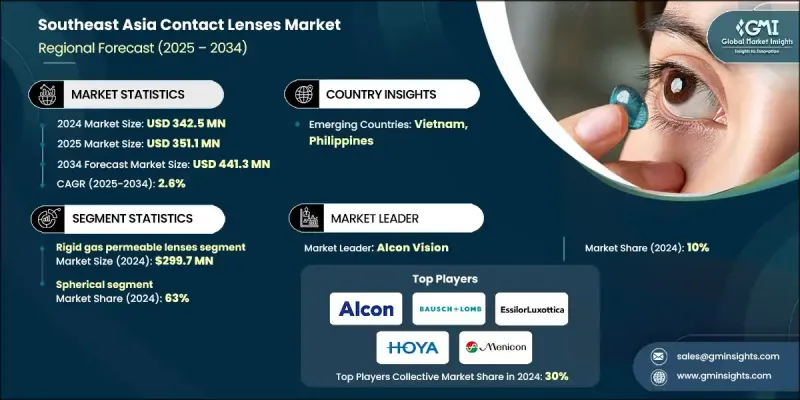
Southeast Asia Contact Lenses Market was valued at USD 342.5 million in 2024 and is estimated to grow at a CAGR of 2.6% to reach USD 441.3 million by 2034.
Vision disorders, including myopia, hyperopia, and astigmatism, are becoming increasingly prevalent in the region due to lifestyle changes, particularly prolonged screen use. Urban populations, especially younger demographics, are spending more time on digital devices, which is contributing to eye strain and an increase in refractive errors. This rising prevalence has strengthened demand for alternatives to traditional spectacles, positioning contact lenses as both a functional and fashionable choice. Growing awareness of eye care, early diagnosis, and educational initiatives by eye care professionals is further boosting adoption. The demand for modern lens technologies that prioritize comfort, safety, and hygiene is increasing, while ongoing urbanization and digital adoption are expected to support long-term market growth by creating a consumer base seeking convenience, practicality, and aesthetic appeal in vision correction solutions.
| Market Scope | |
|---|---|
| Start Year | 2024 |
| Forecast Year | 2025-2034 |
| Start Value | $342.5 Million |
| Forecast Value | $441.3 Million |
| CAGR | 2.6% |
In 2024, the rigid gas permeable (RGP) lenses segment generated USD 299.7 million. RGP lenses maintain their shape on the eye, providing a smooth optical surface that delivers more precise vision correction than soft lenses. These lenses are particularly beneficial for individuals with high astigmatism or irregular corneas, as they neutralize distortions and provide clear, stable vision during eye movements. Patients seeking superior clarity often prefer RGP lenses due to their consistent optical performance.
The spherical lenses segment accounted for a 63% share in 2024. These lenses are widely used in Southeast Asia as they effectively address common refractive errors such as myopia and hyperopia while offering simple and convenient wear. Daily disposable designs are gaining popularity among younger, urban consumers due to hygiene and convenience factors. The growth of e-commerce, subscription models, and virtual try-on tools is further driving trial and adoption of spherical lenses across the region.
Indonesia Contact Lenses Market held a 30% share, generating USD 102.8 million. The market is fueled by rising urbanization, growing disposable incomes, and heightened awareness of eye health. In Indonesia, contact lenses are increasingly used not only for vision correction but also for cosmetic purposes, including colored lenses. Lifestyle changes and fashion trends are contributing to greater adoption, particularly among metropolitan populations seeking alternatives to traditional eyewear.
Major players in the Southeast Asia Contact Lenses Market include Alcon Vision, Bausch + Lomb, EssilorLuxottica, Carl Zeiss Vision, Menicon, Hoya, Brighten Optix, EyeMuse, ClearLab, FreshKon/Oculus, Supervision Optimax, TRANSITIONS OPTICAL, TWOOAK, and Visco Vision. Key strategies adopted by companies in the Southeast Asia Contact Lenses Market focus on innovation, distribution expansion, and customer engagement. Companies are investing in R&D to develop lenses with advanced comfort, safety, and vision-correcting features tailored to regional needs. Strategic partnerships with optometrists, retailers, and e-commerce platforms help widen market reach and improve accessibility. Subscription-based models and digital try-on technologies enhance customer experience and trial adoption. Marketing campaigns emphasize both cosmetic appeal and functional benefits to target younger, urban populations.
Table of Contents
Chapter 1 Methodology and Scope
- 1.1 Market scope and definition
- 1.2 Research design
- 1.2.1 Research approach
- 1.2.2 Data collection methods
- 1.3 Data mining sources
- 1.3.1 Regional
- 1.4 Base estimates and calculations
- 1.4.1 Base year calculation
- 1.4.2 Key trends for market estimation
- 1.5 Primary research and validation
- 1.5.1 Primary sources
- 1.6 Forecast model
- 1.7 Research assumptions and limitations
Chapter 2 Executive Summary
- 2.1 Industry 360° synopsis
- 2.2 Key market trends
- 2.2.1 Countries
- 2.2.2 Type
- 2.2.3 Material
- 2.2.4 Design
- 2.2.5 Color variation
- 2.2.6 Usage
- 2.2.7 Pricing
- 2.2.8 Application
- 2.2.9 Distribution channel
- 2.3 CXO perspectives: Strategic imperatives
- 2.3.1 Key decision points for industry executives
- 2.3.2 Critical success factors for market players
- 2.4 Future outlook and strategic recommendations
Chapter 3 Industry Insights
- 3.1 Industry ecosystem analysis
- 3.1.1 Supplier landscape
- 3.1.2 Profit margin
- 3.1.3 Value addition at each stage
- 3.1.4 Factor affecting the value chain
- 3.2 Industry impact forces
- 3.2.1 Growth drivers
- 3.2.1.1 Rising prevalence of refractive errors
- 3.2.1.2 Urbanization and rising disposable incomes
- 3.2.1.3 Growing cosmetic application
- 3.2.2 Industry pitfalls & challenges
- 3.2.2.1 Limited awareness in rural areas
- 3.2.2.2 Safety concerns & lack of skilled professionals
- 3.2.3 Opportunities
- 3.2.3.1 Rising demand for daily disposables via e commerce
- 3.2.3.2 Product innovation & R&D potential
- 3.2.1 Growth drivers
- 3.3 Growth potential analysis
- 3.4 Future market trends
- 3.5 Technology and innovation landscape
- 3.5.1 Current technological trends
- 3.5.2 Emerging technologies
- 3.6 Price trends
- 3.6.1 By countries
- 3.6.2 By type
- 3.7 Regulatory landscape
- 3.7.1 Standards and compliance requirements
- 3.7.2 Regional regulatory frameworks
- 3.7.3 Certification standards
- 3.8 Porter's analysis
- 3.9 PESTEL analysis
- 3.10 Consumer behavior analysis
- 3.10.1 Purchasing patterns
- 3.10.2 Preference analysis
- 3.10.3 Regional variations in consumer behavior
- 3.10.4 Impact of e-commerce on buying decisions
Chapter 4 Competitive Landscape, 2024
- 4.1 Introduction
- 4.2 Company market share analysis
- 4.3 Company matrix analysis
- 4.4 Competitive analysis of major market players
- 4.5 Competitive positioning matrix
- 4.6 Key developments
- 4.6.1 Mergers & acquisitions
- 4.6.2 Partnerships & collaborations
- 4.6.3 New product launches
- 4.6.4 Expansion plans
Chapter 5 Market Estimates and Forecast, By Type, 2021 - 2034 (USD Million) (Million Units)
- 5.1 Key trends
- 5.2 Soft contact lenses
- 5.3 Rigid gas permeable lenses
- 5.4 Hybrid contact lenses
Chapter 6 Market Estimates and Forecast, By Material, 2021 - 2034 (USD Million) (Million Units)
- 6.1 Key trends
- 6.2 Hydrogel
- 6.2.1 Silicone hydrogel
- 6.2.2 HEMA hydrogels
- 6.3 Rigid gas permeable
- 6.4 Others
Chapter 7 Market Estimates and Forecast, By Design, 2021 - 2034 (USD Million) (Million Units)
- 7.1 Key trends
- 7.2 Spherical
- 7.3 Toric
- 7.4 Multifocal
- 7.5 Others
Chapter 8 Market Estimates and Forecast, By Color Variation, 2021 - 2034 (USD Million) (Million Units)
- 8.1 Key trends
- 8.2 Opaque contact lenses
- 8.3 Enhancers/tinted contact lenses
- 8.4 Visibility tinted contact lenses
Chapter 9 Market Estimates and Forecast, By Usage, 2021 - 2034 (USD Million) (Million Units)
- 9.1 Key trends
- 9.2 Daily disposable
- 9.3 Weekly disposable
- 9.4 Monthly disposable
- 9.5 Annual
Chapter 10 Market Estimates and Forecast, By Pricing, 2021 - 2034 (USD Million) (Million Units)
- 10.1 Key trends
- 10.2 Low
- 10.3 Medium
- 10.4 High
Chapter 11 Market Estimates and Forecast, By Application, 2021 - 2034 (USD Million) (Million Units)
- 11.1 Key trends
- 11.2 Vision correction
- 11.3 Therapeutic lenses
- 11.4 Cosmetic lenses
- 11.4.1 Colored
- 11.4.2 Circle
- 11.5 Prosthetic lenses
- 11.6 Others
Chapter 12 Market Estimates and Forecast, By Distribution Channel, 2021 - 2034 (USD Million) (Million Units)
- 12.1 Key trends
- 12.2 Offline
- 12.2.1 Specialty stores
- 12.2.2 Supermarkets & hypermarkets
- 12.2.3 Pharmacy stores
- 12.2.4 Others
- 12.3 Online
- 12.3.1 E-commerce
- 12.3.2 Brand websites
Chapter 13 Market Estimates and Forecast, By Countries, 2021 - 2034 (USD Million) (Million Units)
- 13.1 Key trends
- 13.2 Indonesia
- 13.3 Thailand
- 13.4 Malaysia
- 13.5 Singapore
- 13.6 Vietnam
- 13.7 Philippines
- 13.8 Rest of SEA
Chapter 14 Company Profiles
- 14.1 Alcon vision
- 14.2 Bausch + Lomb
- 14.3 Bionics Sciences
- 14.4 Brighten Optix
- 14.5 Carl Zeiss Vision
- 14.6 ClearLab
- 14.7 EssilorLuxottica
- 14.8 EyeMuse
- 14.9 FreshKon/Oculus
- 14.10 Hoya
- 14.11 Menicon
- 14.12 Supervision Optimax
- 14.13 TRANSITIONS OPTICAL
- 14.14 TWOOAK
- 14.15 Visco Vision

