PUBLISHER: Global Market Insights Inc. | PRODUCT CODE: 1885790

PUBLISHER: Global Market Insights Inc. | PRODUCT CODE: 1885790
Latin America Industrial Cleaning Products Market Opportunity, Growth Drivers, Industry Trend Analysis, and Forecast 2025 - 2034
Latin America Industrial Cleaning Products Market was valued at USD 11.8 billion in 2024 and is estimated to grow at a CAGR of 6.5% to reach USD 22.1 billion by 2034.
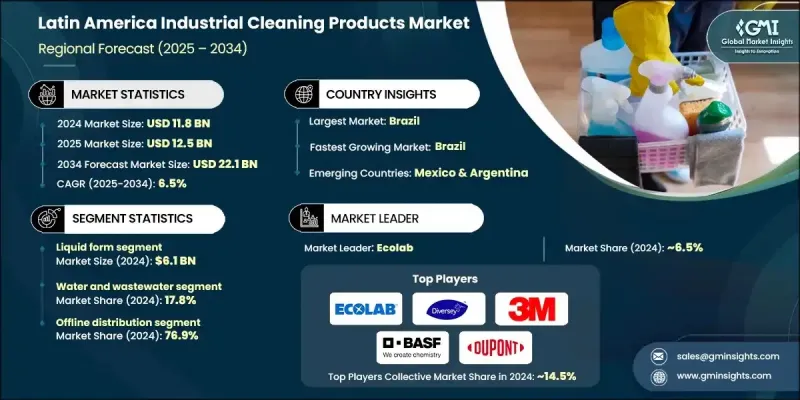
Growth across the region is driven by stricter hygiene expectations and more comprehensive sanitation regulations implemented to improve safety standards across public and industrial environments. Regulatory authorities are reinforcing compliance in sectors where contamination risks are heightened, including healthcare, food production, and advanced manufacturing. Industrial expansion and rapid urban development are also increasing product consumption as automotive, chemical, and food-related operations scale up. Advancements in formulation technologies are reshaping product portfolios, encouraging the adoption of high-performance and environmentally conscious cleaning solutions. Manufacturers are investing in eco-aligned innovation, introducing biodegradable components, concentrated blends, and automated cleaning technologies that increase operational efficiency while reducing environmental impact. These trends support sustainability-focused purchasing behavior and elevate overall cleaning effectiveness throughout industrial and commercial facilities.
| Market Scope | |
|---|---|
| Start Year | 2024 |
| Forecast Year | 2025-2034 |
| Start Value | $11.8 Billion |
| Forecast Value | $22.1 Billion |
| CAGR | 6.5% |
The liquid form segment generated USD 6.1 billion in 2024 and is forecasted to grow at a 6.5% CAGR between 2025 and 2034. Liquids remain the preferred choice due to their ability to be adjusted for both intense industrial cleaning and lighter facility maintenance. Their strong flow characteristics allow them to reach uneven surfaces and confined spaces, providing thorough hygiene protection in environments with demanding sanitation standards. Liquid formulations also support the integration of advanced ingredients, including enzymatic agents, disinfecting components, and environmentally responsible additives, aligning with regional sustainability goals.
The offline distribution channel captured 76.9% share in 2024 and is expected to grow at a CAGR of 6% through 2034. Industrial buyers continue to rely on offline procurement because it ensures immediate stock access, facilitates bulk ordering, and provides technical support essential for meeting regulatory hygiene mandates. Personalized service and on-site assistance remain key advantages in segments where operational continuity is critical.
Brazil Industrial Cleaning Products Market generated USD 4.8 billion in 2024 and is projected to register a CAGR of 6.9% from 2025 to 2034. Its market strength is supported by its broad industrial base, including major healthcare, water treatment, and food-processing facilities that require reliable, high-efficiency cleaning platforms. The country's regulatory environment also reinforces demand for certified and specialized formulations.
Major companies active in the Latin America Industrial Cleaning Products Market include 3M, BASF, Clariant, Diversey, Dow Chemical Company, DuPont, Ecolab, Evonik Industries, Henkel, Hexafluo, Inventec, Kimberly Clark, Noah Chemicals, Procter & Gamble (P&G), Reckitt Benckiser, Solvay, Stepan, and The Clorox Company. Companies competing in the Latin America Industrial Cleaning Products Market are strengthening their positions by expanding localized manufacturing, improving distribution capabilities, and focusing on advanced formulation technologies that meet growing sustainability expectations. Many players are investing in biodegradable chemistries, concentrated cleaning solutions, and low-impact surfactants to align with regional environmental regulations. Strengthened relationships with industrial buyers through technical training programs, on-site consultancy, and tailored hygiene solutions help companies differentiate their offerings.
Table of Contents
Chapter 1 Methodology & Scope
- 1.1 Market scope and definition
- 1.2 Research design
- 1.2.1 Research approach
- 1.2.2 Data collection methods
- 1.3 Data mining sources
- 1.3.1 Global
- 1.3.2 Regional/Country
- 1.4 Base estimates and calculations
- 1.4.1 Base year calculation
- 1.4.2 Key trends for market estimation
- 1.5 Primary research and validation
- 1.5.1 Primary sources
- 1.6 Forecast model
- 1.7 Research assumptions and limitations
Chapter 2 Executive Summary
- 2.1 Industry 3600 synopsis
- 2.2 Key market trends
- 2.2.1 Country
- 2.2.2 Product type
- 2.2.3 Form type
- 2.2.4 Price
- 2.2.5 End use industry
- 2.2.6 Distribution channel
- 2.3 CXO perspectives: strategic imperatives
- 2.3.1 Key decision points for industry executives
- 2.3.2 Critical success factors for market players
- 2.4 Future outlook and strategic recommendations
Chapter 3 Industry Insights
- 3.1 Industry ecosystem analysis
- 3.1.1 Supplier landscape
- 3.1.2 Profit margin
- 3.1.3 Value addition at each stage
- 3.1.4 Factor affecting the value chain
- 3.2 Industry impact forces
- 3.2.1 Growth drivers
- 3.2.1.1 Stringent hygiene & sanitation regulations
- 3.2.1.2 Rapid industrialization & urbanization
- 3.2.1.3 Technological & formulation innovation
- 3.2.2 Industry pitfalls & challenges
- 3.2.2.1 Raw material & pricing instability
- 3.2.2.2 Fragmented regulation & compliance complexity
- 3.2.1 Growth drivers
- 3.3 Growth potential analysis
- 3.4 Future market trends
- 3.5 Technology and innovation landscape
- 3.5.1 Current technological trends
- 3.5.2 Emerging technologies
- 3.6 Price trends
- 3.6.1 Latin America
- 3.6.2 By product type
- 3.7 Regulatory landscape
- 3.7.1 Standards and compliance requirements
- 3.7.2 Regional regulatory frameworks
- 3.7.3 Certification standards
- 3.8 Trade statistics
- 3.8.1 Major importing countries
- 3.8.2 Major exporting countries
- 3.9 Porter's analysis
- 3.10 PESTEL analysis
Chapter 4 Competitive Landscape, 2024
- 4.1 Introduction
- 4.2 Company market share analysis
- 4.3 Company matrix analysis
- 4.4 Competitive analysis of major market players
- 4.5 Competitive positioning matrix
- 4.6 Key developments
- 4.6.1 Mergers & acquisitions
- 4.6.2 Partnerships & collaborations
- 4.6.3 New product launches
- 4.6.4 Expansion plans
Chapter 5 Market Estimates & Forecast, By Product Type, 2021 - 2034, (USD Billion) (Thousand Units)
- 5.1 Key trends
- 5.2 Disinfectants & sanitizers
- 5.2.1 Hospital-grade disinfectants
- 5.2.1.1 Quaternary ammonium-based disinfectants
- 5.2.1.2 Peracetic acid-based systems
- 5.2.1.3 Hydrogen peroxide-based solutions
- 5.2.1.4 Alcohol-based disinfectants
- 5.2.2 Surface sanitizers
- 5.2.2.1 Multi-surface daily cleaners
- 5.2.2.2 High-touch point sanitizers
- 5.2.2.3 Food-contact surface sanitizers
- 5.2.1 Hospital-grade disinfectants
- 5.3 Specialized antimicrobial products
- 5.3.1 Cleanroom-grade disinfectants
- 5.3.2 Pharmaceutical manufacturing sanitizers
- 5.3.3 Laboratory disinfection systems
- 5.4 Industrial degreasers & heavy-duty cleaners
- 5.4.1 Solvent-based degreasers
- 5.4.2 Water-based degreasers
- 5.4.3 Specialty industrial cleaners
- 5.5 Floor care products
- 5.5.1 Floor strippers & finishes
- 5.5.2 Daily floor cleaners
- 5.5.3 Specialty floor products
Chapter 6 Market Estimates & Forecast, By Form Type, 2021 - 2034, (USD Billion) (SKU Thousand Units)
- 6.1 Key trends
- 6.2 Liquid
- 6.3 Powder
- 6.4 Gel
- 6.5 Foam
- 6.6 Aerosol/Spray
- 6.7 Others
Chapter 7 Market Estimates & Forecast, By Price, 2021 - 2034, (USD Billion) (SKU Thousand Units)
- 7.1 Key trends
- 7.2 Low
- 7.3 Medium
- 7.4 High
Chapter 8 Market Estimates & Forecast, By End Use Industry, 2021 - 2034, (USD Billion) (SKU Thousand Units)
- 8.1 Key trends
- 8.2 Water and wastewater
- 8.3 Oil and gas
- 8.4 Energy and power
- 8.5 Pharmaceuticals
- 8.6 Chemicals
- 8.7 Automotive & aerospace
- 8.8 Food & beverage
- 8.9 Metals & mining
- 8.10 Others
Chapter 9 Market Estimates & Forecast, By Distribution Channel, 2021 - 2034, (USD Billion) (SKU Thousand Units)
- 9.1 Key trends
- 9.2 Online
- 9.2.1 E-commerce websites
- 9.2.2 Company owned websites
- 9.3 Offline
- 9.3.1 Specialty retail stores
- 9.3.2 Industrial distributors & wholesalers
- 9.3.3 Others
Chapter 10 Market Estimates & Forecast, By Country, 2021 - 2034, (USD Billion) (SKU Thousand Units)
- 10.1 Key trends
- 10.2 Brazil
- 10.3 Mexico
- 10.4 Argentina
- 10.5 Colombia
- 10.6 Chile
- 10.7 Peru
- 10.8 Rest of Latin America
Chapter 11 Company Profiles
- 11.1 3M
- 11.2 BASF
- 11.3 Clariant
- 11.4 Diversey
- 11.5 Dow Chemical Company
- 11.6 DuPont
- 11.7 Ecolab
- 11.8 Evonik Industries
- 11.9 Henkel
- 11.10 Hexafluo
- 11.11 Inventec
- 11.12 Kimberly Clark
- 11.13 Noah Chemicals
- 11.14 Procter & Gamble (P&G)
- 11.15 Reckitt Benckiser
- 11.16 Solvay
- 11.17 Stepan
- 11.18 The Clorox Company

