
PUBLISHER: Global Market Insights Inc. | PRODUCT CODE: 1885816

PUBLISHER: Global Market Insights Inc. | PRODUCT CODE: 1885816
Inboard Boat Market Opportunity, Growth Drivers, Industry Trend Analysis, and Forecast 2025 - 2034
The Global Inboard Boat Market was valued at USD 4.24 billion in 2024 and is estimated to grow at a CAGR of 5.9% to reach USD 7.36 billion by 2034.
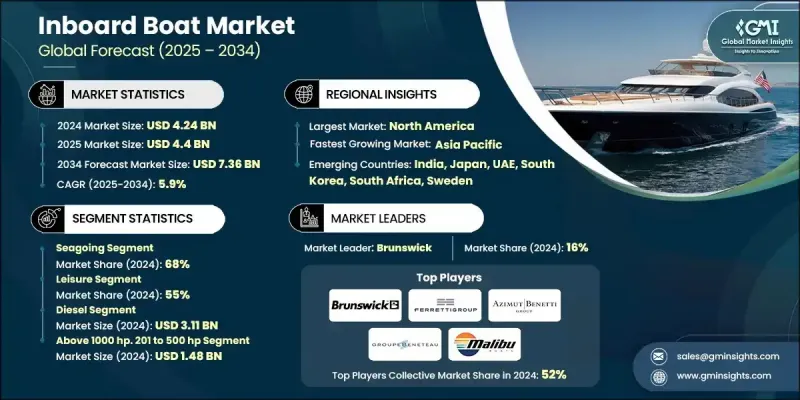
The market is expanding owing to increasing recreational boating, technological innovations, and rising disposable incomes. Inboard engines, including advanced V-drive and direct-drive systems, are known for their high performance, efficiency, and durability. Modern inboard propulsion is increasingly integrated with technologies that optimize hull designs, fuel consumption, torque output, and overall vessel performance. Regulatory frameworks such as the EPA Tier 3/4 in the United States, IMO MARPOL Annex VI globally, and EU RCD2 in Europe are pushing OEMs to adopt low-NOx combustion technologies, closed-loop fuel control, and advanced catalytic treatment systems. For example, the EPA Tier 3 standards, effective from 2024, mandate a 60% reduction in NOx emissions and a 50% reduction in particulate matter for engines exceeding 600 hp. The COVID-19 pandemic significantly disrupted supply chains, affecting market dynamics in the short term.
| Market Scope | |
|---|---|
| Start Year | 2024 |
| Forecast Year | 2025-2034 |
| Start Value | $4.24 Billion |
| Forecast Value | $7.36 Billion |
| CAGR | 5.9% |
The seagoing segment held a 68% share in 2024 and is expected to grow at a CAGR of 5.6% from 2025 to 2034. Seagoing inboard boats operate in coastal, offshore, and blue-water conditions that demand engines capable of withstanding saltwater corrosion, long-range operations, and rough waves. These vessels often feature dual-engine sport fishing systems between 500-1000 hp, single or dual diesel engines ranging from 200-600 hp for cruisers and trawlers, and high-powered multi-engine configurations.
The leisure segment held a 55% share in 2024 and is forecast to grow at a CAGR of 5.1% through 2034. This segment covers recreational vessels for activities such as cruising, fishing, and water sports. These boats generally experience low annual usage of 50-100 hours, with consumer decisions heavily influenced by operational costs, purchase price, lifestyle, and aspirational preferences.
U.S. Inboard Boat Market generated USD 1.89 billion in 2024. The market growth is influenced by technical innovations and regulatory drivers, including EPA Tier 3 standards that reduce NOx and particulate matter emissions. Gasoline engines require three-way catalytic converters, while diesel engines over 600 hp utilize selective catalytic reduction (SCR) systems. States along the Gulf Coast and Florida show high demand for offshore fishing boats equipped with twin diesel inboard engines optimized for extended operations.
Key players in the Global Inboard Boat Market include Azimut-Benetti, BAVARIA Yachts, Fairline Yachts, Ferretti, Groupe Beneteau, Malibu Boats, MasterCraft Boat, Princess Yachts International, Sanlorenzo, Sunseeker International, and Yamaha. Market leaders focus on innovation in engine efficiency, propulsion systems, and hull design to improve fuel economy, torque output, and overall vessel performance. Companies invest heavily in R&D to integrate digital technologies, including engine diagnostics, navigation systems, and IoT-enabled performance monitoring. Strategic collaborations with marina operators, distributors, and luxury yacht builders help expand market reach and improve after-sales services. Regional expansions and manufacturing facility upgrades enable companies to meet growing demand and comply with strict emission regulations. Marketing efforts emphasize lifestyle and leisure appeal to attract aspirational consumers.
Table of Contents
Chapter 1 Methodology & Scope
- 1.1 Research design
- 1.1.1 Research approach
- 1.1.2 Data collection methods
- 1.2 Base estimates and calculations
- 1.2.1 Base year calculation
- 1.2.2 Key trends for market estimates
- 1.3 Forecast
- 1.4 Primary research and validation
- 1.5 Some of the primary sources
- 1.6 Data mining sources
- 1.6.1 Secondary
- 1.6.1.1 Paid Sources
- 1.6.1.2 Public Sources
- 1.6.1.3 Sources, by region
- 1.6.1 Secondary
Chapter 2 Executive Summary
- 2.1 Industry 360° synopsis
- 2.2 Key market trends
- 2.2.1 Regional
- 2.2.2 Waterways
- 2.2.3 Propulsion
- 2.2.4 Application
- 2.2.5 Horsepower
- 2.2.6 Boat
- 2.3 TAM Analysis, 2025-2034
- 2.4 CXO perspectives: Strategic imperatives
- 2.4.1 Key decision points for industry executives
- 2.4.2 Critical success factors for market players
- 2.5 Future outlook and strategic recommendations
Chapter 3 Industry Insights
- 3.1 Industry ecosystem analysis
- 3.1.1 Supplier landscape
- 3.1.1.1 Raw material suppliers
- 3.1.1.2 Component manufacturers
- 3.1.1.3 Boat builders & OEMs
- 3.1.1.4 End use & after-sales service providers
- 3.1.2 Cost structure
- 3.1.3 Profit margin
- 3.1.4 Value addition at each stage
- 3.1.5 Factors impacting the supply chain
- 3.1.5.1 Technology disruption factors
- 3.1.5.2 Supply chain vulnerability factors
- 3.1.6 Disruptors
- 3.1.6.1 Technology-driven disruptions
- 3.1.6.2 Alternative fuel disruptions
- 3.1.6.3 Digital transformation disruptions
- 3.1.1 Supplier landscape
- 3.2 Impact on forces
- 3.2.1 Growth drivers
- 3.2.1.1 Stringent emission regulations driving technology upgrades
- 3.2.1.2 Growing recreational boating participation post-pandemic
- 3.2.1.3 Rising demand for tow-sport & watersports activities
- 3.2.1.4 Commercial vessel fleet modernization requirements
- 3.2.2 Industry pitfalls & challenges
- 3.2.2.1 High initial cost of hybrid & electric inboard systems
- 3.2.2.2 Complexity of emission compliance & certification costs
- 3.2.3 Market opportunities
- 3.2.3.1 Retrofit market for emission compliance upgrades
- 3.2.3.2 Alternative fuel infrastructure development
- 3.2.1 Growth drivers
- 3.3 Technology trends & innovation ecosystem
- 3.3.1 Current technologies
- 3.3.1.1 Hybrid-electric propulsion deep dive
- 3.3.1.2 Full battery-electric propulsion deep dive
- 3.3.1.3 Pem fuel cell technology for marine applications
- 3.3.1.4 Ammonia as marine fuel
- 3.3.2 Emerging technologies
- 3.3.2.1 Remote diagnostics & over-the-air updates
- 3.3.2.2 Autonomous navigation algorithms
- 3.3.2.3 Cybersecurity architecture for connected vessels
- 3.3.2.4 Blockchain for supply chain traceability
- 3.3.1 Current technologies
- 3.4 Growth potential analysis
- 3.5 Regulatory landscape
- 3.5.1 IMO MARPOL annex vi (tier i-iii, NOX ECAS)
- 3.5.2 EU recreational craft directive & NRMM stage v
- 3.5.3 NMMA & ABYC certification standards
- 3.5.4 Zero-emission mandates & green port initiatives
- 3.6 Porter's analysis
- 3.7 PESTEL analysis
- 3.8 Patent analysis
- 3.9 Cost breakdown analysis
- 3.10 Price trends
- 3.10.1 Pricing by segment
- 3.10.1.1 Boat
- 3.10.1.2 Region
- 3.10.2 Premium pricing strategies and justification
- 3.10.3 Cost structure analysis across value chain
- 3.10.4 Price sensitivity by application and region
- 3.10.5 Price adjustments for currency fluctuations
- 3.10.1 Pricing by segment
- 3.11 Production statistics
- 3.11.1 Production hubs
- 3.11.2 Consumption hubs
- 3.11.3 Export and import
- 3.12 Regional infrastructure & deployment trends
- 3.12.1 Charging infrastructure for electric inboards
- 3.12.2 Alternative fuel bunkering infrastructure
- 3.12.3 Service & maintenance infrastructure
- 3.12.4 Manufacturing infrastructure
- 3.13 Patent analysis
- 3.13.1 Patent filing trends by technology area (2014-2024)
- 3.13.2 Geographic distribution of patent filings
- 3.13.3 Key patent holders & innovation leaders
- 3.13.4 Emerging technology patents (hybrid, electric, alternative fuels)
- 3.13.5 Patent expiration analysis & generic entry opportunities
- 3.13.6 Licensing & technology transfer activity
- 3.13.7 Patent litigation & dispute trends
- 3.13.8 Freedom-to-operate analysis for new entrants
- 3.14 Sustainability and environmental aspects
- 3.14.1 Reducing physical prototyping and testing
- 3.14.2 Energy efficiency improvements
- 3.14.3 Support for electrification and emission reduction technologies
- 3.14.4 Lifecycle and e-waste management
- 3.14.5 Compliance with environmental regulations
- 3.15 Investment & funding analysis
- 3.15.1 R&D investment by major manufacturers
- 3.15.2 Venture capital in electric marine propulsion
- 3.15.3 Government grants & subsidies for clean marine technology
- 3.15.4 Private equity & strategic investment activity
- 3.15.5 IPO & public market activity
- 3.15.6 Investment returns & exit analysis
- 3.16 Product pipeline & R&D roadmap
- 3.16.1 Industry R&D landscape overview
- 3.16.2 Digital & autonomous technology roadmap (2024-2034)
- 3.16.3 Product pipeline by manufacturer
- 3.16.4 Failed product development analysis
- 3.17 Best case scenarios
- 3.17.1 Full electrification of urban waterways
- 3.17.2 Predictive maintenance network across global fleets
- 3.17.3 Circular economy for marine propulsion
- 3.17.4 Regulatory-driven market transformation
- 3.17.5 Digital twin integration in vessel design and operations
- 3.18 Risk assessment & mitigation strategies
- 3.18.1 Risk assessment criteria (likelihood & impact)
- 3.18.2 Risk monitoring & early warning systems
- 3.18.3 Insurance & risk transfer
- 3.18.4 Substitution risk
Chapter 4 Competitive Landscape, 2024
- 4.1 Introduction
- 4.2 Company market share analysis
- 4.2.1 North America
- 4.2.2 Europe
- 4.2.3 Asia-Pacific
- 4.2.4 Latin America
- 4.2.5 Middle East & Africa
- 4.3 Competitive positioning matrix
- 4.4 Strategic outlook matrix
- 4.5 Key developments
- 4.5.1 Mergers & acquisitions
- 4.5.2 Partnerships & collaborations
- 4.5.3 New product launches
- 4.5.4 Expansion plans and funding
- 4.6 Premium positioning strategies
- 4.7 Strategic OEM partnership opportunities
- 4.8 Competitive analysis and USPs
Chapter 5 Market Estimates & Forecast, By Waterways, 2021 - 2034 ($Mn, Units)
- 5.1 Key trends
- 5.2 Seagoing
- 5.3 Inland
Chapter 6 Market Estimates & Forecast, By Propulsion, 2021 - 2034 ($Mn, Units)
- 6.1 Key trends
- 6.2 Gasoline
- 6.3 Diesel
- 6.4 Electric
Chapter 7 Market Estimates & Forecast, By Application, 2021 - 2034 ($Mn, Units)
- 7.1 Key trends
- 7.2 Leisure
- 7.3 Transport of goods
- 7.4 Transport of people
- 7.5 Fishing
- 7.6 Government use
Chapter 8 Market Estimates & Forecast, By Horsepower, 2021 - 2034 ($Mn, Units)
- 8.1 Key trends
- 8.2 Below 200 hp
- 8.3 201 to 500 hp
- 8.4 501 to 1000 hp
- 8.5 Above 1000 hp
Chapter 9 Market Estimates & Forecast, By Boat, 2021 - 2034 ($Mn, Units)
- 9.1 Key trends
- 9.2 Center console
- 9.3 Express cruiser
- 9.4 Pontoon
- 9.5 Runabout bowrider
- 9.6 Others
Chapter 10 Market Estimates & Forecast, By Region, 2021 - 2034 ($Mn, Units)
- 10.1 North America
- 10.1.1 US
- 10.1.2 Canada
- 10.2 Europe
- 10.2.1 UK
- 10.2.2 Germany
- 10.2.3 France
- 10.2.4 Italy
- 10.2.5 Spain
- 10.2.6 Belgium
- 10.2.7 Netherlands
- 10.2.8 Sweden
- 10.2.9 Russia
- 10.3 Asia Pacific
- 10.3.1 China
- 10.3.2 India
- 10.3.3 Japan
- 10.3.4 Australia
- 10.3.5 Singapore
- 10.3.6 South Korea
- 10.3.7 Vietnam
- 10.3.8 Indonesia
- 10.4 Latin America
- 10.4.1 Brazil
- 10.4.2 Mexico
- 10.4.3 Argentina
- 10.5 MEA
- 10.5.1 South Africa
- 10.5.2 Saudi Arabia
- 10.5.3 UAE
Chapter 11 Company Profiles
- 11.1 Global Players
- 11.1.1 Azimut-Benetti
- 11.1.2 Brunswick
- 11.1.3 Ferretti
- 11.1.4 Groupe Beneteau
- 11.1.5 Malibu Boats
- 11.1.6 Princess Yachts International
- 11.1.7 Yamaha
- 11.2 Regional Players
- 11.2.1 BAVARIA Yachts
- 11.2.2 Chaparral Boats
- 11.2.3 Cruisers Yachts
- 11.2.4 Fairline Yachts
- 11.2.5 Formula Boats
- 11.2.6 MasterCraft Boat
- 11.2.7 Regal Boats
- 11.2.8 Sanlorenzo
- 11.2.9 Sunseeker International
- 11.2.10 Tiara Yachts
- 11.3 Emerging players
- 11.3.1 Bertram Yachts
- 11.3.2 Centurion Boats
- 11.3.3 Correct Craft
- 11.3.4 Damen Shipyards
- 11.3.5 Everblue Marine
- 11.3.6 Fincantieri
- 11.3.7 Gulf Craft
- 11.3.8 Hatteras Yachts
- 11.3.9 Horizon Yachts
- 11.3.10 Ocean Alexander
- 11.3.11 Sanlian Marine
- 11.3.12 Toyama Shipbuilding
- 11.3.13 Viking Yachts
- 11.3.14 Wauquiez

