
PUBLISHER: Global Market Insights Inc. | PRODUCT CODE: 1885830

PUBLISHER: Global Market Insights Inc. | PRODUCT CODE: 1885830
Bio-Based Platform Chemicals Market Opportunity, Growth Drivers, Industry Trend Analysis, and Forecast 2025 - 2034
The Global Bio-Based Platform Chemicals Market was valued at USD 22 billion in 2024 and is estimated to grow at a CAGR of 15.7% to reach USD 95 billion by 2034.
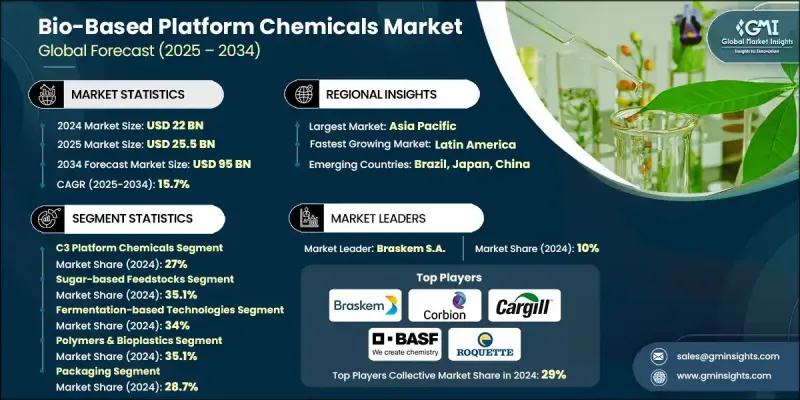
The transition toward sustainability and rapid advances in technology have shifted these bio-derived chemical building blocks from a relatively small category to a significant industrial priority. The sector is expanding at a pace far above that of conventional chemical markets, signaling its growing influence on decarbonization efforts and circular-economy models shaped by evolving policy frameworks and escalating corporate sustainability targets. As investments accelerate and biomass availability improves, production is becoming more scalable through established fermentation practices. Growth patterns are widely distributed, with Asia Pacific benefiting from strong resource availability, Europe supported by structured regulations, and North America advancing through substantial feedstock supply. Key segments such as C3-based molecules, sugar-derived inputs, and bio-oriented materials are gaining acceptance in multiple industries, from polymers to high-value specialty uses. Beyond commercial momentum, these products contribute meaningful reductions in carbon intensity compared with fossil-derived chemicals, positioning them as essential components of future low-carbon manufacturing pathways.
| Market Scope | |
|---|---|
| Start Year | 2024 |
| Forecast Year | 2025-2034 |
| Start Value | $22 Billion |
| Forecast Value | $95 Billion |
| CAGR | 15.7% |
The C3-derived platform chemicals segment held 27% share in 2024 and is forecast to grow at a 15.1% CAGR through 2034. This category benefits from highly developed fermentation processes and broad compatibility with downstream chemical pathways. These routes support the creation of a wide variety of materials used in sectors such as packaging, textiles, and performance applications. The combination of readily available feedstock sources and industrial-scale production capabilities strengthens the position of this segment as a cornerstone of bio-oriented material development.
The sugar-derived feedstocks segment captured a 35.1% share in 2024 and is projected to grow at a CAGR of 14.8% from 2025 to 2034. Their dominance is supported by a longstanding processing infrastructure and strong alignment with fermentation-based technologies. High sugar content and proven production scalability continue to reinforce their role in the industry. However, rising concerns over land use and potential overlap with food systems are gradually accelerating interest in next-generation feedstocks. Lignocellulosic inputs, including agricultural and forestry residues as well as dedicated energy crops, emerging as alternatives aimed at supporting long-term supply stability for bio-based chemical production.
North America Bio-Based Platform Chemicals Market held a 25.9% share in 2024 and is experiencing significant expansion. The region's established agricultural networks and abundant lignocellulosic material, combined with a strong bioethanol sector, are creating opportunities to scale bio-based chemical manufacturing. Ongoing research initiatives and supportive government programs are accelerating technological advances, while climate-driven policies and clean-energy incentives are attracting investment and enabling broader commercialization.
Major companies active in the Global Bio-Based Platform Chemicals Market include Braskem S.A., Corbion N.V., Cargill, Incorporated, BASF SE, Roquette Freres, DuPont de Nemours, Inc., Genomatica, Inc., Evonik Industries AG, Avantium N.V., Mitsubishi Chemical Holdings Corporation, Royal DSM N.V., PTT Global Chemical Public Company Limited, and Novozymes A/S. Companies in the Bio-Based Platform Chemicals Market are strengthening their positions through strategies designed to expand technological capacity, secure reliable feedstock channels, and accelerate commercial deployment. Many firms are forming partnerships with research institutions to advance new conversion technologies and improve process yields. Investments in large-scale biorefineries and diversification of feedstock sources are enhancing supply resilience. Several players are also entering into long-term supply agreements with manufacturers in packaging, polymers, and specialty sectors to ensure consistent market demand.
Table of Contents
Chapter 1 Methodology & Scope
- 1.1 Market scope and definition
- 1.2 Research design
- 1.2.1 Research approach
- 1.2.2 Data collection methods
- 1.3 Data mining sources
- 1.3.1 Global
- 1.3.2 Regional/Country
- 1.4 Base estimates and calculations
- 1.4.1 Base year calculation
- 1.4.2 Key trends for market estimation
- 1.5 Primary research and validation
- 1.5.1 Primary sources
- 1.6 Forecast model
- 1.7 Research assumptions and limitations
Chapter 2 Executive Summary
- 2.1 Industry 360° synopsis
- 2.2 Key market trends
- 2.2.1 Regional
- 2.2.2 Product Type
- 2.2.3 Feedstock Type
- 2.2.4 Production Technology
- 2.2.5 Application
- 2.2.6 End Use
- 2.3 TAM Analysis, 2025-2034
- 2.4 CXO perspectives: Strategic imperatives
- 2.4.1 Executive decision points
- 2.4.2 Critical success factors
- 2.5 Future Outlook and Strategic Recommendations
Chapter 3 Industry Insights
- 3.1 Industry ecosystem analysis
- 3.1.1 Supplier landscape
- 3.1.2 Profit margin
- 3.1.3 Value addition at each stage
- 3.1.4 Factor affecting the value chain
- 3.1.5 Disruptions
- 3.2 Industry impact forces
- 3.2.1 Growth drivers
- 3.2.1.1 Stringent sustainability mandates & carbon neutrality targets
- 3.2.1.2 Consumer demand for bio-based & biodegradable products
- 3.2.1.3 Technological advances in synthetic biology & metabolic engineering
- 3.2.2 Industry pitfalls and challenges
- 3.2.2.1 High production costs vs. petrochemicals
- 3.2.2.2 Feedstock variability & logistics challenges
- 3.2.3 Market opportunities
- 3.2.3.1 Lignin valorization for aromatic platform chemicals
- 3.2.3.2 C1 Gas utilization (CO2, CO, CH4) via gas fermentation
- 3.2.1 Growth drivers
- 3.3 Growth potential analysis
- 3.4 Regulatory landscape
- 3.4.1 North America
- 3.4.2 Europe
- 3.4.3 Asia Pacific
- 3.4.4 Latin America
- 3.4.5 Middle East & Africa
- 3.5 Porter's analysis
- 3.6 PESTEL analysis
- 3.7 Price trends
- 3.7.1 By region
- 3.7.2 By Product type
- 3.8 Future market trends
- 3.9 Technology and Innovation landscape
- 3.9.1 Current technological trends
- 3.9.2 Emerging technologies
- 3.10 Patent Landscape
- 3.11 Trade statistics (HS code)( Note: the trade statistics will be provided for key countries only)
- 3.11.1 Major importing countries
- 3.11.2 Major exporting countries
- 3.12 Sustainability and environmental aspects
- 3.12.1 Sustainable practices
- 3.12.2 Waste reduction strategies
- 3.12.3 Energy efficiency in production
- 3.12.4 Eco-friendly initiatives
- 3.13 Carbon footprint consideration
Chapter 4 Competitive Landscape, 2024
- 4.1 Introduction
- 4.2 Company market share analysis
- 4.2.1 By region
- 4.2.1.1 North America
- 4.2.1.2 Europe
- 4.2.1.3 Asia Pacific
- 4.2.1.4 LATAM
- 4.2.1.5 MEA
- 4.2.1 By region
- 4.3 Company matrix analysis
- 4.4 Competitive analysis of major market players
- 4.5 Competitive positioning matrix
- 4.6 Key developments
- 4.6.1 Mergers & acquisitions
- 4.6.2 Partnerships & collaborations
- 4.6.3 New Product Launches
- 4.6.4 Expansion Plans
Chapter 5 Market Estimates and Forecast, By Product Type, 2021-2034 (USD Billion) (Kilo Tons)
- 5.1 Key trends
- 5.2 C2 platform chemicals
- 5.2.1 Bio-ethylene
- 5.2.2 Bio-ethanol
- 5.2.3 Bio-ethylene glycol
- 5.3 C3 platform chemicals
- 5.3.1 Lactic acid
- 5.3.2 1,3-propanediol (1,3-PDO)
- 5.3.3 3-hydroxypropionic acid (3-HPA)
- 5.4 C4 platform chemicals
- 5.4.1 Succinic acid
- 5.4.2 1,4-butanediol (BDO)
- 5.4.3 N-butanol
- 5.5 C5 platform chemicals
- 5.5.1 Furfural
- 5.5.2 Isoprene
- 5.5.3 Glutaric acid
- 5.5.4 Cadaverine
- 5.5.5 δ-Valerolactam
- 5.5.6 1,5-pentanediol
- 5.6 C6 platform chemicals
- 5.6.1 2,5-furandicarboxylic acid (FDCA)
- 5.6.2 Adipic acid
- 5.6.3 Cis,cis-muconic acid
- 5.6.4 Caprolactam
- 5.6.5 1,6-hexamethylenediamine (HMDA)
- 5.7 Other platform chemicals
- 5.7.1 Levulinic acid
- 5.7.2 Itaconic acid
- 5.7.3 Bio-glycerol
- 5.7.4 5-hydroxymethylfurfural (5-HMF)
Chapter 6 Market Estimates and Forecast, By Feedstock Type, 2021-2034 (USD Billion) (Kilo Tons)
- 6.1 Key trends
- 6.2 Sugar-based feedstocks
- 6.2.1 C6 sugars (corn, sugarcane, sugar beet)
- 6.2.2 C5/C6 mixed sugars (lignocellulosic hydrolysis)
- 6.3 Lignocellulosic biomass
- 6.3.1 Agricultural residues
- 6.3.2 Forest resources
- 6.4 Plant-based oils & lipids
- 6.4.1 Vegetable oils
- 6.4.2 Waste lipids
- 6.4.3 Oilseeds (second-crop)
- 6.5 C1 gases & syngas
- 6.5.1 Carbon dioxide (Co2)
- 6.5.2 Carbon monoxide (CO) & syngas
- 6.5.3 Methane (CH4) & methanol
- 6.6 Waste streams
- 6.6.1 Municipal solid waste (MSW)
- 6.6.2 Industrial organic waste
- 6.6.3 Plastic waste
- 6.7 Algae
- 6.7.1 Microalgae
- 6.7.2 Macroalgae
Chapter 7 Market Estimates and Forecast, By Production Technology, 2021-2034 (USD Billion) (Kilo Tons)
- 7.1 Key trends
- 7.2 Fermentation-based technologies
- 7.2.1 Microbial fermentation
- 7.2.2 Consolidated bioprocessing (CBP)
- 7.3 Synthetic biology & metabolic engineering
- 7.3.1 CRISPR/Cas-based strain engineering
- 7.3.2 Pathway engineering
- 7.3.3 High-throughput screening & directed evolution
- 7.4 Enzymatic conversion
- 7.4.1 Enzymatic hydrolysis
- 7.4.2 Enzymatic depolymerization
- 7.5 Catalytic & chemical conversion
- 7.5.1 Acid/base catalysis
- 7.5.2 Metal catalysis
- 7.6 Thermochemical conversion
- 7.6.1 Pyrolysis
- 7.6.2 Gasification
- 7.7 Hybrid chemo-biological routes applications
Chapter 8 Market Estimates and Forecast, By Application, 2021-2034 (USD Billion) (Kilo Tons)
- 8.1 Key trends
- 8.2 Polymers & bioplastics
- 8.2.1 Polylactic acid (PLA)
- 8.2.2 Polyhydroxyalkanoates (PHA)
- 8.2.3 Polybutylene succinate (PBS)
- 8.2.4 Polyethylene furanoate (PEF)
- 8.2.5 Bio-polyethylene (Bio-PE)
- 8.2.6 Other bioplastics (Bio-PET, Bio-PA, Bio-PP)
- 8.3 Solvents
- 8.4 Pharmaceuticals & nutraceuticals
- 8.5 Cosmetics & personal care
- 8.6 Paints, coatings, inks & dyes
- 8.7 Surfactants & detergents
- 8.8 Adhesives & sealants
- 8.9 Lubricants
- 8.10 Textiles & fibers
Chapter 9 Market Estimates and Forecast, By End Use, 2021-2034 (USD Billion) (Kilo Tons)
- 9.1 Key trends
- 9.2 Packaging
- 9.3 Automotive
- 9.4 Textiles & apparel
- 9.5 Construction & building materials
- 9.6 Agriculture
- 9.7 Pharmaceuticals & healthcare
- 9.8 Food & beverage
- 9.9 Personal care & cosmetics
- 9.10 Energy
Chapter 10 Market Estimates and Forecast, By Region, 2021-2034 (USD Billion) (Kilo Tons)
- 10.1 Key trends
- 10.2 North America
- 10.2.1 U.S.
- 10.2.2 Canada
- 10.3 Europe
- 10.3.1 Germany
- 10.3.2 UK
- 10.3.3 France
- 10.3.4 Spain
- 10.3.5 Italy
- 10.3.6 Rest of Europe
- 10.4 Asia Pacific
- 10.4.1 China
- 10.4.2 India
- 10.4.3 Japan
- 10.4.4 Australia
- 10.4.5 South Korea
- 10.4.6 Rest of Asia Pacific
- 10.5 Latin America
- 10.5.1 Brazil
- 10.5.2 Mexico
- 10.5.3 Argentina
- 10.5.4 Rest of Latin America
- 10.6 Middle East and Africa
- 10.6.1 Saudi Arabia
- 10.6.2 South Africa
- 10.6.3 UAE
- 10.6.4 Rest of Middle East and Africa
Chapter 11 Company Profiles
- 11.1 Braskem S.A.
- 11.2 Corbion N.V.
- 11.3 Cargill, Incorporated
- 11.4 BASF SE
- 11.5 Roquette Freres
- 11.6 DuPont de Nemours, Inc.
- 11.7 Genomatica, Inc.
- 11.8 Evonik Industries AG
- 11.9 Avantium N.V.
- 11.10 Mitsubishi Chemical Holdings Corporation
- 11.11 Royal DSM N.V.
- 11.12 PTT Global Chemical Public Company Limited
- 11.13 Novozymes A/S

