PUBLISHER: Global Market Insights Inc. | PRODUCT CODE: 1885833

PUBLISHER: Global Market Insights Inc. | PRODUCT CODE: 1885833
Sinusitis Drugs Market Opportunity, Growth Drivers, Industry Trend Analysis, and Forecast 2025 - 2034
The Global Sinusitis Drugs Market was valued at USD 2.2 billion in 2024 and is estimated to grow at a CAGR of 5.9% to reach USD 3.8 billion by 2034.
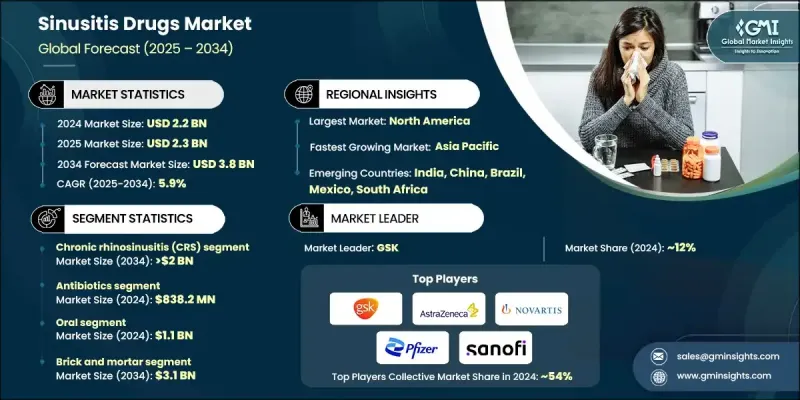
The market is fueled by a rising prevalence of acute and chronic sinusitis, increasing use of over-the-counter decongestants and antihistamines, and technological advancements in targeted nasal drug delivery. Allergy-induced sinus disorders are further contributing to demand. Sinusitis drugs are designed to reduce swelling, infection, and blockage of the sinus cavities while alleviating symptoms such as congestion, pain, pressure, and nasal discharge. These medications include antibiotics, corticosteroids, antihistamines, decongestants, and other supportive therapies that restore normal sinus function. Innovations in intranasal corticosteroids, mucoadhesive delivery systems, and precision drug-device combinations are enhancing efficacy, minimizing systemic side effects, and improving patient compliance. Patients increasingly prefer non-invasive treatments with faster relief, long-term symptom control, and improved bioavailability. Both prescription and OTC channels continue to witness strong adoption of these advanced therapies.
| Market Scope | |
|---|---|
| Start Year | 2024 |
| Forecast Year | 2025-2034 |
| Start Value | $2.2 Billion |
| Forecast Value | $3.8 Billion |
| CAGR | 5.9% |
The corticosteroids segment is expected to grow at a CAGR of 6.5% through 2034. This growth is driven by their potent anti-inflammatory effects, which reduce mucosal swelling and restore sinus drainage more effectively than many traditional therapies. Advances in intranasal formulations that improve localized delivery and safety are further increasing their adoption for both acute and chronic cases.
The brick-and-mortar segment held an 81.4% share and is expected to reach USD 3.1 billion through 2034. Physical drugstores remain the most trusted source for sinusitis medications, particularly antibiotics and prescription corticosteroids. Patients value immediate access, professional guidance, and pharmacist support for OTC selection, dosing, and symptom management, which sustains high footfall and consistent sales in these outlets.
North America Sinusitis Drugs Market held a 41% share in 2024. The region reports high incidences of sinusitis due to allergens, pollution, viral respiratory infections, and indoor air contaminants. Millions of adults experience acute or chronic sinusitis annually, creating a continuous demand for medications. The increasing prevalence of allergic rhinitis further aggravates sinus conditions, supporting sustained drug consumption.
Key players operating in the Global Sinusitis Drugs Market include GSK, AdvaCare Pharma, Amneal Pharmaceuticals, APOTEX, AstraZeneca, Aurobindo Pharma, Cipla, Fresenius Kabi, Glenmark Pharmaceuticals, Hikma Pharmaceuticals, HSG (Bayer), NOVARTIS, Pfizer, Sanofi, and Viatris. Companies in the Sinusitis Drugs Market are focusing on innovation in drug delivery systems, including nasal sprays, mucoadhesive formulations, and device-drug combinations that enable precision dosing and enhanced bioavailability. Firms are investing in research and development to create faster-acting, safer, and non-invasive therapies with improved patient compliance. Geographic expansion into high-prevalence regions and partnerships with healthcare providers strengthen market presence and accessibility. Additionally, companies emphasize robust marketing campaigns, educational programs for pharmacists and patients, and collaborations with distributors to enhance OTC and prescription adoption.
Table of Contents
Chapter 1 Methodology and Scope
- 1.1 Market scope and definitions
- 1.2 Research design
- 1.2.1 Research approach
- 1.2.2 Data collection methods
- 1.3 Data mining sources
- 1.3.1 Global
- 1.3.2 Regional/country
- 1.4 Base estimates and calculations
- 1.4.1 Base year calculation
- 1.4.2 Key trends for market estimation
- 1.5 Primary research and validation
- 1.5.1 Primary sources
- 1.6 Forecast model
- 1.7 Research assumptions and limitations
Chapter 2 Executive Summary
- 2.1 Industry 3600 synopsis
- 2.2 Key market trends
- 2.2.1 Regional trends
- 2.2.2 Disease type trends
- 2.2.3 Drug class trends
- 2.2.4 Route of administration trends
- 2.2.5 Distribution channel trends
- 2.3 CXO perspectives: Strategic imperatives
- 2.3.1 Key decision points for industry executives
- 2.3.2 Critical success factors for market players
- 2.4 Future outlook and strategic recommendations
Chapter 3 Industry Insights
- 3.1 Industry ecosystem analysis
- 3.2 Industry impact forces
- 3.2.1 Growth drivers
- 3.2.1.1 Rising prevalence of acute and chronic sinusitis
- 3.2.1.2 Increasing demand for intranasal corticosteroids
- 3.2.1.3 Growing use of antibiotics for bacterial sinusitis
- 3.2.1.4 Adoption of biologics for chronic rhinosinusitis with nasal polyps
- 3.2.2 Industry pitfalls and challenges
- 3.2.2.1 Overuse and resistance to antibiotics
- 3.2.2.2 Limited efficacy of certain drug classes in chronic cases
- 3.2.3 Market opportunities
- 3.2.3.1 Expansion of biologics and targeted therapies
- 3.2.3.2 Rising demand for OTC symptomatic relief products
- 3.2.1 Growth drivers
- 3.3 Growth potential analysis
- 3.4 Reimbursement scenario
- 3.5 Regulatory landscape
- 3.5.1 North America
- 3.5.2 Europe
- 3.5.3 Asia Pacific
- 3.6 Technology landscape
- 3.6.1 Current technological trends
- 3.6.2 Emerging technologies
- 3.7 Consumer insights
- 3.8 Pipeline analysis
- 3.9 Gap analysis
- 3.10 Porter's analysis
- 3.11 PESTEL analysis
- 3.12 Value chain analysis
- 3.13 Future market trends
Chapter 4 Competitive Landscape, 2024
- 4.1 Introduction
- 4.2 Company matrix analysis
- 4.3 Company market share analysis
- 4.3.1 Global
- 4.3.2 North America
- 4.3.3 Europe
- 4.3.4 Asia Pacific
- 4.4 Competitive positioning matrix
- 4.5 Competitive analysis of major market players
- 4.6 Key developments
- 4.6.1 Mergers & acquisitions
- 4.6.2 Partnerships & collaborations
- 4.6.3 New product launches
- 4.6.4 Expansion plans
Chapter 5 Market Estimates and Forecast, By Disease Type, 2021 - 2034 ($ Mn)
- 5.1 Key trends
- 5.2 Chronic rhinosinusitis (CRS)
- 5.3 Acute rhinosinusitis (ARS)
Chapter 6 Market Estimates and Forecast, By Drug Class, 2021 - 2034 ($ Mn)
- 6.1 Key trends
- 6.2 Antibiotics
- 6.3 Corticosteroids
- 6.4 Antihistamines
- 6.5 Analgesics
- 6.6 Other drug classes
Chapter 7 Market Estimates and Forecast, By Route of Administration, 2021 - 2034 ($ Mn)
- 7.1 Key trends
- 7.2 Oral
- 7.3 Nasal spray
- 7.4 Topical
- 7.5 Parenteral
Chapter 8 Market Estimates and Forecast, By Distribution Channel, 2021 - 2034 ($ Mn)
- 8.1 Key trends
- 8.2 Brick and mortar
- 8.3 E-commerce
Chapter 9 Market Estimates and Forecast, By Region, 2021 - 2034 ($ Mn)
- 9.1 Key trends
- 9.2 North America
- 9.2.1 U.S.
- 9.2.2 Canada
- 9.3 Europe
- 9.3.1 Germany
- 9.3.2 UK
- 9.3.3 France
- 9.3.4 Spain
- 9.3.5 Italy
- 9.3.6 Netherlands
- 9.4 Asia Pacific
- 9.4.1 China
- 9.4.2 Japan
- 9.4.3 India
- 9.4.4 Australia
- 9.4.5 South Korea
- 9.5 Latin America
- 9.5.1 Brazil
- 9.5.2 Mexico
- 9.5.3 Argentina
- 9.6 Middle East and Africa
- 9.6.1 South Africa
- 9.6.2 Saudi Arabia
- 9.6.3 UAE
Chapter 10 Company Profiles
- 10.1 GSK
- 10.2 AdvaCare Pharma
- 10.3 Amneal Pharmaceuticals
- 10.4 APOTEX
- 10.5 AstraZeneca
- 10.6 Aurobindo Pharma
- 10.7 Cipla
- 10.8 Fresenius Kabi
- 10.9 Glenmark Pharmaceuticals
- 10.10 Hikma Pharmaceuticals
- 10.11 HSG (Bayer)
- 10.12 NOVARTIS
- 10.13 Pfizer
- 10.14 Sanofi
- 10.15 Viatris

