PUBLISHER: Global Market Insights Inc. | PRODUCT CODE: 1885844

PUBLISHER: Global Market Insights Inc. | PRODUCT CODE: 1885844
Algae-Based Plastic Recycling Market Opportunity, Growth Drivers, Industry Trend Analysis, and Forecast 2025 - 2034
The Global Algae-Based Plastic Recycling Market was valued at USD 485.7 million in 2024 and is estimated to grow at a CAGR of 19.3% to reach USD 2.9 billion by 2034.
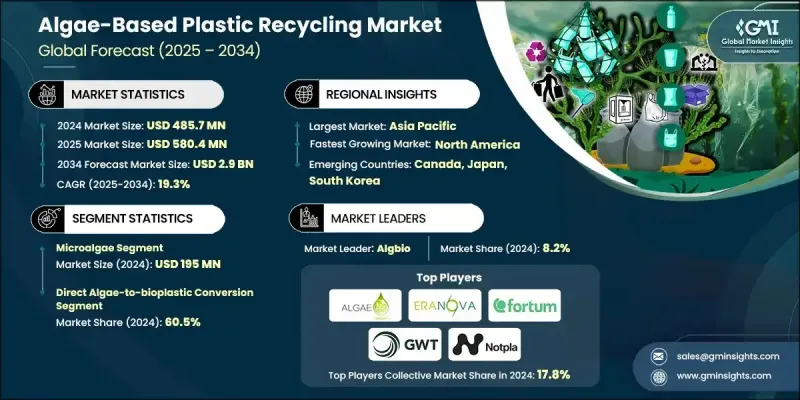
Algae-based plastic recycling is emerging as a transformative solution that converts algae into biodegradable plastics, offering a practical response to escalating plastic waste and environmental concerns. Growing regulatory pressure, including restrictions on single-use plastics, is pushing governments and industries to adopt more sustainable materials. Companies across sectors are also prioritizing carbon-reduction commitments and integrating eco-friendly inputs into product lines and packaging, which strengthens demand for algae-based alternatives. Rising consumer preference for environmentally conscious products further accelerates adoption. Advances in algae cultivation systems, including high-efficiency photobioreactors and automated harvesting technologies, continue to improve biomass output and reduce production costs. Together, regulatory momentum, corporate sustainability initiatives, and shifting consumer expectations are positioning algae-based plastic recycling as a vital contributor to the global transition toward low-impact materials.
| Market Scope | |
|---|---|
| Start Year | 2024 |
| Forecast Year | 2025-2034 |
| Start Value | $485.7 Million |
| Forecast Value | $2.9 Billion |
| CAGR | 19.3% |
The microalgae segment generated USD 195 million in 2024, reflecting its strong role in the market. Its rapid growth rates, high biochemical productivity, and diverse application potential ranging from biodegradable packaging to agricultural materials and select medical uses make microalgae a cost-effective and versatile foundation for algae-based plastics.
The direct algae-to-bioplastic conversion accounted for a 60.5% share in 2024. This pathway relies on algal biomass as the primary source for producing polymers such as PHA. The process typically includes cultivation, biomass collection, cell disruption, and polymer extraction, utilizing biotechnology infrastructures to streamline production. Integration with wastewater treatment operations enhances economic feasibility by cutting cultivation expenses while generating additional environmental advantages.
North America Algae-Based Plastic Recycling Market is expected to grow at a CAGR of 19.4% between 2025 and 2034. Increasing consumer emphasis on sustainable lifestyles and stronger demand for environmentally responsible materials across nutraceuticals, food, and cosmetic sectors is creating a fertile environment for algae-derived plastics. Improvements in solvent systems and recycling technologies also support lower-cost and lower-impact processing compared with traditional plastic recycling, encouraging broader adoption across packaging and industrial applications.
Key companies participating in the Algae-Based Plastic Recycling Market include Algbio, Danimer Scientific, Eranova, Fortum, Gross-Wen Technologies, Kelpi, Nenu2PHAr, and Notpla. Companies in the Algae-Based Plastic Recycling Market employ multiple strategies to strengthen their market presence and accelerate commercialization. Many are enhancing production efficiency by optimizing algae cultivation systems, improving nutrient delivery, and adopting automation to increase biomass yields. Firms are also forming alliances with packaging manufacturers, consumer goods brands, and biotechnology partners to scale distribution and secure long-term supply agreements. Investment in R&D remains a priority, with companies developing more efficient extraction technologies, advanced polymer blends, and improved biodegradability profiles. Certification programs, life-cycle assessments, and transparent sustainability reporting help reinforce credibility with regulators and consumers.
Table of Contents
Chapter 1 Methodology & Scope
- 1.1 Market scope and definition
- 1.2 Research design
- 1.2.1 Research approach
- 1.2.2 Data collection methods
- 1.3 Data mining sources
- 1.3.1 Global
- 1.3.2 Regional/Country
- 1.4 Base estimates and calculations
- 1.4.1 Base year calculation
- 1.4.2 Key trends for market estimation
- 1.5 Primary research and validation
- 1.5.1 Primary sources
- 1.6 Forecast model
- 1.7 Research assumptions and limitations
Chapter 2 Executive Summary
- 2.1 Industry 360° synopsis
- 2.2 Key market trends
- 2.2.1 Algae type trends
- 2.2.2 Process trends
- 2.2.3 Application trends
- 2.2.4 Regional trends
- 2.3 TAM Analysis, 2025-2034
- 2.4 CXO perspectives: strategic imperatives
- 2.4.1 Executive decision points
- 2.4.2 Critical success factors
- 2.5 Future outlook and strategic recommendations
Chapter 3 Industry Insights
- 3.1 Industry ecosystem analysis
- 3.1.1 Supplier landscape
- 3.1.2 Profit margin
- 3.1.3 Value addition at each stage
- 3.1.4 Factor affecting the value chain
- 3.1.5 Disruptions
- 3.2 Industry impact forces
- 3.2.1 Growth drivers
- 3.2.1.1 Regulatory push for plastic waste reduction
- 3.2.1.2 Corporate sustainability commitments
- 3.2.1.3 Consumer demand for eco-friendly products
- 3.2.2 Industry pitfalls and challenges
- 3.2.2.1 High production costs vs conventional plastics
- 3.2.2.2 Material property limitations
- 3.2.3 Market opportunities
- 3.2.3.1 Integration with wastewater treatment
- 3.2.3.2 Co2 capture & utilization synergies
- 3.2.1 Growth drivers
- 3.3 Growth potential analysis
- 3.4 Regulatory landscape
- 3.4.1 North America
- 3.4.2 Europe
- 3.4.3 Asia Pacific
- 3.4.4 Latin America
- 3.4.5 Middle East & Africa
- 3.5 Porter's analysis
- 3.6 PESTEL analysis
- 3.7 Technology and Innovation landscape
- 3.7.1 Current technological trends
- 3.7.2 Emerging technologies
- 3.8 Price trends
- 3.8.1 By region
- 3.8.2 By algae type
- 3.9 Future market trends
- 3.10 Patent landscape
- 3.11 Trade statistics (HS code) ( Note: the trade statistics will be provided for key countries only)
- 3.11.1 Major importing countries
- 3.11.2 Major exporting countries
- 3.12 Sustainability and environmental aspects
- 3.12.1 Sustainable practices
- 3.12.2 Waste reduction strategies
- 3.12.3 Energy efficiency in production
- 3.12.4 Eco-friendly initiatives
- 3.13 Carbon footprint consideration
Chapter 4 Competitive Landscape, 2024
- 4.1 Introduction
- 4.2 Company market share analysis
- 4.2.1 By region
- 4.2.1.1 North America
- 4.2.1.2 Europe
- 4.2.1.3 Asia Pacific
- 4.2.1.4 LATAM
- 4.2.1.5 MEA
- 4.2.1 By region
- 4.3 Company matrix analysis
- 4.4 Competitive analysis of major market players
- 4.5 Competitive positioning matrix
- 4.6 Key developments
- 4.6.1 Mergers & acquisitions
- 4.6.2 Partnerships & collaborations
- 4.6.3 New product launches
- 4.6.4 Expansion plans
Chapter 5 Market Estimates and Forecast, By Algae Type, 2021-2034 (USD Billion) (Kilo Tons)
- 5.1 Key trends
- 5.2 Microalgae
- 5.2.1 Chlorella
- 5.2.2 Spirulina
- 5.2.3 Chlamydomonas
- 5.3 Macroalgae
- 5.4 Cyanobacteria
- 5.5 Others
Chapter 6 Market Estimates and Forecast, By Process, 2021-2034 (USD Billion) (Kilo Tons)
- 6.1 Key trends
- 6.2 Direct algae-to-bioplastic conversion
- 6.3 Algae-assisted plastic degradation
- 6.4 Others
Chapter 7 Market Estimates and Forecast, By Application, 2021-2034 (USD Billion) (Kilo Tons)
- 7.1 Key trends
- 7.2 Packaging materials
- 7.2.1 Food packaging
- 7.2.2 Consumer goods
- 7.3 Automotive components
- 7.4 Textiles & fibers
- 7.5 Biomedical
- 7.6 Electronics & advanced materials
- 7.7 Others
Chapter 8 Market Estimates and Forecast, By Region, 2021-2034 (USD Billion) (Kilo Tons)
- 8.1 Key trends
- 8.2 North America
- 8.2.1 U.S.
- 8.2.2 Canada
- 8.3 Europe
- 8.3.1 Germany
- 8.3.2 UK
- 8.3.3 France
- 8.3.4 Spain
- 8.3.5 Italy
- 8.3.6 Rest of Europe
- 8.4 Asia Pacific
- 8.4.1 China
- 8.4.2 India
- 8.4.3 Japan
- 8.4.4 Australia
- 8.4.5 South Korea
- 8.4.6 Rest of Asia Pacific
- 8.5 Latin America
- 8.5.1 Brazil
- 8.5.2 Mexico
- 8.5.3 Argentina
- 8.5.4 Rest of Latin America
- 8.6 Middle East and Africa
- 8.6.1 Saudi Arabia
- 8.6.2 South Africa
- 8.6.3 UAE
- 8.6.4 Rest of Middle East and Africa
Chapter 9 Company Profiles
- 9.1 Algbio
- 9.2 Danimer Scientific
- 9.3 Eranova
- 9.4 Fortum
- 9.5 Gross-Wen Technologies
- 9.6 Kelpi
- 9.7 Nenu2PHAr
- 9.8 Notpla

