
PUBLISHER: Global Market Insights Inc. | PRODUCT CODE: 1885858

PUBLISHER: Global Market Insights Inc. | PRODUCT CODE: 1885858
Insect Protein Hydrolysates Market Opportunity, Growth Drivers, Industry Trend Analysis, and Forecast 2025 - 2034
The Global Insect Protein Hydrolysates Market was valued at USD 395 million in 2024 and is estimated to grow at a CAGR of 16.7% to reach USD 2 billion by 2034.
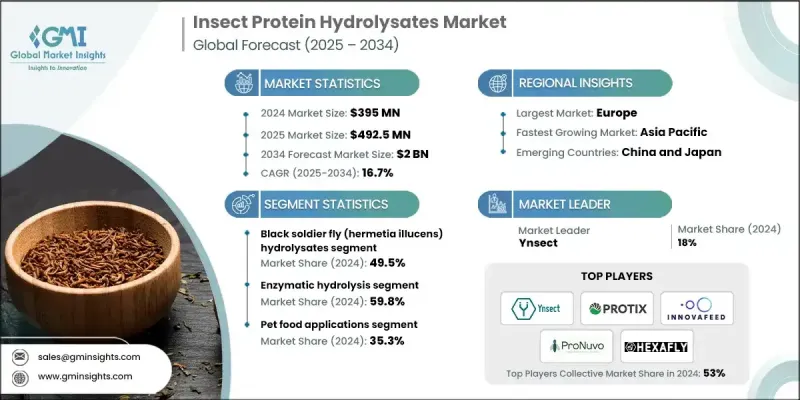
Demand is increasing as insect-derived hydrolysates become an important part of the alternative-protein segment. Enzymatic processing applied to insect sources such as mealworms and black soldier fly larvae has produced ingredients with improved absorption, high bioactivity, and versatile nutritional properties. This profile makes them appealing for high-value uses spanning sports and clinical nutrition, pet health, and functional food development, attracting both innovators and investors. Insect farming's resource-efficient footprint aligns with sustainability goals and reinforces the appeal of these products as eco-friendly protein solutions. Their unique compositional strengths, including antioxidant and immune-support capacities, further position them well in medical and nutraceutical applications. As more countries advance regulatory pathways for insect-based ingredients, commercial opportunities are broadening, while consumer preferences continue shifting toward protein-dense, clean-label, and multifunctional formulations. Regional trends reflect differing cultural acceptance of insect-based proteins, along with government-backed sustainability initiatives, adding further momentum to market adoption.
| Market Scope | |
|---|---|
| Start Year | 2024 |
| Forecast Year | 2025-2034 |
| Start Value | $395 Million |
| Forecast Value | $2 Billion |
| CAGR | 16.7% |
The black soldier fly hydrolysates segment held 49.5% share in 2024 and is projected to grow at a CAGR of 16.4% through 2034. Their rise is linked to strong amino acid profiles and comparatively lower production costs, which make them suitable for a wide range of nutrition and feed applications. Hydrolysates sourced from crickets are increasingly incorporated into human nutrition categories due to their clean-label positioning and favorable digestibility traits. Meanwhile, mealworm-derived hydrolysates are gaining traction in advanced clinical formulations and other specialized dietary products because of their well-rounded nutrient composition.
The enzymatic hydrolysis segment held a 59.8% share in 2024 and is projected to grow at a CAGR of 16.6% from 2025 to 2034. This method is widely used because it enables consistent peptide structures with high functional activity tailored to sports and clinical nutrition needs. Advances in process engineering, including optimized hydrolysis control, improved filtration, and efficient drying techniques, are helping manufacturers scale production while preserving the bioactive integrity of the final product.
North America Insect Protein Hydrolysates Market held a 27.6% share in 2024. Rising awareness of sustainable nutrition, combined with interest in ingredients that support digestive health, continues to shape market expansion. The region is also seeing increasing use of insect-based hydrolysates in pet food and aquaculture, creating a broader set of applications alongside human nutrition.
Leading companies in the Insect Protein Hydrolysates Market include Ynsect, Protix B.V., InnovaFeed, ProNuvo, Hexafly, Nutrition Technologies, AgriProtein (acquired by Insect Technology Group), Entocycle, P&O Biotechnology, and Agronutris. Companies participating in the Insect Protein Hydrolysates Market pursue several strategies to strengthen their competitive edge. Many are investing in expanding production capacity to meet growing demand for sustainable proteins. Firms are prioritizing technological improvements in enzymatic processing, waste-to-value systems, and vertically integrated insect farming to optimize yield and cost-efficiency. Strategic partnerships with nutrition brands, pet food manufacturers, and feed producers help accelerate market penetration. Companies are also focusing on developing high-purity peptide fractions tailored for specialized nutrition segments, enhancing product differentiation.
Table of Contents
Chapter 1 Methodology & Scope
- 1.1 Market scope and definition
- 1.2 Research design
- 1.2.1 Research approach
- 1.2.2 Data collection methods
- 1.3 Data mining sources
- 1.3.1 Global
- 1.3.2 Regional/Country
- 1.4 Base estimates and calculations
- 1.4.1 Base year calculation
- 1.4.2 Key trends for market estimation
- 1.5 Primary research and validation
- 1.5.1 Primary sources
- 1.6 Forecast model
- 1.7 Research assumptions and limitations
Chapter 2 Executive Summary
- 2.1 Industry 360° synopsis
- 2.2 Key market trends
- 2.2.1 Regional
- 2.2.2 Source Insect
- 2.2.3 Processing Method
- 2.2.4 Application
- 2.3 TAM Analysis, 2025-2034
- 2.4 CXO perspectives: Strategic imperatives
- 2.4.1 Executive decision points
- 2.4.2 Critical success factors
- 2.5 Future Outlook and Strategic Recommendations
Chapter 3 Industry Insights
- 3.1 Industry ecosystem analysis
- 3.1.1 Supplier landscape
- 3.1.2 Profit margin
- 3.1.3 Value addition at each stage
- 3.1.4 Factor affecting the value chain
- 3.1.5 Disruptions
- 3.2 Industry impact forces
- 3.2.1 Growth drivers
- 3.2.1.1 Growing demand for sustainable protein alternatives
- 3.2.1.2 Regulatory approvals & policy support
- 3.2.1.3 Superior functional properties of hydrolysates
- 3.2.2 Industry pitfalls and challenges
- 3.2.2.1 High production costs vs conventional proteins
- 3.2.2.2 Complex regulatory approval processes
- 3.2.3 Market opportunities
- 3.2.3.1 Expanding novel food authorizations
- 3.2.3.2 Bioactive peptide applications
- 3.2.1 Growth drivers
- 3.3 Growth potential analysis
- 3.4 Regulatory landscape
- 3.4.1 North America
- 3.4.2 Europe
- 3.4.3 Asia Pacific
- 3.4.4 Latin America
- 3.4.5 Middle East & Africa
- 3.5 Porter's analysis
- 3.6 PESTEL analysis
- 3.7 Price trends
- 3.7.1 By region
- 3.7.2 By source insect
- 3.8 Future market trends
- 3.9 Technology and Innovation landscape
- 3.9.1 Current technological trends
- 3.9.2 Emerging technologies
- 3.10 Patent Landscape
- 3.11 Trade statistics (HS code)
( Note: the trade statistics will be provided for key countries only)
- 3.11.1 Major importing countries
- 3.11.2 Major exporting countries
- 3.12 Sustainability and environmental aspects
- 3.12.1 Sustainable practices
- 3.12.2 Waste reduction strategies
- 3.12.3 Energy efficiency in production
- 3.12.4 Eco-friendly initiatives
- 3.13 Carbon footprint consideration
Chapter 4 Competitive Landscape, 2024
- 4.1 Introduction
- 4.2 Company market share analysis
- 4.2.1 By region
- 4.2.1.1 North America
- 4.2.1.2 Europe
- 4.2.1.3 Asia Pacific
- 4.2.1.4 LATAM
- 4.2.1.5 MEA
- 4.2.1 By region
- 4.3 Company matrix analysis
- 4.4 Competitive analysis of major market players
- 4.5 Competitive positioning matrix
- 4.6 Key developments
- 4.6.1 Mergers & acquisitions
- 4.6.2 Partnerships & collaborations
- 4.6.3 New Product Launches
- 4.6.4 Expansion Plans
Chapter 5 Market Estimates and Forecast, By Source Insect, 2021-2034 (USD Million) (Kilo Tons)
- 5.1 Key trends
- 5.2 Black soldier fly (hermetia illucens) hydrolysates
- 5.3 Cricket (acheta domesticus) hydrolysates
- 5.4 Mealworm (tenebrio molitor) hydrolysates
- 5.5 Other insect species hydrolysates
- 5.5.1 Locusta migratoria hydrolysates
- 5.5.2 Alphitobius diaperinus hydrolysates
- 5.5.3 Gryllodes sigillatus hydrolysates
- 5.5.4 Emerging species development
Chapter 6 Market Estimates and Forecast, By Processing Method, 2021-2034 (USD Million) (Kilo Tons)
- 6.1 Key trends
- 6.2 Enzymatic hydrolysis
- 6.2.1 Single enzyme hydrolysis
- 6.2.2 Multi-enzyme hydrolysis
- 6.2.3 Sequential enzyme treatment
- 6.2.4 High-pressure assisted enzymatic hydrolysis
- 6.3 Processing technology integration
- 6.3.1 Wet processing with hydrolysis
- 6.3.2 Dry processing with hydrolysis
- 6.3.3 Membrane filtration & concentration
- 6.3.4 Spray drying & stabilization
- 6.4 Specialized processing methods
- 6.4.1 Maillard reaction enhanced hydrolysates
- 6.4.2 Ultrasound-assisted hydrolysis
- 6.4.3 Microwave-assisted processing
Chapter 7 Market Estimates and Forecast, By Application, 2021-2034 (USD Million) (Kilo Tons)
- 7.1 Key trends
- 7.2 Pet food applications
- 7.3 Aquaculture feed applications
- 7.4 Human food applications
- 7.5 Cosmetics & personal care
- 7.6 Livestock feed applications
- 7.7 Other applications
Chapter 8 Market Estimates and Forecast, By Region, 2021-2034 (USD Million) (Kilo Tons)
- 8.1 Key trends
- 8.2 North America
- 8.2.1 U.S.
- 8.2.2 Canada
- 8.3 Europe
- 8.3.1 Germany
- 8.3.2 UK
- 8.3.3 France
- 8.3.4 Spain
- 8.3.5 Italy
- 8.3.6 Rest of Europe
- 8.4 Asia Pacific
- 8.4.1 China
- 8.4.2 India
- 8.4.3 Japan
- 8.4.4 Australia
- 8.4.5 South Korea
- 8.4.6 Rest of Asia Pacific
- 8.5 Latin America
- 8.5.1 Brazil
- 8.5.2 Mexico
- 8.5.3 Argentina
- 8.5.4 Rest of Latin America
- 8.6 Middle East and Africa
- 8.6.1 Saudi Arabia
- 8.6.2 South Africa
- 8.6.3 UAE
- 8.6.4 Rest of Middle East and Africa
Chapter 9 Company Profiles
- 9.1 Ynsect
- 9.2 Protix B.V.
- 9.3 InnovaFeed
- 9.4 ProNuvo
- 9.5 Hexafly
- 9.6 Nutrition Technologies
- 9.7 AgriProtein (acquired by Insect Technology Group)
- 9.8 Entocycle
- 9.9 P&O Biotechnology
- 9.10 Agronutris

