
PUBLISHER: Global Market Insights Inc. | PRODUCT CODE: 1885883

PUBLISHER: Global Market Insights Inc. | PRODUCT CODE: 1885883
Professional Diving and Recreational Gloves Market Opportunity, Growth Drivers, Industry Trend Analysis, and Forecast 2025 - 2034
The Global Professional Diving and Recreational Gloves Market was valued at USD 2.4 billion in 2024 and is estimated to grow at a CAGR of 7% to reach USD 4.7 billion by 2034.
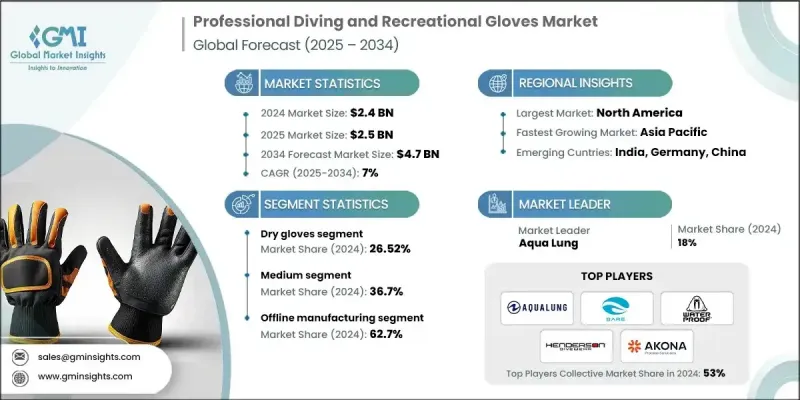
Market revenues represent sales from manufacturers and brands supplying gloves to a wide range of distribution outlets, including specialty dive retailers, online platforms, rental programs, dive schools, travel operators, and institutional purchasers such as defense agencies, scientific organizations, commercial diving firms, and government units. The category includes neoprene gloves ranging from 1.5mm to 7mm for different water temperatures, dry gloves compatible with wrist-ring systems on drysuits, semi-dry gloves with tightly sealed seams, heated gloves with built-in battery modules, and protective models made with materials such as Dyfiber or Kevlar for high-risk environments. Although the market forms a subset of the broader diving equipment industry, it continues to face pressure from declining participation in mature diving regions. Fewer annual certifications and reduced diving frequency noted by the Business of Diving Institute have lowered the rate of personal gear purchases. Growth is further moderated by travelers who opt to rent heavier gear instead of purchasing their own gloves.
| Market Scope | |
|---|---|
| Start Year | 2024 |
| Forecast Year | 2025-2034 |
| Start Value | $2.4 Billion |
| Forecast Value | $4.7 Billion |
| CAGR | 7% |
The online distribution segment held a 37.26% share in 2024 and will grow at a 7.4% CAGR through 2034. This channel includes manufacturers' direct-to-consumer websites, digital dive-equipment specialists, broad sporting-goods platforms, and major online marketplaces. Its rapid expansion is driven by shoppers' preference for convenience, broad inventory selection, transparent pricing, reviews, and simple home delivery.
The low-price tier segment held 36.48% share and will grow at a 6.9% CAGR through 2034, making it the highest-volume category. This segment includes gloves priced under USD 30, typically built with neoprene in the 1.5mm to 3mm range, using flatlock stitching, standard palm texturing, and basic sizing without specialized ergonomic shaping.
North America Professional Diving and Recreational Gloves Market held 31.33% share in 2024, supported by the region's large certified diving population, extensive coastlines, and high recreational equipment spending. Regional standards emphasize protective gear requirements, which reinforces consistent demand for gloves that meet established performance specifications. The region's military and specialized units also depend on gloves sourced from reliable manufacturers with proven quality controls.
Key companies in the Professional Diving and Recreational Gloves Market include Aqua Lung, DeepSea Locker / Pro Diver, Aropec, Bare Sports, KFD Group, DUI, Akona, Cressi, Fourth Element, Henderson, Mares, Northern Diver, SANTI Diving, Scubapro, and Body Glove. Companies are strengthening their Professional Diving and Recreational Gloves Market presence by expanding product portfolios with advanced materials that enhance thermal protection, grip, and durability across various diving conditions. Many brands are prioritizing ergonomic design improvements to ensure greater comfort, flexibility, and dexterity, which appeal to both recreational and professional users. Digital-first strategies are becoming essential, with firms investing in optimized e-commerce platforms, detailed product listings, and targeted online campaigns to capture the fast-growing online segment. Partnerships with dive training centers, rental operators, and institutional buyers also help secure steady volume demand.
Table of Contents
Chapter 1 Methodology and Scope
- 1.1 Market scope and definition
- 1.2 Research design
- 1.2.1 Research approach
- 1.3 Data collection methods
- 1.4 Data mining sources
- 1.4.1 Global
- 1.4.2 Regional/Country
- 1.5 Base estimates and calculations
- 1.5.1 Base year calculation
- 1.5.2 Key trends for market estimation
- 1.6 Primary research and validation
- 1.6.1 Primary sources
- 1.7 Forecast model
- 1.8 Research assumptions and limitations
Chapter 2 Executive Summary
- 2.1 Industry 3600 synopsis
- 2.2 Key market trends
- 2.2.1 Regional
- 2.2.2 Product
- 2.2.3 Price
- 2.2.4 Application
- 2.2.5 End use
- 2.2.6 Distribution channel
- 2.3 CXO perspectives: strategic imperatives
- 2.3.1 Key decision points for industry executives
- 2.3.2 Critical success factors for market players
- 2.4 Future outlook and strategic recommendations
Chapter 3 Industry Insights
- 3.1 Industry ecosystem analysis
- 3.1.1 Supplier landscape
- 3.1.2 Profit margin
- 3.1.3 Value addition at each stage
- 3.1.4 Factors affecting the value chain
- 3.2 Industry impact forces
- 3.2.1 Growth drivers
- 3.2.1.1 Growing participation in water sports and dive tourism
- 3.2.1.2 Regulatory and safety standards mandating equipment use
- 3.2.1.3 Material innovation and product differentiation
- 3.2.1.4 Expansion of technical and professional diving activities
- 3.2.2 Industry pitfalls & challenges
- 3.2.2.1 Declining core diver participation and market maturity
- 3.2.2.2 Commoditization and intense price competition
- 3.2.2.3 Trade tariffs and supply chain disruptions
- 3.2.3 Opportunities
- 3.2.3.1 Growth in recreational diving & adventure tourism
- 3.2.3.2 Rising demand for professional-grade gloves
- 3.2.3.3 Eco-friendly & sustainable materials
- 3.2.1 Growth drivers
- 3.3 Growth potential analysis
- 3.4 Future market trends
- 3.5 Technology and innovation landscape
- 3.5.1 Current technological trends
- 3.5.2 Emerging technologies
- 3.6 Price trends
- 3.6.1 By region
- 3.6.2 By Product
- 3.7 Regulatory landscape
- 3.7.1 standards and compliance requirements
- 3.7.2 Regional regulatory frameworks
- 3.8 Porter's analysis
- 3.9 PESTEL analysis
- 3.10 Consumer behavior analysis
Chapter 4 Competitive Landscape, 2024
- 4.1 Introduction
- 4.2 Company market share analysis
- 4.2.1 By region
- 4.2.1.1 North America
- 4.2.1.2 Europe
- 4.2.1.3 Asia Pacific
- 4.2.1.4 Latin America
- 4.2.1.5 Middle East and Africa
- 4.2.1 By region
- 4.3 Company matrix analysis
- 4.4 Competitive analysis of major market players
- 4.5 Competitive positioning matrix
- 4.6 Key developments
- 4.6.1 Mergers & acquisitions
- 4.6.2 Partnerships & collaborations
- 4.6.3 New Product Launches
- 4.6.4 Expansion Plans
Chapter 5 Market Estimates & Forecast, By Product, 2021 - 2034 ($Bn, Thousand Units)
- 5.1 Key trends
- 5.2 Neoprene wet gloves
- 5.3 Dry gloves
- 5.4 Semi-dry gloves
- 5.5 Heated gloves
- 5.6 Specialized protective gloves
Chapter 6 Market Estimates & Forecast, By Price 2021 - 2034 ($Bn, Thousand Units)
- 6.1 Key trends
- 6.2 Low
- 6.3 Medium
- 6.4 High
Chapter 7 Market Estimates & Forecast, By Application, 2021 - 2034 ($Bn, Thousand Units)
- 7.1 Key trends
- 7.2 Recreational diving
- 7.2.1 Scuba diving (open-circuit, nitrox)
- 7.2.2 Snorkeling
- 7.2.3 Freediving & breath-hold diving
- 7.3 Professional & commercial diving
- 7.3.1 Offshore oil & gas operations
- 7.3.2 Underwater construction & inspection
- 7.3.3 Underwater welding & cutting
- 7.3.4 Salvage operations
- 7.4 Technical diving
- 7.4.1 Cave diving
- 7.4.2 Wreck diving
- 7.4.3 Deep diving (>130 FSW)
- 7.4.4 Rebreather diving
- 7.4.5 Decompression diving
- 7.5 Scientific diving
- 7.5.1 Archaeological diving
- 7.5.2 Oceanographic research
- 7.5.3 Government agency programs
- 7.6 Contaminated water diving
- 7.7 Water sports
- 7.7.1 Surfing
- 7.7.2 Kayaking & paddling
- 7.7.3 Stand-up paddleboarding
- 7.7.4 Sailing & windsurfing
Chapter 8 Market Estimates & Forecast, By End Use, 2021 - 2034 ($Bn, Thousand Units)
- 8.1 Key trends
- 8.2 Professional / competitive users
- 8.3 Amateur / enthusiast users
- 8.4 Casual / recreational users
- 8.5 Institutional / commercial buyers
Chapter 9 Market Estimates & Forecast, By Distribution Channel, 2021 - 2034 ($Bn, Thousand Units)
- 9.1 Key trends
- 9.2 Online
- 9.3 Offline
Chapter 10 Market Estimates & Forecast, By Region, 2021 - 2034 ($Bn, Thousand Units)
- 10.1 Key trends
- 10.2 North America
- 10.2.1 U.S.
- 10.2.2 Canada
- 10.3 Europe
- 10.3.1 UK
- 10.3.2 Germany
- 10.3.3 France
- 10.3.4 Italy
- 10.3.5 Spain
- 10.3.6 Russia
- 10.4 Asia Pacific
- 10.4.1 China
- 10.4.2 India
- 10.4.3 Japan
- 10.4.4 Australia
- 10.4.5 South Korea
- 10.5 Latin America
- 10.5.1 Brazil
- 10.5.2 Mexico
- 10.5.3 Argentina
- 10.6 MEA
- 10.6.1 UAE
- 10.6.2 South Africa
- 10.6.3 Saudi Arabia
Chapter 11 Company Profiles
- 11.1 Akona
- 11.2 Aqua Lung
- 11.3 Aropec
- 11.4 Bare Sports
- 11.5 Body Glove
- 11.6 Cressi
- 11.7 DeepSea Locker / Pro Diver
- 11.8 DUI
- 11.9 Fourth Element
- 11.10 Henderson
- 11.11 KFD Group
- 11.12 Mares
- 11.13 Northern Diver
- 11.14 SANTI Diving
- 11.15 Scubapro

