PUBLISHER: Global Market Insights Inc. | PRODUCT CODE: 1885884

PUBLISHER: Global Market Insights Inc. | PRODUCT CODE: 1885884
Cellular Agriculture Ingredients Market Opportunity, Growth Drivers, Industry Trend Analysis, and Forecast 2025 - 2034
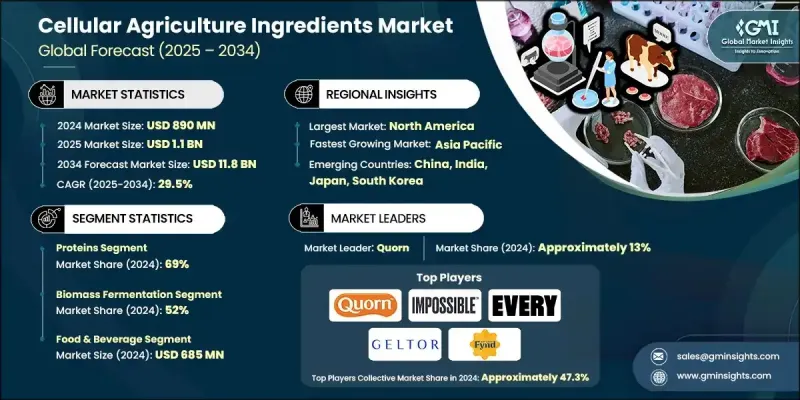
The Global Cellular Agriculture Ingredients Market was valued at USD 890 million in 2024 and is estimated to grow at a CAGR of 29.5% to reach USD 11.8 billion by 2034.
Cellular agriculture ingredients are emerging as a core element of future food production, utilizing precision fermentation, biomass fermentation, and cell cultivation methods to generate animal-identical proteins, fats, enzymes, and bioactive components without relying on conventional livestock systems. These bio-manufacturing approaches use microbial hosts and cultured cells to create high-purity ingredients such as dairy and egg proteins, collagen, heme-based compounds, and specialized lipids that match or exceed the functionality of traditional animal-derived inputs. As the global food sector confronts climate-related pressures and increasing demand for sustainable sourcing, manufacturers are accelerating the adoption of cellular agriculture solutions that deliver nutritional equivalence, reliable performance, and reduced environmental footprints. The shift toward regenerative and low-impact production models is amplifying interest in fermentation-derived materials across alternative proteins, fortified foods, and mainstream consumer categories. High-purity precision-fermented proteins with improved solubility, clean sensory profiles, and bioactive potential offer a consistent supply option that supports large-scale ingredient innovation.
| Market Scope | |
|---|---|
| Start Year | 2024 |
| Forecast Year | 2025-2034 |
| Start Value | $890 Million |
| Forecast Value | $11.8 Billion |
| CAGR | 29.5% |
The proteins segment generated USD 610 million in 2024, representing 69% share, and is projected to grow at a CAGR of 29.1% from 2025 to 2034. Their predominance comes from their essential functional roles in multiple product formulations and their nutritionally complete amino acid structures. Fermentation-based protein platforms produce molecularly identical protein ingredients with enhanced solubility, heat tolerance, and emulsification attributes, supported by precision-controlled fermentation and cell cultivation technologies.
The biomass fermentation segment generated USD 462 million in 2024. This segment leads due to its mature infrastructure and scalability for mass protein production. Whole-cell biomass generated from fungal and microbial systems delivers comprehensive nutritional content, natural structure, and competitive production economics, enabling high-volume output suitable for diverse food applications.
North America Cellular Agriculture Ingredients Market is projected to grow at a CAGR of 30.6% through 2034. Increasing commitments to sustainable ingredient development, expanding interest in alternative agricultural systems, and the rising integration of fermentation-derived components into dairy replacements, meat alternatives, and functional nutrition products are key factors driving regional expansion. Heightened focus on climate resilience and reduced dependence on traditional livestock-based sourcing also contributes to market growth.
Major companies active in the Cellular Agriculture Ingredients Market include Quorn, Impossible Foods, The EVERY Company, Geltor, Nature's Fynd, Bored Cow, Onego Bio, TurtleTree, Planetary Group, Modern Kitchen, WNWN Food Labs, and GOOD Meat. Companies operating in Cellular Agriculture Ingredients Market are strengthening their competitive positioning by scaling fermentation capacity, optimizing bioprocess efficiency, and expanding collaborative ecosystems across food manufacturing and biotechnology networks. Many firms are developing proprietary microbial strains and cell lines to improve yield, reduce production costs, and enhance ingredient functionality. Strategic partnerships with global food brands are helping accelerate formulation adoption and secure long-term supply agreements. Investments in regulatory readiness, safety validation, and clean-label ingredient development are further supporting market entry across multiple regions. Additionally, companies are diversifying product portfolios with specialized proteins, lipids, and bioactive compounds to serve high-value applications and unlock new revenue channels.
Table of Contents
Chapter 1 Methodology & Scope
- 1.1 Market scope and definition
- 1.2 Research design
- 1.2.1 Research approach
- 1.2.2 Data collection methods
- 1.3 Data mining sources
- 1.3.1 Global
- 1.3.2 Regional/Country
- 1.4 Base estimates and calculations
- 1.4.1 Base year calculation
- 1.4.2 Key trends for market estimation
- 1.5 Primary research and validation
- 1.5.1 Primary sources
- 1.6 Forecast model
- 1.7 Research assumptions and limitations
Chapter 2 Executive Summary
- 2.1 Industry 3600 synopsis
- 2.2 Key market trends
- 2.2.1 Ingredient type trends
- 2.2.2 Technology trends
- 2.2.3 Application trends
- 2.2.4 Regional trends
- 2.3 TAM Analysis, 2025-2034
- 2.4 CXO perspectives: Strategic imperatives
- 2.4.1 Executive decision points
- 2.4.2 Critical success factors
- 2.5 Future Outlook and Strategic Recommendations
Chapter 3 Industry Insights
- 3.1 Industry ecosystem analysis
- 3.1.1 Supplier landscape
- 3.1.2 Profit margin
- 3.1.3 Value addition at each stage
- 3.1.4 Factor affecting the value chain
- 3.1.5 Disruptions
- 3.2 Industry impact forces
- 3.2.1 Drivers
- 3.2.2 Pitfalls & Challenges
- 3.2.3 Opportunities
- 3.3 Growth potential analysis
- 3.4 Regulatory landscape
- 3.4.1 North America
- 3.4.2 Europe
- 3.4.3 Asia Pacific
- 3.4.4 Latin America
- 3.4.5 Middle East & Africa
- 3.5 Porter's analysis
- 3.6 PESTEL analysis
- 3.7 Price trends
- 3.7.1 By region
- 3.7.2 By product type
- 3.8 Future market trends
- 3.9 Technology and Innovation landscape
- 3.9.1 Current technological trends
- 3.9.2 Emerging technologies
- 3.10 Patent Landscape
- 3.11 Trade statistics (HS code) ( Note: the trade statistics will be provided for key countries only)
- 3.11.1 Major importing countries
- 3.11.2 Major exporting countries
- 3.12 Sustainability and environmental aspects
- 3.12.1 Sustainable practices
- 3.12.2 Waste reduction strategies
- 3.12.3 Energy efficiency in production
- 3.12.4 Eco-friendly initiatives
- 3.13 Carbon footprint consideration
Chapter 4 Competitive Landscape, 2024
- 4.1 Introduction
- 4.2 Company market share analysis
- 4.2.1 By region
- 4.2.1.1 North America
- 4.2.1.2 Europe
- 4.2.1.3 Asia Pacific
- 4.2.1.4 LATAM
- 4.2.1.5 MEA
- 4.2.1 By region
- 4.3 Company matrix analysis
- 4.4 Competitive analysis of major market players
- 4.5 Competitive positioning matrix
- 4.6 Key developments
- 4.6.1 Mergers & acquisitions
- 4.6.2 Partnerships & collaborations
- 4.6.3 New Product Launches
- 4.6.4 Expansion Plans
Chapter 5 Market Estimates and Forecast, By Ingredient Type, 2021-2034 (USD Million & Kilo Tons)
- 5.1 Key trends
- 5.2 Proteins
- 5.3 Fats & lipids
- 5.4 Enzymes
- 5.5 Flavors & aromatics
- 5.6 Cell culture media components
- 5.7 Scaffolds & matrices
Chapter 6 Market Estimates and Forecast, By Technology, 2021-2034 (USD Million & Kilo Tons)
- 6.1 Key trends
- 6.2 Biomass fermentation
- 6.3 Precision fermentation
- 6.4 Cultivated/cultured products
Chapter 7 Market Estimates and Forecast, By Application, 2021-2034 (USD Million & Kilo Tons)
- 7.1 Key trends
- 7.2 Food & beverage
- 7.3 Pet food
- 7.4 Nutraceuticals & dietary supplements
- 7.5 Cosmetics & personal care
- 7.6 Bioprocessing & cell culture inputs
Chapter 8 Market Estimates and Forecast, By Region, 2021-2034 (USD Million & Kilo Tons)
- 8.1 Key trends
- 8.2 North America
- 8.2.1 U.S.
- 8.2.2 Canada
- 8.3 Europe
- 8.3.1 Germany
- 8.3.2 UK
- 8.3.3 France
- 8.3.4 Spain
- 8.3.5 Italy
- 8.3.6 Rest of Europe
- 8.4 Asia Pacific
- 8.4.1 China
- 8.4.2 India
- 8.4.3 Japan
- 8.4.4 Australia
- 8.4.5 South Korea
- 8.4.6 Rest of Asia Pacific
- 8.5 Latin America
- 8.5.1 Brazil
- 8.5.2 Mexico
- 8.5.3 Argentina
- 8.5.4 Rest of Latin America
- 8.6 Middle East and Africa
- 8.6.1 Saudi Arabia
- 8.6.2 South Africa
- 8.6.3 UAE
- 8.6.4 Rest of Middle East and Africa
Chapter 9 Company Profiles
- 9.1 Quorn
- 9.2 Impossible Foods
- 9.3 The EVERY Company
- 9.4 Geltor
- 9.5 Nature's Fynd
- 9.6 Bored Cow
- 9.7 Onego Bio
- 9.8 TurtleTree
- 9.9 Planetary Group
- 9.10 Modern Kitchen
- 9.11 WNWN Food Labs
- 9.12 GOOD Meat

