PUBLISHER: Global Market Insights Inc. | PRODUCT CODE: 1885907

PUBLISHER: Global Market Insights Inc. | PRODUCT CODE: 1885907
Plush Toys Market Opportunity, Growth Drivers, Industry Trend Analysis, and Forecast 2025 - 2034
The Global Plush Toys Market was valued at USD 15.1 billion in 2024 and is estimated to grow at a CAGR of 3.4% to reach USD 21 billion by 2034.
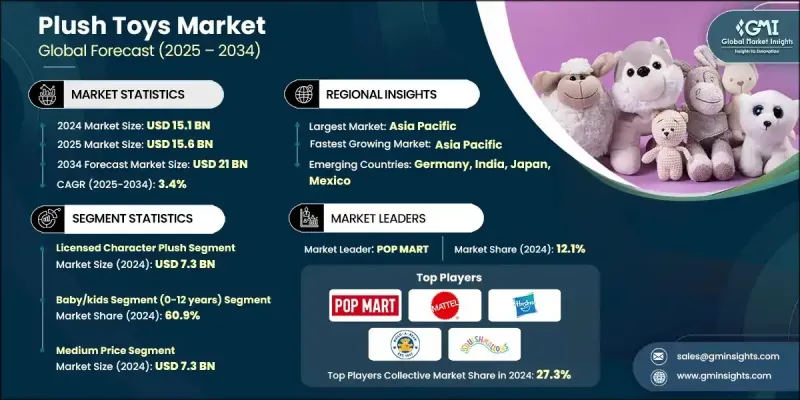
Market growth is supported by rising demand for comforting, soft, and emotionally engaging toys across children, youth, and the growing "kidult" demographic. Plush toys continue to benefit from strong gifting culture, expanding entertainment franchises, and the increasing appeal of collectible, licensed characters. Innovations such as tech-enabled plush toys with sound, motion sensors, and interactive features are further enhancing product appeal. Additionally, sustainability trends have accelerated the use of recycled fibers, organic fabrics, and eco-friendly dyes, prompting manufacturers to redesign plush toys that align with modern consumer values.
| Market Scope | |
|---|---|
| Start Year | 2024 |
| Forecast Year | 2025-2034 |
| Start Value | $15.1 Billion |
| Forecast Value | $21 Billion |
| CAGR | 3.4% |
The medium-priced segment generated USD 7.3 billion in 2024. This tier appeals to mainstream buyers by offering a blend of affordability and dependable quality. Demand continues to rise among middle-income households seeking plush toys that provide long-lasting value without compromising on safety standards or design features, especially as disposable incomes increase.
The licensed character plush toys segment generated USD 7.3 billion in 2024 and is projected to grow at a CAGR of 3.3% between 2025 and 2034. Their popularity extends beyond children, as they attract a substantial adult collector segment, which supports steady market expansion. One of the fastest-rising names in this market is Squishmallows, a Jazwares brand that has gained strong traction among adult buyers through character-based designs inspired by well-known franchises.
U.S. Plush Toys Market accounted for 85% share in 2024, reflecting its position as the dominant contributor to growth. This leadership is fueled by strong consumer interest in licensed plush toys from major entertainment brands such as Disney and Marvel. U.S. Census Bureau data indicates that the country's toy and game sector exceeded USD 25 billion in revenue in 2022, highlighting a substantial opportunity for continued expansion. A well-developed retail ecosystem, combined with rapid e-commerce growth, supports widespread access to these plush toy categories across the nation.
Key companies shaping the Global Plush Toys Market landscape include Build-A-Bear Workshop, Hasbro Inc., Mattel Inc., MGA Entertainment, Simba-Dickie Group, Ty Inc., Bandai Namco, Spin Master, Melissa & Doug, and Aurora World Inc. Companies in the Plush Toys Market are increasingly focusing on licensed collaborations with leading entertainment brands to enhance product desirability and secure recurring consumer engagement. Many manufacturers are investing in eco-friendly materials, such as recycled polyester fibers and organic cotton, to appeal to environmentally conscious buyers. Firms are also strengthening their presence through omnichannel retail strategies, combining experiential in-store formats with digital customization tools and e-commerce platforms. Additionally, companies are developing tech-enhanced plush toys featuring interactive elements to broaden their appeal to both children and adults.
Table of Contents
Chapter 1 Methodology & Scope
- 1.1 Market scope and definition
- 1.2 Research design
- 1.2.1 Research approach
- 1.2.2 Data collection methods
- 1.3 Data mining sources
- 1.3.1 Global
- 1.3.2 Regional
- 1.4 Base estimates and calculations
- 1.4.1 Base year calculation
- 1.4.2 Key trends for market estimation
- 1.5 Primary research and validation
- 1.5.1 Primary sources
- 1.6 Forecast model
- 1.7 Research assumptions and limitations
Chapter 2 Executive Summary
- 2.1 Industry 3600 synopsis
- 2.2 Key market trends
- 2.2.1 Regional
- 2.2.2 Product Type
- 2.2.3 Type
- 2.2.4 Material
- 2.2.5 Age Group
- 2.2.6 Price
- 2.2.7 Distribution Channel
- 2.3 CXO perspectives: Strategic imperatives
- 2.3.1 Key decision points for industry executives
- 2.3.2 Critical success factors for market players
- 2.4 Future outlook and strategic recommendations
Chapter 3 Industry Insights
- 3.1 Industry ecosystem analysis
- 3.1.1 Supplier landscape
- 3.1.2 Profit margin
- 3.1.3 Value addition at each stage
- 3.1.4 Factor affecting the value chain
- 3.2 Industry impact forces
- 3.2.1 Growth drivers
- 3.2.1.1 Rising disposable incomes
- 3.2.1.2 Expansion of online retail
- 3.2.1.3 Demand for interactive toys
- 3.2.2 Industry pitfalls & challenges
- 3.2.2.1 Intense competition
- 3.2.2.2 Fluctuating raw material costs
- 3.2.3 Opportunities
- 3.2.3.1 Expansion through licensed & pop culture collaborations
- 3.2.3.2 Sustainability & eco-friendly materials
- 3.2.1 Growth drivers
- 3.3 Growth potential analysis
- 3.4 Future market trends
- 3.5 Technology and innovation landscape
- 3.5.1 Current technological trends
- 3.5.2 Emerging technologies
- 3.6 Regulatory landscape
- 3.6.1 Standards and compliance requirements
- 3.6.2 Regional regulatory frameworks
- 3.6.3 Certification standards
- 3.7 Trade statistics (HS code 9503)
- 3.7.1 Major importing countries
- 3.7.2 Major exporting countries
- 3.8 Gap analysis
- 3.9 Risk assessment and mitigation
- 3.10 Porter's analysis
- 3.11 PESTEL analysis
- 3.12 Consumer behaviour analysis
- 3.12.1 Purchasing patterns
- 3.12.2 Preference analysis
- 3.12.3 Regional variations in consumer behaviour
- 3.12.4 Impact of e-commerce on buying decisions
Chapter 4 Competitive Landscape, 2024
- 4.1 Introduction
- 4.2 Company market share analysis
- 4.2.1 By region
- 4.2.1.1 North America
- 4.2.1.2 Europe
- 4.2.1.3 Asia Pacific
- 4.2.1.4 Latin America
- 4.2.1.5 Middle East and Africa
- 4.2.1 By region
- 4.3 Company matrix analysis
- 4.4 Competitive analysis of major market players
- 4.5 Competitive positioning matrix
- 4.6 Key developments
- 4.6.1 Mergers & acquisitions
- 4.6.2 Partnerships & collaborations
- 4.6.3 New product launches
- 4.6.4 Expansion plans
Chapter 5 Market Estimates & Forecast, By Product Type, 2021-2034 (USD Billion) (Thousand Units)
- 5.1 Standard Plush Figures
- 5.2 Plush Dolls & Dress-Up
- 5.3 Plush Puppets
- 5.4 Plush Playsets
- 5.5 Accessory Plush toys
- 5.5.1 Charms
- 5.5.2 Collectible Designer Figures
- 5.5.3 Others (Keychains plush toys, etc.)
- 5.6 Others (plush puzzles, etc.)
Chapter 6 Market Estimates & Forecast, By Type, 2021-2034 (USD Billion) (Thousand Units)
- 6.1 Key trends
- 6.2 Licensed character plush
- 6.2.1 Traditional Licensed Characters (Disney, Marvel, etc.)
- 6.2.2 Artist-Designed Characters
- 6.2.3 Gaming & Digital Characters
- 6.3 Animal-themed plush
- 6.4 Fantasy/mythical creature plush
- 6.5 Educational/interactive plush
- 6.6 Customizable plush toys
Chapter 7 Market Estimates & Forecast, By Material, 2021-2034 (USD Billion) (Thousand Units)
- 7.1 Key trends
- 7.2 Synthetic
- 7.3 Natural
Chapter 8 Market Estimates & Forecast, By Age Group, 2021-2034 (USD Billion) (Thousand Units)
- 8.1 Key trends
- 8.2 Baby/Kids Segment (0-12 years)
- 8.2.1 Infants and Toddlers (0-3 years)
- 8.2.2 Preschoolers (4-6 years)
- 8.2.3 School Age (7-12 years)
- 8.3 Kidults (13-35 years)
- 8.3.1 Teenagers (13-17 years)
- 8.3.2 Young Adults (18-25 years)
- 8.3.3 Millennials (26-35 years)
- 8.4 Collectors Segment (35+ years)
- 8.4.1 Mature Collectors (35-50 years)
- 8.4.2 Senior Collectors (50+ years)
Chapter 9 Market Estimates & Forecast, By Price, 2021-2034 (USD Billion) (Thousand Units)
- 9.1 Key trends
- 9.1.1 Low
- 9.1.2 Medium
- 9.1.3 High
Chapter 10 Market Estimates & Forecast, By Distribution Channel, 2021-2034 (USD Billion) (Thousand Units)
- 10.1 Key trends
- 10.2 Online
- 10.2.1 E-commerce websites
- 10.2.2 Company owned websites
- 10.3 Offline
- 10.3.1 Retail stores
- 10.3.2 Specialty toy stores
- 10.3.3 Others (home improvement stores, etc.)
Chapter 11 Market Estimates & Forecast, By Region, 2021-2034 (USD Billion) (Thousand Units)
- 11.1 Key trends
- 11.2 North America
- 11.2.1 U.S.
- 11.2.2 Canada
- 11.3 Europe
- 11.3.1 Germany
- 11.3.2 France
- 11.3.3 UK
- 11.3.4 Italy
- 11.3.5 Spain
- 11.3.6 Russia
- 11.4 Asia Pacific
- 11.4.1 China
- 11.4.2 India
- 11.4.3 Japan
- 11.4.4 South Korea
- 11.4.5 Australia
- 11.5 Latin America
- 11.5.1 Brazil
- 11.5.2 Mexico
- 11.6 MEA
- 11.6.1 South Africa
- 11.6.2 Saudi Arabia
- 11.6.3 UAE
Chapter 12 Company Profiles
- 12.1 Aurora World
- 12.2 Build-A-Bear Workshop
- 12.3 Douglas Company
- 12.4 Fiesta Toy
- 12.5 Gund
- 12.6 Hasbro
- 12.7 Jellycat
- 12.8 Mattel
- 12.9 Melissa & Doug
- 12.10 POP MART
- 12.11 Spin Master
- 12.12 Squishmallows
- 12.13 Steiff
- 12.14 Tokidoki
- 12.15 Ty

