
PUBLISHER: Global Market Insights Inc. | PRODUCT CODE: 1885910

PUBLISHER: Global Market Insights Inc. | PRODUCT CODE: 1885910
Baby Diapers Market Opportunity, Growth Drivers, Industry Trend Analysis, and Forecast 2025 - 2034
The Global Baby Diapers Market was valued at USD 49.6 billion in 2024 and is estimated to grow at a CAGR of 5.2% to reach USD 78 billion by 2034.
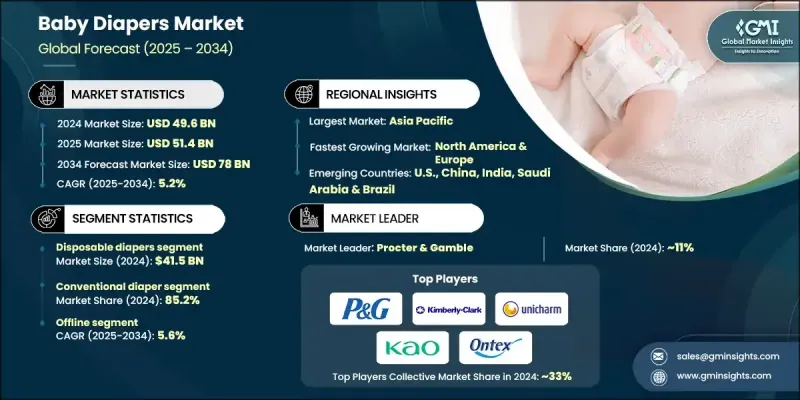
Market expansion is fueled by higher birth rates in emerging regions, particularly across Asia-Pacific and Africa, where fertility rates surpass those in developed regions, creating a sustained demand for baby diapers. Increasing awareness among caregivers regarding infant hygiene and health is another significant driver, as modern parents are more informed about the risks of infections and skin irritations. This has prompted manufacturers to focus on premium diaper offerings that provide enhanced absorbency, breathable fabrics, and hypoallergenic properties. Regulatory frameworks in regions like Europe, coupled with consumer demand for chemical-free, safe, and baby-friendly products, are further shaping market trends. Manufacturers are innovating to meet these expectations, offering diapers that combine comfort, safety, and functionality, while responding to the rising global emphasis on child health and hygiene.
| Market Scope | |
|---|---|
| Start Year | 2024 |
| Forecast Year | 2025-2034 |
| Start Value | $49.6 billion |
| Forecast Value | $78 billion |
| CAGR | 5.2% |
The disposable diapers segment generated USD 41.5 billion in 2024 and is expected to grow at a CAGR of 5.1% from 2025 to 2034. Busy lifestyles and urban living, particularly with increasing female workforce participation, drive parents toward disposable options that save time and effort compared to reusable alternatives, which require constant cleaning.
The conventional diaper segment held 85.2% share in 2024 and is projected to grow at a CAGR of 5.1% through 2034. Traditional materials, including nonwoven fabrics, superabsorbent polymers, and fluff pulp, provide reliable performance at lower costs, appealing to price-sensitive consumers and regions prioritizing practicality over organic or eco-friendly alternatives.
U.S. Baby Diapers Market was valued at USD 6.3 billion in 2024 and is anticipated to grow at a CAGR of 4.8% from 2025 to 2034. American parents emphasize convenience and quality, driving demand for advanced disposable diapers with features like enhanced absorbency, wetness indicators, and hypoallergenic compositions. High female workforce participation and urban lifestyles further reinforce the preference for time-saving, efficient baby hygiene solutions. Strong retail infrastructure, including supermarkets, pharmacies, and e-commerce platforms with subscription and home delivery models, enhances market accessibility and consumer convenience.
Key players in the Global Baby Diapers Market include Bambino Mio Ltd., Bambo Nature USA, Daio Paper, Essity AB, First Quality Enterprises, Hello Bello, Hengan International, Kao Corporation, Kimberly-Clark Corporation, Nobel Hygiene, Ontex Group, Ontex International N.V., Paul Hartmann AG, The Procter & Gamble Company (P&G), and Unicharm Corporation. Companies in the Baby Diapers Market adopt multiple strategies to strengthen their presence and market share. They focus on product innovation by introducing diapers with superior absorbency, eco-friendly materials, breathable fabrics, and hypoallergenic features. Expanding distribution networks, leveraging e-commerce platforms, and offering subscription services increase accessibility and convenience for consumers. Firms engage in sustainability initiatives, ensuring compliance with environmental regulations and promoting chemical-free, safe products.
Table of Contents
Chapter 1 Methodology & Scope
- 1.1 Market scope and definition
- 1.2 Research design
- 1.2.1 Research approach
- 1.2.2 Data collection methods
- 1.3 Data mining sources
- 1.3.1 Global
- 1.3.2 Regional/Country
- 1.4 Base estimates and calculations
- 1.4.1 Base year calculation
- 1.4.2 Key trends for market estimation
- 1.5 Primary research and validation
- 1.5.1 Primary sources
- 1.6 Forecast model
- 1.7 Research assumptions and limitations
Chapter 2 Executive Summary
- 2.1 Industry 360° synopsis
- 2.2 Key market trends
- 2.2.1 Regional
- 2.2.2 Type
- 2.2.3 Material
- 2.2.4 Category
- 2.2.5 Size
- 2.2.6 Age group
- 2.2.7 Price range
- 2.2.8 Distribution channel
- 2.3 CXO perspectives: Strategic imperatives
- 2.3.1 Key decision points for industry executives
- 2.3.2 Critical success factors for market players
- 2.4 Future outlook and strategic recommendations
Chapter 3 Industry Insights
- 3.1 Industry ecosystem analysis
- 3.1.1 Supplier landscape
- 3.1.2 Profit margin
- 3.1.3 Value addition at each stage
- 3.1.4 Factor affecting the value chain
- 3.2 Industry impact forces
- 3.2.1 Growth drivers
- 3.2.1.1 Rising birth rates in developing regions
- 3.2.1.2 Awareness of baby hygiene and health
- 3.2.1.3 Rising female workforce participation
- 3.2.1.4 Urbanization and lifestyle changes
- 3.2.2 Industry pitfalls & challenges
- 3.2.2.1 High competition and price sensitivity
- 3.2.2.2 Health concerns
- 3.2.2.3 Shift toward cloth diapers
- 3.2.1 Growth drivers
- 3.3 Growth potential analysis
- 3.4 Future market trends
- 3.5 Technology and innovation landscape
- 3.5.1 Current technological trends
- 3.5.2 Emerging technologies
- 3.6 Price trends
- 3.6.1 By region
- 3.6.2 By type
- 3.7 Regulatory landscape
- 3.7.1 Standards and compliance requirements
- 3.7.2 Regional regulatory frameworks
- 3.7.3 Certification standards
- 3.8 Trade statistics
- 3.8.1 Major importing countries
- 3.8.2 Major exporting countries
- 3.9 Porter's analysis
- 3.10 PESTEL analysis
- 3.11 Consumer behavior analysis
- 3.11.1 Purchasing patterns
- 3.11.2 Preference analysis
- 3.11.3 Regional variations in consumer behavior
- 3.11.4 Impact of e-commerce on buying decisions
Chapter 4 Competitive Landscape, 2024
- 4.1 Introduction
- 4.2 Company market share analysis
- 4.2.1 By Region
- 4.2.1.1 North America
- 4.2.1.2 Europe
- 4.2.1.3 Asia Pacific
- 4.2.1.4 Latin America
- 4.2.1.5 Middle East & Africa
- 4.2.1 By Region
- 4.3 Company matrix analysis
- 4.4 Competitive analysis of major market players
- 4.5 Competitive positioning matrix
- 4.6 Key developments
- 4.6.1 Mergers & acquisitions
- 4.6.2 Partnerships & collaborations
- 4.6.3 New product launches
- 4.6.4 Expansion plans
Chapter 5 Market Estimates & Forecast, By Type, 2021 - 2034, (USD Billion) (Million Units)
- 5.1 Key trends
- 5.2 Disposable
- 5.3 Reusable
Chapter 6 Market Estimates & Forecast, By Material, 2021 - 2034, (USD Billion) (Million Units)
- 6.1 Key trends
- 6.2 Conventional
- 6.3 Organic
Chapter 7 Market Estimates & Forecast, By Category, 2021 - 2034, (USD Billion) (Million Units)
- 7.1 Key trends
- 7.2 Pant
- 7.3 Taped
Chapter 8 Market Estimates & Forecast, By Size, 2021 - 2034, (USD Billion) (Million Units)
- 8.1 Key trends
- 8.2 Small / extra small
- 8.3 Medium
- 8.4 Large
- 8.5 Extra large
Chapter 9 Market Estimates & Forecast, By Age Group, 2021 - 2034, (USD Billion) (Million Units)
- 9.1 Key trends
- 9.2 0-6 months
- 9.3 6-18 months
- 9.4 18-24 months
- 9.5 Above 2 years
Chapter 10 Market Estimates & Forecast, By Price Range, 2021 - 2034, (USD Billion) (Million Units)
- 10.1 Key trends
- 10.2 Economical diapers (Below $0.15)
- 10.3 Mid-Range diapers ($0.15 to $0.30)
- 10.4 Premium diapers (Above $0.30)
Chapter 11 Market Estimates & Forecast, By Distribution Channel, 2021 - 2034, (USD Billion) (Million Units)
- 11.1 Key trends
- 11.1.1 E-commerce website
- 11.1.2 Company’s website
- 11.2 Offline
- 11.2.1 Hypermarket & supermarket
- 11.2.2 Specialty stores
- 11.2.3 Pharmacies/drug stores
- 11.2.4 Other retail stores (department stores, warehouse club etc.)
Chapter 12 Market Estimates & Forecast, By Region, 2021 - 2034, (USD Billion) (Million Units)
- 12.1 Key trends
- 12.2 North America
- 12.2.1 U.S.
- 12.2.2 Canada
- 12.3 Europe
- 12.3.1 Germany
- 12.3.2 UK
- 12.3.3 France
- 12.3.4 Italy
- 12.3.5 Spain
- 12.4 Asia Pacific
- 12.4.1 China
- 12.4.2 India
- 12.4.3 Japan
- 12.4.4 South Korea
- 12.4.5 Australia
- 12.4.6 Indonesia
- 12.4.7 Malaysia
- 12.5 Latin America
- 12.5.1 Brazil
- 12.5.2 Mexico
- 12.5.3 Argentina
- 12.6 MEA
- 12.6.1 Saudi Arabia
- 12.6.2 UAE
- 12.6.3 South Africa
Chapter 13 Company Profiles
- 13.1 Bambino Mio Ltd.
- 13.2 Bambo Nature USA
- 13.3 Daio Paper
- 13.4 Essity AB
- 13.5 First Quality Enterprises
- 13.6 Hello Bello
- 13.7 Hengan International
- 13.8 Kao Corporation
- 13.9 Kimberly-Clark Corporation
- 13.10 Nobel Hygiene
- 13.11 Ontex Group
- 13.12 Ontex International N.V
- 13.13 Paul Hartmann AG
- 13.14 The Procter & Gamble Company (P&G)
- 13.15 Unicharm Corporation

