
PUBLISHER: Global Market Insights Inc. | PRODUCT CODE: 1885912

PUBLISHER: Global Market Insights Inc. | PRODUCT CODE: 1885912
Geriatric Care Services Market Opportunity, Growth Drivers, Industry Trend Analysis, and Forecast 2025 - 2034
The Global Geriatric Care Services Market was valued at USD 1.3 trillion in 2024 and is estimated to grow at a CAGR of 5.1% to reach USD 2.1 trillion by 2034.
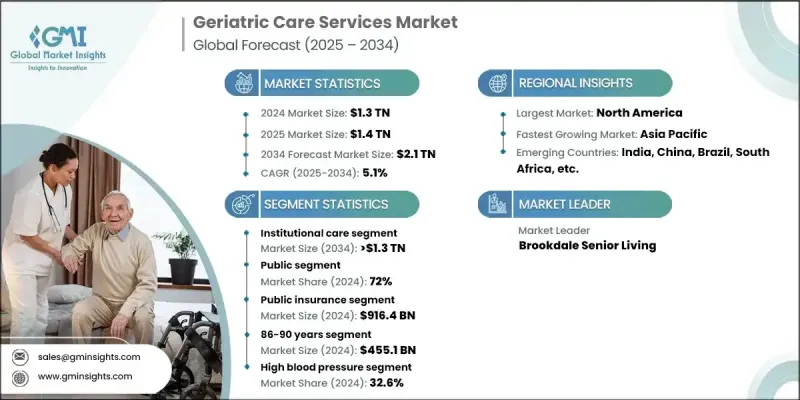
The expansion of the market is driven by the rising elderly population, favorable reimbursement policies, increasing prevalence of chronic diseases, and growing government and societal awareness about senior care. Older adults often require ongoing medical monitoring, assistance with daily living activities, and specialized nursing care due to multiple health conditions such as diabetes, cardiovascular disorders, dementia, and arthritis. The demographic shift toward aging populations has prompted investments in personalized healthcare, telemedicine, and home-based care solutions, reducing hospital dependency while improving patient outcomes. Countries with significant aging populations have accelerated the adoption of advanced geriatric care services, including technologically enabled health monitoring, integrated care models, and AI-supported solutions, creating long-term opportunities for market growth.
| Market Scope | |
|---|---|
| Start Year | 2024 |
| Forecast Year | 2025-2034 |
| Start Value | $1.3 Trillion |
| Forecast Value | $2.1 Trillion |
| CAGR | 5.1% |
The institutional care segment held a 63.1% share in 2024. Institutional care includes nursing homes, assisted living facilities, hospitals, and long-term care centers that provide comprehensive medical and personal assistance for seniors. These facilities cater to elderly patients with chronic conditions or those requiring continuous supervision, offering skilled nursing, rehabilitation, and social engagement programs. Institutional care ensures structured routines, safety, and access to professional-level healthcare for patients with severe mobility or health challenges, making it a critical component of the market.
The public segment accounted for a 72% share in 2024. Public providers encompass government-funded hospitals, community health centers, and social welfare programs, delivering affordable or subsidized care to older adults. These providers enhance accessibility in regions with limited private healthcare engagement, offering services such as nursing, preventive care, and rehabilitation. Public geriatric services also align with national healthcare policies focused on improving senior well-being, especially in low-income or underserved communities.
North America Geriatric Care Services Market held a 42.8% share in 2024. The region benefits from a highly developed healthcare system, extensive insurance coverage through government programs, and widespread adoption of telehealth and home care services. Rising incidences of chronic illnesses such as diabetes and cardiovascular diseases are increasing the need for integrated care models. Additionally, remote monitoring, AI-based health management, and technology-driven interventions are being integrated into geriatric care programs, driving demand and adoption.
Key players in the Global Geriatric Care Services Market include Atria Senior Living, Active Day, Brookdale Senior Living, Sunrise Senior Living, DIVERSICARE, Genesis, Kindred Hospitals, Home Instead, Ensign Group, Extendicare Inc., Life Care Centers of America, Capital Health Care Network, Gentiva, Samvedna Care, ANTARA, ScionHealth, KITES, and St Luke's ELDERCARE. Companies operating in the Geriatric Care Services Market are adopting multiple strategies to strengthen their market presence. They focus on expanding geographic reach by opening new facilities and partnering with local healthcare networks. Investment in technology-enabled care, such as telemedicine, remote monitoring, and AI-driven patient management systems, is a key approach to improving service quality and efficiency. Firms are also emphasizing specialized programs for chronic disease management and rehabilitation to attract a broader elderly population.
Table of Contents
Chapter 1 Methodology and Scope
- 1.1 Market scope and definition
- 1.2 Research design
- 1.2.1 Research approach
- 1.2.2 Data collection methods
- 1.3 Data mining sources
- 1.3.1 Global
- 1.3.2 Regional/Country
- 1.4 Base estimates and calculations
- 1.4.1 Base year calculation
- 1.4.2 Key trends for market estimation
- 1.5 Primary research and validation
- 1.5.1 Primary sources
- 1.6 Forecast model
- 1.7 Research assumptions and limitations
Chapter 2 Executive Summary
- 2.1 Industry 3600 synopsis
- 2.2 Key market trends
- 2.2.1 Regional trends
- 2.2.2 Service trends
- 2.2.3 Service provider trends
- 2.2.4 Payment source trends
- 2.2.5 Age group trends
- 2.2.6 Application trends
- 2.3 CXO perspectives: Strategic imperatives
- 2.3.1 Key decision points for industry executives
- 2.3.2 Critical success factors for market players
- 2.4 Future outlook and strategic recommendations
Chapter 3 Industry Insights
- 3.1 Industry ecosystem analysis
- 3.2 Industry impact forces
- 3.2.1 Growth drivers
- 3.2.1.1 Rise in geriatric population
- 3.2.1.2 Increasing prevalence of chronic diseases
- 3.2.1.3 Favorable reimbursement policies for geriatric population
- 3.2.1.4 Rising awareness and government funding for elderly care
- 3.2.1.5 Shift toward integrated and personalized care models
- 3.2.2 Industry pitfalls and challenges
- 3.2.2.1 High cost associated with geriatric care services in developing nations
- 3.2.2.2 Limited insurance penetration and shortage of trained professionals in emerging markets
- 3.2.3 Opportunities
- 3.2.3.1 Growing adoption of telehealth and remote monitoring solutions
- 3.2.3.2 Expansion of home healthcare and aging-in-place strategies
- 3.2.3.3 Increasing focus on preventive healthcare for aging populations
- 3.2.1 Growth drivers
- 3.3 Growth potential analysis
- 3.4 Regulatory landscape
- 3.4.1 North America
- 3.4.2 Europe
- 3.4.3 Asia Pacific
- 3.5 Technology and innovation landscape
- 3.5.1 Current technological trends
- 3.5.2 Emerging technologies
- 3.6 Investment landscape
- 3.7 Reimbursement scenario
- 3.7.1 North America
- 3.7.2 Europe
- 3.7.3 Asia Pacific
- 3.8 Healthcare delivery model transformation
- 3.9 Workforce challenges and training programs
- 3.10 Consumer behavior analysis
- 3.11 Role of community-based care models
- 3.12 Policy outlook
- 3.13 Porter's analysis
- 3.14 PESTEL analysis
- 3.15 Gap analysis
- 3.16 Future market trends
Chapter 4 Competitive Landscape, 2024
- 4.1 Introduction
- 4.2 Company matrix analysis
- 4.3 Company market share analysis
- 4.4 Competitive analysis of major market players
- 4.5 Competitive positioning matrix
- 4.6 Key developments
- 4.6.1 Mergers & acquisitions
- 4.6.2 Partnerships & collaborations
- 4.6.3 New product launches
- 4.6.4 Expansion plans
Chapter 5 Market Estimates and Forecast, By Service, 2021 - 2034 ($ Mn)
- 5.1 Key trends
- 5.2 Institutional care
- 5.2.1 Nursing homes
- 5.2.2 Hospitals
- 5.2.3 Assisted living
- 5.2.4 Independent senior living
- 5.3 Homecare
- 5.4 Adult day care
Chapter 6 Market Estimates and Forecast, By Service Provider, 2021 - 2034 ($ Mn)
- 6.1 Key trends
- 6.2 Public
- 6.3 Private
Chapter 7 Market Estimates and Forecast, By Payment Source, 2021 - 2034 ($ Mn)
- 7.1 Key trends
- 7.2 Public insurance
- 7.3 Private insurance
- 7.4 Out-of-pocket
- 7.5 Other payment sources
Chapter 8 Market Estimates and Forecast, By Age Group, 2021 - 2034 ($ Mn)
- 8.1 Key trends
- 8.2 65-70 years
- 8.3 71-75 years
- 8.4 76-80 years
- 8.5 81-85 years
- 8.6 86-90 years
- 8.7 Above 91 years
Chapter 9 Market Estimates and Forecast, By Application, 2021 - 2034 ($ Mn)
- 9.1 Key trends
- 9.2 High blood pressure
- 9.3 Alzheimer's/Dementias
- 9.4 Depression
- 9.5 Diabetes
- 9.6 Other applications
Chapter 10 Market Estimates and Forecast, By Region, 2021 - 2034 ($ Mn)
- 10.1 Key trends
- 10.2 North America
- 10.2.1 U.S.
- 10.2.2 Canada
- 10.3 Europe
- 10.3.1 Germany
- 10.3.2 UK
- 10.3.3 France
- 10.3.4 Spain
- 10.3.5 Italy
- 10.3.6 Netherlands
- 10.4 Asia Pacific
- 10.4.1 China
- 10.4.2 Japan
- 10.4.3 India
- 10.4.4 Australia
- 10.4.5 South Korea
- 10.5 Latin America
- 10.5.1 Brazil
- 10.5.2 Mexico
- 10.5.3 Argentina
- 10.6 MEA
- 10.6.1 South Africa
- 10.6.2 Saudi Arabia
- 10.6.3 UAE
Chapter 11 Company Profiles
- 11.1 Active Day
- 11.2 Amedisys
- 11.3 ANTARA
- 11.4 Atria Senior Living
- 11.5 Brookdale Senior Living
- 11.6 Capital Health Care Network
- 11.7 DIVERSICARE
- 11.8 Ensign Group
- 11.9 Extendicare Inc.
- 11.10 Genesis
- 11.11 Gentiva
- 11.12 Home Instead
- 11.13 Kindred Hospitals
- 11.14 KITES
- 11.15 Life Care Centers of America
- 11.16 Samvedna Care
- 11.17 ScionHealth
- 11.18 St Luke’s ELDERCARE
- 11.19 Sunrise Senior Living

