
PUBLISHER: Global Market Insights Inc. | PRODUCT CODE: 1885918

PUBLISHER: Global Market Insights Inc. | PRODUCT CODE: 1885918
Remote Vehicle Diagnostics Market Opportunity, Growth Drivers, Industry Trend Analysis, and Forecast 2025 - 2034
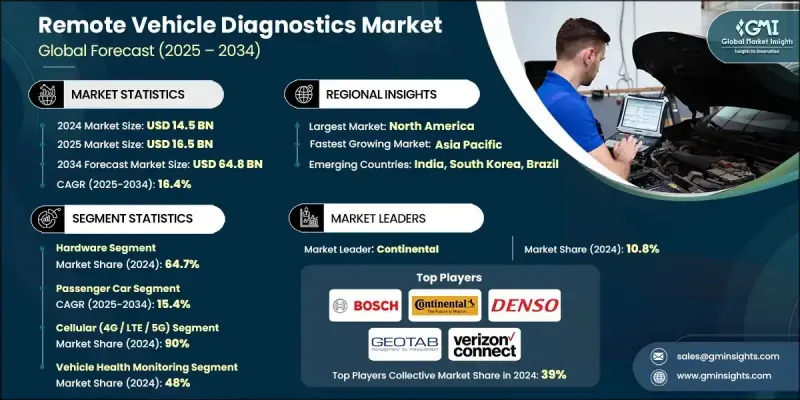
The Global Remote Vehicle Diagnostics Market was valued at USD 14.5 billion in 2024 and is estimated to grow at a CAGR of 16.4% to reach USD 64.8 billion by 2034.
With the increasing adoption of connected vehicles and OEMs prioritizing vehicle uptime and safety, remote diagnostics are becoming essential. Reports from regulatory authorities indicate that over 30 percent of vehicle recalls are linked to electronic or software issues, underlining the need for real-time monitoring and rapid fault detection. The growing complexity of vehicle powertrains and electronic systems is further fueling demand for advanced diagnostic hardware. AI-powered platforms and cloud-based analytics convert telemetry data into actionable insights, enabling predictive maintenance, early detection of potential failures, and minimized service downtime. These solutions allow OEMs and fleet operators to optimize workshop operations, plan proactive maintenance, and enhance vehicle performance and reliability throughout the lifecycle. As the automotive industry moves toward service-oriented models, fleets are increasingly leveraging managed diagnostics that monitor vehicles around the clock, integrate remote service guidance, and provide predictive maintenance recommendations, helping reduce operational costs and improve vehicle availability.
| Market Scope | |
|---|---|
| Start Year | 2024 |
| Forecast Year | 2025-2034 |
| Start Value | $14.5 Billion |
| Forecast Value | $64.8 Billion |
| CAGR | 16.4% |
The hardware segment held a 64.7% share of the market in 2024. This category encompasses OBD-II diagnostic devices, embedded telematics control units (TCUs), and OEM gateways, which form the essential backbone of remote vehicle diagnostics. These components are critical for collecting, transmitting, and processing real-time data from a vehicle's engine, transmission, safety systems, and electronic modules. The increasing complexity of modern powertrains, hybrid and electric vehicle architectures, and advanced driver-assistance systems (ADAS) has driven higher demand for reliable diagnostic hardware.
The passenger vehicles segment is expected to grow at a CAGR of 15.4% from 2025 to 2034, driven by telematics adoption, predictive maintenance demand, and sophisticated onboard monitoring. Remote diagnostics enable continuous monitoring of engine, transmission, battery, and safety systems, improving reliability and user experience through over-the-air updates and timely alerts.
U.S. Remote Vehicle Diagnostics Market accounted for 82.2% share in 2024, generating USD 4.82 billion. Growth is driven by widespread connected passenger vehicles, advanced telematics adoption, and supportive regulations, providing significant opportunities for both OEM-installed and aftermarket solutions.
Major players in the Global Remote Vehicle Diagnostics Market include GM/OnStar, Bosch, Denso, Omnitracs, Harman, ZF, Continental, Verizon Connect, Valeo, and Geotab. Companies are strengthening their Remote Vehicle Diagnostics Market position by investing in AI-driven analytics and cloud platforms to enhance predictive maintenance capabilities. They are forming strategic alliances with OEMs and fleet operators to expand solution deployment and capture long-term contracts. Continuous innovation in embedded diagnostic hardware, telematics units, and software platforms improves service quality and reliability. Firms are also expanding their presence through geographic diversification, acquisitions, and partnerships, ensuring faster market penetration. Additionally, integrating over-the-air updates, cybersecurity features, and real-time fault detection services enhances customer trust and establishes recurring revenue streams while reducing vehicle downtime and maintenance costs.
Table of Contents
Chapter 1 Methodology
- 1.1 Market scope and definition
- 1.2 Research design
- 1.2.1 Research approach
- 1.2.2 Data collection methods
- 1.3 Data mining sources
- 1.3.1 Global
- 1.3.2 Regional/Country
- 1.4 Base estimates and calculations
- 1.4.1 Base year calculation
- 1.4.2 Key trends for market estimation
- 1.5 Primary research and validation
- 1.5.1 Primary sources
- 1.6 Forecast
- 1.7 Research assumptions and limitations
Chapter 2 Executive Summary
- 2.1 Industry 3600 synopsis, 2021 - 2034
- 2.2 Key market trends
- 2.2.1 Regional
- 2.2.2 Offering
- 2.2.3 Vehicle
- 2.2.4 Connectivity
- 2.2.5 Application
- 2.2.6 End Use
- 2.3 TAM Analysis, 2025-2034
- 2.4 CXO perspectives: Strategic imperatives
- 2.4.1 Executive decision points
- 2.4.2 Critical success factors
- 2.5 Future outlook and strategic recommendations
Chapter 3 Industry Insights
- 3.1 Industry ecosystem analysis
- 3.1.1 Supplier landscape
- 3.1.2 Profit margin analysis
- 3.1.3 Cost structure
- 3.1.4 Value addition at each stage
- 3.1.5 Factor affecting the value chain
- 3.1.6 Disruptions
- 3.2 Industry impact forces
- 3.2.1 Growth drivers
- 3.2.1.1 Rising integration of embedded telematics & OEM diagnostic gateways
- 3.2.1.2 Growth of predictive maintenance in fleets
- 3.2.1.3 Expansion of 4G/5G-enabled connected car infrastructure
- 3.2.2 Industry pitfalls and challenges
- 3.2.2.1 High integration complexity across OEM systems, ECUs, and telematics protocols
- 3.2.2.2 Concerns around data privacy & cybersecurity vulnerabilities
- 3.2.3 Market opportunities
- 3.2.3.1 Rising adoption of predictive analytics for commercial fleets
- 3.2.3.2 Growth in connected car penetration across emerging markets
- 3.2.1 Growth drivers
- 3.3 Growth potential analysis
- 3.4 Regulatory landscape
- 3.4.1 North America
- 3.4.2 Europe
- 3.4.3 Asia Pacific
- 3.4.4 Latin America
- 3.4.5 Middle East & Africa
- 3.5 Porter's analysis
- 3.6 Pestel analysis
- 3.7 Technology and innovation landscape
- 3.7.1 Current technological trends
- 3.7.2 Emerging technologies
- 3.8 Price trends
- 3.8.1 By region
- 3.8.2 By product
- 3.9 Cost breakdown analysis
- 3.10 Patent analysis
- 3.11 Sustainability & environmental aspects
- 3.11.1 Carbon footprint assessment
- 3.11.2 Circular economy integration
- 3.11.3 E-waste management requirements
- 3.11.4 Green manufacturing initiatives
- 3.12 Interoperability & standards landscape
- 3.12.1 Standardization of diagnostic protocols (UDS, OBD-II, OEM-specific)
- 3.12.2. Connectivity interoperability (4G, 5G, C-V2X, Wi-Fi/Bluetooth)
- 3.12.3 Data format harmonization (API, cloud-to-cloud interfaces)
- 3.13 Customer Behavior & Adoption Patterns
- 3.13.1 Consumer acceptance of vehicle data sharing
- 3.13.2 Adoption trends among fleet operators
- 3.13.3 Shift from reactive repairs to predictive maintenance
- 3.14 Ecosystem Collaboration Analysis
- 3.14.1 OEM-Tier 1 partnerships
- 3.14.2 Telecom-telematics service collaborations
- 3.14.3 Cloud platform integrations (AWS, Azure, Google)
- 3.15 Risk & Scenario Analysis
- 3.15.1 Economic slowdown impact scenarios
- 3.15.2 Connectivity disruption scenarios
- 3.15.3 Regulatory tightening scenarios
- 3.16 Digital Transformation Roadmap for OEMs
- 3.16.1 Transition from hardware diagnostics to software-defined vehicles
- 3.16.2 Cloud migration strategies for OEM diagnostic platforms
- 3.16.3 AI/ML integration roadmap for predictive diagnostics
Chapter 4 Competitive Landscape, 2024
- 4.1 Introduction
- 4.2 Company market share analysis
- 4.2.1 North America
- 4.2.2 Europe
- 4.2.3 Asia Pacific
- 4.2.4 LATAM
- 4.2.5 MEA
- 4.3 Competitive analysis of major market players
- 4.4 Competitive positioning matrix
- 4.5 Strategic outlook matrix
- 4.6 Key developments
- 4.6.1 Mergers & acquisitions
- 4.6.2 Partnerships & collaborations
- 4.6.3 New product launches
- 4.6.4 Expansion plans and funding
Chapter 5 Market Estimates & Forecast, By Offering, 2021 - 2034 ($Mn, Units)
- 5.1 Key trends
- 5.2 Hardware
- 5.2.1 OBD-II diagnostic devices (aftermarket)
- 5.2.2 Embedded telematics control units (TCUs)
- 5.2.3 OEM diagnostic gateways / ECUs
- 5.3 Software
- 5.3.1 Diagnostic software (DTC, fault-code analytics)
- 5.3.2 Predictive maintenance & analytics platforms
- 5.3.3 Vehicle health monitoring platforms
- 5.4 Services
- 5.4.1 Remote diagnostic services
- 5.4.2 Predictive maintenance services
- 5.4.3 Fleet monitoring & advisory services
Chapter 6 Market Estimates & Forecast, By Vehicle, 2021 - 2034 ($Mn, Units)
- 6.1 Key trends
- 6.2 Passenger Cars
- 6.2.1 Hatchback
- 6.2.2 Sedan
- 6.2.3 SUV
- 6.3 Commercial vehicles
- 6.3.1 Light commercial vehicles (LCV)
- 6.3.2 Medium commercial vehicles (MCV)
- 6.3.3 Heavy commercial vehicles (HCV)
Chapter 7 Market Estimates & Forecast, By Connectivity, 2021 - 2034 ($Mn, Units)
- 7.1 Key trends
- 7.2 Cellular (4G / LTE / 5G)
- 7.3 Short-range (Wi-Fi / Bluetooth)
- 7.4 Satellite
Chapter 8 Market Estimates & Forecast, By Application, 2021 - 2034 ($Mn, Units)
- 8.1 Key trends
- 8.2 Fault & error code diagnostics (DTC-based)
- 8.3 Predictive / preventive maintenance
- 8.4 Vehicle health monitoring
- 8.5 Roadside assistance & remote support
- 8.6 Others
Chapter 9 Market Estimates & Forecast, By End Use, 2021 - 2034 ($Mn, Units)
- 9.1 Key trends
- 9.2 OEM
- 9.3 Aftermarket
Chapter 10 Market Estimates & Forecast, By Region, 2021 - 2034 ($Mn, Units)
- 10.1 Key trends
- 10.2 North America
- 10.2.1 US
- 10.2.2 Canada
- 10.3 Europe
- 10.3.1 Germany
- 10.3.2 UK
- 10.3.3 France
- 10.3.4 Italy
- 10.3.5 Spain
- 10.3.6 Nordics
- 10.3.7 Russia
- 10.4 Asia Pacific
- 10.4.1 China
- 10.4.2 India
- 10.4.3 Japan
- 10.4.4 Australia
- 10.4.5 South Korea
- 10.4.6 Singapore
- 10.4.7 Malaysia
- 10.4.8 Thailand
- 10.5 Latin America
- 10.5.1 Brazil
- 10.5.2 Mexico
- 10.5.3 Argentina
- 10.6 MEA
- 10.6.1 South Africa
- 10.6.2 Saudi Arabia
- 10.6.3 UAE
Chapter 11 Company Profiles
- 11.1 Global Leaders
- 11.1.1 Bosch
- 11.1.2 Continental
- 11.1.3 Denso
- 11.1.4 Delphi Technologies
- 11.1.5 Geotab
- 11.1.6 Harman
- 11.1.7 Valeo
- 11.1.8 Verizon Connect
- 11.1.9 ZF
- 11.1.10 GM/OnStar
- 11.1.11 Omnitracs
- 11.2 Regional Players
- 11.2.1 Actia
- 11.2.2 Fleet Complete
- 11.2.3 KPIT Technologies
- 11.2.4 Magneti Marelli
- 11.2.5 Microlise
- 11.2.6 Octo Telematics
- 11.2.7 Orion Fleet Services
- 11.2.8 Trakm8
- 11.3 Emerging Players
- 11.3.1 Autocrypt
- 11.3.2 Caruso Data Marketplace
- 11.3.3 Fixico
- 11.3.4 Mojio
- 11.3.5 Otonomo
- 11.3.6 Sibros
- 11.3.7 Tantalum
- 11.3.8 UBI Solutions

