
PUBLISHER: Global Market Insights Inc. | PRODUCT CODE: 1892648

PUBLISHER: Global Market Insights Inc. | PRODUCT CODE: 1892648
Smart Logistics Platforms Market Opportunity, Growth Drivers, Industry Trend Analysis, and Forecast 2025 - 2034
The Global Smart Logistics Platforms Market was valued at USD 16.6 billion in 2024 and is estimated to grow at a CAGR of 21.6% to reach USD 115.8 billion by 2034.
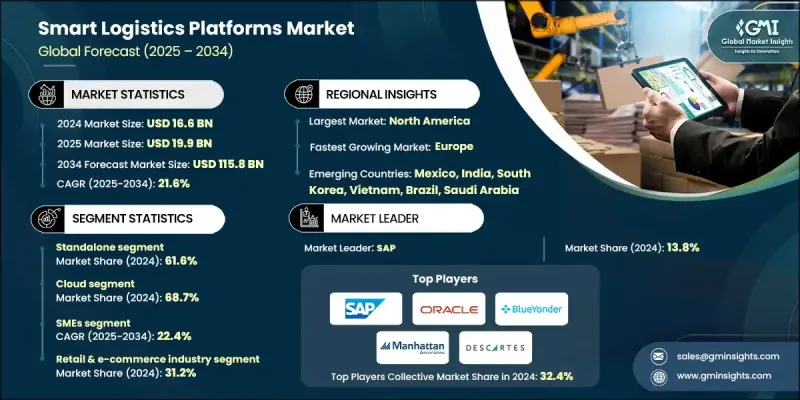
The expansion of global trade is fueling the need for advanced logistics solutions, including fleet management, live tracking, route optimization, inventory control, and warehouse management. Companies are increasingly adopting these platforms to streamline operations, enhance efficiency, and improve visibility across complex supply chains. Businesses can choose between integrated solutions, which offer multiple functionalities within a single platform, and standalone solutions, which focus on specific tasks tailored to operational requirements. Artificial intelligence and machine learning are further accelerating market growth by optimizing routes, improving predictive analytics, strengthening security, and preventing cyber threats. North America and Europe are expected to remain leaders due to substantial investments in global exports, while the Asia-Pacific region is emerging as the fastest-growing market, driven by the expansion of export-oriented economies. China, followed by the U.S. and Germany, dominates global trade, creating strong demand for innovative logistics solutions to manage international supply chains effectively.
| Market Scope | |
|---|---|
| Start Year | 2024 |
| Forecast Year | 2025-2034 |
| Start Value | $16.6 Billion |
| Forecast Value | $115.8 Billion |
| CAGR | 21.6% |
The standalone segment held a 61.6% share in 2024. Its popularity is attributed to faster deployment, lower initial costs, and the ability to handle specific logistics functions such as route optimization, fleet monitoring, and warehouse visibility without full system integration. These solutions are customizable, easy to implement, and ideal for businesses requiring quick, focused results.
The cloud deployment segment held a 68.7% share in 2024. Cloud platforms are widely preferred for their real-time tracking, scalable operations, and AI-driven analytics. They enable seamless collaboration among partners, enhance supply chain visibility, and allow logistics providers to respond effectively to fluctuating demand without heavy on-premises infrastructure.
U.S. Smart Logistics Platforms Market reached USD 6.9 billion in 2024. High logistics costs, which account for more than 8-10% of the national GDP, have driven the adoption of AI-powered platforms that optimize routes, reduce resource waste, and improve operational efficiency.
Key players in the Smart Logistics Platforms Market include Blue Yonder, SAP, Oracle, Manhattan Associates, Descartes Systems, LogiNext Mile, Honeywell, Magaya Supply Chain, Alpega, and Infor. Companies in the Global Smart Logistics Platforms Market are focusing on AI and ML integration to enhance predictive analytics, optimize fleet management, and strengthen cybersecurity. Cloud-based platform development is prioritized to improve scalability, real-time collaboration, and global supply chain visibility. Strategic partnerships with logistics providers, manufacturers, and technology firms help expand market reach and foster innovation. Firms are investing in R&D to introduce customizable and modular solutions that meet diverse client needs. Market players are also emphasizing digital transformation, offering IoT-enabled platforms to track shipments, monitor inventory, and reduce operational inefficiencies.
Table of Contents
Chapter 1 Methodology
- 1.1 Market scope and definition
- 1.2 Research design
- 1.2.1 Research approach
- 1.2.2 Data collection methods
- 1.3 Data mining sources
- 1.3.1 Global
- 1.3.2 Regional/Country
- 1.4 Base estimates and calculations
- 1.4.1 Base year calculation
- 1.4.2 Key trends for market estimation
- 1.5 Primary research and validation
- 1.5.1 Primary sources
- 1.6 Forecast
- 1.7 Research assumptions and limitations
Chapter 2 Executive Summary
- 2.1 Industry 360° synopsis
- 2.2 Key market trends
- 2.2.1 Regional
- 2.2.2 Solution
- 2.2.3 Deployment model
- 2.2.4 Enterprise size
- 2.2.5 End use
- 2.3 TAM analysis, 2025-2034
- 2.4 CXO perspectives: Strategic imperatives
- 2.4.1 Executive decision points
- 2.4.2 Critical success factors
- 2.5 Future outlook and recommendations
Chapter 3 Industry Insights
- 3.1 Industry ecosystem analysis
- 3.1.1 Supplier landscape
- 3.1.2 Profit margin
- 3.1.3 Cost structure
- 3.1.4 Value addition at each stage
- 3.1.5 Factor affecting the value chain
- 3.1.6 Disruptions
- 3.2 Industry impact forces
- 3.2.1 Growth drivers
- 3.2.1.1 E-Commerce growth & omnichannel Fulfilment demands
- 3.2.1.2 Supply chain visibility & resilience imperatives
- 3.2.1.3 Labor shortages & automation adoption
- 3.2.1.4 Cloud adoption & digital transformation mandates
- 3.2.2 Industry pitfalls and challenges
- 3.2.2.1 High initial implementation costs & TCO concerns
- 3.2.2.2 Data security & privacy compliance burden
- 3.2.3 Market opportunities
- 3.2.3.1 Autonomous logistics & hybrid human-robot networks
- 3.2.3.2 Generative AI for operational assistance
- 3.2.3.3 Last-mile delivery innovation
- 3.2.3.4 Landlocked & least developed country (LDC) logistics digitization
- 3.2.1 Growth drivers
- 3.3 Growth potential analysis
- 3.4 Regulatory landscape
- 3.4.1 North America
- 3.4.2 Europe
- 3.4.3 Asia Pacific
- 3.4.4 Latin America
- 3.4.5 Middle East & Africa
- 3.5 Porter's analysis
- 3.6 PESTEL analysis
- 3.7 Technology and innovation landscape
- 3.7.1 Current technological trends
- 3.7.2 Emerging technologies
- 3.7.3 Technology roadmaps & evolution
- 3.7.4 Technology adoption lifecycle analysis
- 3.8 Price trends
- 3.8.1 By region
- 3.8.2 By product
- 3.9 Patent analysis
- 3.10 Cybersecurity & data governance landscape
- 3.11 Customer pain points & workflow optimization analysis
- 3.11.1 Visibility gap & real-time tracking challenges
- 3.11.2 Manual processes & data entry inefficiencies
- 3.11.3 Carrier capacity constraints & freight procurement
- 3.11.4 Last-Mile delivery cost & customer experience
- 3.11.5 Inventory accuracy & warehouse labor productivity
- 3.12 Case studies & implementation success metrics
- 3.13 Best case scenarios
- 3.14 Digital transformation economics & TCO analysis
- 3.14.1 Cloud migration cost-benefit analysis
- 3.14.2 SaaS vs perpetual license TCO comparison
- 3.14.3 Implementation costs & professional services
- 3.14.4 Change management & training investments
- 3.15 Cybersecurity architecture & data privacy framework
- 3.15.1 Cloud security & multi-tenant isolation
- 3.15.2 Data Encryption
- 3.15.3 Identity & access management (IAM)
- 3.15.4 GDPR, CCPA & cross-border data regulations
- 3.15.5 Supply chain cyber threats & attack vectors
Chapter 4 Competitive Landscape, 2024
- 4.1 Introduction
- 4.2 Company market share analysis
- 4.2.1 North America
- 4.2.2 Europe
- 4.2.3 Asia Pacific
- 4.2.4 LATAM
- 4.2.5 MEA
- 4.3 Competitive analysis of major market players
- 4.4 Competitive positioning matrix
- 4.5 Strategic outlook matrix
- 4.6 Key developments
- 4.6.1 Mergers & acquisitions
- 4.6.2 Partnerships & collaborations
- 4.6.3 New product launches
- 4.6.4 Expansion plans and funding
- 4.7 Vendor selection criteria
- 4.8 Supply chain & partner ecosystem analysis
Chapter 5 Market Estimates & Forecast, By Solution, 2021 - 2034 ($Mn)
- 5.1 Key trends
- 5.2 Standalone
- 5.3 Integrated
Chapter 6 Market Estimates & Forecast, By Deployment Model, 2021 - 2034 ($Mn)
- 6.1 Key trends
- 6.2 On-premises
- 6.3 Cloud
- 6.3.1 Private Cloud
- 6.3.2 Public Cloud
- 6.3.3 Hybrid Cloud
- 6.4 Hybrid
Chapter 7 Market Estimates & Forecast, By Enterprise Size, 2021 - 2034 ($Mn)
- 7.1 Key trends
- 7.2 SME
- 7.3 Large Enterprises
Chapter 8 Market Estimates & Forecast, By End Use, 2021 - 2034 ($Mn)
- 8.1 Key trends
- 8.2 Retail & E-commerce
- 8.3 Manufacturing
- 8.4 Third party logistics
- 8.5 Food & Beverage
- 8.6 Pharmaceuticals
- 8.7 Others
Chapter 9 Market Estimates & Forecast, By Region, 2021 - 2034 ($Mn)
- 9.1 Key trends
- 9.2 North America
- 9.2.1 US
- 9.2.2 Canada
- 9.3 Europe
- 9.3.1 Germany
- 9.3.2 UK
- 9.3.3 France
- 9.3.4 Italy
- 9.3.5 Spain
- 9.3.6 Russia
- 9.3.7 Nordics
- 9.3.8 Benelux
- 9.4 Asia Pacific
- 9.4.1 China
- 9.4.2 India
- 9.4.3 Japan
- 9.4.4 South Korea
- 9.4.5 ANZ
- 9.4.6 Singapore
- 9.4.7 Malaysia
- 9.4.8 Indonesia
- 9.4.9 Vietnam
- 9.4.10 Thailand
- 9.5 Latin America
- 9.5.1 Brazil
- 9.5.2 Mexico
- 9.5.3 Argentina
- 9.5.4 Colombia
- 9.6 MEA
- 9.6.1 South Africa
- 9.6.2 Saudi Arabia
- 9.6.3 UAE
Chapter 10 Company Profiles
- 10.1 Global companies
- 10.1.1 Manhattan Associates
- 10.1.2 SAP
- 10.1.3 Oracle
- 10.1.4 Blue Yonder
- 10.1.5 Uber Freight
- 10.1.6 Kinaxis
- 10.1.7. E2 open
- 10.1.8 Infor
- 10.1.9 Descartes Systems
- 10.1.10 HighJump
- 10.1.11 Magaya Supply Chain
- 10.1.12 LogiNext Mile
- 10.1.13 Alpega
- 10.1.14 Honeywell
- 10.2 Regional companies
- 10.2.1 Project44
- 10.2.2 FourKites
- 10.2.3 C.H. Robinson Worldwide
- 10.2.4 XPO Logistics
- 10.2.5 J.B. Hunt Transport Services
- 10.2.6 Transporeon
- 10.2.7 Trimble Transportation
- 10.2.8 Samsara
- 10.3 Emerging companies
- 10.3.1 Flexport
- 10.3.2 Convoy
- 10.3.3 Waymo Via
- 10.3.4 Starship Technologies
- 10.3.5 Waabi
- 10.3.6 Nuro
- 10.3.7 Loadsmart

