
PUBLISHER: Global Market Insights Inc. | PRODUCT CODE: 1892652

PUBLISHER: Global Market Insights Inc. | PRODUCT CODE: 1892652
B2B Fragrance Product Market Opportunity, Growth Drivers, Industry Trend Analysis, and Forecast 2026 - 2035
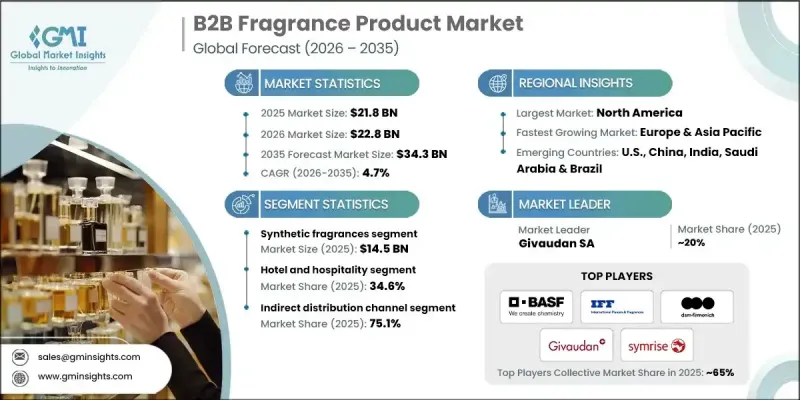
The Global B2B Fragrance Product Market was valued at USD 21.8 billion in 2025 and is estimated to grow at a CAGR of 4.7% to reach USD 34.3 billion by 2035.
The market is expanding due to rising demand for fragrances across personal care and cosmetics products, where consumers increasingly seek items that offer both functionality and an immersive sensory experience. Fragrance has become a crucial element of brand identity for skincare, haircare, and makeup products. Trends such as clean beauty, allergen-free formulations, and vegan products are driving innovation and shaping compliance requirements. Social media and e-commerce platforms provide opportunities for B2B suppliers to meet growing consumer demand for unique, long-lasting, and personalized scents. Additionally, the home and air care sectors play a key role, as products once considered luxury items are now mainstream, enabling consumers to create personalized, calming living environments. Overall, these factors collectively boost the adoption of B2B fragrance products across diverse industries.
| Market Scope | |
|---|---|
| Start Year | 2025 |
| Forecast Year | 2026-2035 |
| Start Value | $21.8 billion |
| Forecast Value | $34.3 billion |
| CAGR | 4.7% |
The synthetic fragrances segment generated USD 14.5 billion in 2025 and is expected to grow at a CAGR of 4.6% from 2026 to 2035. These fragrances are favored for their ability to replicate complex scent profiles consistently at scale, ensuring uniform quality across personal care, home care, and industrial applications. Synthetic ingredients also provide enhanced stability and longer shelf life, making them suitable for products exposed to varying environmental conditions. Growing interest in exotic and innovative scents, alongside the ability to mimic rare or endangered natural ingredients without ecological impact, further supports their widespread use.
The indirect distribution channel held a 75.1% share in 2025 and is projected to grow at a CAGR of 4.6% from 2026 to 2035. Distributors, wholesalers, and third-party agents allow fragrance manufacturers to access diverse regional markets efficiently without investing heavily in in-house sales networks. This strategy benefits global fragrance companies and mid-sized producers serving multiple sectors, including personal care, home care, hospitality, and automotive, across varied geographies.
U.S. B2B Fragrance Product Market reached USD 5.6 billion in 2025 and is expected to grow at a CAGR of 4.6% from 2026 to 2035. Growth is fueled by the rising popularity of personal care and home care products and the adoption of scent marketing strategies across retail, hospitality, and automotive sectors. U.S. companies are investing in innovative fragrance technologies, such as AI-based scent personalization and smart delivery systems, to cater to consumer demand for unique, sustainable, and wellness-oriented products.
Key players in the Global B2B Fragrance Product Market include Alpha Aromatics, Aroma360, BASF SE, DSM-Firmenich, Givaudan SA, Global Perfumes Company, International Flavors & Fragrances (IFF), LEUXSCENT, Mane SA, Prolitec, Robertet SA, Sensient Technologies, Symrise AG, Takasago International Corporation, and Vioryl S.A. Companies in the Global B2B Fragrance Product Market are leveraging several strategies to strengthen their presence and market position. They are focusing on research and development to launch innovative scent profiles, sustainable ingredients, and allergen-free solutions. Strategic collaborations with brands across personal care, home care, and automotive sectors help expand reach and influence. Firms are adopting digital marketing and e-commerce platforms to engage B2B clients, while AI-driven personalization tools and smart delivery technologies enhance product differentiation. Expanding global distribution networks through partnerships with distributors and wholesalers allows companies to serve multiple regions efficiently.
Table of Contents
Chapter 1 Methodology & Scope
- 1.1 Market scope and definition
- 1.2 Research design
- 1.2.1 Research approach
- 1.2.2 Data collection methods
- 1.3 Data mining sources
- 1.3.1 Global
- 1.3.2 Regional/Country
- 1.4 Base estimates and calculations
- 1.4.1 Base year calculation
- 1.4.2 Key trends for market estimation
- 1.5 Primary research and validation
- 1.5.1 Primary sources
- 1.6 Forecast model
- 1.7 Research assumptions and limitations
Chapter 2 Executive Summary
- 2.1 Industry 3600 synopsis
- 2.2 Key market trends
- 2.2.1 Regional
- 2.2.2 Product type
- 2.2.3 Fragrance type
- 2.2.4 Application
- 2.2.5 Distribution channel
- 2.3 CXO perspectives: Strategic imperatives
- 2.3.1 Key decision points for industry executives
- 2.3.2 Critical success factors for market players
- 2.4 Future outlook and strategic recommendations
Chapter 3 Industry Insights
- 3.1 Industry ecosystem analysis
- 3.1.1 Supplier landscape
- 3.1.2 Profit margin
- 3.1.3 Value addition at each stage
- 3.1.4 Factor affecting the value chain
- 3.2 Industry impact forces
- 3.2.1 Growth drivers
- 3.2.1.1 Rising demand in personal care & cosmetics
- 3.2.1.2 Expansion of home & air care
- 3.2.1.3 Premiumization & expressive fragrance formats
- 3.2.2 Industry pitfalls & challenges
- 3.2.2.1 Raw material & commodity price volatility
- 3.2.2.2 Supply chain disruptions & resilience
- 3.2.1 Growth drivers
- 3.3 Growth potential analysis
- 3.4 Future market trends
- 3.5 Technology and innovation landscape
- 3.5.1 Current technological trends
- 3.5.2 Emerging technologies
- 3.6 Price trends
- 3.6.1 By region
- 3.6.2 By product type
- 3.7 Regulatory landscape
- 3.7.1 Standards and compliance requirements
- 3.7.2 Regional regulatory frameworks
- 3.7.3 Certification standards
- 3.8 Trade statistics
- 3.8.1 Major importing countries
- 3.8.2 Major exporting countries
- 3.9 Porter's analysis
- 3.10 PESTEL analysis
- 3.11 Consumer behavior analysis
- 3.11.1 Purchasing patterns
- 3.11.2 Preference analysis
- 3.11.3 Regional variations in consumer behavior
- 3.11.4 Impact of e-commerce on buying decisions
Chapter 4 Competitive Landscape, 2025
- 4.1 Introduction
- 4.2 Company market share analysis
- 4.2.1 By Region
- 4.2.1.1 North America
- 4.2.1.2 Europe
- 4.2.1.3 Asia Pacific
- 4.2.1.4 Latin America
- 4.2.1.5 Middle East & Africa
- 4.2.1 By Region
- 4.3 Company matrix analysis
- 4.4 Competitive analysis of major market players
- 4.5 Competitive positioning matrix
- 4.6 Key developments
- 4.6.1 Mergers & acquisitions
- 4.6.2 Partnerships & collaborations
- 4.6.3 New product launches
- 4.6.4 Expansion plans
Chapter 5 Market Estimates & Forecast, By Product Type, 2022 - 2035, (USD Billion) (Million Units)
- 5.1 Key trends
- 5.2 Personal care & beauty
- 5.2.1 Skincare
- 5.2.2 Haircare
- 5.2.3 Body care
- 5.2.4 Cosmetics
- 5.2.5 Others
- 5.3 Household products
- 5.3.1 Cleaning
- 5.3.2 Laundry
- 5.3.3 Home fragrance systems
- 5.3.4 Others
- 5.4 Industrial essence
- 5.5 Fine fragrance and perfume
- 5.6 Others
Chapter 6 Market Estimates & Forecast, By Fragrance Type, 2022 - 2035, (USD Billion) (Million Units)
- 6.1 Key trends
- 6.2 Natural
- 6.3 Synthetic
Chapter 7 Market Estimates & Forecast, By Application, 2022 - 2035, (USD Billion) (Million Units)
- 7.1 Key trends
- 7.2 Hotel and hospitality
- 7.3 Spa and wellness centers
- 7.4 Retail
- 7.5 Corporates
- 7.6 Others (Educational institutes, healthcare, etc.)
Chapter 8 Market Estimates & Forecast, By Distribution Channel, 2022 - 2035, (USD Billion) (Million Units)
- 8.1 Key trends
- 8.2 Direct sales
- 8.3 Indirect sales
Chapter 9 Market Estimates & Forecast, By Region, 2022 - 2035, (USD Billion) (Million Units)
- 9.1 Key trends
- 9.2 North America
- 9.2.1 U.S.
- 9.2.2 Canada
- 9.3 Europe
- 9.3.1 Germany
- 9.3.2 UK
- 9.3.3 France
- 9.3.4 Italy
- 9.3.5 Spain
- 9.4 Asia Pacific
- 9.4.1 China
- 9.4.2 India
- 9.4.3 Japan
- 9.4.4 South Korea
- 9.4.5 Australia
- 9.4.6 Indonesia
- 9.4.7 Malaysia
- 9.5 Latin America
- 9.5.1 Brazil
- 9.5.2 Mexico
- 9.5.3 Argentina
- 9.6 MEA
- 9.6.1 Saudi Arabia
- 9.6.2 UAE
- 9.6.3 South Africa
Chapter 10 Company Profiles
- 10.1 Alpha Aromatics
- 10.2 Aroma360
- 10.3 BASF SE
- 10.4 dsm-firmenich
- 10.5 Givaudan SA
- 10.6 Global Perfumes Company
- 10.7 International Flavors & Fragrances (IFF)
- 10.8 LEUXSCENT
- 10.9 Mane SA
- 10.10 Prolitec
- 10.11 Robertet SA
- 10.12 Sensient Technologies
- 10.13 Symrise AG
- 10.14 Takasago International Corporation
- 10.15 Vioryl S.A.

