
PUBLISHER: Global Market Insights Inc. | PRODUCT CODE: 1892674

PUBLISHER: Global Market Insights Inc. | PRODUCT CODE: 1892674
Tobacco Products Market Opportunity, Growth Drivers, Industry Trend Analysis, and Forecast 2025 - 2034
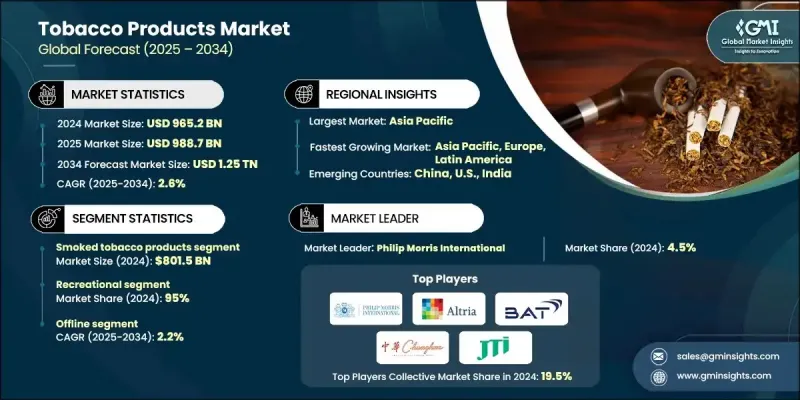
The Global Tobacco Products Market was valued at USD 965.2 billion in 2024 and is estimated to grow at a CAGR of 2.6% to reach USD 1.25 trillion by 2034.
The industry continues to evolve as shifting consumer behavior, regulatory adjustments, and product diversification influence market performance across multiple regions. Demand for premium and specialty tobacco items remains steady, with flavored varieties and modern formats gaining traction among users seeking differentiated experiences. At the same time, rising awareness of the health risks tied to traditional smoking is reshaping consumption patterns and accelerating interest in less conventional nicotine delivery methods. Alternatives such as heated tobacco, e-cigarettes, and nicotine pouches are experiencing sustained momentum as consumers increasingly consider them reduced-risk options. Regulatory bodies worldwide continue to impose stricter taxation, limit promotional activities, and expand smoke-free policies, reshaping competitive strategies for manufacturers. Interest in organic and herbal tobacco formulations is expected to grow as wellness-focused consumers explore products perceived to be more natural. The Asia-Pacific region remains the largest contributor due to its dense population and ingrained cultural habits surrounding tobacco use, while North America and Europe see more gradual shifts as users migrate toward newer, lower-emission nicotine products.
| Market Scope | |
|---|---|
| Start Year | 2024 |
| Forecast Year | 2025-2034 |
| Start Value | $965.2 Billion |
| Forecast Value | $1.25 Trillion |
| CAGR | 2.6% |
The smoked tobacco products generated USD 801.5 billion in 2024 and are anticipated to grow at a CAGR of 2.6% from 2025 to 2034. Despite rising restrictions and health concerns, the category continues to perform strongly due to its established global user base and enduring brand recognition. Meanwhile, smokeless tobacco offerings are projected to experience moderate growth as consumers increasingly lean toward alternatives positioned as less harmful.
The recreational segment accounted for a 95% share in 2024 and is expected to register a CAGR of 2.7% through 2034. Consumer interest in vaping devices and electronic nicotine delivery systems continues to climb, supported by expanding flavor availability and modern product aesthetics. Lifestyle marketing strategies have widened appeal across different age groups, although tighter regulations and public health campaigns remain influential factors.
United States Tobacco Products Market held an 80% share and generated USD 98.9 billion in 2024. Growth is largely driven by rising preferences for innovative tobacco formats such as heated devices and e-cigarettes, supported by established manufacturers investing in new product development and targeted promotions. Flavor-infused items also contribute significantly to consumer engagement and market expansion.
Leading companies in the Global Tobacco Products Market include Philip Morris International, Imperial Brands, ITC, Vector Group, U.S. Smokeless Tobacco, Scandinavian Tobacco Group, British American Tobacco, Chunghwa, KT&G Corp, Smoore International, Pyxus International, Universal Corp, Japan Tobacco International, Altria Group, and Reynolds Tobacco. Companies in the global tobacco products market are reinforcing their competitive standing by accelerating innovation in reduced-risk products, expanding their portfolios to include heated tobacco, vaping technologies, and oral nicotine formats. Many firms are investing heavily in research and development to create products with improved delivery systems, refined flavors, and enhanced consumer safety profiles. Global players are also adopting adaptive regulatory strategies by aligning product designs and packaging with shifting compliance standards.
Table of Contents
Chapter 1 Methodology and scope
- 1.1 Market scope and definition
- 1.2 Research design
- 1.2.1 Research approach
- 1.2.2 Data collection methods
- 1.3 Data mining sources
- 1.3.1 Global
- 1.3.2 Regional/country
- 1.4 Base estimates and calculations
- 1.4.1 Base year calculation
- 1.4.2 Key trends for market estimation
- 1.5 Primary research and validation
- 1.5.1 Primary sources
- 1.6 Forecast model
- 1.7 Research assumptions and limitations
Chapter 2 Executive summary
- 2.1 Industry 3600 synopsis
- 2.2 Key market trends
- 2.2.1 Regional trends
- 2.2.2 Product Type trends
- 2.2.3 Usage trends
- 2.2.4 Consumer Group trends
- 2.2.5 Age Group trends
- 2.2.6 Price trends
- 2.2.7 Distribution Channel trends
- 2.3 CXO perspectives: strategic imperatives
- 2.3.1 Key decision points for industry executives
- 2.3.2 Critical success factors for market players
- 2.4 Future outlook and strategic recommendations
Chapter 3 Industry insights
- 3.1 Industry ecosystem analysis
- 3.1.1 Supplier landscape
- 3.1.2 Profit margin
- 3.1.3 Value addition at each stage
- 3.1.4 Factor affecting the value chain
- 3.1.5 Disruptions
- 3.2 Industry impact forces
- 3.2.1 Growth drivers
- 3.2.2 Industry pitfalls & challenges
- 3.2.3 Opportunities
- 3.3 Growth potential analysis
- 3.4 Future market trends
- 3.5 Technology and innovation landscape
- 3.5.1 Current technological trends
- 3.5.2 Emerging technologies
- 3.6 Price trends
- 3.6.1 By region
- 3.6.2 By product type
- 3.7 Regulatory framework
- 3.7.1 Standards and certifications
- 3.7.2 Environmental regulations
- 3.7.3 Import export regulations
- 3.8 Trade statistics (HS code: 2401)
- 3.8.1 Major importing countries
- 3.8.2 Major exporting countries
- 3.9 Porter's five forces analysis
- 3.10 PESTEL analysis
- 3.11 Consumer behavior analysis
- 3.11.1 Purchasing patterns
- 3.11.2 Preference analysis
- 3.11.3 Regional variations in consumer behavior
- 3.11.4 Impact of e-commerce on buying decisions
Chapter 4 Competitive landscape, 2024
- 4.1 Introduction
- 4.2 Company market share analysis
- 4.2.1 By region
- 4.2.1.1 North America
- 4.2.1.2 Europe
- 4.2.1.3 Asia Pacific
- 4.2.1.4 Latin America
- 4.2.1.5 MEA
- 4.2.1 By region
- 4.3 Company matrix analysis
- 4.4 Competitive analysis of major market players
- 4.5 Competitive positioning matrix
- 4.6 Key developments
- 4.6.1 Mergers & acquisitions
- 4.6.2 Partnerships & collaborations
- 4.6.3 New product launches
- 4.6.4 Expansion plans
Chapter 5 Market Estimates & Forecast, By Product Type, 2021 - 2034 ($Billion, Million Units)
- 5.1 Key trends
- 5.2 Smoked tobacco products
- 5.2.1 Cigarettes
- 5.2.2 Cigars and pipes
- 5.2.3 Hookah
- 5.2.4 E-cigarettes
- 5.2.5 Others (bidis etc.)
- 5.3 Smokeless tobacco products
- 5.3.1 Chewing tobacco
- 5.3.2 Snuff
- 5.3.3 Dry snuff
- 5.3.4 Moist snuff
- 5.3.5 Dissolvable tobacco
- 5.3.6 Others (snus etc.)
- 5.4 Nicotine products
- 5.4.1 Electronic cigarette
- 5.4.1.1 Disposable
- 5.4.1.2 Rechargeable
- 5.4.2 Nicotine pouches
- 5.4.1 Electronic cigarette
Chapter 6 Market Estimates & Forecast, By Usage, 2021 - 2034 ($Billion, Million Units)
- 6.1 Key trends
- 6.2 Medical
- 6.3 Recreational
Chapter 7 Market Estimates & Forecast, By Consumer Group, 2021 - 2034 ($Billion, Million Units)
- 7.1 Key trends
- 7.2 Men
- 7.3 Women
Chapter 8 Market Estimates & Forecast, By Age Group, 2021 - 2034 ($Billion, Million Units)
- 8.1 Key trends
- 8.2 Youth (13-17 years)
- 8.3 Young Adults (18-24 years)
- 8.4 Adults (25-44 years)
- 8.5 Older Adults (45+ years)
Chapter 9 Market Estimates & Forecast, By Price, 2021 - 2034 ($Billion, Million Units)
- 9.1 Key trends
- 9.2 Low
- 9.3 Medium
- 9.4 High
Chapter 10 Market Estimates & Forecast, By Distribution Channel, 2021 - 2034 ($Billion, Million Units)
- 10.1 Key trends
- 10.2 Online
- 10.2.1 E-commerce
- 10.2.2 Company websites
- 10.3 Offline
- 10.3.1 Supermarkets/hypermarket
- 10.3.2 Specialty vape/tobacco shops
- 10.3.3 Convenience stores and gas stations
- 10.3.4 Others (duty-free shops etc.)
Chapter 11 Market Estimates & Forecast, By Region, 2021 - 2034 ($Billion, Million Units)
- 11.1 Key trends
- 11.2 North America
- 11.2.1 U.S.
- 11.2.2 Canada
- 11.3 Europe
- 11.3.1 Germany
- 11.3.2 UK
- 11.3.3 France
- 11.3.4 Spain
- 11.3.5 Italy
- 11.3.6 Netherlands
- 11.4 Asia Pacific
- 11.4.1 China
- 11.4.2 Japan
- 11.4.3 India
- 11.4.4 Australia
- 11.4.5 South Korea
- 11.5 Latin America
- 11.5.1 Brazil
- 11.5.2 Mexico
- 11.5.3 Argentina
- 11.6 MEA
- 11.6.1 South Africa
- 11.6.2 Saudi Arabia
- 11.6.3 UAE
Chapter 12 Company Profiles
- 12.1 Altria Group
- 12.2 British American Tobacco
- 12.3 Chunghwa
- 12.4 Imperial Brands
- 12.5 ITC
- 12.6 Japan Tobacco International
- 12.7 KT&G Corp
- 12.8 Philip Morris International
- 12.9 Pyxus International
- 12.10 Reynolds Tobacco
- 12.11 Scandinavian Tobacco Group
- 12.12 Smoore International
- 12.13 U.S. Smokeless Tobacco
- 12.14 Universal Corp
- 12.15 Vector Group

